Around half the world’s population live in places that held elections in 2024. Some 1.65bn ballots were cast across more than 70 countries. But while the number of democratic elections in a single year has never been higher, 2024 also brought big challenges. According to the latest democracy index published by EIU, our sister company, on February 27th, global democracy is in worse shape than at any point in the nearly two-decade history of the index.
Since 2006 EIU has scored 167 countries and territories on a scale of zero to ten based on five criteria: electoral process and pluralism, functioning of government, political participation, political culture, and civil liberties. The countries are then grouped into four categories: full democracies, flawed democracies, hybrid regimes and authoritarian regimes.
For the 16th consecutive year, Norway was named the most democratic country in the world, with a score of 9.81. New Zealand and Sweden followed. Afghanistan has been the lowest-ranked country since 2021, scoring just 0.25 points. The biggest change came from Bangladesh, which dropped 25 places. Rebuilding democracy there will be an enormous task after the ouster of Sheikh Hasina, the country’s longtime autocratic ruler. But there is cause for optimism. A temporary technocratic government, led by Muhammad Yunus, a Nobel peace prizewinner, has restored order and stabilised the economy. For those reasons, we named Bangladesh our country of the year in 2024.
The global average dropped to a new record low of 5.17, down from a high of 5.55 in 2015. Just 6.6% of the world’s population now lives in a full democracy, down from 12.5% ten years ago. And a large share of the world’s population—currently two in five people—lives under authoritarian rule.
Despite the promise of a global election extravaganza, some of the ballots were a farce. Polling day in Pakistan, for example, was marred by violence. The most popular politician, Imran Khan, whose own democratic credentials are questionable, was jailed shortly before the election took place. The country’s score dropped from 3.25 in 2023 to 2.84. In Russia another sham election gave Vladimir Putin a fifth term as president—it scored just two points on the index. In other countries—including Burkina Faso, Mali and Qatar—elections were cancelled altogether.
Even Europe—home to nine of the top ten countries in the index—saw some notable declines. France was downgraded from a full democracy to a flawed one. This mostly reflects a deterioration in its confidence-in-government score after president Emmanuel Macron’s snap election in June failed to secure a legislative majority for any single party or bloc. (Four different prime ministers during the course of the year did little to instil confidence either.) Romania was also downgraded after allegations of Russian interference, illegal social-media tactics and campaign-finance violations prompted the constitutional court to annul the presidential election and call for a new vote. In Asia, South Korea dropped out of the full-democracy category after President Yoon Suk Yeol declared—then hastily revoked—martial law, plunging the country into crisis.
America remained a flawed democracy, shifting only slightly from its position in 2023. But it could face bigger problems this year: the first month of President Donald Trump’s second term has already challenged the political independence of the civil service and seen a flurry of executive orders of questionable legal authority.
Mr Trump’s victory in 2024 was part of a broader global backlash against incumbents. The next test for global democracy in 2025 will be how these newly elected leaders choose to govern…
* John Adams, whose own handiwork as a Founding Father has been nicked, but so far evaded the fate he predicted (in an 1814 letter to John Taylor)
###
As we batten the hatches, we might recall that it was on this date in 1933 that RKO‘s King Kong premeired. Directed and produced by Merian C. Cooper and Ernest B. Schoedsack, with special effects by Willis H. O’Brien and music by Max Steiner, it received rave reviews, with praise for its stop-motion animation and score… and has only grown in esteem: in 1991, it was deemed “culturally, historically and aesthetically significant” by the Library of Congress and selected for preservation in the National Film Registry. In 2010 it was ranked by Rotten Tomatoes as the greatest horror film of all time and the fifty-sixth greatest film of all time.
Oskar Fischinger, from Allegretto 1936–43 (source)
From Open Culture, an appreciation of an animator who, though never a commercial success in his own time, became an inspriation…
At a time when much of animation was consumed with little anthropomorphized animals sporting white gloves, Oskar Fischinger went in a completely different direction. His work is all about dancing geometric shapes and abstract forms spinning around a flat featureless background. Think of a Mondrian or Malevich painting that moves, often in time to the music. Fischinger’s movies have a mesmerizing elegance to them. Check out his 1938 short An Optical Poem above. Circles pop, sway and dart across the screen, all in time to Franz Liszt’s 2nd Hungarian Rhapsody.
This is, of course, well before the days of digital. While it might be relatively simple to manipulate a shape in a computer, Fischinger’s technique was decidedly more low tech. Using bits of paper and fishing line, he individually photographed each frame, somehow doing it all in sync with Liszt’s composition. Think of the hours of mind-numbing work that must have entailed.
Born in 1900 near Frankfurt, Fischinger trained as a musician and an architect before discovering film. In the 1930s, he moved to Berlin and started producing more and more abstract animations that ran before feature films. They proved to be popular too, at least until the National Socialists came to power. The Nazis were some of the most fanatical art critics of the 20th Century, and they hated anything non-representational. The likes of Paul Klee, Oskar Kokoschka and Wassily Kandinsky among others were written off as “degenerate.” (By stark contrast, the CIA reportedly loved Abstract Expressionism, but that’s a different story.) Fischinger fled Germany in 1936 for the sun and glamour of Hollywood.
The problem was that Hollywood was really not ready for Fischinger. Producers saw the obvious talent in his work, and they feared that it was too ahead of its time for broad audiences. “[Fischinger] was going in a completely different direction than any other animator at the time,” said famed graphic designer Chip Kidd in an interview with NPR. “He was really exploring abstract patterns, but with a purpose to them — pioneering what technically is the music video.”
Fischinger’s most widely seen American work was the section in Walt Disney’s Fantasia set to Bach’s Toccata and Fugue in D Minor [see it here]. Disney turned his geometric forms into mountain peaks and violin bows. Fischinger was apoplectic. “The film is not really my work,” Fischinger later reflected. “Rather, it is the most inartistic product of a factory. …One thing I definitely found out: that no true work of art can be made with that procedure used in the Disney studio.” Fischinger didn’t work with Disney again and instead retreated into the art world.
There he found admirers who were receptive to his vision. John Cage, for one, considered the German animator’s experiments to be a major influence on his own work. Cage recalled his first meeting with Fischinger in an interview with Daniel Charles in 1968.
One day I was introduced to Oscar Fischinger who made abstract films quite precisely articulated on pieces of traditional music. When I was introduced to him, he began to talk with me about the spirit, which is inside each of the objects of this world. So, he told me, all we need to do to liberate that spirit is to brush past the object, and to draw forth its sound. That’s the idea which led me to percussion…
Bonus: an excerpt from Fischinger’s cigarette ad from 1934:
As we appreciate art, we might recall that it was on this date in 1940 (16 days after its single-theater premiere) that Walt Disney’s Pinocchio was released. Although it received critical acclaim and became the first animated feature to win a competitive Academy Award– winning two (for Best Music, Original Score and for Best Music, Original Song for “When You Wish Upon a Star”)– it was initially a commercial failure (mainly due to World War II closing off the European and Asian markets). It eventually made a profit after its 1945 rerelease, and is now considered one of the greatest animated films ever made.
Pinocchio was also a major step forward in animation technique, especially in effects animation, an effort led by Joshua Meador.. (In contrast to the character animators who concentrate on the acting of the characters, effects animators create everything that moves other than the characters—vehicles, machinery, and natural effects such as rain, lightning, snow, smoke, shadows and water.)
… the water effects are the true standout in Pinocchio, representing an artistic achievement that would still be difficult to replicate today. To a certain extent, it was nothing more complicated than good old fashioned hard work: Effects animator Sandy Strother [see here] worked on nothing but water effects for a full year. But in addition to working hard, the animators were working smart: In the open-water scenes, for example, the water toward the back of the frame is less detailed and more impressionistic, allowing the artists to focus on making the foreground as rich in detail as possible.
But as detailed as that water is, it isn’t attempting photorealism; as with the character design, the focus is on how the water should function within the story and the emotional response it should provoke, not replicating the real world exactly. Compare the down-to-the-droplet detail of Pinocchio’s open-water scenes to those of Fleischer Studios’ first entry in the feature-animation game, Gulliver’s Travels. Released only a few months before Pinocchio, Gulliver’s Travels used rotoscoping, which had been developed at Fleischer. While the film’s water looks realistic and imposing, it has a flat, almost geometric look that undermines its visual punch. Whereas the way the water works as Monstro chases Geppetto and Pinocchio’s raft is terrifying and overwhelming, and not especially realistic. This is the power of animation, to mold and morph reality to function as something familiar, yet fantastical…
Fischinger, who was primarily engaged down the hall on his ill-fated contribution to Fantasia (released late that same year), contributed to the effects animation of the Blue Fairy’s wand.
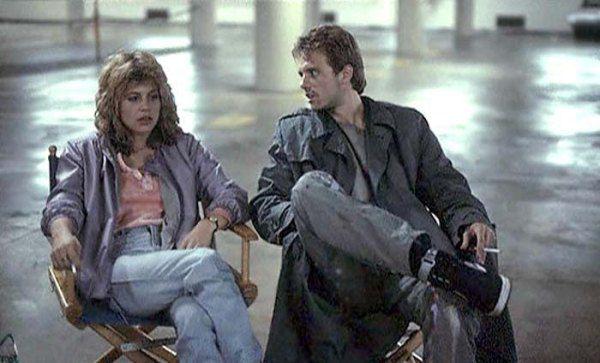
As we give it a rest, we might recall that it was on this date in 1984 that The Terminator was released. Directed by James Cameron and produced by Gale Anne Hurd, it starred Arnold Schwarzenegger as the Terminator, a cybernetic assassin sent back in time from 2029 to 1984 to kill Sarah Connor (Linda Hamilton), whose unborn son will one day save mankind from extinction by Skynet, a hostile artificial intelligence in a post-apocalyptic future. Kyle Reese (Michael Biehn) played a soldier sent back in time to protect Sarah. The screenplay was credited to Cameron and Hurd, while co-writer William Wisher Jr. received an “additional dialogue” credit.
Defying low pre-release expectations, The Terminator topped the United States box office for two weeks, eventually grossing $78.3 million against a modest $6.4 million budget. It is credited with launching Cameron’s film career and solidifying Schwarzenegger’s status as a leading man. The film’s success led to a franchise consisting of several sequels, a television series, comic books, novels and video games. In 2008, The Terminator was selected by the Library of Congress for preservation in the United States National Film Registry.
Linda Hamilton and Michael Biehn taking a break on set (source)
… and newsreels were the first available footage. Pathé News was a producer of newsreels and documentaries from 1910 to 1970 in the United Kingdom. Its founder, Charles Pathé, was a pioneer of moving pictures in the silent era.
The Pathé News archive is known today as “British Pathé,” and contains all of Pathé’s work, along with the archives of Reuters, Gaumont, Visnews and others…
Before television, people came to movie theatres to watch the news. British Pathé was at the forefront of cinematic journalism, blending information with entertainment to popular effect. Over the course of a century, it documented everything from major armed conflicts and seismic political crises to the curious hobbies and eccentric lives of ordinary people. If it happened, British Pathé filmed it….
… Spanning the years from 1896-1978, its collections include footage from around the globe of major events, famous faces, fashion trends, travel, science, and culture. It is an invaluable resource for broadcasters, documentary producers, museum curators, and researchers worldwide. The entire archive of 85,000 films is available to view for free on the British Pathé website while licences can be acquired for other uses.
British Pathé also represents content from partner organisations, such as Reuters’ historical collection, which includes more than 130,000 items dating from 1910 to the end of 1984…
As we rewind, we might recall that it was on this date in 1910 that the British ocean liner RMS Olympic was launched. The lead ship of the White Star Line‘s trio of Olympic-class liners, Olympic had a career spanning 24 years from 1911 to 1935, in contrast to her short-lived sister ships, Titanic and Britannic. This included service as a troopship during the First World War, which gained her the nickname “Old Reliable”, and during which she rammed and sank the U-boat U-103. She returned to civilian service after the war and served successfully as an ocean liner throughout the 1920s and into the first half of the 1930s, although increased competition, and the slump in trade during the Great Depression after 1930, made her operation increasingly unprofitable. Olympic was withdrawn from service and sold for scrap in 1935.
Olympic was the largest ocean liner in the world for two periods during 1910–13, interrupted only by the brief tenure of the slightly larger Titanic, which had the same dimensions but higher gross register tonnage, before the German SS Imperator went into service in June 1913.
Pathe has the footage…
RMS Olympic setting sail. Shots of relatives and survivors after Titanic sinking.
Charlie Chaplin returns home (London) aboard the White Star liner RMS Olympic and greets crowds, 1921
On the heels of Bach and Gluck, a visit to a temple of sound…
The BBC Sound Effects Archive is available for personal, educational or research purposes. There are over 33,000 clips from across the world from the past 100 years. These include clips made by the BBC Radiophonic workshop, recordings from the Blitz in London, special effects made for BBC TV and Radio productions, as well as 15,000 recordings from the Natural History Unit archive. You can explore sounds from every continent – from the college bells ringing in Oxford to a Patagonian waterfall – or listen to a submarine klaxon or the sound of a 1969 Ford Cortina door slamming shut…
As we listen, we might recall that it was on this date in 1927 that Warner Bros. released The Jazz Singer, the first feature-length motion picture with both synchronized recorded music and lip-synchronous singing and speech (in several isolated sequences)… that’s to say, the first “talkie.” Based on the 1925 play of the same title by Samson Raphaelson (the plot, adapted from his short story “The Day of Atonement”), The Jazz Singer was warmly received– and effectively marked the end of the silent film era.
The Jazz Singer won two Oscars at the first Academy Awards, has been added to the United States National Film Registry by the Library of Congress (as being “culturally, historically or aesthetically significant”), and was chosen by the American Film Institute as one of the best American films of all time, ranking at number ninety. It has passed into the public domain and can be seen at the Internet Archive: here.







You must be logged in to post a comment.