Posts Tagged ‘mind’
“Neither privacy nor publicity is dead, but technology will continue to make a mess of both”*…

Indeed, as neurotech advances, privacy concerns grow. Devices that connect brains to computers are increasingly sophisticated. But as Fletcher Reveley asks, can the nascent neurorights movement catch up?…
One afternoon in May 2020, Jerry Tang, a Ph.D. student in computer science at the University of Texas at Austin, sat staring at a cryptic string of words scrawled across his computer screen:
“I am not finished yet to start my career at twenty without having gotten my license I never have to pull out and run back to my parents to take me home.”
The sentence was jumbled and agrammatical. But to Tang, it represented a remarkable feat: A computer pulling a thought, however disjointed, from a person’s mind.
For weeks, ever since the pandemic had shuttered his university and forced his lab work online, Tang had been at home tweaking a semantic decoder — a brain-computer interface, or BCI, that generates text from brain scans. Prior to the university’s closure, study participants had been providing data to train the decoder for months, listening to hours of storytelling podcasts while a functional magnetic resonance imaging (fMRI) machine logged their brain responses. Then, the participants had listened to a new story — one that had not been used to train the algorithm — and those fMRI scans were fed into the decoder, which used GPT1, a predecessor to the ubiquitous AI chatbot ChatGPT, to spit out a text prediction of what it thought the participant had heard. For this snippet, Tang compared it to the original story:
“Although I’m twenty-three years old I don’t have my driver’s license yet and I just jumped out right when I needed to and she says well why don’t you come back to my house and I’ll give you a ride.”
The decoder was not only capturing the gist of the original, but also producing exact matches of specific words — twenty, license. When Tang shared the results with his adviser, a UT Austin neuroscientist named Alexander Huth who had been working towards building such a decoder for nearly a decade, Huth was floored. “Holy shit,” Huth recalled saying. “This is actually working.” By the fall of 2021, the scientists were testing the device with no external stimuli at all — participants simply imagined a story and the decoder spat out a recognizable, albeit somewhat hazy, description of it. “What both of those experiments kind of point to,” said Huth, “is the fact that what we’re able to read out here was really like the thoughts, like the idea.”
The scientists brimmed with excitement over the potentially life-altering medical applications of such a device — restoring communication to people with locked-in syndrome, for instance, whose near full-body paralysis made talking impossible. But just as the potential benefits of the decoder snapped into focus, so too did the thorny ethical questions posed by its use. Huth himself had been one of the three primary test subjects in the experiments, and the privacy implications of the device now seemed visceral: “Oh my god,” he recalled thinking. “We can look inside my brain.”
Huth’s reaction mirrored a longstanding concern in neuroscience and beyond: that machines might someday read people’s minds. And as BCI technology advances at a dizzying clip, that possibility and others like it — that computers of the future could alter human identities, for example, or hinder free will — have begun to seem less remote. “The loss of mental privacy, this is a fight we have to fight today,” said Rafael Yuste, a Columbia University neuroscientist. “That could be irreversible. If we lose our mental privacy, what else is there to lose? That’s it, we lose the essence of who we are.”
Spurred by these concerns, Yuste and several colleagues have launched an international movement advocating for “neurorights” — a set of five principles Yuste argues should be enshrined in law as a bulwark against potential misuse and abuse of neurotechnology. But he may be running out of time…
“Advances in Mind-Decoding Technologies Raise Hopes (and Worries),” from @FletcherReveley in @undarkmag. Eminently worth reading in full.
And to complicate things further (though appropriately), see Eric Hoel‘s “Neuroscience is pre-paradigmatic. Consciousness is why.”
* danah boyd
###
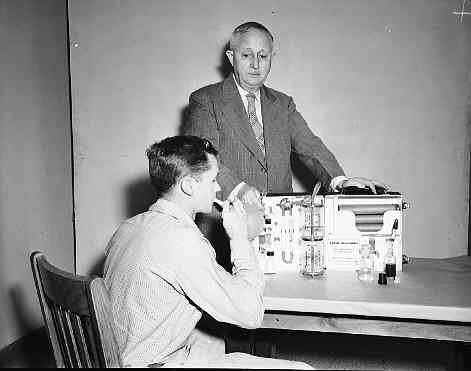
As we ponder the personal, we might send telling birthday greetings to Rolla Harger; he was born on this date in 1890. Biochemistry and pharmacology department chairman of the Indiana University School of Medicine, he invented (in 1931) and patented (in 1936) the first field test for inebriation, the Drunkometer (the forerunner of the Breathalyzer), to test for driving under the influence.
“Poetry might be defined as the clear expression of mixed feelings”*…

Can artificial intelligence have those feelings? Scientist and poet Keith Holyoak explores:
… Artificial intelligence (AI) is in the process of changing the world and its societies in ways no one can fully predict. On the hazier side of the present horizon, there may come a tipping point at which AI surpasses the general intelligence of humans. (In various specific domains, notably mathematical calculation, the intersection point was passed decades ago.) Many people anticipate this technological moment, dubbed the Singularity, as a kind of Second Coming — though whether of a savior or of Yeats’s rough beast is less clear. Perhaps by constructing an artificial human, computer scientists will finally realize Mary Shelley’s vision.
Of all the actual and potential consequences of AI, surely the least significant is that AI programs are beginning to write poetry. But that effort happens to be the AI application most relevant to our theme. And in a certain sense, poetry may serve as a kind of canary in the coal mine — an early indicator of the extent to which AI promises (threatens?) to challenge humans as artistic creators. If AI can be a poet, what other previously human-only roles will it slip into?…
A provocative consideration: “Can AI Write Authentic Poetry?” @mitpress.
Apposite: a fascinating Twitter thread on “why GPT3 algorithm proficiency at producing fluent, correct-seeming prose is an exciting opportunity for improving how we teach writing, how students learn to write, and how this can also benefit profs who assign writing, but don’t necessarily teach it.”
* W. H. Auden
###
As we ruminate on rhymes, we might send thoughtful birthday greetings to Michael Gazzaniga; he was born on this date in 1939. A leading researcher in cognitive neuroscience (the study of the neural basis of mind), his work has focused on how the brain enables humans to perform those advanced mental functions that are generally associated with what we call “the mind.” Gazzaniga has made significant contributions to the emerging understanding of how the brain facilitates such higher cognitive functions as remembering, speaking, interpreting, and making judgments.

“Biology gives you a brain. Life turns it into a mind.”*…

I have a confession. As a physicist and psychiatrist, I find it difficult to engage with conversations about consciousness. My biggest gripe is that the philosophers and cognitive scientists who tend to pose the questions often assume that the mind is a thing, whose existence can be identified by the attributes it has or the purposes it fulfils.
But in physics, it’s dangerous to assume that things ‘exist’ in any conventional sense. Instead, the deeper question is: what sorts of processes give rise to the notion (or illusion) that something exists? For example, Isaac Newton explained the physical world in terms of massive bodies that respond to forces. However, with the advent of quantum physics, the real question turned out to be the very nature and meaning of the measurements upon which the notions of mass and force depend – a question that’s still debated today.
As a consequence, I’m compelled to treat consciousness as a process to be understood, not as a thing to be defined. Simply put, my argument is that consciousness is nothing more and nothing less than a natural process such as evolution or the weather. My favourite trick to illustrate the notion of consciousness as a process is to replace the word ‘consciousness’ with ‘evolution’ – and see if the question still makes sense. For example, the question What is consciousness for? becomes What is evolution for? Scientifically speaking, of course, we know that evolution is not for anything. It doesn’t perform a function or have reasons for doing what it does – it’s an unfolding process that can be understood only on its own terms. Since we are all the product of evolution, the same would seem to hold for consciousness and the self.
My view on consciousness resonates with that of the philosopher Daniel Dennett, who has spent his career trying to understand the origin of the mind. Dennett is concerned with how mindless, mere ‘causes’ (A leads to B) can give rise to the species of mindful ‘reasons’ as we know them (A happens so that B can happen). Dennett’s solution is what he calls ‘Darwin’s dangerous idea’: the insight that it’s possible to have design in the absence of a designer, competence in the absence of comprehension, and reasons (or ‘free-floating rationales’) in the absence of reasoners. A population of beetles that has outstripped another has probably done so for some ‘reason’ we can identify – a favourable mutation which produces a more camouflaging colour, for example. ‘Natural selection is thus an automatic reason-finder, which “discovers” and “endorses” and “focuses” reasons over many generations,’ Dennett writes in From Bacteria to Bach and Back: The Evolution of Minds (2017). ‘The scare quotes are to remind us that natural selection doesn’t have a mind, doesn’t itself have reasons, but is nevertheless competent to perform this “task” of design refinement.’
I hope to show you that nature can drum up reasons without actually having them for herself. In what follows, I’m going to argue that things don’t exist for reasons, but certain processes can nonetheless be cast as engaged in reasoning…
Distinguished neuroscientist and psychiatrist Karl Friston argues that the special trick of consciousness is being able to project action and time into a range of possible futures: “The mathematics of mind-time.”
See also: “How the Brain Creates a Timeline of the Past” (source of the image above).
* Middlesex
###
As we get our minds around our minds, we might spare a thought for Oliver Wolf Sacks; he died on this date in 2015. A neurologist, naturalist, historian of science, and author, he had an active clinical practice, but is more widely-remembered for his writing, mostly case studies from his clinical experience and memoir in which which he treats himself as a clinical subject. Awakenings, for example, recounted his experience treating post-encephalitic patients with a new drug (levodopa); it was a best seller that served as the basis of a BBC Discovery documentary and was adapted into a feature film. Widely honored for his prolific work, Sacks was the recipient of the 2001 Lewis Thomas Prize for excellence in scientific writing.

“Nothing is at last sacred but the integrity of your own mind”*…

Imagine that a person’s brain could be scanned in great detail and recreated in a computer simulation. The person’s mind and memories, emotions and personality would be duplicated. In effect, a new and equally valid version of that person would now exist, in a potentially immortal, digital form. This futuristic possibility is called mind uploading. The science of the brain and of consciousness increasingly suggests that mind uploading is possible – there are no laws of physics to prevent it. The technology is likely to be far in our future; it may be centuries before the details are fully worked out – and yet given how much interest and effort is already directed towards that goal, mind uploading seems inevitable. Of course we can’t be certain how it might affect our culture but as the technology of simulation and artificial neural networks shapes up, we can guess what that mind uploading future might be like.
Suppose one day you go into an uploading clinic to have your brain scanned. Let’s be generous and pretend the technology works perfectly. It’s been tested and debugged. It captures all your synapses in sufficient detail to recreate your unique mind. It gives that mind a standard-issue, virtual body that’s reasonably comfortable, with your face and voice attached, in a virtual environment like a high-quality video game. Let’s pretend all of this has come true.
Who is that second you?
Princeton neuroscientist, psychologist, and philosopher Michael Graziano explores: “What happens if your mind lives forever on the internet?”
* Self-Reliance
###
As we ponder presence, we might spare a thought for William “Willy” A. Higinbotham; he died on this date in 1994. A physicist who was a member of the team that developed the first atomic bomb, he later became a leader in the nuclear non-proliferation movement.
But Higinbotham may be better remembered as the creator of Tennis for Two— the first interactive analog computer game, one of the first electronic games to use a graphical display, and the first to be created as entertainment (as opposed to as a demonstration of a computer’s capabilities). He built it for the 1958 visitor day at Brookhaven National Laboratory.
It used a small analogue computer with ten direct-connected operational amplifiers and output a side view of the curved flight of the tennis ball on an oscilloscope only five inches in diameter. Each player had a control knob and a button.


The 1958 Tennis for Two exhibit
You must be logged in to post a comment.