Posts Tagged ‘fMRI’
“Neither privacy nor publicity is dead, but technology will continue to make a mess of both”*…

Indeed, as neurotech advances, privacy concerns grow. Devices that connect brains to computers are increasingly sophisticated. But as Fletcher Reveley asks, can the nascent neurorights movement catch up?…
One afternoon in May 2020, Jerry Tang, a Ph.D. student in computer science at the University of Texas at Austin, sat staring at a cryptic string of words scrawled across his computer screen:
“I am not finished yet to start my career at twenty without having gotten my license I never have to pull out and run back to my parents to take me home.”
The sentence was jumbled and agrammatical. But to Tang, it represented a remarkable feat: A computer pulling a thought, however disjointed, from a person’s mind.
For weeks, ever since the pandemic had shuttered his university and forced his lab work online, Tang had been at home tweaking a semantic decoder — a brain-computer interface, or BCI, that generates text from brain scans. Prior to the university’s closure, study participants had been providing data to train the decoder for months, listening to hours of storytelling podcasts while a functional magnetic resonance imaging (fMRI) machine logged their brain responses. Then, the participants had listened to a new story — one that had not been used to train the algorithm — and those fMRI scans were fed into the decoder, which used GPT1, a predecessor to the ubiquitous AI chatbot ChatGPT, to spit out a text prediction of what it thought the participant had heard. For this snippet, Tang compared it to the original story:
“Although I’m twenty-three years old I don’t have my driver’s license yet and I just jumped out right when I needed to and she says well why don’t you come back to my house and I’ll give you a ride.”
The decoder was not only capturing the gist of the original, but also producing exact matches of specific words — twenty, license. When Tang shared the results with his adviser, a UT Austin neuroscientist named Alexander Huth who had been working towards building such a decoder for nearly a decade, Huth was floored. “Holy shit,” Huth recalled saying. “This is actually working.” By the fall of 2021, the scientists were testing the device with no external stimuli at all — participants simply imagined a story and the decoder spat out a recognizable, albeit somewhat hazy, description of it. “What both of those experiments kind of point to,” said Huth, “is the fact that what we’re able to read out here was really like the thoughts, like the idea.”
The scientists brimmed with excitement over the potentially life-altering medical applications of such a device — restoring communication to people with locked-in syndrome, for instance, whose near full-body paralysis made talking impossible. But just as the potential benefits of the decoder snapped into focus, so too did the thorny ethical questions posed by its use. Huth himself had been one of the three primary test subjects in the experiments, and the privacy implications of the device now seemed visceral: “Oh my god,” he recalled thinking. “We can look inside my brain.”
Huth’s reaction mirrored a longstanding concern in neuroscience and beyond: that machines might someday read people’s minds. And as BCI technology advances at a dizzying clip, that possibility and others like it — that computers of the future could alter human identities, for example, or hinder free will — have begun to seem less remote. “The loss of mental privacy, this is a fight we have to fight today,” said Rafael Yuste, a Columbia University neuroscientist. “That could be irreversible. If we lose our mental privacy, what else is there to lose? That’s it, we lose the essence of who we are.”
Spurred by these concerns, Yuste and several colleagues have launched an international movement advocating for “neurorights” — a set of five principles Yuste argues should be enshrined in law as a bulwark against potential misuse and abuse of neurotechnology. But he may be running out of time…
“Advances in Mind-Decoding Technologies Raise Hopes (and Worries),” from @FletcherReveley in @undarkmag. Eminently worth reading in full.
And to complicate things further (though appropriately), see Eric Hoel‘s “Neuroscience is pre-paradigmatic. Consciousness is why.”
* danah boyd
###
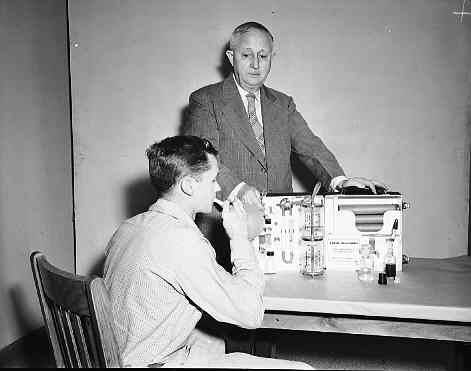
As we ponder the personal, we might send telling birthday greetings to Rolla Harger; he was born on this date in 1890. Biochemistry and pharmacology department chairman of the Indiana University School of Medicine, he invented (in 1931) and patented (in 1936) the first field test for inebriation, the Drunkometer (the forerunner of the Breathalyzer), to test for driving under the influence.
You must be logged in to post a comment.