Jason Kottke on one artist’s attempt to illuminate those talents and the lives of those who practiced them…
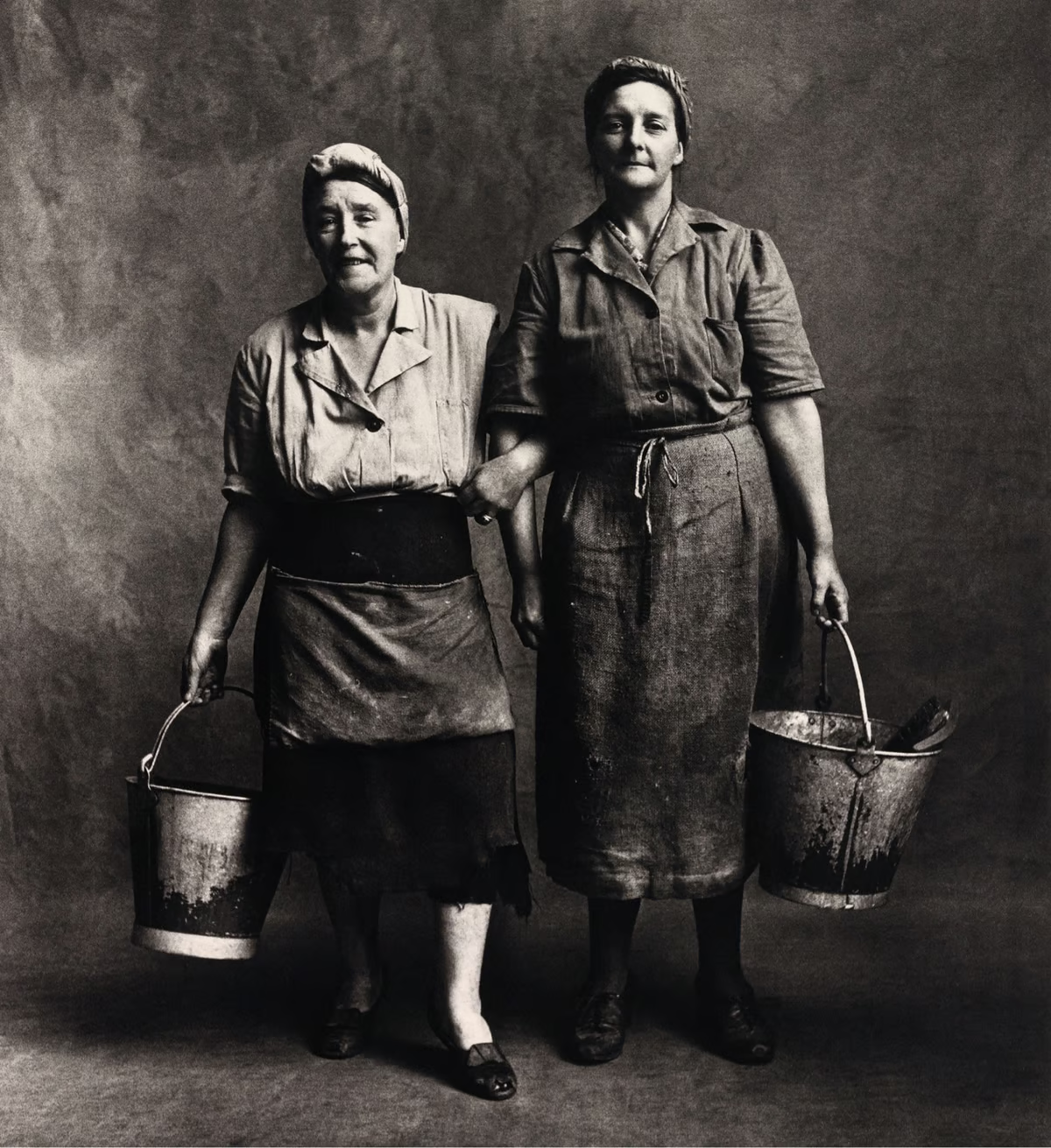
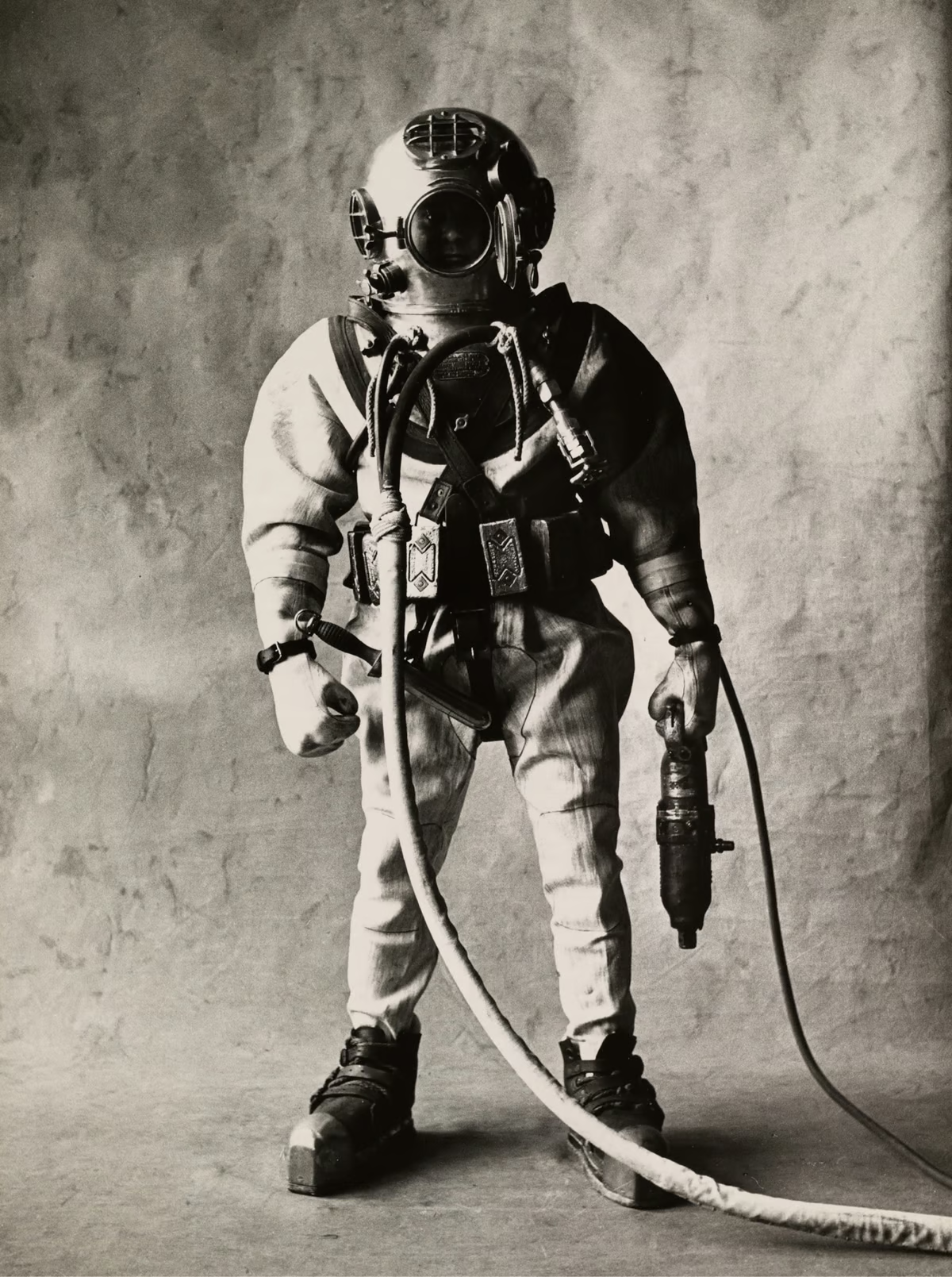
In 1950, master photographer Irving Penn set up a simple studio in Paris and started to photograph people of all kinds of professions, each wearing their work clothes and carrying the tools of their trade.
Working in the tradition of representing the petits métiers, Penn photographed fishmongers, firefighters, butchers, bakers, divers, baseball umpires, chefs, bike messengers, and sellers of goods of all kinds.
Penn continued photographing workers in New York and London, collecting the photos into a project called Small Trades.
Like everyone else who has recorded the look of tradesmen and workers, the author of this book was motivated by the fact that individuality and occupational pride seem on the wane. To a degree everyone has proved right, and since these photographs were made, London chimney sweeps have all but disappeared and in New York horseshoers — hard to find in 1950 — now scarcely exist…
As we peruse professions, we might send muckraking birthday greetings to Upton Sinclair; he was born on this date in 1878. A writer, activist, and politician, he is probably best remembered for his classic novel, The Jungle, which exposed labor and sanitary conditions in the U.S. meatpacking industry, causing a public uproar that contributed in part to the passage a few months later of the 1906 Pure Food and Drug Act and the Meat Inspection Act.
Many of his novels can be read as historical works. Writing during the Progressive Era, Sinclair describes the world of the industrialized United States from both the working man’s and the industrialist’s points of view: e.g., King Coal (1917, covering John D. Rockefeller and the 1914 Ludlow Massacre in the coal fields of Colorado), Oil! (1927, the Teapot Dome Scandal), and The Flivver King (1937, Henry Ford– his “wage reform,” his company’s Sociological Department, and his decline into antisemitism) describe the working conditions of the coal, oil, and auto industries at the time.
Sinclair ran (as a Democrat) for Governor of California in 1934, during the Great Depression, under the banner of the End Poverty in California campaign, but was defeated in the general election.
He was awarded he Pulitzer Prize for Fiction in 1943 for Dragon’s Teeth, which portrayed the Nazi takeover of Germany during the 1930s.
It is difficult to get a man to understand something, when his salary depends upon his not understanding it.
Upton Sinclair, ruminating on his gubernatorial loss
Mosaic of a boar hunt from the Villa del Casale at Piazza Armerina in Sicily, fourth century. Photograph by Laur Phil. Flickr (CC BY 2.0)
In the early medieval West, from North Africa to the British Isles, pigs were a crucial part of both agriculture and culture…
Pigs were the consummate meat of the early Middle Ages. Horses and oxen have pulling power, cows and goats and sheep make milk and manure (and skin for parchment and packaging), sheep grow wool, and poultry lay eggs. But domesticated pigs were only destined to be butchered. It took them less than two years to reach their maximum weight, so efficient were they in converting whatever they found or were fed into meat. The osteoarchaeological record shows that farmers slaughtered almost all their pigs before they reached their third birthday, and many of them much earlier, with the exception of breeding sows and stud boars.
But pork was not the meat that everyone ate most. That distinction generally went either to beef or to mutton. Some people did not keep pigs at all: Greenlanders, for instance, and Jews and Muslims, as far as we can tell. There were also some Christians who did not own pigs—or at least, there were Christians who drew up wills that listed their livestock but did not mention any pigs. But because pigs were only ever raised for their flesh, they were a kind of metonym for meat more generally. Pork inspired rhapsodies, and even miracles; in Saint Brigit’s Ireland, tree bark was turned not into fishes and loaves but bacon in order to feed a crowd. And when the scholar al-Jāḥiẓ wrote a massive collection about animals at the Abbasid court in Baghdad, he had plenty of faults to find with pigs, both as a Muslim and as a naturalist. But he had also heard so many paeans to pork that he was fascinated by what it might taste like…
We are on the cusp of the biggest economic transformation, of any kind, for 200 years. While arguments rage about plant- versus meat-based diets, new technologies will soon make them irrelevant. Before long, most of our food will come neither from animals nor plants, but from unicellular life. After 12,000 years of feeding humankind, all farming except fruit and veg production is likely to be replaced by ferming: brewing microbes through precision fermentation. This means multiplying particular micro-organisms, to produce particular products, in factories.I know some people will be horrified by this prospect. I can see some drawbacks. But I believe it comes in the nick of time…
As we dig in, we might recall that it was on this date in 1943 that an official of the Meats Division of the wartime Office of Price Administration (OPA) announced that, for the duration of World War II, frankfurters (or ‘hot dogs’) would be replaced with “Victory Sausages,” in which a substantial proportion of the meat in those sausages would itself be replaced with “an unspecified amount of soybean meal or some other substitute.”
Victory was achieved; but it was not, in this dimension in any case, sweet.
Cheap beef and a thriving centralised meatpacking industry were the consequence of emerging technologies such as the railroad and refrigeration coupled with the business acumen of a set of honest and hard-working men like… Philip Danforth Armour. According to critics, however, a capitalist cabal was exploiting technological change and government corruption to bankrupt traditional butchers, sell diseased meat and impoverish the worker.
Ultimately, both views were correct. The national market for fresh beef was the culmination of a technological revolution, but it was also the result of collusion and predatory pricing. The industrial slaughterhouse was a triumph of human ingenuity as well as a site of brutal labour exploitation. Industrial beef production, with all its troubling costs and undeniable benefits, reflected seemingly contradictory realities.
Beef production would also help drive far-reaching changes in US agriculture. Fresh-fruit distribution began with the rise of the meatpackers’ refrigerator cars, which they rented to fruit and vegetable growers. Production of wheat, perhaps the US’s greatest food crop, bore the meatpackers’ mark. In order to manage animal feed costs, Armour & Co and Swift & Co invested heavily in wheat futures and controlled some of the country’s largest grain elevators. In the early 20th century, an Armour & Co promotional map announced that “the greatness of the United States is founded on agriculture”, and depicted the agricultural products of each US state, many of which moved through Armour facilities.
Beef was a paradigmatic industry for the rise of modern industrial agriculture, or agribusiness. As much as a story of science or technology, modern agriculture is a compromise between the unpredictability of nature and the rationality of capital. This was a lurching, violent process that saw meatpackers displace the risks of blizzards, drought, disease and overproduction on to cattle ranchers. Today’s agricultural system works similarly. In poultry, processors like Perdue and Tyson use an elaborate system of contracts and required equipment and feed purchases to maximise their own profits while displacing risk on to contract farmers. This is true with crop production as well. As with 19th-century meatpacking, relatively small actors conduct the actual growing and production, while companies like Monsanto and Cargill control agricultural inputs and market access.
The transformations that remade beef production between the end of the American civil war in 1865 and the passage of the Federal Meat Inspection Act in 1906 stretched from the Great Plains to the kitchen table. Before the civil war, cattle raising was largely regional, and in most cases, the people who managed cattle out west were the same people who owned them. Then, in the 1870s and 80s, improved transport, bloody victories over the Plains Indians, and the American west’s integration into global capital markets sparked a ranching boom. Meanwhile, Chicago meatpackers pioneered centralised food processing. Using an innovative system of refrigerator cars and distribution centres, they began to distribute fresh beef nationwide. Millions of cattle were soon passing through Chicago’s slaughterhouses each year. By 1890, the Big Four meatpacking companies – Armour & Co, Swift & Co, Morris & Co and the GH Hammond Co – directly or indirectly controlled the majority of the nation’s beef and pork…
Exploitation and predatory pricing drove the transformation of the US meat industry – and created the model for modern agribusiness: “The price of plenty: how beef changed America.”
* Upton Sinclair, The Jungle
###
As we muse on meat, we might recall that it was on this date in 1637 (or nearabouts, as closely as scholars can say) that Cardinal Richelieu introduced the first table knives (knives with rounded edges)–reputedly to cure dinner guests of the unsavory habit of picking their teeth with the knife-points of the daggers that were, until then, used to cut meat at the table (though some suspect that Richelieu was acting in self-preservation). Indeed, years later, in 1669, King Louis XIV followed suit, forbidding pointed knives at his table; indeed, he extended the prohibition, banning pointed knives in the street in an attempt to reduce violence.
In the mid-to-late 1800s, the meat industry — from the cowboys and cattle drives to the Chicago slaughterhouses to the refrigerated railcars delivering steaks to New York’s finest restaurants — was the largest industry in America. At the heart of this industry were entrepreneurs like Philip Danforth Armour and Gustavus Franklin Swift, who pioneered business practices later adopted by the automobile industry and whose company names survive to this day:
“[In the meat industry in the mid-1800s], automation was the secret ingredient. Overhead wheels were introduced to carry the hog or the steer from one fixed workstation to the next. Before long, this approach evolved into an overhead trolley system driven by steam engines and industrial belts. Specific repetitive tasks were assigned to each worker along what became, in effect, the first assembly line, although the actual work was disassembly. It was from studying this process in the Chicago slaughterhouses that Henry Ford came up with his own method for assembling automobiles — a development that would revolutionize mass manufacturing…
* “It was all so very businesslike that one watched it fascinated. It was pork-making by machinery, pork-making by applied mathematics. And yet somehow the most matter-of-fact person could not help thinking of the hogs; they were so innocent, they came so very trustingly; and they were so very human in their protests – and so perfectly within their rights! They had done nothing to deserve it; and it was adding insult to injury, as the thing was done here, swinging them up in this cold-blooded, impersonal way, without pretence at apology, without the homage of a tear.” – Upton Sinclair (author of The Jungle)
###
As we ponder protein, we might recall that it was on this date in 1921 that Canadians Sir Frederick Banting and his assistant Charles Best isolated insulin (from canine subjects). Later that year, working with a University of Toronto colleague, J.J.R. MacLeod, Banting developed a diabetes treatment for humans– for which he and MacLeod shared the Nobel Prize in Medicine. Banting and Best (with whom he shared his Nobel Prize money) later improved both the sourcing process for insulin (discovering how to extract it from an intact pancreas) and the diabetes detection process.
Best (left) and Bantling with with one of the diabetic dogs used in their experiments with insulin



You must be logged in to post a comment.