Jason Kottke on one artist’s attempt to illuminate those talents and the lives of those who practiced them…
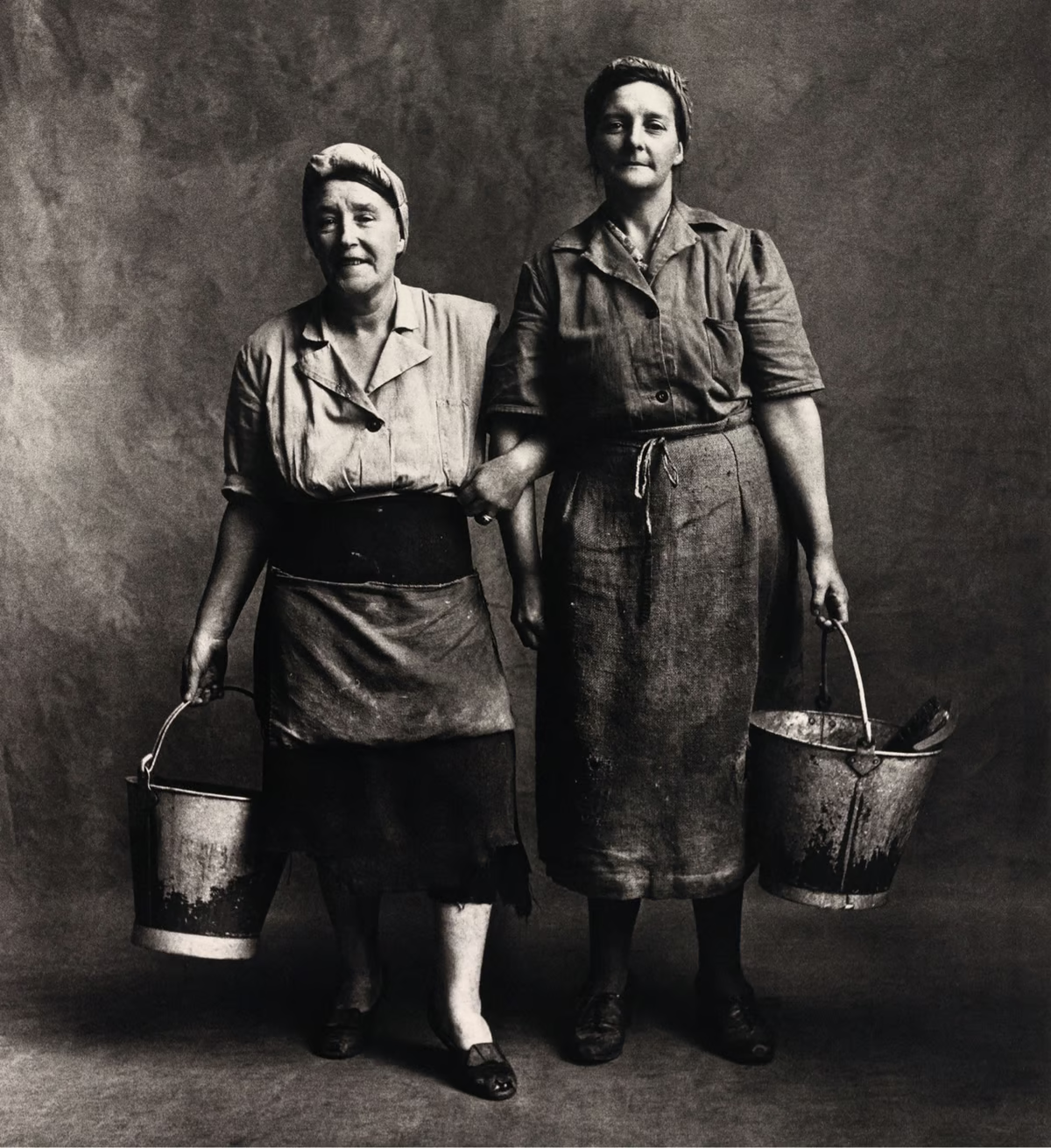
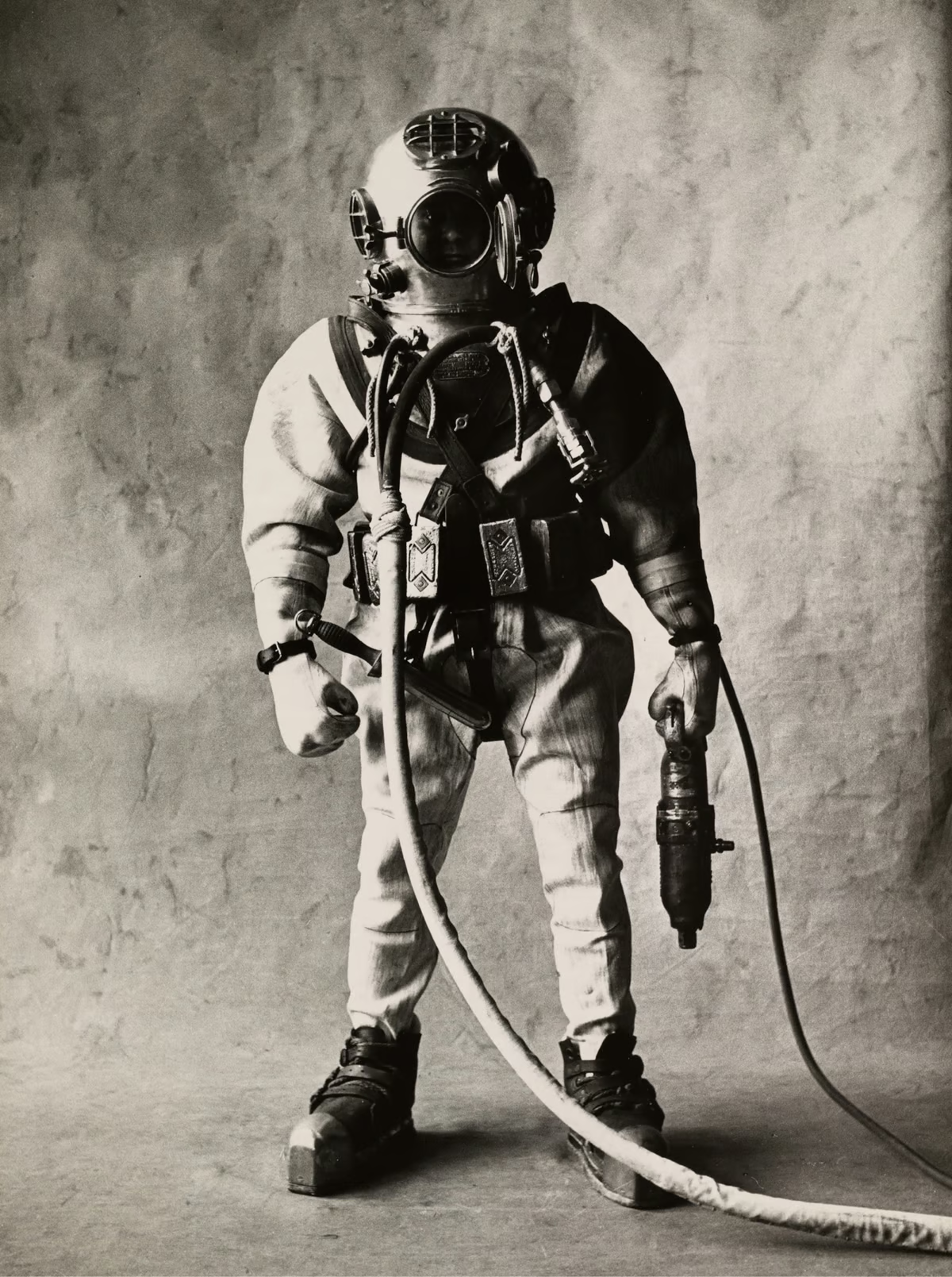
In 1950, master photographer Irving Penn set up a simple studio in Paris and started to photograph people of all kinds of professions, each wearing their work clothes and carrying the tools of their trade.
Working in the tradition of representing the petits métiers, Penn photographed fishmongers, firefighters, butchers, bakers, divers, baseball umpires, chefs, bike messengers, and sellers of goods of all kinds.
Penn continued photographing workers in New York and London, collecting the photos into a project called Small Trades.
Like everyone else who has recorded the look of tradesmen and workers, the author of this book was motivated by the fact that individuality and occupational pride seem on the wane. To a degree everyone has proved right, and since these photographs were made, London chimney sweeps have all but disappeared and in New York horseshoers — hard to find in 1950 — now scarcely exist…
As we peruse professions, we might send muckraking birthday greetings to Upton Sinclair; he was born on this date in 1878. A writer, activist, and politician, he is probably best remembered for his classic novel, The Jungle, which exposed labor and sanitary conditions in the U.S. meatpacking industry, causing a public uproar that contributed in part to the passage a few months later of the 1906 Pure Food and Drug Act and the Meat Inspection Act.
Many of his novels can be read as historical works. Writing during the Progressive Era, Sinclair describes the world of the industrialized United States from both the working man’s and the industrialist’s points of view: e.g., King Coal (1917, covering John D. Rockefeller and the 1914 Ludlow Massacre in the coal fields of Colorado), Oil! (1927, the Teapot Dome Scandal), and The Flivver King (1937, Henry Ford– his “wage reform,” his company’s Sociological Department, and his decline into antisemitism) describe the working conditions of the coal, oil, and auto industries at the time.
Sinclair ran (as a Democrat) for Governor of California in 1934, during the Great Depression, under the banner of the End Poverty in California campaign, but was defeated in the general election.
He was awarded he Pulitzer Prize for Fiction in 1943 for Dragon’s Teeth, which portrayed the Nazi takeover of Germany during the 1930s.
It is difficult to get a man to understand something, when his salary depends upon his not understanding it.
Upton Sinclair, ruminating on his gubernatorial loss
The remarkable Robert Caro– the author of The Power Broker (a biography of Robert Moses) and the four (of five planned) volumes on the life and work of Lyndon Johnson– has won nearly every literary honor, among them the Pulitzer Prize for biography (twice); the National Book Critics Circle Award (three times); the Gold Medal in Biography from the American Academy of Arts and Letters; and the National Humanities Medal, (given to him in 2010 by a big fan, President Barack Obama). He is even a “living landmark,” according to the New York Landmarks Conservancy. So his archives and papers are sure to be a treasure trove…
Early last year the New-York Historical Society arranged to acquire Mr. Caro’s substantial archives, including the files for his Johnson masterwork and for “The Power Broker,” which examined how one unelected official, Robert Moses, used his political wiles to reshape the New York metropolitan region.
But as Ms. Bach, a curator for the society, would learn, the Caro records extend much deeper into the past — back to when he was a young newspaper reporter — revealing hints of the compassionate rigor that would one day earn the writer international acclaim…
So much of Mr. Caro’s research never made the page. For example, he interviewed all the key aides to Fiorello La Guardia, who served as New York’s mayor from 1934 to 1945. Yet only a minuscule fraction of that research appeared in “The Power Broker.”
This is one reason he wanted the archives to be accessible to the public. The unpublished materials extend well beyond Moses and Johnson to encompass much of American life over the last century, from the streets of New York City to the rutted roads of the Texas Hill Country — to the marbled halls of the United States Senate.
“Years of observation,” he said, by which he meant more than a half-century…
As we do the work, we might send thoroughly-researched birthday greetings to Samuel Hopkins Adams; he was born on this date in 1871. A investigative journalist, he began his career at the New York Sun, then McClure’s (where he was a colleague of fellow muckrackers Lincoln Steffens and Ida Tarbell. But it was at Collier‘s that he had his biggest impact– probably most notably his expose on patent medicines, a series of 11 articles that led to the passage of the Pure Food and Drug Act of 1906.
Adams also wrote fiction. His most popular work in his own time was Revelry (1926), based on the scandals of the Harding administration. (He followed it with Incredible Era [1939], a biography of Harding.) But perhaps his most enduring piece of fiction was the magazine story “Night Bus” (1933), which became the basis for the marvelous 1934 film It Happened One Night. A man of many enthusiasms, he also wrote other biographies, (largely historical) non-fiction, and even “risque” novels…



You must be logged in to post a comment.