Posts Tagged ‘measurement’
“If someone separated the art of counting and measuring and weighing from all the other arts, what was left of each (of the others) would be, so to speak, insignificant”*…

Mathematics, Bo Malmberg and Hannes Malmberg argue, was the cornerstone of the Industrial Revolution. A new paradigm of measurement and calculation, more than scientific discovery, built industry, modernity, and the world we inhabit today…
In school, you might have heard that the Industrial Revolution was preceded by the Scientific Revolution, when Newton uncovered the mechanical laws underlying motion and Galileo learned the true shape of the cosmos. Armed with this newfound knowledge and the scientific method, the inventors of the Industrial Revolution created machines – from watches to steam engines – that would change everything.
But was science really the key? Most of the significant inventions of the Industrial Revolution were not undergirded by a deep scientific understanding, and their inventors were not scientists.
The standard chronology ignores many of the important events of the previous 500 years. Widespread trade expanded throughout Europe. Artists began using linear perspective and mathematicians learned to use derivatives. Financiers started joint stock corporations and ships navigated the open seas. Fiscally powerful states were conducting warfare on a global scale.
There is an intellectual thread that runs through all of these advances: measurement and calculation. Geometric calculations led to breakthroughs in painting, astronomy, cartography, surveying, and physics. The introduction of mathematics in human affairs led to advancements in accounting, finance, fiscal affairs, demography, and economics – a kind of social mathematics. All reflect an underlying ‘calculating paradigm’ – the idea that measurement, calculation, and mathematics can be successfully applied to virtually every domain. This paradigm spread across Europe through education, which we can observe by the proliferation of mathematics textbooks and schools. It was this paradigm, more than science itself, that drove progress. It was this mathematical revolution that created modernity…
The fascinating story: “How mathematics built the modern world,” from @bomalmb and @HannesMalmberg1 in @WorksInProgMag.
* Plato
###
As we muse on measurement, we might recall that it was on this date in 1790, early in the French Revolution, that the French Assembly, acting on the urging of Bishop Charles Maurice de Talleyrand, moved to create a new system of weights and measures based on natural units– what we now know as the metric system.

“Tell me to what you pay attention and I will tell you who you are”*…

… and then I’ll sell you something.
D. Graham Burnett on how an alliance between psychologists and advertisers at the turn of the 20th century taught us how to measure (and monetize) human attention…
Our eyes are worth money. We know that, now. It has become a commonplace that our “attention economy” is functionally an eyeball economy. But how did eyeballs come to look like dollar signs? Let’s dig into what we might think of as the original Faustian Bargain by which the sciences of human perception (with their sophisticated technologies of precision monitoring and measurement) cut a deal with those who move the money around…
An illuminating account of the history of a powerful– and profitable– alliance: “Fracking Eyeballs,” from @asterisk_mag_.
* Jose Ortega y Gasset
###
As we analyze attentiveness, we might recall that it was on this date in 1994 that Laurence Cantor unleashed the “Green Card” spam (advertising the law firm that he operated with his wife, Martha Siegel, and its immigration law services) on the Usenet. While it wasn’t the very first instance of spam, it was the first commercial Usenet spam; and its unapologetic authors are seen as having pioneered the modern global practice of spamming.

“You may delay, but time will not”*…
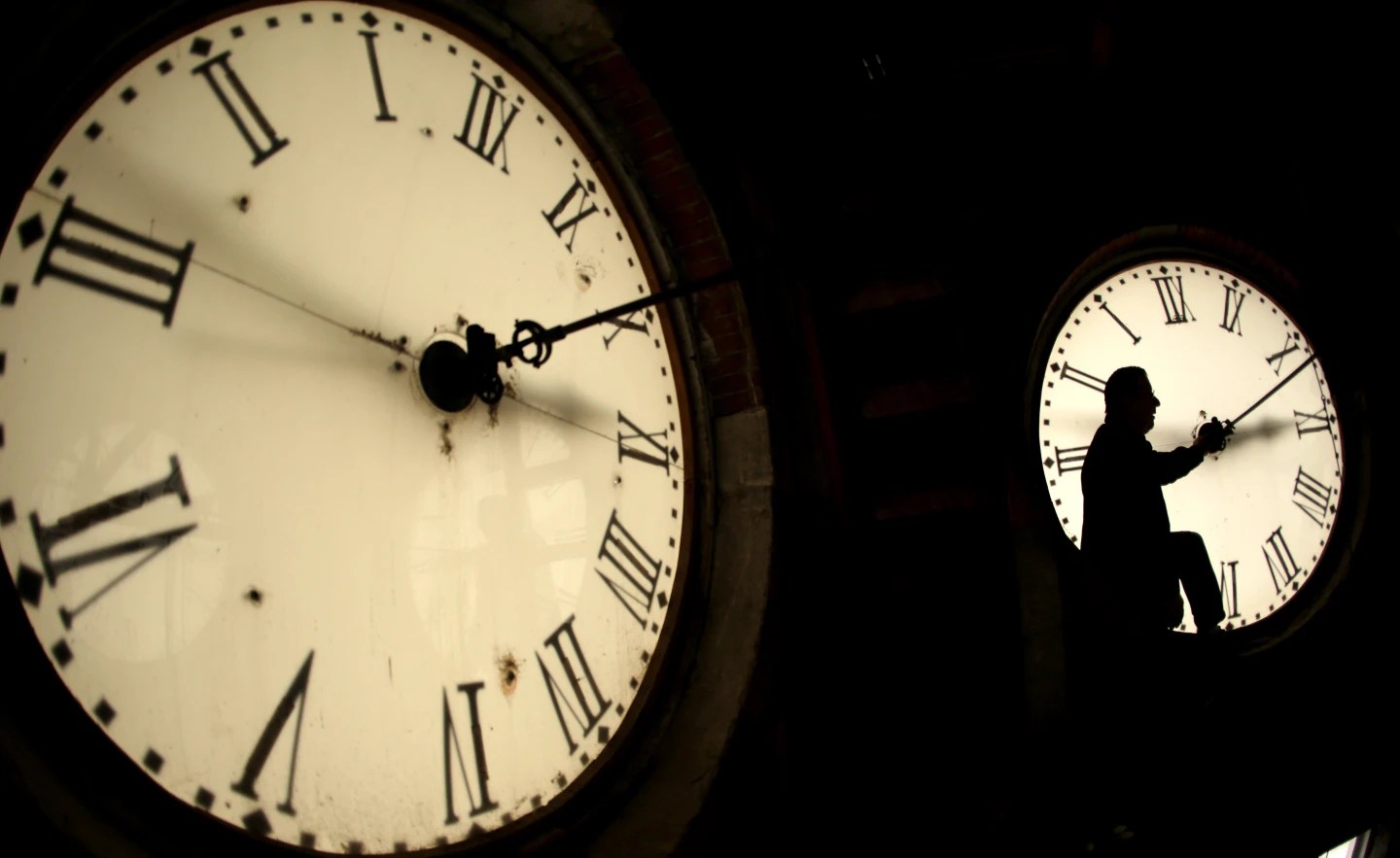
It turns out that our feeling that things are speeding up has some basis in science…
Earth’s changing spin is threatening to toy with our sense of time, clocks and computerized society in an unprecedented way — but only for a second.
For the first time in history, world timekeepers may have to consider subtracting a second from our clocks in a few years because the planet is rotating a tad faster than it used to. Clocks may have to skip a second — called a “negative leap second” — around 2029, a study in the journal Nature said Wednesday.
“This is an unprecedented situation and a big deal,” said study lead author Duncan Agnew, a geophysicist at the Scripps Institution of Oceanography at the University of California, San Diego. “It’s not a huge change in the Earth’s rotation that’s going to lead to some catastrophe or anything, but it is something notable. It’s yet another indication that we’re in a very unusual time.”
Ice melting at both of Earth’s poles has been counteracting the planet’s burst of speed and is likely to have delayed this global second of reckoning by about three years, Agnew said.
“We are headed toward a negative leap second,” said Dennis McCarthy, retired director of time for the U.S. Naval Observatory who wasn’t part of the study. “It’s a matter of when.”…
The full story: “A faster spinning Earth may cause timekeepers to subtract a second from world clocks,” from @AP.
For (even) more on leap seconds on their history, see “Will We Have a Negative Leap Second?“, by Demetrios Matsakis (also a retired director of time for the U.S. Naval Observatory).
See also: “Climate change is altering Earth’s rotation enough to mess with our clocks” (gift article): “in that one second, the Earth rotated about four football fields”
* Benjamin Franklin
###
As we muse on measurement, we might send carefully-observed birthday greetings to Sir Harold Spencer Jones; he was born on this date in 1890. An astronomer (indeed, for 23 years the tenth Astronomer Royal), he specialized in positional astronomy, particularly the motion and orientation of the Earth in space… a focus that helped him contribute to knowledge of the Earth’s rotation and improved timekeeping– efforts that led to Spencer Jones’ election (in 1947) as the first President of the Royal Institute of Navigation (which, In 1951, named its highest award, the Gold Medal, in his honor).

“The metric system did not really catch on in the States, unless you count the increasing popularity of the nine-millimeter bullet”*…

Nearly everywhere in the world, folks use the metric system to measure things; here in the U.S. we use the Imperial system. (Note that Britain should really be a dark shade of green– i.e. a little yellow, mixed with a lot of blue. Brits may regularly use inches, ounces, miles, and pounds in everyday life, but have officially been Metric since 1965.)
Mike Sowden (amusingly and informatively) recounts the history of the metric system, then muses on why Imperial measures– the mile, the inch, the cubit, the ell– have staying power…
… Yes, all of these lack precision, so they’re useless for modern science, and would be incredibly dangerous if used for engineering purposes. But they also tell a story of people’s relationship with the space they moved through.
A lexis of movement – perhaps in a similar fashion to the language of landscape that writer Robert MacFarlane has done so much to retrieve.
This is why I’m on the fence about Imperial now. There’s no question that Metric is necessary as a standardised, exact form used to make cars that don’t shake themselves to bits, planes that don’t fall out the sky and spacecraft that can launch themselves to interplanetary targets with mind-blowing accuracy.
But the versions of Imperial still being used by people in everyday life deserve their place in the world too.
Anyone brought up thinking and feeling temperature in Fahrenheit can tell us Celsius-reared folk something different about how we can experience the world. Anyone cooking in pounds will be thinking about food a little differently (“well, it’s just 2 cups, isn’t it?”). All these things are tiny windows into new ways of seeing what we think we already know…
In defense of an old way of measuring: “Why Go Imperial in a World Gone Metric?” from @Mikeachim.
See also: “The real reasons the US refuses to go metric,” and explainer from Verge Science on the last big attempt to turn the US towards Metric, why it failed, and the ways scientists and manufacturers have snuck it in anyway.
* Dave Barry
###
As we muse on measurement, we might pause, on Pi Day, for a piece of pi(e)…

… in celebration of Albert Einstein’s birthday; he was born on this date in 1879.

“Everything should be made as simple as possible, but not simpler.”
“The concept of ‘measurement’ becomes so fuzzy on reflection that it is quite surprising to have it appearing in physical theory at the most fundamental level”*…

From xkcd (Randall Munroe, who observes that Subway hasn’t clarified whether they sell International Footlongs or US Survey Footlongs– there’s a milligram of sandwich at stake!)
###
As we muse on measurement, we might recall that it was on this date in 1897 that the Indiana State House of Representatives passed Bill No.246 which gave pi the exact value of 3.2– a nice, round… and wrong number.
Hoosier Dr. Edwin J. Goodwin, M.D, a mathematics enthusiast, satisfied himself that he’d succeeded in “squaring the circle.” Hoping to share with his home state the fame that would surely be forthcoming, Dr. Goodwin drafted legislation that would make Indiana the first to declare the value of pi as law, and convinced Representative Taylor I. Record, a farmer and lumber merchant, to introduce it. As an incentive, Dr. Goodwin, who planned to copyright his “discovery,” offered in the bill to make it available to Indiana textbooks at no cost.
It seems likely that few members of the House understood the bill (many said so during the debate), crammed as it was with 19th century mathematical jargon. Indeed, as Peter Beckmann wrote in his History of Pi, the bill contained “hair-raising statements which not only contradict elementary geometry, but also appear to contradict each other.” (Full text of the bill here.) Still, it sailed through the House.
As it happened, Professor Clarence Abiathar Waldo, the head of the Purdue University Mathematics Department and author of a book titled Manual of Descriptive Geometry, was in the Statehouse lobbying for the University’s budget appropriation as the final debate and vote were underway. He was astonished to find the General Assembly debating mathematical legislation. Naturally, he listened in… and he was horrified.
On February 11 the legislation was introduced in the Senate and referred to the Committee on Temperance, which reported the bill favorably the next day, and sent it to the Senate floor for debate.
But Professor Waldo had “coached” (as he later put it) a number of key Senators on the bill, so this time its reception was different. According to an Indianapolis News report of February 13,
…the bill was brought up and made fun of. The Senators made bad puns about it, ridiculed it and laughed over it. The fun lasted half an hour. Senator Hubbell said that it was not meet for the Senate, which was costing the State $250 a day, to waste its time in such frivolity. He said that in reading the leading newspapers of Chicago and the East, he found that the Indiana State Legislature had laid itself open to ridicule by the action already taken on the bill. He thought consideration of such a propostion was not dignified or worthy of the Senate. He moved the indefinite postponement of the bill, and the motion carried.
As one watches state governments around the U.S. enacting similarly nonsensical, unscientific legislation (e.g., here… perhaps legislators went to school on this), one might be forgiven for wondering “Where’s Waldo?”

You must be logged in to post a comment.