Posts Tagged ‘Mathematics’
“For the simplicity on this side of complexity, I wouldn’t give you a fig. But for the simplicity on the other side of complexity, for that I would give you anything I have.”*…

Indeed. And as Jordana Cepelewicz reports, mathematicians are on the case…
Repetition doesn’t always have to be humdrum. In mathematics, it is a powerful force, capable of generating bewildering complexity.
Even after decades of study, mathematicians find themselves unable to answer questions about the repeated execution of very simple rules — the most basic “dynamical systems.” But in trying to do so, they have uncovered deep connections between those rules and other seemingly distant areas of math.
For example, the Mandelbrot set, which I wrote about last month [see also the almanac entry here], is a map of how a family of functions — described by the equation f(x) = x2 + c — behaves as the value of c ranges over the so-called complex plane. (Unlike real numbers, which can be placed on a line, complex numbers have two components, which can be plotted on the x- and y-axes of a two-dimensional plane.)
No matter how much you zoom in on the Mandelbrot set, novel patterns always arise, without limit. “It’s completely mind-blowing to me, even now, that this very complex structure emerges from such simple rules,” said Matthew Baker of the Georgia Institute of Technology. “It’s one of the really surprising discoveries of the 20th century.”
The complexity of the Mandelbrot set emerges in part because it is defined in terms of numbers that are themselves, well, complex. But, perhaps surprisingly, that isn’t the whole story. Even when c is a straightforward real number like, say, –3/2, all sorts of strange phenomena can occur. Nobody knows what happens when you repeatedly apply the equation f(x) = x2 – 3/2, using each output as the next input in a process known as iteration. If you start iterating from x = 0 (the “critical point” of a quadratic equation), it’s unclear whether you will produce a sequence that eventually converges toward a repeating cycle of values, or one that continues to endlessly bounce around in a chaotic pattern…
[Cepelewicz runs through mathemeticians’ efforts to understand– and find explanation, if not order– in the complexity, concluding with the “entropy bagel”…]
… Galois conjugates [see here] also paved the way to the discovery of a mysterious object dubbed the “entropy bagel,” a glowing fractal ring in the complex plane. Entropy is a measure of randomness; in this context, it measures how difficult it is to predict the sequence of numbers generated by iterating x2 + c. In the last paper he wrote before he died in 2012, the renowned topologist William Thurston graphed the set of entropy values corresponding to almost a billion different real values of c — together with the Galois conjugates of those entropy values, which can be complex. The notion of entropy “is just on the real line, but somehow you can still see this shadow of the complex world,” Tiozzo said.
“You see that this is organizing itself into this incredible lacy fractal structure,” Koch said. “It’s so cool.” The entropy bagel is only one very complicated pattern that emerges from the iteration of real quadratic equations. “We’re still learning all these magical statements — little gems — about real quadratic polynomials,” she added. “You can always go back and be surprised by this thing you thought you knew extremely well.”…
Simple rules in simple settings continue to puzzle mathematicians, even as they devise intricate tools to analyze them: “‘Entropy Bagels’ and Other Complex Structures Emerge From Simple Rules,” from @jordanacep.bsky.social in @quantamagazine.bsky.social.
* Oliver Wendell Holmes
###
As we untangle, we might spare a thought for cherished creator of chaos, Milton Supman (better known by his stage name, Soupy Sales); he died on this date in 2009. A comedian, actor, radio-television personality, and jazz aficionado, he is best remembered for his local and network children’s television series, Lunch with Soupy Sales (later titled The Soupy Sales Show), which ran from 1953–1966, a collection of comedy sketches frequently ending with Sales receiving a pie in the face, which became his trademark.

“Where all think alike there is little danger of innovation”*…

Last week, Northwestern Professor Joel Mokyr was awarded a half-share in The Nobel Prize in Economic Sciences (AKA The Sveriges Riksbank Prize in Economic Sciences in Memory of Alfred Nobel) “for having identified the prerequisites for sustained growth through technological progress.” Anton Howes explains why this is noteworthy…
Among today’s winners of the Nobel prize in Economics is Joel Mokyr, the professor at Northwestern whose name is indelibly associated with the primacy of innovation to modern economic growth – the gradual, sustained, and unprecedented improvement in living standards that first Britain, and then country after country, have enjoyed over the past few hundred years. It was reading Mokyr’s The Enlightened Economy that first opened my eyes to the importance of studying the history of invention to explaining the causes of the Industrial Revolution, which I have since made my career.
What makes this Nobel win so remarkable, and so pleasantly surprising, is that Mokyr’s work is not the kind that is often published by economics journals, or even many economic history journals anymore. Over the past few decades, journal editors and peer-reviewers have increasingly insisted that papers must present large datasets that have been treated using complex statistical methods in order to make even the mildest claims about what caused what. Although Mokyr is a master of such methods – he was one of the early pioneers of economic history’s quantitative turn – the work for which he has won the prize is firmly and necessarily qualitative.
Mokyr’s is the economic history that gets written up in books – his classics are The Lever of Riches, The Gifts of Athena, The Enlightened Economy, and A Culture of Growth – and in readable papers shorn of unnecessary formulae. His is history accessible to the layman, though rigorously applying the insights of economics. The prize is a clear signal from the economics profession that it doesn’t just value the application of fancy statistical methods; its highest prize can go to works of history.
Whereas most of the public, and even many historians, think of the causes of modern economic growth – the beginnings of the Industrial Revolution – as being rooted in material factors, like conquest, colonialism, or coal, Mokyr tirelessly argued that it was rooted in ideas, in the intellectual entrepreneurship of figures like Francis Bacon and Isaac Newton, and in the uniquely precocious accumulation in eighteenth-century Britain of useful, often mechanically actionable knowledge. Britain, he argued, through its scientific and literary societies, and its penchant for publications and sharing ideas, was the site of a world-changing Industrial Enlightenment – the place where progress was thoughtpossible, and then became real.
One of Mokyr’s big early insights, first appearing in Lever of Riches, was that many inventions could not be predicted by economic factors. Society could enjoy remarkable productivity improvements from simply increasing the size of the market, leading to division of labour and specialization – what he labelled ‘micro-inventions’ – in the vein popularised by Adam Smith. But this could not explain an invention that appeared out of the blue, like Montgolfier’s hot air balloon in the 1780s – what he called a ‘macro-invention’, not for the magnitude of its impact, but for its novelty. Macro-inventions often required further development to make them important, but the original breakthrough could not be predicted by looking at changes in prices or the availability of resources. It ultimately came down to advances in our understanding of the world. Mokyr put the Scientific Revolution – and the factors that contributed to it – on the economist’s map.
Mokyr also looked at the relationship between different kinds of knowledge. A scientist might know, through observation, that the air has a weight. A craftsman might know, through long training and experience with glass, how to make a long glass tube. Each could not get far alone. But combining them, by creating means to ensure that scientists and craftsmen talked with one another and collaborated – through connecting their propositional and prescriptive knowledge, their heads and hands – very quickly led to the invention of thermometers, barometers, and much more besides, in an ever expanding field of knowledge. What Mokyr taught economists is that it’s not knowledge per se that makes the difference, but the way it is organized. Much of his later work has shown just how deep a pool Britain’s scientists could draw on, of skilled artisans.
In a way, Mokyr himself has practised what he preached. As editor of Princeton University Press’s book series on the Economic History of the Western World, Mokyr has for decades provided an all-important space for economists and historians to write the kinds of research that would never have been publishable in economics journals – including of explanations of the Industrial Revolution that are the polar opposite to his own. He helped keep the connection between history and economics alive.
Mokyr’s case for the primacy of knowledge and ideas was not an easy one to make to economists. They are naturally drawn to data that can be counted, and not to narrative, often no matter how well evidenced. But it appears that Mokyr’s persistence, elevated by his infectious, irrepressible sprightliness, has paid off. His prize is a long overdue recognition of the historyin economic history, and a remarkable testament to the power of ideas to persuade…
A triumph for history and the importance of ideas: “Joel Mokyr’s Nobel,” from @antonhowes.bsky.social.
See also: “Why Joel Mokyr deserves his Nobel prize,” gift article from The Economist.
* Edward Abbey, Desert Solitaire
###
As we ponder the process of progress, we might send creative birthday greetings to one of the subjects Mokyr’s study, Sir Christopher Wren; he born on this date in 1632. A mathematician and astronomer (who co-founded and later served as president of the Royal Society), he is better remembered as one of the most highly acclaimed English architects in history; he was given responsibility for rebuilding 52 churches in the City of London after the Great Fire in 1666, including what is regarded as his masterpiece, St. Paul’s Cathedral, on Ludgate Hill.
Wren, whose scientific work ranged broadly– e.g., he invented a “weather clock” similar to a modern barometer, new engraving methods, and helped develop a blood transfusion technique– was admired by Isaac Newton, as Newton noted in the Principia.

“If I am to be remembered, I hope it will not be primarily for my specialized scientific work, but as a generalist; one to whom, enlarging Terence’s words, nothing human and nothing in external nature was alien.”*…
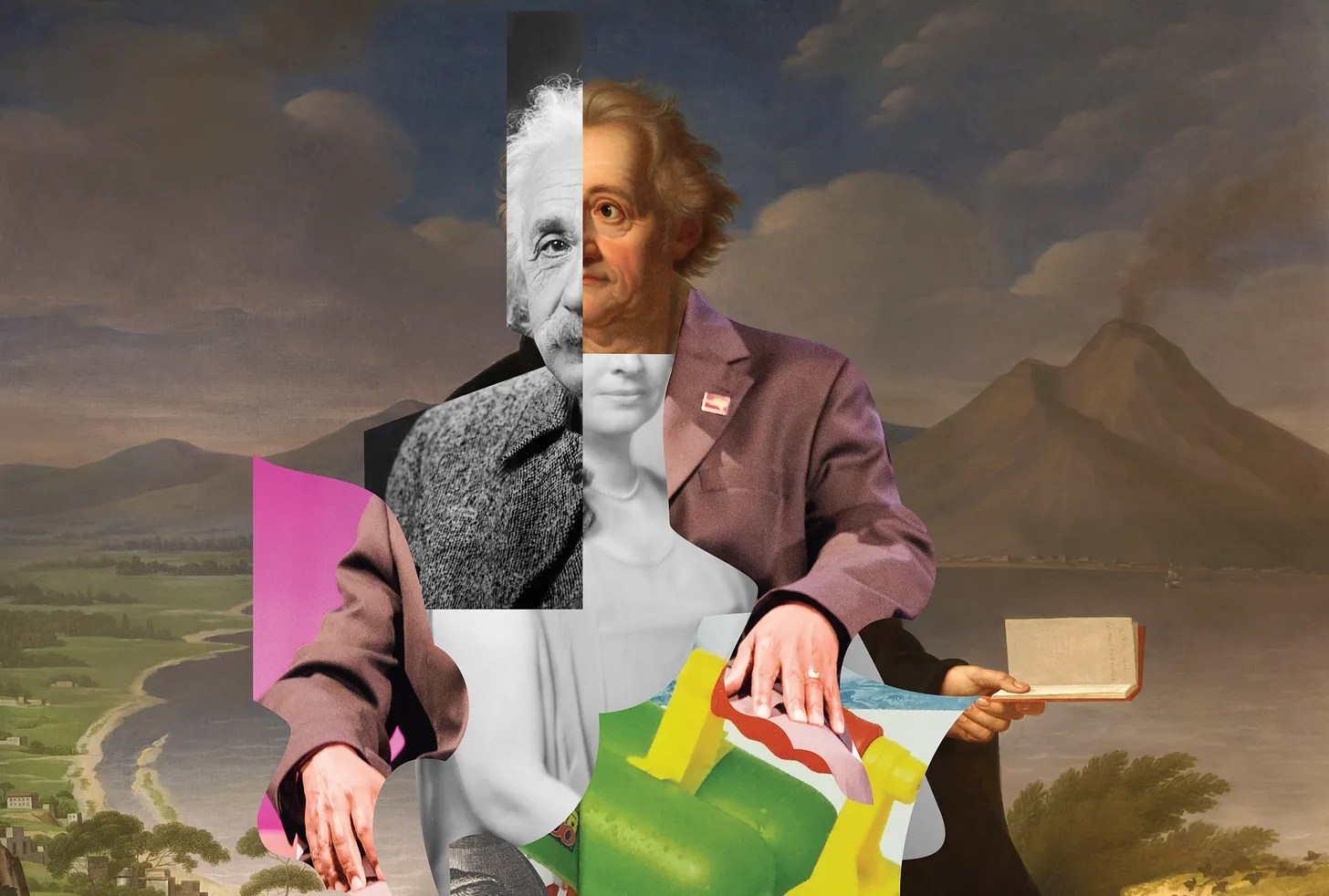
Interdisciplinary artist, writer, and musician Ross Simonini with 47 thoughts on the glory of looking– and living– beyond a specialty…
1. I was raised to believe that I was made to do one thing. Find that one pursuit that fills my life with meaning and empty all my energy into it. This is the realization of human potential: to excel with rigorous focus on a refined lifelong mission. This and only this will bring us to our greatest success and fulfillment.
For me, this was not something I even had to be told—though I was, many times, by many people—because I implicitly understood that this kind of teleology was woven into the fibers of my world. I also knew that rejecting a singular pursuit would be an insult to my very existence. Without this unifying reason for being alive, I would wander aimlessly into the barren void of nihilism. I’d heard about great artists who refused to create, who stepped away from their work to fritter away their time on leisure, and I knew this was a life of tragedy.
Likewise, I understood that sliding your attention across interests is a way to waste your gift. The more hours you put into a skill, the more skilled you become—right? To treat your gift with the proper deference, you must exhaust yourself into it.
Within this paradigm, the most unfortunate people are those who do not have a single, clear vocation. These types float from job to job without a trajectory; they are vagabonds who have given up on greatness.
This may sound a little dramatic, but somewhere inside me, these beliefs are there—and as a lifelong generalist, I spend every day rubbing up against them.
…
16. Let’s talk about mastery. Everyone wants to be a master, even if they are disgusted by the monstrous implications of the word. Mastery suggests dominance over something, but every true master knows that they are merely a supplicant at the mercy of their field, which existed long before them and will exist long after them. Anyone who believes in their own mastery likely suffers from hubris. Work hard enough at something and you watch your dominance slip ever further away.
Mastery is an illusion, a notion of a fictional purity that cannot be understood or measured in terms of time. Just look at those young savants who excel wildly after only a few years spent on their craft. For them, mastery cannot be the result of time plus work, as we all assume it is. In fact, maybe the newness of their skills is precisely what gives their work its value.
But these little wonders are exceptions, right? The rest of us have to dedicate our lives to something to achieve greatness, and anyone who doesn’t do this will likely be middling in their work. Most writers I know are immediately suspicious when an actor publishes a novel. We delight in calling the person a moonlighter. Literature is our territory, and the only way to live here is to put in the time and labor.
…
24. Isaiah Berlin, the political theorist, ethicist, philosopher, and historian, wrote a book called The Hedgehog and the Fox, in which he divides people into two types: hedgehogs, who see the entire world through one big thing, and foxes, who see the world as many things that cannot be reduced. According to Berlin, hedgehogs include Plato, Dostoyevsky, and Proust, while foxes include Aristotle, Shakespeare, and James Joyce.
“Everything I learned in my life, I learned because I decided to try something new,” said David Lynch (musician, filmmaker, painter, lamp maker, sculptor, writer, actor, and lecturer, mostly on meditation).
…
29. Sometimes history hides generalism to preserve a specialized agenda. Isaac Newton, a figure whom we consider the father of modern math, physics, and reasoned thinking, was also a dedicated alchemist. Alchemy, a generalist practice in itself, was a precursor to modern chemistry. It involves spirituality, myth, belief, and metallurgy, but its inclusion of belief stands in direct conflict with the scientific rationalism Newton now represents. Subsequent generations of historians and scientists buried Newton’s dedication to the occult, willfully ignoring the blow it deals to their obsessive, single-minded materialism. But Newton’s own records tell a different story. He wrote over a million words on alchemy in his lifetime, and his study of the subject helped inspire some of his most paradigm-shifting discoveries.
…
31. A filmmaker must understand aspects of sound design, photography, storytelling, music, acting, props, environment, finance, writing, and dialogue. In this way, some jobs are naturally suited to the generalist. A skilled homemaker, for example, understands everything from cooking to cleaning to healing to sociology. Acting, too, is a fairly generalist vocation. The practice of writing, what I am doing right now, is extremely broad, without consistent subject matter, form, or even mediums.
Generalism can be an approach of the neophyte or of the seasoned worker. Some entry-level positions (assistant, secretary, intern) are, in fact, compilations of micro-jobs, and some high-level positions—
managers, CEOs, directors, business owners, presidents—are positions of vast, nonspecific oversight. Sometimes the highest perch has the widest perspective.…
39. A generalist must engage with both sides of any argument: skepticism and belief, optimism and pessimism. So, for this essay, it would only be right to take a look at the dark side of generalism and the side effects of adopting it as a whole-life philosophy.
The glaring danger of general thinking in its extreme form is relativism, a sort of mushy non-position in which there are no universal standards: nothing can ever be condemnable or universally wrong. At the most dramatic levels, relativism might dismiss murder and genocide. It’s a slippery slope of open-mindedness.
Likewise, a generalist must contend with political centrism. In our bifurcated world, the center is one of the most reviled of all political positions, and a generalist will come to understand whether their own centrism is an evasion of choice or a refusal of unpalatable options.
Few things are more torturous than making decisions, and a mind will do anything to avoid such a relentlessly complex activity. Adherence to these vague philosophies, as I see them, can certainly be used as an excuse for escaping commitment. As a generalist, I must stay vigilant against this kind of laziness of mind and instead allow many fierce, contrary ideas to exist at once.
…
42. Generalism is not a thing. It’s definitely not an ism or some kind of doctrine. The general approach defies the nature of ideologies, which are characterized by the limits they place on understanding the world. There is no system of generalism. The general philosophy is to love variety.
For this reason, generalists don’t exist—not in the way that, say, Marxists do—because they can’t identify as generalists. I can call myself intra-, cross-, multi-, inter-, and trans-disciplinary—which, for some, are all legitimate and distinct prefixes—but that does more to distinguish and alienate me from others than to connect me with a community. There is no lineage of generalists, as there is for microbiologists or flutists, because every generalist works with their own complex bouquet of interests.
Probably this whole essay is my attempt to give a sense of unity to my life. Maybe I have to write a manifesto on “the art of doing many things”because I fear that if our culture doesn’t have a catchy keyword for my role, I’ll just fade away. So here I am, reducing generalism to a single, branded snap, just like a specialist.
After all, generalists are, in moments, great specialists. Likewise, a deep specialist can approach their niche from an ever-growing number of perspectives. A man with a repetitive job can endlessly engage with his work from fresh angles. And, of course, it’s all relative. A single task looked at from another angle is a plentiful cornucopia of individuated micro-tasks.
Some long-term generalists focus exclusively on a single activity for a number of years before moving on to the next. Rather than doing many things simultaneously, they do them sequentially.
Pure generalism and pure specialism are just intellectual games. Our minds drift between unified oneness and individuality without ever settling into either. Binary thinking is for computers.
These two states of being are not roles we need to inhabit but rather nodes to be considered. One situation requires diligent focus, but another benefits from a more diffuse form of attention. Certain qualities of engagement can occur only when you do multiple things at once. This is the value of the glance.
…
47. Generalism is not the opposite of specialism. It includes specialism. Everyone gets to experience both. Or maybe both approaches lead to the same place. Maybe the study of quantum physics brings a mind to the same conclusions as basketry. Maybe it’s like meditation: You can sit in open awareness and experience everything until you reach an unprejudiced understanding of life. Or you can unflinchingly focus on a single mantra for decades, repeating it with each breath, and as you plunge deeper toward a single infinite point, you discover that everything is already right there.
Eminently worth reading in full: “In praise of generalism” from @thebeliever.net.
###
As we widen our irises, we might send carefully-calculated birthday greetings to Pierre de Fermat; he was born on this date in 1601. While he is remembered as one of the two great mathematicians of the early 17th century (with Descartes), Fermat was (like Descartes) driven by wider interests. Fermat was a trained lawyer, who served as a councilor at the Parlement de Toulouse, one of the High Courts of Judicature in France. He was fluent in six languages and praised for his written verse in several of them; his advice was eagerly sought regarding the emendation of Greek texts… which is to say that mathematics was but one of his interests, and more a hobby than a profession at that. Still, Fermat made foundational contributions to analytical geometry, probability, number theory and calculus.

“Patience’s design flaw became obvious for the first time in my life: the outcome is decided not during the course of play but when the cards are shuffled, before the game even begins. How pointless is that?”*…

As Simone de Rochefort explains, Patience– or as we tend to know it, solitaire— illustrates the way in which some of humanity’s oldest toys are our most complex…
… last year, I got addicted to Solitaire.
Why me.
During the dark final days of 2024, I was averaging 12 wins per day in Sawayama Solitaire, one of the Solitaires created by developer Zachtronics. Sawayama Solitaire is a variant of Klondike — the one that’s been bundled into every version of Windows since 1990.
Some games of Sawayama Solitaire felt impossible. Some were absurdly easy. Most of them were a satisfying detangling of cards that had me immediately pressing that “new game” button once I got the win.
How was the most basic card game on Earth owning my life like this?
I think it’s because we don’t understand playing cards.
In 1969, as protests raged against the Vietnam War and counterculture made waves across the nation, a magician [and dear friend of Ricky Jay] named Persi Diaconis went to college.
Diaconis had been a professional magician since age 14, and was skilled in sleight-of-hand tricks. But it was probability that fascinated him.
He went on to take a degree in statistics. He became a world-renowned mathematician. In 1992, he proved that it takes seven riffle shuffles to truly randomize a 52-card deck, alongside fellow mathematician Dave Bayer. His research on card shuffling has implications for scientific fields as far-flung as the study of glass melting and the creation of magnets.
He doesn’t know how Solitaire works.
“One of the embarrassment of applied probability is that we can not analyze the original game of solitaire,” he wrote in the abstract for an academic talk called “The Mathematics of Solitaire,” given at the University of Washington in 1999. The talk has been given several times over the years, and is currently viewable on YouTube. One of his most recent appearances, in 2024, reiterates that despite all the technical advances we’ve made in science and mathematics, the complexity of cards is still somewhat a black box.
“What’s the chance of winning, how to play well, how do various changes of rules change the answers?” Diaconis wrote. “Surely you say, the computer can do this. Not at present, not even close.”
It’s not hard to see the relationship between magic and math. Cards contain limitless possibilities. In fact, math tells us there are more combinations of cards in a 52-card deck than there are atoms on Earth.
Writing for Quanta Magazine, Erica Klarreich asked mathematician Ron Graham what that means in practice. He told her, “If everyone had been shuffling decks of cards every second since the start of the Earth, you couldn’t touch 52 factorial,” the number of possible arrangements of a 52-card deck. Klarreich goes on: “Any time you shuffle a deck to the point of randomness, you have probably created an arrangement that has never existed before.”
So that’s nuts…
More amazement at “No one understands how playing cards work,” from @polygon.com.
And here:
* David Mitchell, Cloud Atlas
###
As we shuffle along, we might spare a thought for Christiaan Huygens; he died on this date in 1695. A mathematician, physicist, engineer, astronomer, and inventor, he was a key figure in the Scientific Revolution. In physics, Huygens made seminal contributions to optics and mechanics, while as an astronomer he studied the rings of Saturn and discovered its largest moon, Titan. As an engineer and inventor, he improved the design of telescopes and invented the pendulum clock, the most accurate timekeeper for almost 300 years. A talented mathematician and physicist, his works contain the first idealization of a physical problem by a set of mathematical parameters, and the first mathematical and mechanistic explanation of an unobservable physical phenomenon.
Relevantly to the piece above, Huygens also contributed to the development of probability theory and statistics. In 1665 he visited Paris and encountered the work of Fermat and Pascal, which led him to write what was, at the time, the most coherent presentation of a mathematical approach to games of chance in De Ratiociniis in Ludo Aleae (On reasoning in games of chance)– a work contains early game-theoretic ideas.

“As far as the laws of mathematics refer to reality, they are not certain; and as far as they are certain, they do not refer to reality”*…

As Gregory Barber explains, two new notions of infinity challenge a long-standing plan to define the mathematical universe…
It was minus 20 degrees Celsius, and while some went cross-country skiing, Juan Aguilera, a set theorist at the Vienna University of Technology, preferred to linger in the cafeteria, tearing pieces of pulla pastry and debating the nature of two new notions of infinity. The consequences, Aguilera believed, were grand. “We just don’t know what they are yet,” he said.
Infinity, counterintuitively, comes in many shapes and sizes. This has been known since the 1870s, when the German mathematician Georg Cantor proved that the set of real numbers (all the numbers on the number line) is larger than the set of whole numbers, even though both sets are infinite. (The short version: No matter how you try to match real numbers to whole numbers, you’ll always end up with more real numbers.) The two sets, Cantor argued, represented entirely different flavors of infinity and therefore had profoundly different properties.
From there, Cantor constructed larger infinities, too. He took the set of real numbers, built a new set out of all of its subsets, then proved that this new set was bigger than the original set of real numbers. And when he took all the subsets of this new set, he got an even bigger set. In this way, he built infinitely many sets, each larger than the last. He referred to the different sizes of these infinite sets as cardinal numbers (not to be confused with the ordinary cardinals 1, 2, 3…).
Set theorists have continued to define cardinals that are far more exotic and difficult to describe than Cantor’s. In doing so, they’ve discovered something surprising: These “large cardinals” fall into a surprisingly neat hierarchy. They can be clearly defined in terms of size and complexity. Together, they form a massive tower of infinities that set theorists then use to probe the boundaries of what’s mathematically possible.
But the two new cardinals that Aguilera was pondering in the Arctic cold behaved oddly. He had recently constructed them, along with Joan Bagaria of the University of Barcelona and Philipp Lücke of the University of Hamburg, only to find that they didn’t quite fit into the usual hierarchy. Instead, they “exploded,” Aguilera said, creating a new class of infinities that their colleagues hadn’t bargained on — and implying that far more chaos abounds in mathematics than expected.
It’s a provocative claim. The prospect is, to some, exciting. “I love this paper,” said Toby Meadows, a logician and philosopher at the University of California, Irvine. “It seems like real progress — a really interesting insight that we didn’t have before.”
But it’s also difficult to really know whether the claim is true. That’s the nature of studying infinity. If mathematics is a tapestry sewn together by traditional assumptions that everyone agrees on, the higher reaches of the infinite are its tattered fringes. Set theorists working in these extreme areas operate in a space where the traditional axioms used to write mathematical proofs do not always apply, and where new axioms must be written — and often break down.
Up here, most questions are fundamentally unprovable, and uncertainty reigns. And so to some, the new cardinals don’t change anything. “I don’t buy it at all,” said Hugh Woodin, a set theorist at Harvard University who is currently leading the quest to fully define the mathematical universe. Woodin was Bagaria’s doctoral adviser 35 years ago and Aguilera’s in the 2010s. But his students are cutting their own path through infinity’s thickets. “Your children grow up and defy you,” Woodin said…
More on the fascinating state of play at: “Is Mathematics Mostly Chaos or Mostly Order?” from @GregoryJBarber in @quantamagazine.bsky.social.
* Albert Einstein
###
As we get down with Gödel, we might send insightful birthday greetings to John Allen Paulos; he was born on this date in 1945. A mathematician, he is best known as an advocate for– and a skilled teacher of– mathematical literacy. His book Innumeracy: Mathematical Illiteracy and its Consequences (1988) was a bestseller, and A Mathematician Reads the Newspaper (1995) extended the critique. Paulos was a regular columinst for both The Guardian and ABC News. And in 2001 he created and taught a course on quantitative literacy for journalists at the Columbia University School of Journalism– an exercise that stimulated further programs at Columbia and elsewhere in precision and data-driven journalism.

Happy 4th of July to readers in the U.S… but are we commemorating the right day?
You must be logged in to post a comment.