Posts Tagged ‘manufacturing’
“These gems have life in them: their colors speak, say what words fail of”*…
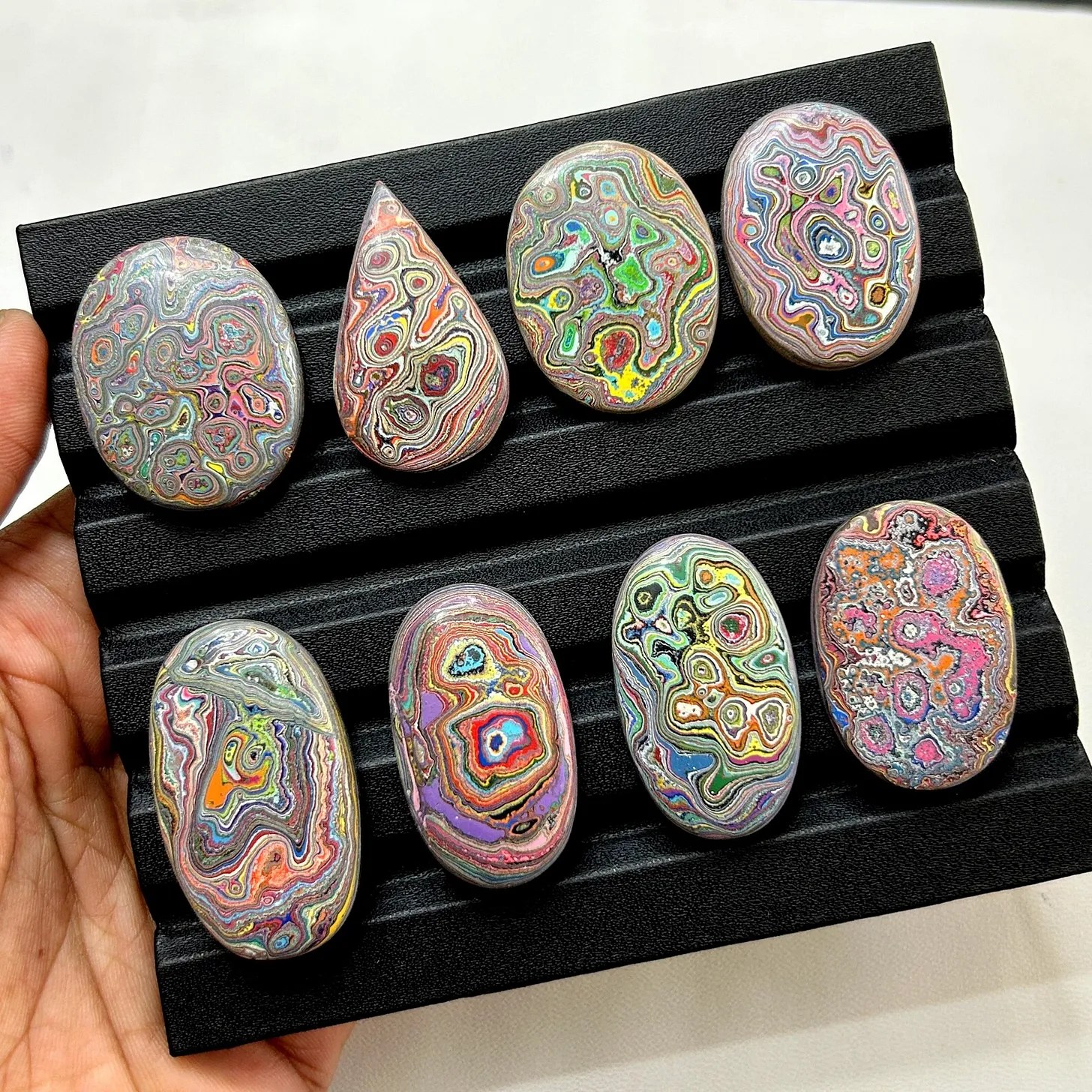
Ryan McManus on geologic byproducts, American automotive lore, and the hidden beauty of the industrial age…
Let’s be real for a second: gems are basically very pretty garbage. A byproduct of a geologic or biological process we hang on our bodies for some weird reason. Diamonds are just charcoal that has been squeezed a little longer than usual. Geodes are dried lava that got a little wet. Pearls? Oyster mucus, secreted to smooth out the bivalve equivalent of a stone in one’s shoe. They are unintentional, accidental and, due to the peculiarities of our brains, unquestionably beautiful.
So, if nature can accidentally create works of art while going about its business, why not us?
In the 1940s and 50s, Detroit’s automotive factories had a beautifully messy problem: paint. Workers hand-sprayed enamel paint onto cars on assembly lines, with excess overspray gradually building up on the tracks, skids, and walls of painting bays. This oversprayed paint accumulated over years, layer by layer—creating thick, multicolored deposits that factory workers would periodically chip away and discard.
What they were throwing out, however, would eventually become one of the most sought-after materials in contemporary jewelry making: Fordite, also known as Detroit agate.
Fordite is a man-made gemstone (technically a non-faceted gemstone, called a cabochan), but not like the rubies and diamonds grown in labs. The material represents a fascinating intersection of industrial inefficiency and geological mimicry: As cars were spray painted by hand, the hardened enamel paint built up and baked, creating sedimentary-like layers that mirror how natural agates form over millennia, except compressed into decades of automotive production.
When cut and polished, the visual result is striking—especially in the most valuable samples from the late 1960s and early 1970s, the period of bright “high impact” colors like Ford’s Grabber Blue or Mopar’s Plum Crazy purple. Fordite reveals psychedelic swirls and bands that chronicle automotive color trends year by year, strata by strata: It’s essentially a cross-section of American car culture, with each stratum representing a different model year’s palette. Like the proverbial Jurassic Age mosquito trapped in the stone of amber, the DNA of a bygone epoch is hidden inside.
But Fordite’s deeper appeal lies in its accidental scarcity and temporal specificity. By the 1980s, car manufacturers had moved away from hand-spray painting, adopting an electrostatic process that magnetizes enamels to car bodies, leaving little to no overspray. Efficient, yes—but this electrostatic process ended Fordite production in abundance by the late 1970s. The material can never be recreated—it’s a finite byproduct of a particular moment in industrial history.
This creates a curious value proposition: Fordite is valuable precisely because modern manufacturing has become more efficient. It is industrial waste transformed into luxury material through the simple passage of time and technological progress. With the old factories long gone and today’s automated systems eliminating waste, each piece of Fordite becomes increasingly rare (and expensive), turning Detroit’s former inefficiency into today’s artisanal treasure.
In an age of planned obsolescence and disposable manufacturing, Fordite stands as an accidental monument to the beauty that emerges from industrial imperfection—proof that sometimes the most interesting materials come from processes we’ve intentionally left behind.
A better poet might even see Fordite as metaphor for the City of Detroit itself—forever tied to the automobile, often written off as worthless; unrecognized as a thing of curious quality and glorious beauty waiting for its moment…
More beautiful examples at “Fordite,” from @ryantomorrow.bsky.social in the always-illuminating Why is This Interesting?
* George Eliot (Mary Ann Evans)
###
As we rethink remnants, we might recall that it was on this date in 1899 that America’s first fatal automobile accident occurred. At West 74th Street and Central Park West in New York City, Henry Hale Bliss, a 69-year-old local real estate dealer, stepped off of a south bound 8th Avenue trolley car and was struck by the driver of an electric-powered taxicab (Automobile No. 43). Bliss hit the pavement, crushing his head and chest. He was taken by ambulance to Roosevelt Hospital, but upon arrival the house surgeon, Dr. Marny, judged his injuries too severe to survive. Bliss died the next morning.

“The duty of a good Cuisinier is to transmit to the next generation everything he has learned and experienced.”*…

Five years ago, we marked the passage of Lynn Olver, a reference librarian who pretty much single-handedly created and maintained The Food Timeline: history of human eating habits for 20,000 years. Worried that her life’s work might lie fallow and spoil, her family was searching for a new host.
Happily, one was found. Later in 2020, Virginia Tech University Libraries and the College of Liberal Arts and Human Sciences (CLAHS) offered Virginia Tech as a new home for the physical book collection and the web resource– and the site lives on…
Ever wonder how the ancient Romans fed their armies? What the pioneers cooked along the Oregon Trail? Who invented the potato chip…and why? So do we!!! Food history presents a fascinating buffet of popular lore and contradictory facts. Some experts say it’s impossible to express this topic in exact timeline format. They are correct. Most foods are not invented; they evolve…
Dive into “The Food Timeline,” courtesy of @vtliberalarts.bsky.social.
See also (the source of the almanac entry below) chef James T. Ehler‘s marvelous FoodReference.com– “on this date” history and more.
(Image above: source)
###
As we dig in, we might send healthy birthday greetings to Gilbert Blane; he was born on this date in 1749. A Scottish physician who served on the Sick and Wounded Board of the Admiralty, he instituted health reform in the Royal Navy. Perhaps most memorably, he was largely responsible for requiring citrus juice (lemons, later limes) on all naval vessel to prevent scurvy.

“While there might be a bit of genius in what we create, the real genius rests in whoever created the essential materials without which we could not create.”*…

Ben Reinhardt on how to mass-produce the new substances on which the cavalcade of wonders that populate ours lives depend…
I’m writing these words using plastic keys, on a composite wood desk, looking at a Gorilla Glass screen. The screen is linked to a machined-aluminum computer, inside of which doped silicon switches on and off a billion times per second.
One hundred and fifty years ago, not a single one of these materials existed.
Materials are not charismatic technologies like cars or computers. Yet they enable almost every one of humanity’s technical achievements: rebar unlocked the skyscrapers of the 1920s; chemically strengthened glass delivered us smartphones; and stainless steel, not created until 1913, brought with it the clinical equipment upon which modern medicine depends.
New materials create fundamentally new human capabilities. And yet, despite university teams regularly announcing triumphantly that they’ve created a material with seemingly magical properties like artificial muscles made out of carbon nanotubes or ‘limitless power’ from graphene, new materials-enabled human capabilities have been rare in the past 50 years.
Why is there such a gap between headlines and reality when it comes to new materials? Is there anything we can do about it?
The only way to answer those questions is to understand how a material goes from a tiny test tube sample to a commodity measured in megatons. Each step in the process requires different skills, mindsets, and resources. Each step is also governed by different incentives that make sense locally but create deadly traps for the entire process. Bypassing these traps needs systems-level solutions that take into account each step of the process – whether in policy, organizational reform, or new institutions – and unlock the progress that new materials enable…
Fascinating: “Getting materials out of the lab,” from @benjaminreinhardt.com in @worksinprogress.bsky.social.
See also: “The Wonder of Modern Drywall.”
(Image above: source)
###
As we celebrate stuff, we might recall that it was on this date in 1892 that Dr. Washington Sheffeld, a pioneering dentist and dental surgeon, invented the collapsible metal toothpaste tube– making dental hygiene easier– and thus more regular– for millions. His original toothpaste recipe continues to be packaged and sold as “Dr. Sheffield’s: The Original Toothpaste.”

“The pencil is mightier than the pen”*…

Carson Monetti on an industrial rivalry that yielded the finest pencils in the world…
It was the summer of 1952, and the executives of Tombow Pencil were about to revolutionize the Japanese pencil industry—or, possibly, fall flat on their faces. Hachiro Ogawa, the son of founder Harunosuke Ogawa, was Tombow’s managing director, and he had just finished a years-long project, at enormous cost, to make the best pencil Japan had ever seen.
It was called “HOMO,” because in comparison with other Japanese pencils of its day, Tombow’s new model had a much more homogenous core. Pencil cores are a mixture of graphite and clay (thanks to Nicolas-Jacques Conté’s invention of the modern pencil in the late eighteenth century), and the components in early cores were not always evenly mixed. This was particularly true in Japan, where pencils had only been made since the turn of the century and advanced industrial equipment was just starting to become available.
Hachiro’s team at Tombow was determined to do whatever it took to produce more consistent cores. They struck up a working relationship with scientists at the University of Tokyo, a visionary move that yielded crucial technical research in 1948. Then, to implement the research findings, Tombow had to import more advanced industrial mills from the United States.
It was a gamble, but it worked, and suddenly Tombow could make much finer particles of graphite and clay than any other Japanese manufacturer. HOMO cores were stronger, smoother, and more consistent than anything else on the domestic market. They came in 17 grades, from 9H to 9B, a wide and finely graduated range that hadn’t been possible with Tombow’s old process.
They were also incredibly beautiful. Another import that had become available in the wake of World War II was incense cedar, the material of choice for high-quality pencils. Most of the pencil industry’s incense cedar comes from California, and Tombow quickly restarted its imports of the aromatic red wood. HOMO’s design takes full advantage of the material upgrade, with a subtle transparent lacquer that highlights the cedar’s color and grain.
For Hachiro Ogawa and his father Harunosuke, the completion of the HOMO project was the culmination of a dream, and it was undoubtedly a pioneering moment in Japanese industry. But as the company prepared to introduce HOMO at the grand Tokyo Kaikan meeting hall, the skeptics must have been hard to ignore. In the early 1950s, a Japanese pencil cost five or ten yen (about 25-50 cents in 2022 dollars.) Tombow’s technical leap forward had produced a model far superior to those inexpensive pencils, but they would also be pioneers in price. HOMO would cost 30 yen (about $1.50 today) for a single pencil, with boxes of twelve priced at 360 yen (about $19 today.)
Japanese consumers weren’t used to spending that kind of money on a pencil. But if Hachiro, Harunosuke, and their colleagues were nervous, their fears were surely resolved at the first-ever Tombow New Product Presentation. Tokyo Kaikan was the esteemed meeting place of foreign dignitaries, corporate titans, even heads of state—and now it was absolutely bustling with stationery wholesalers, curious people from other companies, and the press. Tombow took orders for 720,000 HOMO pencils on launch day alone.
Tombow’s surprising success with Japan’s first premium pencil, along with the ambition and competitive spirit of midcentury manufacturers, led to the most intense period of development the global pencil industry has ever seen.
We call it the Golden Age of Japanese Pencils.
The Golden Age began and ended with two Tombow launches: Hachiro’s pioneering HOMO launch in 1952 and the MONO 100 launch in 1967, fifteen years later. During this period, Tombow and its crosstown rival Mitsubishi Pencil created many of the greatest pencils of all time, including the two best-regarded models offered today…
[Monetti tells the story of that fertile period…]
… although Mitsubishi and Tombow didn’t know in advance that the Japanese pencil industry would reach its peak in 1966, both companies clearly saw it coming, and they had already prepared themselves for a future beyond pencils. One wonders why both companies continued to expend research and development resources on high-end pencils in the late 1960s, but they did—and on a personal note, this sometimes inexplicable tendency of Japanese manufacturers to perfect what doesn’t need to be perfected is a major reason why we’re so passionate about our Japanese imports…
[More detail…]
… In this pencil merchant’s opinion, there’s simply no need for a pencil more perfect than the best of Japan’s Golden Age. We can admire the heady moment and the strong personalities who created these pencils, and we can be forgiven for daydreaming about the even-more-perfect pencil, the one that would make our handwriting beautiful and our drawings perfectly proportional.
But when I sit down to sharpen my pencil (usually a Hi-Uni HB or Mitsubishi 9852 “Master Writing” B), my primary feeling is gratitude. The designers and engineers who created these tools didn’t know they would be made for 70 years, but they treated their seemingly small task with intense seriousness of purpose, and that passion produced outstanding tools that have still not been surpassed. Today, in 2022, I frequently speak with artists who tell me how much these pencils inspire them and enable their best work.
So I’m not regretful about the end of the Golden Age of Pencils, because in the ways that matter most, it never ended. Mitsubishi, in particular, has loyally maintained its midcentury product line, continuing to manufacture its pencils in Japan and even adding a minor new model now and then. (There’s an antiviral-coated Mitsubishi in light blue, new for 2022.) Artists and writers still debate the merits of Hi-Uni and MONO 100.
And I can’t speak for everyone who works here [St. Louis Art Supply], but personally, I’m excited every time I ship a fresh, unsharpened dozen to a new customer. For them, the Golden Age is just getting started…
A celebration of dedicated craft: “The Golden Age of Japanese Pencils, 1952-1967,” from @monetti.bsky.social, via Spencer Wright and his wonderful newsletter, Scope of Work.
See also: The Pencil, by Henry Petrosky
* Robert Pirsig (and here)
###
As we find poetry in the prosaic, we might recall that it was on this date in 1970 that the inaugural gathering of pencil users and their fans that we now know as San Diego Comic-Con was held. Originally called “San Diego’s Golden State Comic-Minicon,” it has grown into the the largest pop and culture festival in the world.

“I tell you, sir, the only safeguard of order and discipline in the modern world is a standardized worker with interchangeable parts.”*…

… a sentiment that grates on the indivisualists among us. Still, there’s no denying the enormous impact that standardization has had. In an excerpt from his book, Exactly: How Precision Engineers Created The Modern World, Simon Winchester on the revolution that came from interchangeable parts…
Lewis Mumford, the historian and philosopher of technology, was one of the earliest to recognize the major role played by the military in the advancement of technology, in the dissemination of precision-based standardization, in the making of innumerable copies of the same and usually deadly thing, all iterations of which must be identical to the tiniest measure, in nanometers or better. The stories that follow, in which standardization and precision-based manufacturing are shown to become crucial ambitions of armies on both sides of the Atlantic, serve both to confirm Mumford’s prescience and to underline the role that the military plays in the evolution of precision. The examples from the early days of the science are of course far from secret; those from today, and that might otherwise be described in full to illustrate today’s very much more precise and precision-obsessed world, are among the most secure and confidential topics of research on the planet — kept in permanent shadow, as the dark side necessarily has to be.
It was in the French capital in 1785 that the idea of producing interchangeable parts for guns was first properly realized, and the precision manufacturing processes that allowed for it were ordered to be first put into operation. Still, it is reasonable to ask why, if the process was dreamed up in 1785, was it not being applied to the American musketry in official use in 1814, twenty-nine years later? Men were running, battles were being lost, great cities were being burned — and in part because the army’s guns were not being made as they should have been made. There is an answer, and it is not a pretty one.
Two little-remembered Frenchmen got the honor of first introducing the system that, had it been implemented in time and implemented properly, would have given America the guns it should have had. The first, the less familiar of the pair, despite the evidently superior nature of his name, was Jean-Baptiste Vaquette de Gribeauval, a wellborn and amply connected figure who specialized in designing cannons for the French artillery. He supposedly came up with a scheme, in 1776, for boring out cannons using almost exactly the same technique that John Wilkinson had invented in England, that of moving a rotating drill into a solid cannon-size and cannon-shaped slug of iron. Wilkinson had patented his precisely similar system two years earlier, in 1774, but nonetheless, the French system, the système Gribeauval, as it came to be known for the next three decades, long dominated French artillery making. It gave the French armies access to a range of highly efficient and lightweight, but manifestly not entirely originally conceived, field pieces. (Gribeauval did employ what were called go and no-go gauges as a means of ensuring that cannonballs fitted properly inside his cannons, but this was hardly revolutionary engineering, and it had been around in principle for five centuries.)
The second figure, the man who did the most to bring the system of interchangeable parts to the making of guns, and whose technique was, unlike Gribeauval’s, unchallengeable, was Honoré Blanc. He was not a soldier but a gunsmith, and during his apprenticeship he became well aware of the Gribeauval system. He decided early in his career that he could bring a similar standardization to the flintlock musket, for the benefit of the man on the battlefield.
Yet there was a difference. A cannon was big and heavy and crude — a gunner simply touched his linstock, with its attached lighted match, to the vent, and the cannon fired — and so such parts as there were proved easily amenable to standardization. With the flintlock, however, the lock (that part of a musket that delivered the spark that exploded the priming powder that ignited the main charge and drove the ball down the barrel) was a fairly delicate and complex piece of engineering, made of many oddly shaped parts and liable to all kinds of failure. To the uninitiated, the names of the bits and pieces of a flintlock alone are bewildering: a lock has parts that are variously known as the bridle, the sear, the frizzen, the pan, and any number of springs and screws and bolts and plates as well as, of course, the spark-producing (when struck by the aforementioned metal frizzen) piece of flint. To render the lock into a standard piece of military equipment, with all its parts made exactly the same for each lock, was going to be a tall order.
Cost, rather than the well-being of the infantryman or the conduct of the battle, was the prime motive. The French government declared in the mid-1780s that the country’s gunsmiths were charging too much for their craftsmanship, and demanded they improve their manufacturing process or lower their prices. The smiths not unnaturally balked at the impertinence of the suggestion, and promptly tried selling their products to the new armories and gun makers across the Atlantic in America, a move that alarmed the French government, as it imagined it might well run out of weaponry as a result.
It was at this point that Honore Blanc entered the picture, taking a civilian job as the army’s quality-control inspector. His brother gunsmiths expressed their dismay over the fact that one of their number was going over to the other side, was a poacher turning gamekeeper. Blanc dismissed the criticism and got on with his job, his own motivation being the welfare of the soldier out in the field rather than allowing the government to cut costs. He was greatly influenced by M. de Gribeauval, and decided he could ape his system of standardization, ensuring that all the component parts of a flintlock he made as exact and faithful copies of one perfectly made master.
This master he made himself, carefully and with great precision, and with all the specifications laid down as precisely as possible (using the arcane system of the Ancien Régime, which still employed dimensional measures such as the pointe, the ligne, and the pouce) to tolerances of about what today we would recognize as 0.02 millimeters. He then made a series of jigs and gauges to ensure that all the locks made subsequently were faithful to this first perfect master, by the judicious use of files and such lathes as were available. The gunsmiths hired by Blanc to perform this task — by hand, still — made each lock exactly as the original. Providing that they did so, exactly, all the pieces would then fit perfectly together, and the whole assembled lock would fit equally perfectly into each completed weapon.
Yet only a small number of gunsmiths were willing to work under these stringent new conditions. Most balked. Making guns simply by copying parts reduced the value of the gunsmith’s craftsmanship to near insignificance, they argued. Unskilled drones could do their work instead. By arguing this, the French smiths were voicing much the same complaints as the Luddites had grumbled over in England: that precision was stripping their skills of worth. This argument would be heard many times in the future as the steady march of precision engineering advanced across Europe, the Americas, the world. The kind of mutinous sentiments heard in the English Midlands half a century before were now being muttered in northern France, as precision started to become an international phenomenon, its consequences rippling into the beyond.
Such was the hostility in France to Honoré Blanc, in fact, that the government had to offer him protection, and so sequestered him and his small but faithful crew of precision gun makers in the basement dungeons of the great Château de Vincennes, east of Paris. At the time, the great structure (much of it still standing, and much visited) was in use as a prison: Diderot had been incarcerated there, and the Marquis de Sade. In the relative peace of what would, within thirty years, become one of postrevolutionary France’s greatest arsenals, Blanc and his team worked away producing his locks, all of them supposedly identical. Blanc made all the necessary tools and jigs to help in his efforts — according to one source, hardening the metal pieces by burying them for weeks in the copious leavings of manure from the castle stables.
By July of 1785, Blanc was ready to offer a demonstration. He sent out invitations to the capital’s nabobs and military flag officers and to his still-hostile colleague gunsmiths, to show them what he had achieved. Many officials came, but few of the smiths, who were still seething. Yet one person of great future significance did present himself at the donjon’s fortified gates: the minister to France of the United States of America, Thomas Jefferson…
On the making of the modern world: interchangeable parts, from @simonwwriter, via the invaluable @delanceyplace.
###
As we mix and match, we might spare a thought for another contibutor to our modern age, Jethro Tull; he died on this date in 1741. An agronomist who promoted planting seeds in rows (as opposed to “broadcast,” simply casting the seeds around), he perfected a horse-drawn seed drill in 1701 that economically sowed the seeds in three neat rows; because of its internal moving parts (including a rotary mechanism that became part of all sowing devices that followed), it has been called the first agricultural machinery. He later developed a horse-drawn hoe, a four-coultered plow that made vertical cuts in the soil before the plowshare.
Tull’s methods– horse-hoeing and row seeding, effectively a rejection of traditional Virgilian husbandry– were initailly controversial, but were steadily adopted by many landowners and helped to provide the basis for modern agriculture.

You must be logged in to post a comment.