Posts Tagged ‘invention’
“Progress means getting nearer to the place you want to be. And if you have taken a wrong turn, then to go forward does not get you any nearer.”*…

Earlier (Roughly) Daily posts have looked at “Progress Studies” and at its relationship to the Rationalism community. Garrison Lovely takes a deeper look at this growing and influential intellectual movement that aims to understand why human progress happens – and how to speed it up…
For most of history, the world improved at a sluggish pace, if at all. Civilisations rose and fell. Fortunes were amassed and squandered. Almost every person in the world lived in what we would now call extreme poverty. For thousands of years, global wealth – at least our best approximations of it – barely budged.
But beginning around 150-200 years ago, everything changed. The world economy suddenly began to grow exponentially. Global life expectancy climbed from less than 30 years to more than 70 years. Literacy, extreme poverty, infant mortality, and even height improved in a similarly dramatic fashion. The story may not be universally positive, nor have the benefits been equally distributed, but by many measures, economic growth and advances in science and technology have changed the way of life for billions of people.
What explains this sudden explosion in relative wealth and technological power? What happens if it slows down, or stagnates? And if so, can we do something about it? These are key questions of “progress studies”, a nascent self-styled academic field and intellectual movement, which aims to dissect the causes of human progress in order to better advance it.
Founded by an influential economist and a billionaire entrepreneur, this community tends to define progress in terms of scientific or technological advancement, and economic growth – and therefore their ideas and beliefs are not without their critics. So, what does the progress studies movement believe, and what do they want to see happen in the future?
Find out at: “Do we need a better understanding of ‘progress’?,” from @GarrisonLovely at @BBC_Future.
Then judge for yourself: was Adorno right? “It would be advisable to think of progress in the crudest, most basic terms: that no one should go hungry anymore, that there should be no more torture, no more Auschwitz. Only then will the idea of progress be free from lies.” Or can–should– we be more purposively, systemically ambitious?
* C. S. Lewis
###
As we get better at getting better, we might recall that it was on this date in 1922 that the United States paid tribute to a man instrumental in the progress that Progress Studies is anxious to sustain, Alexander Graham Bell…
There were more than 14 million telephones in the United States by the time Alexander Graham Bell died. For one minute on August 4, 1922, they were all silent.
The reason: Bell’s funeral. The American inventor was the first to patent telephone technology in the United States and who founded the Bell Telephone System in 1877. Though Bell wasn’t the only person to invent “the transmission of speech by electrical wires,” writes Randy Alfred for Wired, achieving patent primacy in the United States allowed him to spend his life inventing. Even though the telephone changed the world, Bell didn’t stop there.
Bell died on August 2, 1922, just a few days after his 75th birthday. “As a mark of respect every telephone exchange in the United States and Canada closed for a minute when his funeral began around 6:30 p.m. Eastern Standard Time,” Alfred writes.
On the day of the funeral, The New York Times reported that Bell was also honored by advocates for deaf people. “Entirely apart from the monumental achievement of Professor Bell as the inventor of the telephone, his conspicuous work in [sic] behalf of the deaf of this country would alone entitle him to everlasting fame,” said Felix H. Levey, president of the Institution for the Improved Instruction of Deaf Mutes.
In fact, Bell spent much of his income from the telephone on helping deaf people. The same year he founded the Bell Telephone System, 1880, Bell founded the Volta Laboratory. The laboratory, originally called Volta Associates, capitalized on Bell’s work and the work of other sound pioneers. It made money by patenting new innovations for the gramophone and other recorded sound technologies. In 1887, Bell took his share of the money from the sale of gramophone patents and founded the Volta Bureau “as an instrument for the increase and diffusion of knowledge relating to the Deaf,’” writes the National Park Service. Bell and Volta continued to work for deaf rights throughout his life.
Volta Laboratory eventually became Bell Laboratories, which was home to many of the twentieth century’s communication innovations.
Smithsonian

“Culture is not only passed on orally or by instinctive imitation, but above all through reading and study, hence also through the assistance of such a small object as a bookmark”*…

Siena Linton explains how a failed invention and a choir hymnbook led to one of the most iconic office staples of the 20th century…
The year is 1968, and in a laboratory in the midwestern state of Minnesota, US, Dr Spencer Silver is hard at work, attempting to develop an extra-strong adhesive for 3M, then called the Minnesota Mining and Manufacturing Company.
Instead of the super-sticky substance he had hoped to create, Silver was left with a ‘low-tack’ adhesive, albeit a reusable one which could be stuck and unstuck when pressure was applied.
Keen not to let his time and efforts go to waste, Dr Silver searched far and wide for a use for what he called his “solution without a problem”.
For five years, he brought his invention to the table at various seminars and summits, but ultimately failed to make his idea stick.
Little did Silver know, one of his colleagues at 3M had attended one of these many seminars, and was interested to find out more about the oddly-behaving adhesive. Arthur ‘Art’ Fry, who worked to develop new products at 3M, was a keen singer, and sang in his church choir in his downtime.
Fry often used small slips of paper to mark important pages in his hymnbook, but with nothing to keep them in place they frequently fell out, causing Fry to lose his place and costing him precious time.
One Sunday in 1973, during choir practice, he remembered Dr Silver’s seminar. He wondered if he could somehow coat his bookmarks with the adhesive in a way that could help save his page more effectively, without damaging the delicate, wafer-thin pages of his hymnbook.
In the spirit of encouraging creative collaboration and inventiveness, 3M operate a “permitted bootlegging” initiative, which Fry made use of to further develop his design.
Using scrap paper borrowed from the lab next door – which just so happened to be canary yellow – Fry experimented with different ways of applying the adhesive to the paper, eventually settling on a strip of glue along one edge of the paper: enough to allow it to stick, without any tackiness left on the part of the bookmark that extended from the page.
Silver and Fry later began leaving each other notes, stuck to various surfaces around the office. It was then that they realised the full potential of their discovery…
The rest of the extraordinary story at “The surprising role classical music played in the invention of the Post-it Note,” from @sienalinton at @ClassicFM, via @tedgioia.
###
As we mark our progress, we might recall that it is on this date in 1948 that Shirley Jackson’s short story, “The Lottery,” was published in The New Yorker. In her tale, each year (on June 27– so just as the issue was landing) the the roughly 300 residents of a small village participate in a drawing that determines who will be sacrificed to insure a good harvest…
The story evoked strong initial negative response: subscriptions were cancelled; much hate mail received throughout the summer; and the Union of South Africa banned the story. It is now considered a classic of short fiction (and among the most famous American short stories); it spawned several radio, television, and film adaptations, and inspired voluminous analysis, both literary and sociological.

“Almost everybody today believes that nothing in economic history has ever moved as fast as, or had a greater impact than, the Information Revolution. But the Industrial Revolution moved at least as fast in the same time span, and had probably an equal impact if not a greater one.”*…

Dylan Matthews talks with Jared Rubin and Mark Koyama, the authors of an ambitious new economic history…
You can crudely tell the story of our species in three stages. In the first, which lasted for the vast majority of our time on Earth, from the emergence of Homo sapiens over 300,000 years ago to about 12,000 years ago, humans lived largely nomadic lifestyles, subsisting through hunting and foraging for food. In the second, lasting from about 10,000 BC to around 1750 AD, humans adopted agriculture, allowing for a more secure supply of food and leading to the establishment of towns, cities, even empires.
The third period, in which we all live, is characterized by an unprecedented phenomenon: sustained economic growth. Quality of life went from improving very gradually if at all for the vast majority of human history to improving very, very quickly. In the United Kingdom, whose Industrial Revolution kicked off this transformation, GDP per capita grew about 40 percent between 1700 and 1800. It more than doubled between 1800 and 1900. And between 1900 and 2000, it grew more than fourfold.
What today we’d characterize as extreme poverty was until a few centuries ago the condition of almost every human on Earth. In 1820, some 94 percent of humans lived on less than $2 a day. Over the next two centuries, extreme poverty fell dramatically; in 2018, the World Bank estimated that 8.6 percent of people lived on less than $1.90 a day. And the gains were not solely economic. Before 1800, average lifespans didn’t exceed 40 years anywhere in the world. Today, the average human life expectancy is more like 73. Deaths in childhood have plunged, and adult heights have surged as malnutrition decreased.
The big question is what drove this transformation. Historians, economists, and anthropologists have proposed a long list of explanations for why human life suddenly changed starting in 18th-century England, from geographic effects to forms of government to intellectual property rules to fluctuations in average wages.
For a long time, there was no one book that could explain, compare, and evaluate these theories for non-experts. That’s changed: How the World Became Rich, by Chapman University’s Jared Rubin and George Mason University’s Mark Koyama, provides a comprehensive look at what, exactly, changed when sustained economic growth began, what factors help explain its beginning, and which theories do the best job of making sense of the new stage of life that humans have been experiencing for a couple brief centuries…
Two economic historians explain what made the Industrial Revolution, and modern life, possible: “About 200 years ago, the world started getting rich. Why?,” from @dylanmatt @jaredcrubin @MarkKoyama in @voxdotcom.
* Peter Drucker
###
As we contemplate change and its causes, we might spare a thought for Charles Francis Jenkins; he died on this date in 1934. An engineer and inventor, he is rightly remembered for his contributions to film and television: he invented a film projector and sold the rights to Thomas Edison, who marketed it as the Vitascope, the projector that Edison used in paid, public screenings in vaudeville theaters; and he opened the first television broadcasting station in the U.S. (W3XK in Washington, D.C.).
But Jenkins also pioneered in other areas. He was the first to move an automobile engine from under the seat to the front of the car; he invented the automotive self starter (replacing the crank) and an improved altimeter for aviation; and he created the cone-shaped drinking cup.

“The longer I live the greater is my respect for manure in all its forms”*…
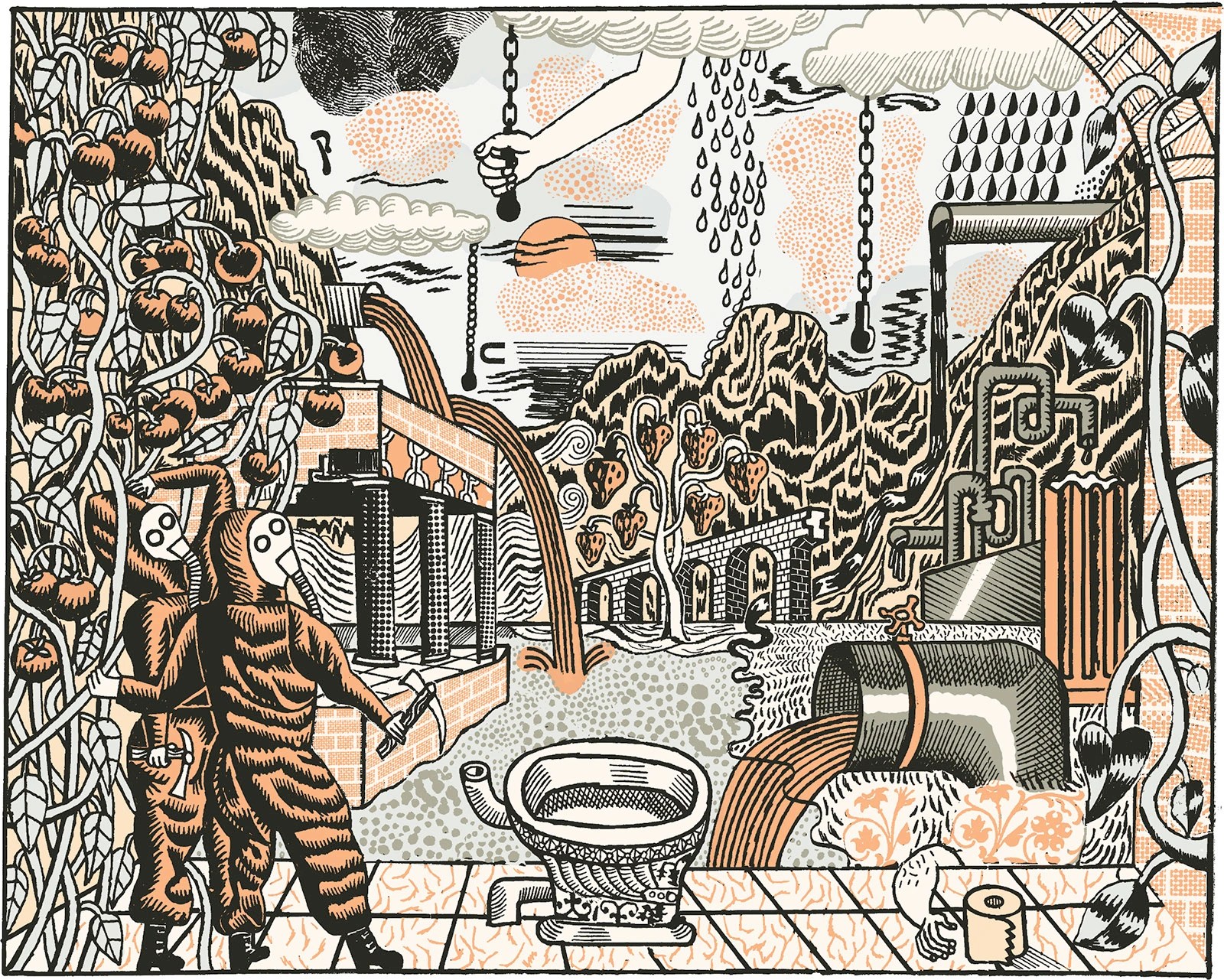
Two crucial and interconnected resources—human feces and arable soil—face crises of mismanagement…
… the problem of how to deal with our “dark matter” has plagued humanity for millennia. As soon as people stopped moving around in pursuit of prey, the stuff began to pile up. Neolithic farmers may have had no idea of germ theory, but they were smart enough to know they didn’t want to live next to—or on top of—their own shit. They dug pits or ditches out in their fields to serve as open-air toilets. As the number of people living in close quarters grew, pits no longer sufficed. People turned to more sophisticated waste-disposal methods, usually involving water.
…
Sewage treatment plants… manage, by and large, to keep raw sewage out of waterways, and this has mostly eliminated outbreaks of cholera as well as typhoid. But the practice of washing nutrients down the drain remains as big an issue as ever.
Of all the nutrients we’re redistributing, probably the most significant is nitrogen. It’s difficult for plants—and, by extension, plant eaters—to obtain nitrogen. In the air, it exists in a form—N2—that most living things can’t utilize. For hundreds of millions of years, plants have relied on specialized bacteria that “fix” nitrogen into a compound they can make use of. When people started farming, they figured out that legume crops, which harbor nitrogen-fixing bacteria in nodules on their roots, replenish soil. Manure and human waste, or “night soil,” also provide nitrogen for plants.
When synthetic fertilizer was invented, in the early twentieth century, the world was suddenly awash in nitrogen. This enabled people to grow a lot more food, which, in turn, enabled them to produce a lot more people, who produced a lot more shit. Via our wastewater treatment plants, we now introduce vast quantities of nitrogen into coastal environments, where it’s wreaking havoc. (Fertilizer runoff also contributes to the problem.)
…
Jo Handelsman, a plant pathologist who runs an interdisciplinary research center at the University of Wisconsin at Madison, is also interested in “dark matter.” Handelsman, however, uses the term to refer to soil. And the problem she’s concerned with is not that we have too much of the stuff, but too little. “The plight of the world’s soils is a silent crisis”… Agriculture requires rich soil, but most modern practices are, unfortunately, terrible for it…
From the estimable Elizabeth Kolbert (@ElizKolbert) and @nybooks: “The Waste Land.”
###
As we go back to basics, we might recall that it was on this date in in 1874 that Lewis H. Latimer received his first patent (U.S. Patent 147,363), for an improved water-closet for railway cars.
Latimer went on to develop an improved process for manufacturing carbon filaments for light bulbs, to write the first book on electric lighting, and to invent an evaporative air conditioner, a forerunner of today’s systems.

“In the attempt to make scientific discoveries, every problem is an opportunity and the more difficult the problem, the greater will be the importance of its solution”*…

(Roughly) Daily is headed into its traditional Holiday hibernation; regular service will begin again very early in the New Year.
It seems appropriate (especially given the travails of this past year) to end the year on a positive and optimistic note, with a post celebrating an extraordinary accomplishment– Science magazine‘s (thus, the AAAS‘) “Breakthrough of the Year” for 2021…
In his 1972 Nobel Prize acceptance speech, American biochemist Christian Anfinsen laid out a vision: One day it would be possible, he said, to predict the 3D structure of any protein merely from its sequence of amino acid building blocks. With hundreds of thousands of proteins in the human body alone, such an advance would have vast applications, offering insights into basic biology and revealing promising new drug targets. Now, after nearly 50 years, researchers have shown that artificial intelligence (AI)-driven software can churn out accurate protein structures by the thousands—an advance that realizes Anfinsen’s dream and is Science’s 2021 Breakthrough of the Year.
AI-powered predictions show proteins finding their shapes: the full story: “Protein structures for all.”
And read Nature‘s profile of the scientist behind the breakthrough: “John Jumper: Protein predictor.”
* E. O. Wilson
###
As we celebrate science, we might send well-connected birthday greetings to Robert Elliot Kahn; he was born on this date in 1938. An electrical engineer and computer scientist, he and his co-creator, Vint Cerf, first proposed the Transmission Control Protocol (TCP) and the Internet Protocol (IP), the fundamental communication protocols at the heart of the Internet. Later, he and Vint, along with fellow computer scientists Lawrence Roberts, Paul Baran, and Leonard Kleinrock, built the ARPANET, the first network to successfully link computers around the country.
Kahn has won the Turing Award, the National Medal of Technology, and the Presidential Medal Of Freedom, among many, many other awards and honors.

You must be logged in to post a comment.