Posts Tagged ‘invention’
“I have not failed. I’ve just found 10,000 ways that won’t work.”*…

Liam Grace-Flood on the near universal comedy of technological failure…
… I’ve always been more interested in the failed inventions that aren’t just paving stones on the road to success. The kind of attempts that are so bad that you have to wonder “are they serious?” – like a nose stylus (pictured above) for using your phone in the bath when your hands get wet.
There are many variations on the idea of ‘failed invention.’ Rube Goldberg machines are overly-complicated contraptions, designed to accomplish simple tasks. Kludges and jugaads are hacky devices assembled from what’s available – usually creating something much weirder than if you started from scratch. There’s a whole genre of life hack TikToks where creators, in the quest to create as much content as possible, don’t stop to ask if what they’re creating makes any sense at all. But I’d say the genre of bad invention with the most nuanced and interesting relationship to failure is Chindogu.
Chindogu is a Japanese word meaning “weird tool.” These (almost) useless inventions might address a challenge, but they also create bigger problems. Iconic Chindogu inventions include chopsticks with a fan attached for cooling hot food and a onesie with mop-like fringe, harnessing the untapped crawling power of your baby to clean the floor. While inventions like these are usually not practical for their intended purpose, they can still be charming, evocative, and funny, and give us something that successful inventions can’t. They offer a moment’s deviation from some prescribed path to success, a pause in the slog of value creation, to allow a moment’s worth of weird joy…
A warm and wonderful appraisal of the innovative spirit (that doubles as a last-minute Holiday gift list): “On Chindogu,” in @the_prepared.
(Image above: source)
* Thomas Edison
###
As we celebrate snafus, we might send well-designed birthday greetings to someone who successfully connected products with users, Walter Dorwin Teague; he was born on this date in 1883. An industrial designer, architect, illustrator, graphic designer, writer, and entrepreneur, he is often called the “Dean of Industrial Design,” a field that he pioneered as a profession in the US, along with Norman Bel Geddes, Raymond Loewy, and Henry Dreyfuss. He is widely known for his exhibition designs during the 1939-40 New York World’s Fair (including the Ford Building), and for his iconic product and package designs, from Eastman Kodak’s Bantam Special to the steel-legged Steinway piano.

“So these are the ropes, The tricks of the trade, The rules of the road”*…

Morgan Housel shares a few thing with which he’s come to terms…
Everyone belongs to a tribe and underestimates how influential that tribe is on their thinking.
Most of what people call “conviction” is a willful disregard for new information that might make you change your mind. That’s when beliefs turn dangerous.
History is driven by surprising events but forecasting is driven by obvious ones.
People learn when they’re surprised. Not when they read the right answer, or are told they’re doing it wrong, but when they experience a gap between expectations and reality.
“Learn enough from history to respect one another’s delusions.” -Will Durant
Your personal experiences make up maybe 0.00000001% of what’s happened in the world but maybe 80% of how you think the world works.
Unsustainable things can last longer than you anticipate.
It’s hard to tell the difference between boldness and recklessness, ambition and greed, contrarian and wrong.
There are two types of information: stuff you’ll still care about in the future, and stuff that matters less and less over time. Long-term vs. expiring knowledge. It’s critical to identify which is which when you come across something new.
Small risks are overblown because they’re easy to talk about, big risks are discounted and ignored because they seem preposterous before they arrive.
You can’t believe in risk without also believing in luck because they are fundamentally the same thing—an acknowledgment that things outside of your control can have a bigger impact on outcomes than anything you do on your own.
Once-in-a-century events happen all the time because lots of unrelated things can go wrong. If there’s a 1% chance of a new disastrous pandemic, a 1% chance of a crippling depression, a 1% chance of a catastrophic flood, a 1% chance of political collapse, and on and on, then the odds that something bad will happen next year – or any year – are … pretty good. It’s why Arnold Toynbee says history is “just one damn thing after another.”
Many more affecting aphorisms at: “Little Rules About Big Things,” from @morganhousel @collabfund.
* “Rules Of The Road,” by Cy Coleman and Caroline Leigh (famously recorded by Tony Bennett and Nat King Cole)
###
As we ponder precepts, we might send prophylactic birthday greetings to Samuel W. Alderson; he was born on this date in 1914. A physicist and engineer of broad accomplishment, Alderson is probably best remembered as the inventor of the crash test dummy. Alderson created his first dummies in 1956 to test jet ejection seats for the military. But with the passage of the Highway Traffic and Motor Vehicle Safety Act in 1966 (on the heels of the stir created by Ralph Nader’s Unsafe at Any Speed), Alderson found a much broader market. (From the first experiments on car safety in the 1930s, cadavers had been used to assess risk and damage; the dummy had obvious advantages.) Alderson continuously improved his dummies, and later branched out to produce medical “phantoms” for simulations– e.g., synthetic wounds that ooze mock blood.

“It is difficult to predict, especially the future”*…

While perfectly accurate prediction is beyond our ken, it is possible to spot indicators– early warning signs or signals– that the world is headed in one direction or another. BBC R&D Futures is an attempt to do exactly that (in the service of building understanding of the impacts that they might have, right down to the artifacts that they might spawn). For example (from a recent “signals” newsletter):
We are in an era of increasing protests
A number of recent studies tracking and understanding protests and demonstrations around the world are seeing a rise in events. One looking at demonstrations between 2006 and 2020 found that “the number of protest movements around the world had more than tripled in less than 15 years. Every region saw an increase, the study found, with some of the largest protest movements ever recorded.”
Common reasons given for protesting were ‘perceived failure of political systems or representation’, inequality, corruption, lack of action over climate change, and the sense that people’s concerns are not being addressed.
- Why is the world protesting so much? A new study claims to have some answers. – The Washington Post
- World Protests | SpringerLink
- Political protests have become more widespread and more frequent | The Economist
- The Age of Mass Protests: Understanding an Escalating Global Trend | Center for Strategic and International Studies
- Global Protest Tracker – Carnegie Endowment for International Peace
Concerned about the future? A useful source of social, economic, technological, environmental, and political dynamics worthy of attention: BBC R&D Futures.
* Niels Bohr
###
As we seek signs, we might recall that it was on this date in 1876 that Melville Bissell patented the first carpet sweeper… one of the innovations (see here, here, e.g.) that revolutionized housekeeping… and with it, modern society.

“Some assembly required”*…

Photographer Todd McLellan disassembles things. As the Smithsonian explains in the web intro to an exhibition of his work…
What makes a watch tick? How does a sewing machine stitch? Where does an iPod get its shuffle? For those who have ever asked questions like these, Things Come Apart is a revelation.
Through extraordinary photographs, disassembled objects and fascinating videos, Things Come Apart reveals the inner workings of common, everyday possessions. Images of dozens of objects explore how things are designed and made and how technology has evolved over time. For example, the individual components of a record player, a Walkman, and an iPod illustrate the technical changes in sound reproduction over the years, and images of the parts of a mechanical and digital watch demonstrate different approaches to timepiece engineering.
As a visual investigation of design and engineering, Things Come Apart also celebrates classic examples of industrial design like the sewing machine, the mechanical pencil, and the telescope. Additionally, the exhibition explores ideas about reuse, repair, and recycling….

More on the exhibit (with examples) at “Things Come Apart” @smithsonian; Even more on McLellan’s website (and at @Todd_McLellan).
* the frequently-encountered qualification in advertising and product packaging
###
As we take it apart, we might recall that it was on this date in 1843 that Charles Thurber was issued the first patent for a typewriter that actually worked. The forerunners of typewriters had been around for some time; the first known patent was issued in England in 1714, but for a machine that never worked and was never manufactured. Thurber’s “printing machine” did work– but was so slow as to be impractical. He patented an improved (but still painfully sluggish) version a few years later… then moved on. Typewriter development continued in other hands, but slowly. It wasn’t until the late 19th century (and the introduction of a QWERTY keyboard design as a standard) that typewriting became a wide-spread practice.

“Mustard: Good only in Dijon”*…
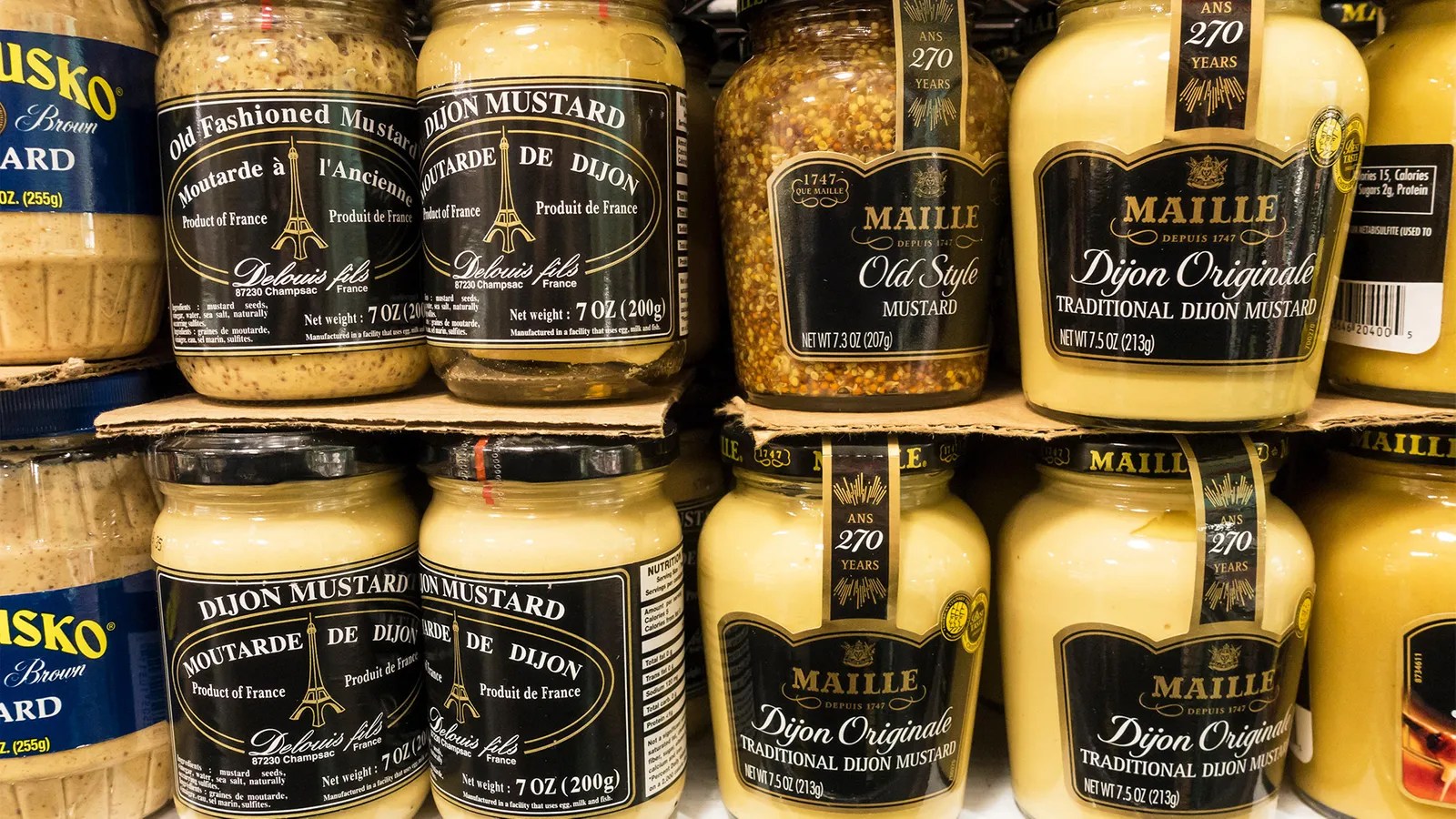
France is facing a widespread dearth of Dijon mustard; Emily Monaco explains…
Take a wander down any condiment aisle in France these days, and you’ll notice a pervasive absence between le mayo and le ketchup. Since this May, France has faced a widespread dearth of Dijon mustard, leading one French resident to advertise two jars for sale to the tune of €6,000 or about £5,000 (since revealed to be merely in jest). The shortage has incited expats (this author included) to not-at-all-jokingly smuggle squeeze bottles of Maille back into the country from places like the US to get their fix, while author and Paris resident David Lebovitz even resorted to hunting his jars down at a local gardening store, of all places.
While French news outlets wasted no time in attributing the shortage to the war in Ukraine, the real story is a whole lot spicier than that.
Omnipresent on French tables, Dijon mustard, made by combining brown mustard seeds with white wine, is a beloved condiment that provides a counterpoint to rich, hearty dishes thanks to its acidity and heat. It’s the perfect accompaniment to a slice of crisp-skinned roast chicken, the ideal way to jazz up a simple ham-and-butter sandwich and an essential ingredient in homemade mayonnaise.
That the condiment is so anchored in France’s Burgundy region – of which Dijon is the capital city – is thanks to the historical co-planting of brown mustard seeds with the region’s renowned grapevines, a practice introduced by the Ancient Romans to provide the vines with essential nutrients like phosphorous. Monks continued to cultivate mustard in this fashion for centuries, and, in 1752, the link between Dijon and mustard was cemented thanks to Dijon local Jean Naigeon, who married the seeds, not with vinegar, but with verjuice – the juice of unripe wine grapes historically used to add a pleasantly sour flavour to recipes in regions inhospitable to citrus…
But the truth is that despite its historical link the to the region, Dijon mustard has been delocalised for quite some time.
After Burgundian farmers largely abandoned mustard cultivation in favour of higher-paying crops decades ago, moutardiers (mustard makers) began looking further afield for the tiny seed at the root of the condiment that launched 1,000 “Pardon me, sir” jokes. Their mustard seed needs were chiefly met by Canada, which produces about 80% of the world’s supply. But this winter, Canadian-grown mustard also dried up, when, after several years of declining production had reduced stores, dry summer weather obliterated the Canadian crop, sending mustard seed prices skyrocketing threefold.
Though the shortage was not caused by the Russian invasion of Ukraine, it was exacerbated by it, impacting Dijon mustard makers “indirectly”, according to Luc Vandermaesen, CEO of mustard producer Reine de Dijon. Rather than the brown seeds required for Dijon, Ukraine predominantly produces the white variety used in yellow and English mustard. Given the conflict, producers less tied to specific mustard varieties turned to Canada’s already meagre supply, intensifying the shortage.
Inadvertently, this all shed new light on the discrepancy between the name “Dijon mustard” and where it’s made. After all, unlike Champagne or Roquefort, the “Dijon” in Dijon mustard refers to a specific recipe and not to a geographic region protected by an Appellation d’Origine Contrôlée (AOC) or Appellation d’Origine Protégée (AOP) designation, which regulate products like wine, cheese and even lentils with an iron fist…
A spicy tale: “Why there’s no ‘Dijon’ in Dijon mustard,” from @emily_in_france in @BBC_Travel.
* Gustave Flaubert
###
As we spread it thin, we might recall that it was on this date in 1795 that the Reverend Samuel Henshall was awarded the first patent for a corkscrew.
His idea was to incorporate a button between the shank & the worm. Its purpose was to compress and turn the cork once the worm was fully inserted, thus breaking any bond that might exist between cork and bottle.
Henshall’s improvement to the simple direct pull corkscrew was no doubt a winner. His design
Antique & Vintage Corkscrew Guide
was produced well into the 20th century in a vast array of different styles…


You must be logged in to post a comment.