Posts Tagged ‘invention’
“How we spend our days is, of course, how we spend our lives”*…

On the history and impact of a seemingly simple service…
If I was to ask you what was the most important invention of the 20th century, you might mention the car, the television, the computer, or the internet. But there’s another invention that had such a huge impact on culture and society that people would organize their lives around it, and it drove the growth of multi-billion dollar industries. Despite this, most of us wouldn’t think of it as an invention at all, as it seems to have always just been there. So here’s a brief history of one of the most important overlooked inventions of modern times: the TV schedule…
The TV schedule organized the attention of millions of people at the same time, sharing the same experience, whether it was Richard Nixon sweating in a presidential debate, Neil Armstrong stepping foot onto the moon, or finding out who shot JR. These live, synchronous events created a kind of public sphere at a scale that had never been seen before, and we’re unlikely to see again. Sports are the only TV events that get close—on the list of most-watched US TV programs of all time, the only entries from the 2000s are Superbowls.
For nearly a century, a simple list, based around the hours of the day, structured the daily habits of millions of people, shaped the careers of politicians and celebrities, and powered a multi-billion dollar advertising industry. As we spend less time watching live TV, and more time on digital platforms, that power is now passing from the TV schedule to another way of organising our attention—algorithmic streams…
Entertainment, technology, and shared experiences: “The TV Schedule Edition,” from Why Is This Interesting? (@WhyInteresting), by Matt Locke (@matlock).
(Image above: source)
* Annie Dillard
###
As we tune in, we might recall that it was on this date in 1980 that Magnum, P. I. premiered on CBS; consistently highly-rated and the recipient of numerous Emmy and Golden Globe nominations and awards, it ran until 1988, and made a star of its lead, Tom Selleck.

“Why has our age surrendered so easily to the controllers, the manipulators, the conditioners of an authoritarian technics?”*…

Half a century ago, Lewis Mumford developed a concept that explains why we trade autonomy for convenience…
… Surveying the state of the high-tech life, it is tempting to ponder how it got so bad, while simultaneously forgetting what it was that initially convinced one to hastily click “I agree” on the terms of service. Before certain social media platforms became foul-smelling swamps of conspiratorial misinformation, many of us joined them for what seemed like good reasons; before sighing at the speed with which their batteries die, smartphone owners were once awed by these devices: before grumbling that there was nothing worth watching, viewers were astounded by how much streaming content was available at one’s fingertips. Overwhelmed by the way today’s tech seems to be burying us in the bad, it’s easy to forget the extent to which tech won us over by offering us a share in the good — or to be more precise, in “the goods.”
Nearly 50 years ago, long before smartphones and social media, the social critic Lewis Mumford put a name to the way that complex technological systems offer a share in their benefits in exchange for compliance. He called it a “bribe.” With this label, Mumford sought to acknowledge the genuine plentitude that technological systems make available to many people, while emphasizing that this is not an offer of a gift but of a deal. Surrender to the power of complex technological systems — allow them to oversee, track, quantify, guide, manipulate, grade, nudge, and surveil you — and the system will offer you back an appealing share in its spoils. What is good for the growth of the technological system is presented as also being good for the individual, and as proof of this, here is something new and shiny. Sure, that shiny new thing is keeping tabs on you (and feeding all of that information back to the larger technological system), but it also lets you do things you genuinely could not do before. For a bribe to be accepted it needs to promise something truly enticing, and Mumford, in his essay “Authoritarian and Democratic Technics,” acknowledged that “the bargain we are being asked to ratify takes the form of a magnificent bribe.” The danger, however, was that “once one opts for the system no further choice remains.”
For Mumford, the bribe was not primarily about getting people into the habit of buying new gadgets and machines. Rather it was about incorporating people into a world that complex technological systems were remaking in their own image. Anticipating resistance, the bribe meets people not with the boot heel, but with the gift subscription.
The bribe is a discomforting concept. It asks us to consider the ways the things we purchase wind up buying us off, it asks us to see how taking that first bribe makes it easier to take the next one, and, even as it pushes us to reflect on our own complicity, it reminds us of the ways technological systems eliminate their alternatives. Writing about the bribe decades ago, Mumford was trying to sound the alarm, as he put it: “This is not a prediction of what will happen, but a warning against what may happen.” As with all of his glum predictions, it was one that Mumford hoped to be proven wrong about. Yet as one scrolls between reviews of the latest smartphone, revelations about the latest misdeeds of some massive tech company, and commentary about the way we have become so reliant on these systems that we cannot seriously speak about simply turning them off — it seems clear that what Mumford warned “may happen” has indeed happened…
Eminently worth reading in full: “The Magnificent Bribe,” by Zachary Loeb in @_reallifemag.
As to (some of) the modern implications of that bargain, see also Shoshana Zuboff‘s: “You Are the Object of a Secret Extraction Operation.”
As we move into the third decade of the 21st century, surveillance capitalism is the dominant economic institution of our time. In the absence of countervailing law, this system successfully mediates nearly every aspect of human engagement with digital information. The promise of the surveillance dividend now draws surveillance economics into the “normal” economy, from insurance, retail, banking and finance to agriculture, automobiles, education, health care and more. Today all apps and software, no matter how benign they appear, are designed to maximize data collection.
Historically, great concentrations of corporate power were associated with economic harms. But when human data are the raw material and predictions of human behavior are the product, then the harms are social rather than economic. The difficulty is that these novel harms are typically understood as separate, even unrelated, problems, which makes them impossible to solve. Instead, each new stage of harm creates the conditions for the next stage…
And resonantly: “AI-tocracy” a working paper from NBER that links the development of artificial intelligence with the interests of autocracies: from the abstract:
Can frontier innovation be sustained under autocracy? We argue that innovation and autocracy can be mutually reinforcing when: (i) the new technology bolsters the autocrat’s power; and (ii) the autocrat’s demand for the technology stimulates further innovation in applications beyond those benefiting it directly. We test for such a mutually reinforcing relationship in the context of facial recognition AI in China. To do so, we gather comprehensive data on AI firms and government procurement contracts, as well as on social unrest across China during the last decade. We first show that autocrats benefit from AI: local unrest leads to greater government procurement of facial recognition AI, and increased AI procurement suppresses subsequent unrest. We then show that AI innovation benefits from autocrats’ suppression of unrest: the contracted AI firms innovate more both for the government and commercial markets. Taken together, these results suggest the possibility of sustained AI innovation under the Chinese regime: AI innovation entrenches the regime, and the regime’s investment in AI for political control stimulates further frontier innovation.
(And, Anne Applebaum warns, “The Bad Guys Are Winning.”)
* “Why has our age surrendered so easily to the controllers, the manipulators, the conditioners of an authoritarian technics? The answer to this question is both paradoxical and ironic. Present day technics differs from that of the overtly brutal, half-baked authoritarian systems of the past in one highly favorable particular: it has accepted the basic principle of democracy, that every member of society should have a share in its goods. By progressively fulfilling this part of the democratic promise, our system has achieved a hold over the whole community that threatens to wipe out every other vestige of democracy.
The bargain we are being asked to ratify takes the form of a magnificent bribe. Under the democratic-authoritarian social contract, each member of the community may claim every material advantage, every intellectual and emotional stimulus he may desire, in quantities hardly available hitherto even for a restricted minority: food, housing, swift transportation, instantaneous communication, medical care, entertainment, education. But on one condition: that one must not merely ask for nothing that the system does not provide, but likewise agree to take everything offered, duly processed and fabricated, homogenized and equalized, in the precise quantities that the system, rather than the person, requires. Once one opts for the system no further choice remains. In a word, if one surrenders one’s life at source, authoritarian technics will give back as much of it as can be mechanically graded, quantitatively multiplied, collectively manipulated and magnified.”
– Lewis Mumford in “Authoritarian and Democratic Technics,” via @LMSacasas
###
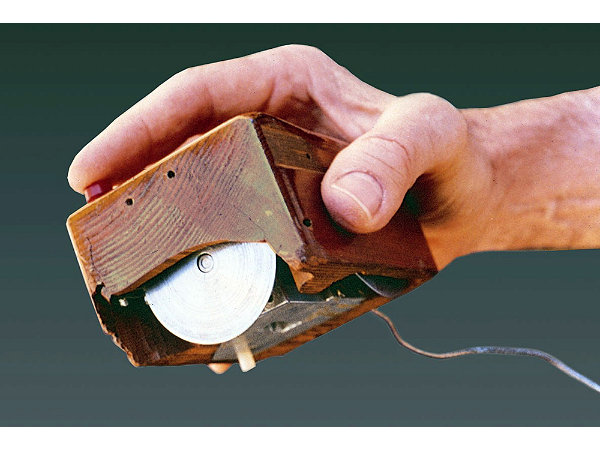
As we untangle user agreements, we might recall that it was on this date in 1970 that Douglas Engelbart (see here, here, and here) was granted a patent (US No. 3,541,541) on the “X-Y Position Indicator for a Display System,” the world’s first prototype computer mouse– a wooden block containing the tracking apparatus, with a single button attached.

“The very existence of flamethrowers proves that sometime, somewhere, someone said to themselves, ‘You know, I want to set those people over there on fire, but I’m just not close enough to get the job done”*…

Inventions so fundamentally important that we take them for granted…
You might find it impossible to imagine a world without your smartphone, or have trouble remembering a time when Wi-Fi wasn’t everywhere, but many of today’s most relied-upon technologies would not have been possible—or even dreamed of—if it weren’t for the game-changing inventions that came before them. And while it’s easy to take many of the marvels of design and engineering we interact with on a daily basis for granted—think toilets, seat belts, and suspension bridges—it’s just as easy to overlook how a handful of more surprising inventions, like the Super Soaker or the pizza saver, have affected the world around us…
For example…
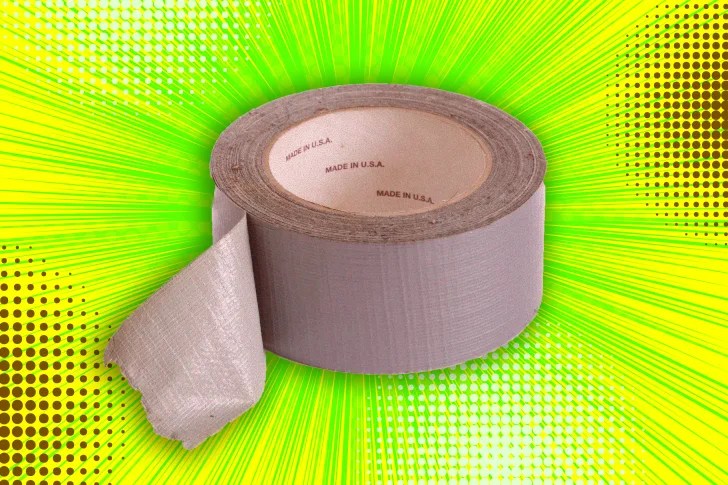
Duct tape was the brainchild of Vesta Stoudt, an Illinois mom whose two sons were in the Navy. Stoudt worked at Green River Ordnance Plant packing and inspecting boxes of ammunition. The boxes were sealed with paper tape, dipped in wax, and had a tab to open them. Stoudt noticed that the boxes had a flaw: The tape was flimsy and tabs often tore off, which meant that soldiers couldn’t quickly open the boxes when they were under fire. Why not create a cloth-based waterproof tape to seal the boxes? She asked her supervisors, but they weren’t supportive, so she escalated the matter … straight to President Franklin Delano Roosevelt. “I suggested we use a strong cloth tape to close seams, and make tab of same,” she wrote. “It worked fine, I showed it to different government inspectors they said it was all right, but I could never get them to change tape.”
The president sent her letter to the War Production Board, her idea was approved, and the rest is history. Duct tape has been a quick fix for everyone from your average joe to physicists (who use it on their particle accelerators) to astronauts (duct tape helped them make repairs on the moon). When the three crewmembers of Apollo 13 were forced to transfer to the lunar module, duct tape helped them survive—according to Northrop Grumman, the vessel was designed to hold two people for 36 hours, but after the accident, had to hold three for over 86 hours. They used the adhesive (along with cardboard, plastic bags, and space suit components) to adapt their square carbon dioxide filters to the module’s round holes. Jerry Woodfill, a NASA engineer who assisted the team from the ground, later told Universe Today, “Of course … the solution to every conceivable knotty problem has got to be duct tape! And so it was.”
Blood banks, barcodes and beyond: “The Stories Behind 20 Inventions That Changed the World.”
* George Carlin
###
As we exalt ingenuity, we might spare a thought for one of the protagonists in the story above, Nils Bohlin; he died on this date in 2002 (though some sources suggest that he passed on September 21 of that year). An engineer who had worked on avaition ejection seats (and restraints) before joining Volvo, he developed and patented the three-point lap and shoulder seatbelt– considered one of the most important innovations in automobile safety. Volvo introduced the seatbelts in 1959– then made the design freely available to other car manufacturers to save more lives.
In 1974, Bohlin was awarded The Ralph Isbrandt Automotive Safety Engineering Award, and in 1989 he was inducted into the Hall of Fame for Safety and Health. He received a gold medal from Royal Swedish Academy of Engineering Sciences in 1995 and in 1999, was inducted into the Automotive Hall of Fame. He retired from Volvo as Senior Engineer in 1985 and was posthumously inducted into the National Inventors Hall of Fame.

“Why should we look to the past in order to prepare for the future? Because there is nowhere else to look.”*…

With a tip of the hat to James Burke…
European civilization is built on ham and cheese, which allowed protein to be stored throughout the icy winters.
Without this, urban societies in most of central Europe would simply not have been possible.
This is also why we have hardback books. Here’s why…
Ham, cheese, snails, underwear, Jesus, spectacles– the ingredients in the birth of the book as we know it: a wonderful thread from the wonderful Incunabula (@incunabula) TotH to @inevernu.
* James Burke, Connections
###
As we ponder precedents, we might send inventive birthday greetings to Marvin P. Middlemark; he was born on this date in 1919.
Old Westbury tinkerer Marvin Middlemark invented the “rabbit ears” TV antenna in 1953, helping millions of Americans get the fuzz, or some of it, out of their pre-cable television reception. Though not completely original – the design was based on the dipole antenna invented by Heinrich Hertz in 1886 – the update made Middlemark a wealthy man.
Middlemark was awarded 62 patents in his lifetime, but his other inventions, including a water-powered potato peeler and a technique for resuscitating gone-soft tennis balls, didn’t muster the same commercial appeal. He sold his antenna company, All Channel Products Corp., in the mid-1960s, parked the proceeds in municipal bonds, and retired to his wooded 12-acre estate, where he kept miniature horses, collected stained glass windows and housed a pet chimpanzee named Josie who liked to finish unwary guests’ drinks.
Middlemark died in 1989, leaving behind a $5 million fortune and, inexplicably, 1,000 pairs of woolen gloves. His son, second wife and her son from another marriage fought over the will for years. Highlights: Planted drugs and weapons, death threats and at least one choking attempt. And all that was by the widow. The stepson, a prominent North Hempstead political operative, pleaded guilty to perjury and was sentenced to two years in jail.
“Every lawyer has read ‘Bleak House,’ ” Neal Johnston, an attorney for Middlemark’s son said at the time. “This is as close as I’ve come to living it.”…
Long Island Press

“I propose to build for eternity”*…

Sent back in time 600 years and tasked with building the world’s largest dome, how would most of us fare? Most of us, of course, are not trained architects or engineers, but then, neither was Filippo Brunelleschi. Known at the time as a goldsmith, Brunelleschi ended up winning the commission to build just such a colossal dome atop Florence’s Cattedrale di Santa Maria del Fiore, which itself had already been under construction for well over a century. The year was 1418, the dawn of the Italian Renaissance, but a break with medieval building styles had already been made, not least in the rejection of the kind of flying buttresses that had held up the stone ceilings of previous cathedrals. Brunelleschi had thus not just to build an unprecedentedly large dome, in accordance with a design drawn up 122 years earlier, but also to come up with the technology required to do so.
“He invented an ox-driven hoist that brought the tremendously heavy stones up to the level of construction,” architect David Wildman tells HowStuffWorks. Noticing that “marble for the project was being damaged as it was unloaded off of boats,” he also “invented an amphibious boat that could be used on land to transport the large pieces of marble to the cathedral.”
These and other new devices were employed in service of an ingenious structure using not just one dome but two, the smaller inner one reinforced with hoops of stone and chain. Built in brick — the formula for the concrete used in the Pantheon having been lost, like so much ancient Roman knowledge — the dome took sixteen years in total, which constituted the final stage of the Cattedrale di Santa Maria del Fiore’s generations-long construction.
Brunelleschi’s masterpiece, still the largest masonry dome in the world, has yet to quite yield all of its secrets: “There is still some mystery as to how all of the components of the dome connect with each other,” as Wildman puts it, thanks to Brunelleschi’s vigilance about concealing the nature of his techniques throughout the project. But you can see some of the current theories visualized (and, in a shamelessly fake Italian accent, hear them explained) in the National Geographic video [below]. However he did it, Brunelleschi ensured that every part of his structure fit together perfectly — and that it would hold up six centuries later, when we can look at it and see not just an impressive church, but the beginning of the Renaissance itself…
For more on the dome, see Ross King’s marvelous 2013 book, Brunelleschi’s Dome: How a Renaissance Genius Reinvented Architecture.
And for more on Brunelleschi— whose other accomplishments include the first precise system of linear perspective, which revolutionized painting and opened the way for the naturalistic styles of Renaissance art– see here.
* Filippo Brunelleschi
###
As we go big, we might recall that it was on this date in 330 that Roman Emperor Constantine the Great consecrated Constantinople (on the site of what had been the ancient city of Byzantium; today, Istanbul). Constantine identified the site of Byzantium as a place where an emperor could sit, readily defended, with easy access to the Danube or the Euphrates frontiers, his court supplied from the rich gardens and sophisticated workshops of Roman Asia, his treasuries filled by the wealthiest provinces of the Empire.
The city became famous for its architectural masterpieces, such as Hagia Sophia, the cathedral of the Eastern Orthodox Church. Built by the eastern Roman emperor Justinian I as the Christian cathedral of Constantinople for the state church of the Roman Empire between 532 and 537, the church was then the world’s largest interior space and among the first to employ a fully pendentive dome. It is considered the epitome of Byzantine architecture and is said to have “changed the history of architecture”… It set the bar for Brunelleschi.

You must be logged in to post a comment.