Posts Tagged ‘Internet’
“Cyberspace undeniably reflects some form of geography”*…

Your correspondent in stepping again into the rapids, so (Roughly) Daily is going into a short hiatus. Regular service should resume on or around Nov 4. Here, something to enjoy in the meantime…
Our old friend Neal Agarwal has created an interactive museum of sorts, a stroll through the history of the internet, as manifest in the artifacts of important “firsts”– the first smiley, the first MP3, the first “LOL.” the first live-steamed concert, and so, so much more…
Browse through Internet Artifacts, from @nealagarwal.
* Sandra Day O’Connor
###
As we touch the exhibits, we might send imperial birthday greetings to William Henry Gates III; he was born on this date in 1955. Gates is, of course, best known for co-founding the technology giant Microsoft, along with his childhood friend Paul Allen. He led the company from its packaged software beginnings onto the internet. After leaving the company in 2008, he founded several other companies, including BEN, Cascade Investment, TerraPower, bgC3, and Breakthrough Energy; but he has increasingly turned his attention to philanthropy.

“We are as gods and might as well get good at it”*…

In 1968, Stewart Brand and small group of colleagues published the first Whole Earth Catalog, then followed it over the years with a series of updates, spin-offs, and sequels. An at-the-time unprecedented marriage of counterculture magazine and product catalog, it (and its successors) have been enormously influential. Now, as Long Now‘s Jacob Kupperman reports, the entire run of Whole Earth publications is freely available online…
When the Whole Earth Catalog arrived in the Fall of 01968, it came bearing a simple, epochal label: “Access to Tools.” As its editor and Long Now Co-founder Stewart Brand wrote in the introduction to that first edition, the goal was for the Catalog to serve as an “evaluation and access device” for tools that empowered its readers “to conduct his own education, find his own inspiration, shape his own environment, and share his adventure with whoever is interested.”
The key word in all of that idealistic declaration of purpose was “access.” The Whole Earth Catalog did not intend to directly grant its readers this knowledge, wisdom, and mastery, but to provide a kaleidoscopic array of gateways from which they could attempt to find it themselves.
Yet for years, access to the Whole Earth Catalog itself has been difficult. 55 years on from the first publication of the Catalog, it mostly lives on in the interstices — as a symbol of a vibrant countercultural history and an inspiration for writers, designers, and technologists, but less so as an actual set of catalogs that you can read. The Catalog is not lost media per se — copies can be found in libraries, archives, and personal collections across the world — but accessing its trove of information is no longer as easy as it was in its heyday.
That is, until now.
on the 55th anniversary of the publication of the original Whole Earth Catalog, Gray Area and the Internet Archive have made the Catalog freely available online via the Whole Earth Index, a website bringing together more than 130 Whole Earth Catalog-related publications, ranging from some of the earliest Catalogs published in the late 01960s and early 01970s to 02002 issues of Whole Earth Magazine.
Within the site’s grid of publications rests a cornucopia of writing and curation, from in-depth looks at space colonies to ecological analyses of the insurance industry to reporting on the state of the global teenager at the turn of the 01990s. The Whole Earth Index is a work of love, a noncommercial enterprise designed, as project lead and Gray Area Executive Director Barry Threw told Long Now Ideas, to “allow us to reflect on how we got to where we are and regain some of that connection to the countercultural world” of the Bay Area of the 01960s and 01970s.
…
For the people who helped make the Whole Earth Catalog and its descendants, the Whole Earth Index is in many ways a dream come true. Long Now Board Member Kevin Kelly, who wrote for, edited, and led the CoEvolution Quarterly, the Whole Earth Review, and later editions of the Whole Earth Catalog, told us that he found “the interface to this historic collection to be as good, maybe even better, as reading the original paper artifacts,” adding that he’d “been giddy with delight in how satisfying this archive is.” The project’s model of “instant access from your home, for free!”, Kelly noted, was something that the team behind the Whole Earth Catalog could only dream of when they began their work.
The open-ended design of the Whole Earth Index is intended as a sort of provocation towards future works — a message and invitation in the spirit of the original catalog’s epochal claim that “we are as gods and might as well get good at it.” The tens of thousands of scanned pages will live on the servers of the Internet Archive — as good a place as any to try and stave off a Digital Dark Age — but the ideas of the Whole Earth Catalog and its heirs will always live among those of us who read it and access its tools. What will you do with them?
The Whole Earth Catalog and its descendants are newly available online through the Whole Earth Index: “The Lasting Whole Earth Catalog,” from @Jacobkupp and @longnow.
* Stewart Brand, in the “Statement of Purpose” in the first Whole Earth Catalog
###
As we treasure tools, we might spare a thought for a man whose work kicked in about the same time as the Whole Earth Catalog– and intersected with it in myriad ways (e.g., The WELL), Jon Postel; he died on this date in 1998. A computer scientist, he played a pivotal role in creating and administering the Internet. As a graduate student in the late 1960s, he was instrumental in developing ARPANET, the forerunner of the internet. He is known principally for being the Editor of the Request for Comment (RFC) document series from which internet standards emerged, for Simple Mail Transfer Protocol (SMTP), and for founding and administering the Internet Assigned Numbers Authority (IANA) until his death.
During his lifetime he was referred to as the “god of the Internet” for his comprehensive influence; Postel himself noted that this “compliment” came with a barb, the suggestion that he should be replaced by a “professional,” and responded with typical self-effacing matter-of-factness: “Of course, there isn’t any ‘God of the Internet.’ The Internet works because a lot of people cooperate to do things together.”

“Of course there’s a lot of knowledge in universities: the freshmen bring a little in; the seniors don’t take much away, so knowledge sort of accumulates”*…

Professor Paul Musgrave on the wacky world of university fundraising…
I would like you to buy me a chair. Not just any chair: an endowed chair.
Let me explain.
Universities have strange business models. The legendary University of California president Clark Kerr once quipped that their functions were “To provide sex for the students, sports for the alumni, and parking for the faculty.” These days, the first is laundered for public consumption as “the student experience” and the third is a cost center (yes, many to most professors have to pay, rather a lot, for their parking tags). (The second remains unchanged.)
You can tell that Kerr was president during a time of lavish support because he didn’t include the other function of a university: to provide naming opportunities for donors.
…
Presidents, chancellors, and provosts seek to finagle gifts because the core business of universities—providing credits to students in exchange for tuition—is both volatile and insufficient to meet the boundless ambitions of administrators and faculty alike. (Faculty might protest that their ambitions are quite modest, as they include merely limitless research budgets and infinite releases from course time—but other than that, they ask only for cost of living adjustments as well as regular salary increases.) Trustees expect presidents to bring in new buildings and new chairs; presidents expect trustees to help dun their friends and acquaintances for donations. The incentives even trickle down to deans, directors, and chairs, all of whom live with increasingly austere baseline budgets and a concomitant incentive to find and cultivate donors to expand, or even just support, their operations.
It’s easy, and wrong, for faculty to be cynical about this. First, these operations reflect the gloriously incongruous medieval nature of the university. Higher education in its upper reaches resembles medieval monasteries, and such monasteries provided not just seclusion and sanctity for their initiates but the possibility of the purchase of virtue for the wealthy. So, too, do universities offer grateful alumni and those sentimental about the generation of knowledge opportunities to turn worldly wealth into tax-deductible noblesse oblige.
Second, donors are the customers for the other product of the university: the social proof of good works. Universities offer donors solicitous for the future of the less fortunate opportunities to subsidize tuition, and they offer donors more interested in the benefits of knowledge the opportunity to subsidize research. The reward comes in some combination of the knowledge that such works are being done and the fact that the donor’s name will be associated with it. (Few large university buildings are named the Anonymous Center for Cancer Research.)
…
The bar for giving continues to rise. Nine-figure gifts were once unheard of; nowadays, they are striking but no longer unprecedented. For such a sum you can have a constituent college named for yourself. The next frontier must be the billion, or multi-billion, dollar gift. For that level, of course, the reward would have to be commensurate. Given that Harvard was named for a donor who left some books and a few hundred pounds to his eponymous university, one wonders whether someone in Harvard’s charitable receiving arm hasn’t calculated how much it would cost to become, say, the Zuckerberg-Harvard University. (I would wager that an earnest offer of $10 billion would at least raise the issue.)…
[There follows a price list for endowed/named Chairs at different universities, and an analysis of their economics. The author suggest that a chair for him would run $2.5-3 million…]
Fascinating: “Buy Me a Chair,” from @profmusgrave.
* A. Lawrence Lowell (legal scholar and President of Harvard University from 1909 to 1933)
###
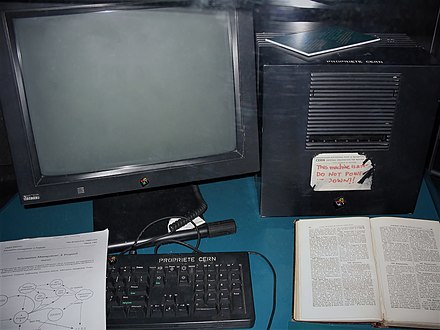
As we dig deep, we might recall that it was on this date in 1991 that the World Wide Web was introduced to the world at large.
In 1989, Tim Berners-Lee (now Sir Tim) proposed the system to his colleagues at CERN. He got a working system implemented by the end of 1990, including a browser called WorldWideWeb (which became the name of the project and of the network) and an HTTP server running at CERN. As part of that development, he defined the first version of the HTTP protocol, the basic URL syntax, and implicitly made HTML the primary document format.
The technology was released outside CERN to other research institutions starting in January 1991, and then– with the publication of this (likely the first public) web page— to the whole Internet 32 years ago today. Within the next two years, there were 50 websites created. (Today, while it is understood that the number of active sites fluctuates, the total is estimated at over 1.5 billion.)
“Good design’s not about what medium you’re working in. It’s about thinking hard about what you want to do and what you have to work with before you start.”*…

From the team at Readymag, a project exploring the impact of women in design (and calling attention to the ongoing gender imbalance in the design industry). For example…
Susan Kare [pictured above] is famous for designing Apple’s Macintosh interface elements, icons and typefaces in the 1980s, as well as a number of other pixel-based graphics for early computers. She was one of the key figures in the PC usability revolution initiated by Steve Jobs at Apple. Kare is often referred to as “the woman who gave the Macintosh a smile,” for designing the original Happy Mac icon…
19 others at “Designing women,” from @readymag.
More on @SusanKare here.
###
As we give credit where credit is due, we might recall that it was on this date in 1985 that the Advanced Research Projects Agency (ARPA, later DARPA) opened internet domains for registration. Symbolics Computer Corporation was the first out of the gate with Symbolics.com. The company used the website to sell specialized computers running the programming language Lisp. (Symbolics initially meant these machines to develop artificial intelligence but were a little ahead of their time; they later adapted them for other uses.)

“No man is an island, entire of itself; every man is a piece of the continent, a part of the main”*…
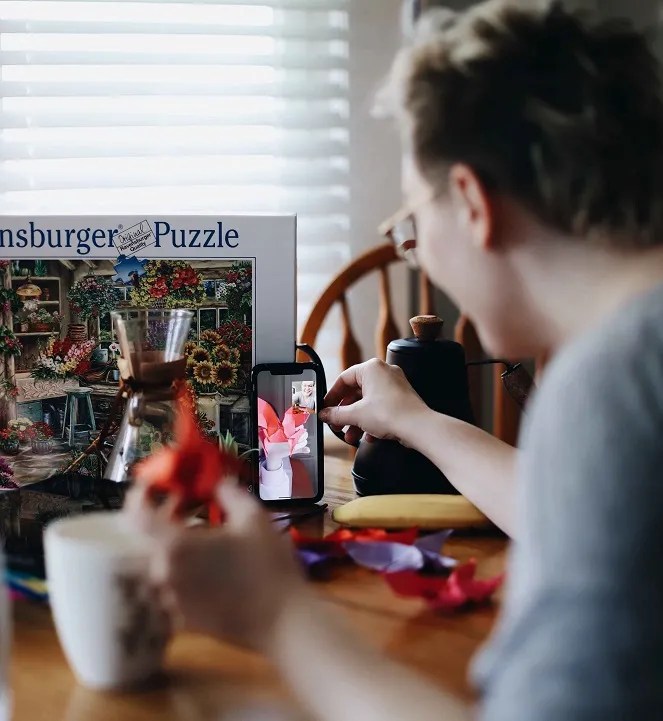
But in what does the “continent”– our community– consist? Further to yesterday’s piece on Epicureanism, Noah Smith argues that the internet has changed what “community” means…
… I think the kind of communities we inhabit has simply changed. In the past, our communities were primarily horizontal — they were simply the people we lived close to on the surface of the Earth. Increasingly, though, new technology has enabled us to construct communities that I’ve decided to call vertical — groups of people united by identities, interests, and values rather than by physical proximity… for most of history, most of the people you interacted with most of the time were the people who lived near to you — your horizontal community.
Horizontal communities can often be stifling and repressive, because they impose community norms on people with a diverse array of occupations, temperaments, and backgrounds. Sinclair Lewis’ novel Main Street is a great depiction of the ever-present, crushing conformity pressure of small American towns in the 1910s. But that social pressure was nothing compared to the pogroms, inquisitions, and genocides that enforced religious, cultural, and racial homogeneity in many of the world’s horizontal communities — and which still do, in some parts of the world.
When the people around you pressure you to be the same as them, you can use exit, voice, or loyalty — you can knuckle under and conform, you can fight back and rebel, or you can simply leave and find some place that you fit in better. A lot of immigration to the U.S. was driven by misfits looking for communities where they didn’t stick out as much. In the latter half of the 20th century, Americans themselves sorted into different parts of the country in order to create pockets of local political homogeneity.
In fact, our use of the word “community” to describe racial, religious, and sexuality groups is probably a relic of an ugly pattern of history, in which minorities were forced to live in circumscribed, segregated areas — Chinatowns, ghettos, the Castro in San Francisco — either by law, or by mass violence that made them unwelcome elsewhere…
But then the internet came along, and everything changed. Suddenly we stopped being isolated and started being social again, through the windows of our laptop screens and phone screens. There was a whole world of human interaction waiting there for us — forums, social media feeds, chat apps, online games, and so on. Suddenly we were surrounded by people all the time — or at least, their written words, and perhaps once in a while their pictures or videos or voices.
Constant internet usage allowed us to organize a far greater percentage of our human interaction around vertical communities. It let us find the people we identified with and interact with them, rather than being forced to interact with whoever was close to us on the map. We could surround ourselves with other anime fans, or other Muslims, or other economists, or other trans people — and we did. What were once notional bonds of connection that existed mostly in our minds became Facebook groups and subreddits and loose networks of Twitter contacts. And those spaces developed their own norms, rules, customs, and institutions, because now, thanks to the internet, it was easy to do that…
The identity-based “communities” that people talk about are thus no longer simply shorthand for a notion of cultural or political affinity with distant people, or for a fading memory of segregated neighborhoods. They’re thriving online verticals — archipelagos of online spaces where people can go to talk about what it means to be gay, or Jewish, or Pakistani. And like the small towns of Sinclair Lewis’ day, these vertical communities have the ability to use social ostracism to punish those who deviate from consensus norms and political objectives.
At the same time, horizontal communities didn’t completely vanish. We still educate our children in physical space (more or less), meaning we still have to deal with other children’s parents in a local community. Local government policies rule many of the aspects of our lives that are still offline — food, public safety, housing, transport — and this means we have to go to city planning meetings and school board meetings and various other community forums to hash out our differences with people who don’t share our interests or our identities. We now live in a world where our communities exist in three dimensions — the familiar hodgepodge of local humanity in two dimensions, and our self-sorted online spaces in a third.
And this dichotomy presents an enormous challenge to our institutions… for now and for the foreseeable future, our public goods are provided locally, but our social interaction happens in the cloud. In theory, this could be a dangerous recipe…
Eminently worth reading in full: “Vertical Communities” from @Noahpinion.
* John Donne
###
As we find our folks, we might recall that it was on this date in 1933 that The Lone Ranger debuted on Detroit’s WXYZ radio station. Created and written by station-owner George Trendle and Fran Striker (who went on to create the Green Hornet and Sgt. Preston of the Yukon), they aimed create an American version of Zorro. Though (or perhaps because) they worked with no real knowledge of Texas in the period, their creation became an American icon, succeeding on radio, television, in comic books, film shorts, feature films, books, and newspaper strips.

You must be logged in to post a comment.