Posts Tagged ‘health’
“24 hours in a day, 24 beers in a case. Coincidence?”*…

Social distancing makes a soul thirsty– and as the Journal of the American Medical Association reports, that has had consequences…
Alcohol consumption has substantially increased during the COVID-19 pandemic… We examined national changes in waiting list registration and liver transplantation for ALD and the association with alcohol sales during the COVID-19 pandemic. We hypothesized that waiting list registrations and deceased donor liver transplants (DDLTs) for alcoholic hepatitis (AH), which can develop after a short period of alcohol misuse, would disproportionately rise…
This cross-sectional study found that waiting list registrations and DDLTs for AH increased significantly during COVID-19, exceeding the volumes forecasted by pre–COVID-19 trends by more than 50%, whereas trends for AC and non-ALD remained unchanged. While we cannot confirm causality, this disproportionate increase in association with increasing alcohol sales may indicate a relationship with known increases in alcohol misuse during COVID-19. Since less than 6% of patients with severe AH are listed for transplantation, increasing waiting list volume during COVID-19 represents a small fraction of the increase in AH, a preventable disease with 6-month mortality up to 70%.
Pandemic drinking is up– way up. So, it turns out, is serious liver disease: “Association of COVID-19 With New Waiting List Registrations and Liver Transplantation for Alcoholic Hepatitis in the United States.”
And lest we think think that waning COVID-19 pressure will be the end of all of this, a warning: “The Coming Age of Climate Trauma.”
[Image above: source]
* Steven Wright
###
As we muse on moderation, we might recall that it was on this date in 2012 that Charles Darwin received about 4,000 write-in votes in the election in Georgia’s 10th Congressional District. Republican Paul Broun, an M.D. who was running unopposed for re-election, had given (the September before) a campaign speech at the Liberty Baptist Church Sportsman’s Banquet in which he said “All that stuff I was taught about evolution and embryology and the Big Bang Theory, all that is lies straight from the pit of Hell.”
In response, radio talk show host Neil Boortz and University of Georgia plant biology professor Jim Leebens-Mack spearheaded a campaign to run the English naturalist and evolutionary theorist against Broun, a young earth creationist. They had no expectation of unseating him (and indeed, Broun carried his district handily) but hoped to draw attention to these comments from the scientific community and to have Broun removed from his post on the House Science Committee– at which they also failed.

“It is what it is”*…
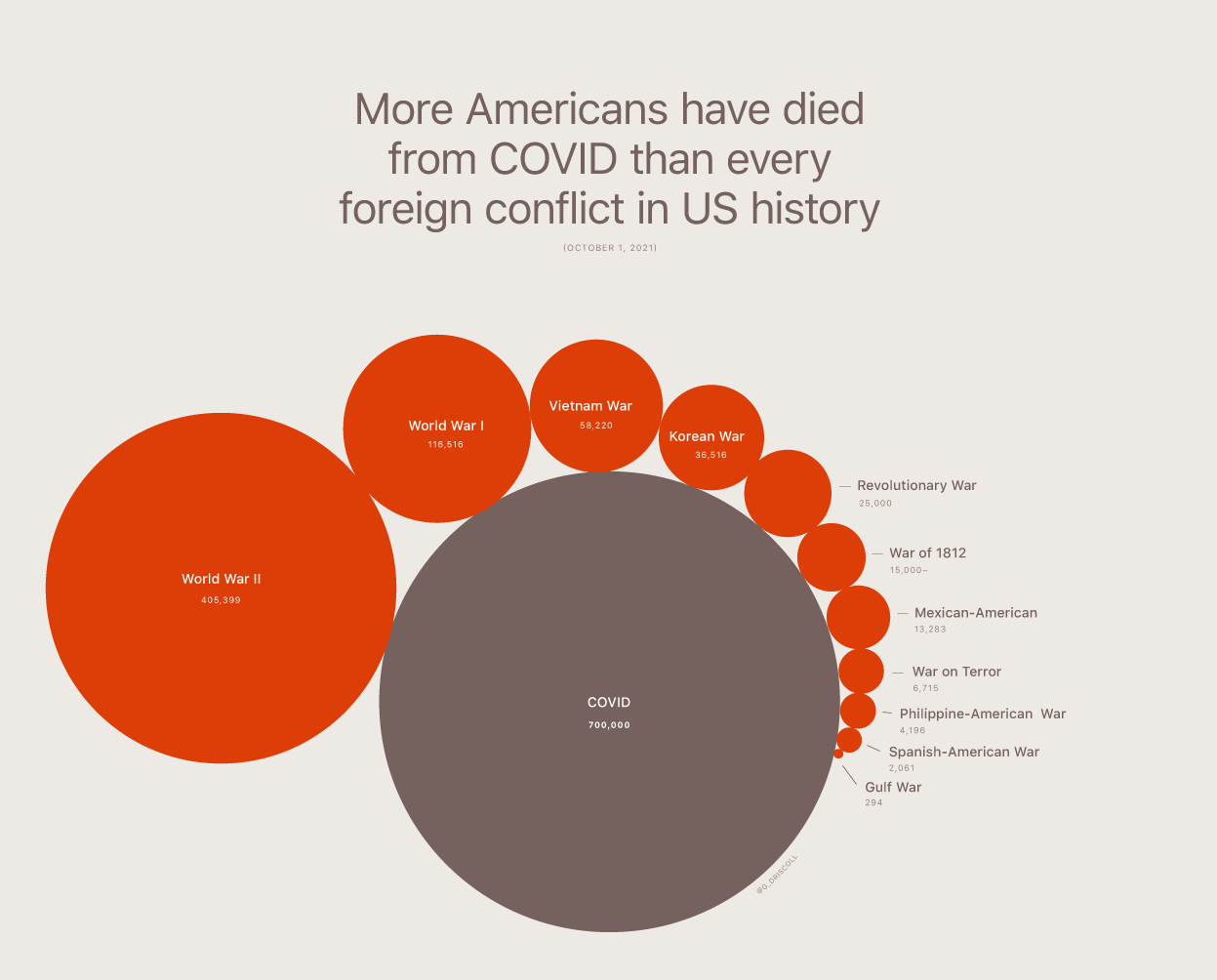
COVID-19 deaths in the U.S. have topped 700,000, which means that more Americans have died in the pandemic than died in every foreign conflict the U.S. has ever fought (combined combat deaths in all U.S foreign wars are estimated at 659,267).
This graphic is from r/dataisbeautiful.
Two things to note:
- Deaths in the American Civil War were equal or higher (they’re estimated to have been 620,000 and 750,000 soldiers dead, along with an undetermined number of civilian casualties).
- On a death-per-100,000-population basis, COVID-19 deaths are at roughly 211 per 100,000. That’s materially more than deaths in any U.S. foreign war except World War II (which had a death toll of 307 per 100,000). See here and here for the underlying data.
* then-President Donald Trump, on COVID deaths
###
As we mourn, we might recall that it was on this date in 1945 that Desmond Doss received the U.S. Medal of Honor. A conscientious objector serving as a U.S. Army medic, he saved 75 men during the Battle of Okinawa during World War II. (Prior to that, he had twice been awarded the Bronze Star for heroism in Guam and the Philippines.) He was the only conscientious objector to receive the Medal of Honor for his actions during the war; his story has been told in several books, a documentary (The Conscientious Objector), and the 2016 Oscar-winning film Hacksaw Ridge.

“When the graphs were finished, the relations were obvious at once”*…

We can only understand what we can “see”…
… this long-forgotten, hand-drawn infographic from the 1840s… known as a “life table,” was created by William Farr, a doctor and statistician who, for most of the Victorian era, oversaw the collection of public health statistics in England and Wales… it’s a triptych documenting the death rates by age in three key population groups: metropolitan London, industrial Liverpool, and rural Surrey.
With these visualizations, Farr was making a definitive contribution to an urgent debate from the period: were these new industrial cities causing people to die at a higher rate? In some ways, with hindsight, you can think of this as one of the most crucial questions for the entire world at that moment. The Victorians didn’t realize it at the time, but the globe was about to go from less than five percent of its population living in cities to more than fifty percent in just about a century and a half. If these new cities were going to be killing machines, we probably needed to figure that out.
It’s hard to imagine just how confusing it was to live through the transition to industrial urbanism as it was happening for the first time. Nobody really had a full handle on the magnitude of the shift and its vast unintended consequences. This was particularly true of public health. There was an intuitive feeling that people were dying at higher rates than they had in the countryside, but it was very hard even for the experts to determine the magnitude of the threat. Everyone was living under the spell of anecdote and availability bias. Seeing the situation from the birds-eye view of public health data was almost impossible…
The images Farr created told a terrifying and unequivocal story: density kills. In Surrey, the increase of mortality after birth is a gentle slope upward, a dune rising out of the waterline. The spike in Liverpool, by comparison, looks more like the cliffs of Dover. That steep ascent condensed thousands of individual tragedies into one vivid and scandalous image: in industrial Liverpool, more than half of all children born were dead before their fifteenth birthday.
The mean age of death was just as shocking: the countryfolk were enjoying life expectancies close to fifty, likely making them some of the longest-lived people on the planet in 1840. The national average was forty-one. London was thirty-five. But Liverpool—a city that had undergone staggering explosions in population density, thanks to industrialization—was the true shocker. The average Liverpudlian died at the age of twenty-five, one of the lowest life expectancies ever recorded in that large a human population.
There’s a natural inclination to think about innovation in human health as a procession of material objects: vaccines, antibiotics, pacemakers. But Farr’s life tables are a reminder that new ways of perceiving the problems we face, new ways of seeing the underlying data, are the foundations on which we build those other, more tangible interventions. Today cities reliably see life expectancies higher than rural areas—a development that would have seemed miraculous to William Farr, tabulating the data in the early 1840s. In a real sense, Farr laid the groundwork for that historic reversal: you couldn’t start to tackle the problem of how to make industrial cities safer until you had first determined that the threat was real.
Why the most important health innovations sometimes come from new ways of seeing: “The Obscure Hand-Drawn Infographic That Changed The Way We Think About Cities,” from Steven Johnson (@stevenbjohnson). More in his book, Extra Life, and in episode 3 of the PBS series based on it.
###
As we investigate infographics, we might send carefully calculated birthday greetings to Lewis Fry Richardson; he was born on this date in 1881. A mathematician, physicist, and psychologist, he is best remembered for pioneering the modern mathematical techniques of weather forecasting. Richardson’s interest in weather led him to propose a scheme for forecasting using differential equations, the method used today, though when he published Weather Prediction by Numerical Process in 1922, suitably fast computing was unavailable. Indeed, his proof-of-concept– a retrospective “forecast” of the weather on May 20, 1910– took three months to complete by hand. (in fairness, Richardson did the analysis in his free time while serving as an ambulance driver in World War I.) With the advent of modern computing in the 1950’s, his ideas took hold. Still the ENIAC (the first real modern computer) took 24 hours to compute a daily forecast. But as computing got speedier, forecasting became more practical.
Richardson also yoked his forecasting techniques to his pacifist principles, developing a method of “predicting” war. He is considered (with folks like Quincy Wright and Kenneth Boulding) a father of the scientific analysis of conflict.
And Richardson helped lay the foundations for other fields and innovations: his work on coastlines and borders was influential on Mandelbrot’s development of fractal geometry; and his method for the detection of icebergs anticipated the development of sonar.

“God loveth the clean”*…

The history of ordinary things can be fascinating while offering insight into our immediate future. We’ve previously noted how artificial ice and assorted refrigeration/cooling technologies helped change demographics in the American South. Recent news from the Census Bureau confirms this trend as northern states like Michigan and New York lost population while the south, Texas and Florida in particular, gained. But the history of the ordinary can be hidden by ubiquity, tedium, and general disinterest. Unnoticed until they cry out for attention. Today’s Tedium is looking at the history of New York City restaurant inspections and the variety of ways restaurants cope. (And yes, the pandemic has certainly had an impact.)
…
There is no shortage of great New Yorkers, the people that helped shape the city and its culture. How one measures impact can vary. The wealthy and influential find their names on street signs, convention centers, and airports. A year into the COVID-19 pandemic, however, there is a renewed appreciation for those that helped lay the foundation for the city’s hospitals and medical care. In this regard, there are few New Yorkers greater than Dr. Sigismund Goldwater.
A graduate of Columbia University and NYU medical school, Dr. Goldwater was a recognized authority in hospital construction. Among the numerous posts he held over a distinguished career included Superintendent at Mount Sinai Hospital, president of the American Conference on Hospital Service, and vice president of the New York Academy of Medicine. In recognition of his career and experience, he was appointed City Commissioner of Hospitals from 1934 to 1940. During his administration, Dr. Goldwater oversaw the construction of 25 new hospital buildings. His Times obituary credits him with adding more than 5,000 hospital beds to city capacity.
While his work in hospital administration and construction helped lay the foundation for New York City as a world-class center for health care, Dr. Goldwater has a legacy a bit more meaningful to modern restaurateurs. In 1914, Mayor John Purroy Mitchel was newly elected and in need of a health commissioner. His first choice, Dr. Goldwater, didn’t really want the job but finally acquiesced on the strong insistence of his predecessor.
About six months after taking over the role, now Health Commissioner Goldwater announced a couple of general initiatives in public transportation and dining to ensure general cleanliness, pointing out to the Times that, “…the Sanitary Code at present did not call for regular inspection as in the case of bakeries and meat markets.” His solution was to require permits and require commercial restaurants to be inspected on an annual basis.
Public health, especially regarding sanitary food handling practices, had grabbed media attention in the early 20th century in part to Upton Sinclair’s The Jungle. Sinclair, an investigative journalist, went undercover to detail the working conditions in meat packing facilities. His account of rat infested factories and spoiled meat products shipped to consumers provoked outrage. Unfortunately for Sinclair, who was trying to shed light on the conditions of workers, readers were incensed to learn what was in their food. By 1905, the federal government had passed legislation to create what would become the Food and Drug Administration (FDA).
Another unique circumstance that kept food safety in the minds of New Yorkers was the terrible tale of Mary Mallon, better known as Typhoid Mary. A private cook that was also an asymptomatic carrier of typhoid, Mary Mallon became infamous for her condition, the number of people she infected, and her refusal to cooperate with safety guidelines. [See here]
There was another reason for the attention Mary Mallon received, explains Claire Stewart, a chef and hospitality management professor at the New York City College of Technology. “Typhoid was considered a disease of the poor and associated with immigrants and overcrowded tenements,” she said. “Mary Mallon spent a lot of her career cooking for wealthy people, so her bringing typhoid to the upper classes caused a lot of alarm.”
Still, by the time Dr. Goldwater became health commissioner, New York City had yet to regulate restaurants, creating a range of dining experiences and anxiety about the status of any given kitchen.
One concerned citizen wrote to the Times in a letter titled, “We Need Dainty Waiters.”, “In these days of pure food laws and Boards of Health… I would like to ask what assurance, if any, has the public that in our hotels, restaurants, and clubs proper supervision over their employes is exercised so as to insure us a fair degree of cleanliness on the part of those who handle the food we are to eat? This inquiry is prompted by occurrences coming under the personal observation of the writer, showing that employes in so-called high-class hotels, clubs, and restaurants are often guilty of practices which would not be tolerated in our own homes. One large restaurant in this city requires its waiters to pass an inspection by a manicure before they are allowed to handle food for its patrons.”
After Dr. Goldwater noted that other cities had also adopted regular restaurant inspections, and noting the potential for additional revenue via fines and permit fees, the city agreed. Now they just had to get some 15,000 owners and operators to comply. Should be easy, right?…
The wacky and surprising history of NYC restaurant inspections (and by extension, that same system in other cities). That letter grade is a lot more effective than you might think: “The Letter in the Window.” By Andrew Egan, in Ernie Smith’s (@ShortFormErnie) ever-illuminating newsletter Tedium (@readtedium).
* Francis Bacon
###
As we wash our hands, we might recall that it was on this date in 1913 that Gideon Sundback was granted a patent on the first modern zipper. While he did well with his invention for several decades, he and his western competitors were overtaken in the mid-20th century by YKK.
Most checked chefs pants still have buttons.

“If locusts are ravenous sociopaths, cicadas are more like frat boys – clumsy, loud, and obsessed with sex”*…

… and they are, themselves, the object of other species’ obsessions…
This spring’s emergence of periodical cicadas in the eastern U.S. will make more than a buzz. Their bodies—which will number in the billions—will also create an unparalleled food fest for legions of small would-be predators, including many birds and mammals. But some animals may benefit more than others, and any boost predator populations get from the coming buffet of winged insects will likely be short-lived, researchers say.
Tiny chickadees and mice have been known to wrestle these chunky bugs for a quick snack. Raptors, fish, spiders, snakes and turtles will gulp them down when given the chance. Captive zoo animals, such as meerkats, monitor lizards and sloth bears, will do so as well if the insects show up in their enclosure. Observers have even reported seeing domestic cats trap two cicadas at once, one under each forepaw.
This spring, three species of cicadas (collectively referred to as Brood X or Brood 10) will crawl out of the ground where they have spent the previous 17 years. They will coat the limbs and leaves of trees, sing, mate, lay eggs and then die. Uneaten corpses and body parts will add nutrients to the soil, bolstering the ecosystem and its denizens long after the boisterous insects disappear. But the famous periodicity of cicada broods can set some predators up for feast-then-famine scenarios—population booms followed by food insecurity and then sudden drops in numbers.
“In response to this superabundance of food, a lot of the predator populations have outrageously good years,” says Richard Karban, a University of California, Davis, entomologist who studies periodical cicadas. “But then the next year, and in the intervening years, there’s no food for them, so their populations crash again.”
Predators could be part of the reason that these slow-flying, defenseless and colorful cicadas emerge periodically instead of perennially. Over millennia, synchronized periodic emergences as a dense mob could have led to higher adult survival rates. Thus, the insects evolved to adopt their unusual life cycle—most of which is spent feeding underground—explains University of Connecticut evolutionary biologist and ecologist Chris Simon, who studies cicadas. “The predators are really important in driving the whole story,” she says. The success of the species effectively banks on sheer volume…
Most bird species do not travel to take advantage of cicada emergences… They live and eat in the same areas year after year, picking off the insects opportunistically instead of traveling to the cicada motherlode… cuckoos are an exception: they migrate to take advantage of insect outbreaks all over the country…
Despite all the eager predators, the life-cycle gamble on high-volume emergences pays off for periodical cicadas. Most survive predation to mate and then drop dead to the forest floor. But even if they go uneaten, their ecosystem impact does not stop there. Cicada bodies contain about 10 percent nitrogen, which is more than the concentration found in dead leaves and other typical forest litter, says Louie Yang, a University of California, Davis, entomologist, who studies resource pulses and phenological shifts. Plants such as American bellflowers will take up the nitrogen from the dead cicadas, and herbivorous mammals and insects will selectively feed on the higher-nitrogen fertilized leaves, he adds.
Patterns such as this one illustrate the ecological lens that periodical cicadas can provide on biological communities and evolutionary timelines. “I love the reciprocity of the whole system,” Yang says. “I think this kind of stuff happens all the time, but it’s usually hard to see. When these pulse events happen, it makes it really obvious—we can see that pulse pass through the system.”…
Billions of emerging insects will likely trigger predator population surges: “Brood X Cicadas Could Cause a Bird Baby Boom.”
Oh, and given climate change, 17-year cicadas could become 13-year cicadas: “The cicadas are coming. And they’re changing dramatically.”
* Catherine Price, 101 Places Not to See Before You Die
###
As we bear the buzz, we might recall that it was on this date in 1923 that insulin became publicly available for use by diabetics. Frederick Banting had discovered insulin in 1921, and refused to put his name on the patent. He felt it was unethical for a doctor to profit from a discovery that would save lives. He and his co-inventors, James Collip and Charles Best, sold the insulin patent to the University of Toronto for a mere $1. They wanted everyone who needed their medication to be able to afford it.
Today, Banting and his colleagues would be spinning in their graves: Their drug, which many of the 30 million Americans with diabetes rely on, has become the poster child for pharmaceutical price gouging.
The cost of the four most popular types of insulin has tripled over the past decade, and the out-of-pocket prescription costs patients now face have doubled. By 2016, the average price per month rose to $450 — and costs continue to rise, so much so that as many as one in four people with diabetes are now skimping on or skipping lifesaving doses…

You must be logged in to post a comment.