Posts Tagged ‘Gutenberg’
“Every great advance in science has issued from a new audacity of the imagination”*…

Itai Yanai and Martin Lercher on the importance of interdisciplinarity and creativity in science…
The hypothesis-testing mode of science, which François Jacob called “day science,” operates within the confines of a particular scientific field. As highly specialized experts, we confidently and safely follow the protocols of our paradigms and research programs . But there is another side of science, which Jacob called “night science”: the much less structured process by which new ideas arise and questions and hypotheses are generated. While day science is compartmentalized, night science is truly interdisciplinary. You may bring an answer from your home field to another discipline, or conversely, venturing into another field may let you discover a route towards answering a research question in your
main discipline. To be most creative, we may be best off cultivating interests in many areas, much like Renaissance thinkers such as Leonardo da Vinci or Galileo Galilei. But this creativity-enhancing interdisciplinarity comes at a price we may call “expert’s dilemma”: with your loss of status as a highly focused expert comes a loss of credibility, making it harder to get your work accepted by your peers. To resolve the dilemma, we must find our own balance between disciplinary day science expertise and interdisciplinary night science creativity…
Eminently worth reading in full: “Renaissance minds in 21st century science,” from @ItaiYanai and @MartinJLercher.
See also: “Night Science“
And for more: see their project’s home page and listen to their podcast.
Apposite: “8 lessons on lifelong learning from an astrophysicist,” from Ethan Siegel.
* John Dewey
###
As we find a balance, we might send easily-reproducible birthday greetings to a man who was moved by necessity to cross disciplinary boundaries, Alois Senefelder; he was born on this date in 1771. A playwright and actor, was having trouble getting his plays printed; he needed a less expensive and more efficient printing alternative to relief printed hand set type or etched plates. So he invented the technique we call lithography– the biggest revolution in the printing industry since Gutenberg’s movable type.
The principle is simple: oil-based printing ink and water repel each other. The image is drawn on a stone (Bavarian limestone for Senefelder) with greasy crayon, after which the stone is soaked in water, which is absorbed into the part of the stone not covered in greasy paint. The ink is rolled onto the stone. The image areas of the stone accept ink and undrawn areas reject it. Finally, a piece of paper is pressed onto the stone, and the ink transfers onto the paper from the stone.
Senefelder called the technique “stone printing” or “chemical printing,” but the French name “lithography” became more widely adopted. Today photo lithography is used to print magazines and books, but the original process of drawing by hand on litho stones still exists in the fine art world.

“What is an anarchist? One who, choosing, accepts the responsibility of choice.”*…

Per the Oxford Dictionaries, “anarchy” has two meanings:
1. a state of disorder due to absence or nonrecognition of authority or other controlling systems.
2. the organization of society on the basis of voluntary cooperation, without political institutions or hierarchical government; anarchism.
It’s fair to observe that, in common parlance, it’s the first definition that rules. The estimable Alan Jacobs puts in a word for the second, and positions it as something beyond the political, something spiritual…
Perhaps the most unusual element of my 2022 essay on anarchism is this: I present anarchism not as a political system but as a spiritual discipline. I don’t put the point quite that bluntly, but I come fairly close:
The first target of anarchistic practice ought to be whatever it is in me that resists anarchy — what resists negotiation, the turning toward the Other as neighbor and potential collaborator. I return to Odo’s line, “What is an anarchist? One who, choosing, accepts the responsibility of choice,” but I add this: The responsibility of choice arises when I acknowledge my own participation, in a thousand different ways, in the imposition of order on others. This is where anarchism begins; where the turning aside from the coldest of all cold monsters begins; where I begin. The possibility of anarchic action arises when I acknowledge my own will to power...
It should be obvious that if you are delighted with power politics – if you think the purpose of politics is “defeating the enemy and enjoying the spoils” of your victory – then you won’t be worried about your own will to power. You can just turn off your conscience and go on the attack, thinking only about winning (good) and losing (bad). My suggestion that the desire to impose order on others is a desire that needs to be reflected on will seem obviously silly to you. But there’s another way of thinking about the political order that is equally incompatible with the kind of reflection I counsel in that essay: the libertarian model.
Libertarianism doesn’t want to impose order on others, but its most passionate advocates have a strong tendency to assess existence in terms of winning and losing – winning and losing not in the corridors of political power but in the marketplace; the individual entrepreneur controlling the segment of the market in which he works. As Mark Zuckerberg likes to say, it’s all about DOMINATION; just not domination by law. Anarchism, by contrast — this is my argument in that essay — stands between (libertarian) chaos and (seeking to become) the Man. Some of the most thoughtful anarchists like to say that “anarchy is order” – but order that emerges from collaboration and cooperation rather than being imposed by governmental power. I don’t think it’s possible to create an anarchist system, because an anarchism imposed on people by those in power isn’t anarchism.
Here’s what I think can be done: Try, in every way we can think of, to increase the number of situations in our lives in which we are neither dehumanized by an omnipotent state nor engaged in ceaseless competition with one another in an omnipotent marketplace. As Wendell Berry has written, “Rats and roaches live by competition under the law of supply and demand; it is the privilege of human beings to live under the laws of justice and mercy.” We should assume that privilege whenever we can, and take it upon ourselves as a collaborative of equals to determine what, in any given case facing us, justice and mercy are. In other words, what I call the anarchic imperative is an attempt to rebalance what Berry has called “the two economies”:
For the thing that so troubles us about the industrial economy is exactly that it is not comprehensive enough, that, moreover, it tends to destroy what it does not comprehend, and that it is dependent upon much that it does not comprehend. In attempting to criticize such an economy, it is probably natural to pose against it an economy that does not leave anything out. And we can say without presuming too much, that the first principle of the kingdom of God is that it includes everything; in it the fall of every sparrow is a significant event. We are in it, we may say, whether we know it or not, and whether we wish to be or not. Another principle, both ecological and traditional, is that everything in the kingdom of God is joined both to it and to everything else that is in it. That is to say that the kingdom of God is orderly.
Amen to that. But what is the nature of that order? Eschatologically, it certainly ain’t anarchic: it is the kingdom of the archē, the source of all things, the Lord. But to understand and instantiate that Kingdom here and now – when, as St. Augustine says, the City of God and the City of Man are inevitably and confusingly mixed – we need to collaborate with one another to increase both our knowledge and our ability to act effectively.
I have argued at some length that Christians aren’t pluralists – we believe that “at the name of Jesus every knee will bow” (Phil. 2:10) – but in our current position we should expect, accept, and even embrace plurality. We need to cultivate the virtues appropriate to a plural world, and we can do that by expanding the sphere of voluntary collaboration, negotiation among equals, emergent order, even when such expansion makes life more difficult for us. That’s anarchism as a spiritual discipline…
Charting a course between libertarianism and autocracy: “Anarchism as a spiritual discipline.”
[The image above is from Jacobs’ Harpers essay— eminently worth reading]
* Ursula K. Le Guin, who created Odo (and Odoism) in The Dispossessed
###
As we choose, we might recall that it was (probably) on this date that the first edition of what we know as the Gutenberg Bible was published.
While many believe that Johannes Gutenberg first work using moveable type was the Bible, it was probably the second or maybe even third. [Indeed, there was an earlier (32 line) version of the parts of the Bible, labeled an “indulgence.”] The Gutenberg press was in operation by 1450, and it is known that a German poem had been printed before the Bible. However, it is known that Gutenberg began the painstaking process of hand placing every letter for every page of the new Bible during that same year. It is believed that the 42-line Gutenberg Bible [the one we know as “The Gutenberg Bible”] was completed on this day in 1456. About 180 copies of the book were printed, which seems rather small for a first edition…

“Nothing is so painful to the human mind as a great and sudden change”*…
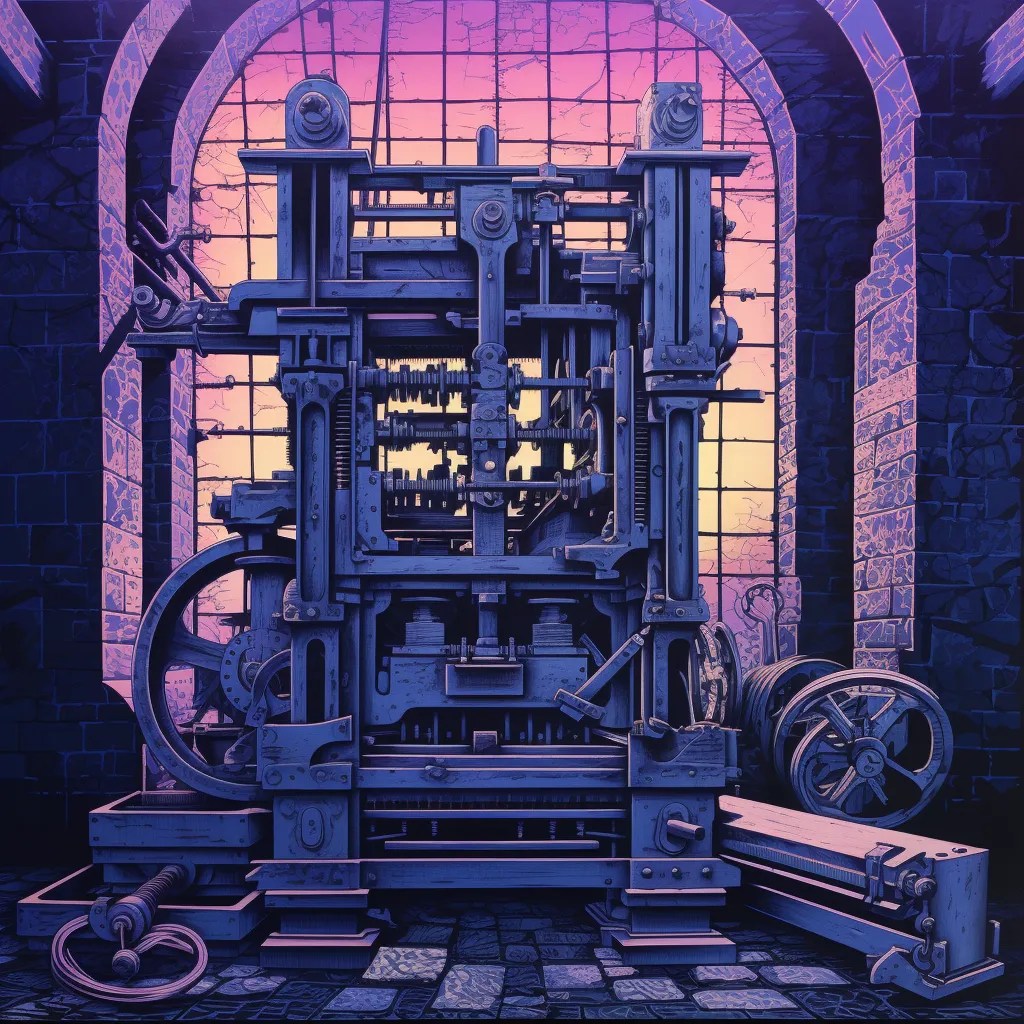
If an AI-infused web is the future, what can we learn from the past? Jeff Jarvis has some provocative thoughts…
The Gutenberg Parenthesis—the theory that inspired my book of the same name—holds that the era of print was a grand exception in the course of history. I ask what lessons we may learn from society’s development of print culture as we leave it for what follows the connected age of networks, data, and intelligent machines—and as we negotiate the fate of such institutions as copyright, the author, and mass media as they are challenged by developments such as generative AI.
Let’s start from the beginning…
In examining the half-millennium of print’s history, three moments in time struck me:
- After Johannes Gutenberg’s development of movable type in the 1450s in Europe (separate from its prior invention in China and Korea), it took a half-century for the book as we now know it to evolve out of its scribal roots—with titles, title pages, and page numbers. It took another century, until this side and that of 1600, before there arose tremendous innovation with print: the invention of the modern novel with Cervantes, the essay with Montaigne, a market for printed plays with Shakespeare, and the newspaper.
- It took another century before a business model for print at last emerged with copyright, which was enacted in Britain in 1710, not to protect authors but instead to transform literary works into tradable assets, primarily for the benefit of the still-developing industry of publishing.
- And it was one more century—after 1800—before major changes came to the technology of print: the steel press, stereotyping (to mold complete pages rather than resetting type with every edition), steam-powered presses, paper made from abundant wood pulp instead of scarce rags, and eventually the marvelous Linotype, eliminating the job of the typesetter. Before the mechanization and industrialization of print, the average circulation of a daily newspaper in America was 4,000 (the size of a healthy Substack newsletter these days). Afterwards, mass media, the mass market, and the idea of the mass were born alongside the advertising to support them.
One lesson in this timeline is that the change we experience today, which we think is moving fast, is likely only the beginning. We are only a quarter century past the introduction of the commercial web browser, which puts us at about 1480 in Gutenberg years. There could be much disruption and invention still ahead. Another lesson is that many of the institutions we assume are immutable—copyright, the concept of creativity as property, mass media and its scale, advertising and the attention economy—are not forever. That is to say that we can reconsider, reinvent, reject, or replace them as need and opportunity present…
Read on for his suggestion for a reinvention of copyright: “Gutenberg’s lessons in the era of AI,” from @jeffjarvis via @azeem in his valuable newsletter @ExponentialView.
* Mary Wollstonecraft Shelley, Frankenstein
###
As we contemplate change, we might spare a thought for Jan Hus. A Czech theologian and philosopher who became a Church reformer, he was burned at the stake as a heretic (for condemning indulgences and the Crusades) on this date in 1415. His teachings (which largely echoed those of Wycliffe) had a strong influence, over a century later, on Martin Luther, helping inspire the Reformation… which was fueled by Gutenberg’s technology, which had been developed and begun to spread in the meantime.

“Every day sees humanity more victorious in the struggle with space and time”*…

Contact: A hundred years before iconic figures like Bill Gates and Steve Jobs permeated our lives, 60 years before Marshall McLuhan proclaimed media to be “the extensions of man,” an Irish-Italian inventor laid the foundation of the communication explosion of the 21st century. Guglielmo Marconi was arguably the first truly global figure in modern communication. Not only was he the first to communicate globally, he was the first to think globally about communication. Marconi may not have been the greatest inventor of his time, but more than anyone else, he brought about a fundamental shift in the way we communicate.
Today’s globally networked media and communication system has its origins in the 19th century, when, for the first time, messages were sent electronically across great distances. The telegraph, the telephone, and radio were the obvious precursors of the Internet, iPods, and mobile phones. What made the link from then to now was the development of wireless communication. Marconi was the first to develop and perfect a practical system for wireless, using the recently-discovered “air waves” that make up the electromagnetic spectrum…
An excerpt from Marconi: The Man Who Networked the World by Marc Raboy. Oxford University Press. Via “How Marconi Gave Us the Wireless World.”
* Guglielmo Marconi
###
As we tweak the dial, we might recall that, thanks to a handwritten note by illustrator Heinrich Cremer, we know that the final binding of the Gutenberg Bible took place on this date in 1456.

“Some people have a way with words, and other people…oh, uh, not have way”*…

A few times each decade, the number of acceptable Scrabble words grows. Some sixty-five hundred new words—“lolz,” “shizzle,” and “blech” among them—will officially enter one of the two major competitive Scrabble lexicons on September 1st of this year. The grumbling that results when a word list lengthens is not so much about the inclusion of obscene or offensive words—though a cleaned-up list was controversially published in 1996, after someone protested the inclusion of “jew” as a verb. Instead, it is more about the growing divide between two Scrabble communities: North America and everywhere else…
The history of everyone’s favorite word game– and an explanation of the controversy roiling it today– at “The battle over Scrabble’s dictionaries.”
* Steve Martin
###
As we reach for a triple-letter double-word combo, we might recall that, while February 23rd, 1455 is the traditionally-given date of the publication of the Gutenberg Bible, the first Western book printed from movable type, the first evidence-based date is this date in 1456: the copy in the Bibliothèque nationale de France contains a note from the binder establishing the time of its publication.
(The Jikji— the world’s oldest known extant movable metal type printed book– was published in Korea in 1377. Bi Sheng created the first known moveable type– out of wood– in China in 1040.)

You must be logged in to post a comment.