Posts Tagged ‘economics’
“It’s easy to meet expenses – everywhere we go, there they are.”*…

… And those expenses seem to keep rising. Ben Brubaker weighs in on one ever-more-timely culprit…
Imagine a town with two widget merchants. Customers prefer cheaper widgets, so the merchants must compete to set the lowest price. Unhappy with their meager profits, they meet one night in a smoke-filled tavern to discuss a secret plan: If they raise prices together instead of competing, they can both make more money. But that kind of intentional price-fixing, called collusion, has long been illegal. The widget merchants decide not to risk it, and everyone else gets to enjoy cheap widgets.
For well over a century, U.S. law has followed this basic template: Ban those backroom deals, and fair prices should be maintained. These days, it’s not so simple. Across broad swaths of the economy, sellers increasingly rely on computer programs called learning algorithms, which repeatedly adjust prices in response to new data about the state of the market. These are often much simpler than the “deep learning” algorithms that power modern artificial intelligence, but they can still be prone to unexpected behavior.
So how can regulators ensure that algorithms set fair prices? Their traditional approach won’t work, as it relies on finding explicit collusion. “The algorithms definitely are not having drinks with each other,” said Aaron Roth, a computer scientist at the University of Pennsylvania.
Yet a widely cited 2019 paper showed that algorithms could learn to collude tacitly, even when they weren’t programmed to do so. A team of researchers pitted two copies of a simple learning algorithm against each other in a simulated market, then let them explore different strategies for increasing their profits. Over time, each algorithm learned through trial and error to retaliate when the other cut prices — dropping its own price by some huge, disproportionate amount. The end result was high prices, backed up by mutual threat of a price war.
Implicit threats like this also underpin many cases of human collusion. So if you want to guarantee fair prices, why not just require sellers to use algorithms that are inherently incapable of expressing threats?
In a recent paper, Roth and four other computer scientists showed why this may not be enough. They proved that even seemingly benign algorithms that optimize for their own profit can sometimes yield bad outcomes for buyers. “You can still get high prices in ways that kind of look reasonable from the outside,” said Natalie Collina, a graduate student working with Roth who co-authored the new study…
Read on for more on recent findings that reveal that even simple pricing algorithms can make things more expensive: “The Game Theory of How Algorithms Can Drive Up Prices,” from @benbenbrubaker.bsky.social in @quantamagazine.bsky.social.
See also the charmingly-understatedly-titled “AI-Driven Personalized Pricing May Not Help Consumers.“
* anonymous
###
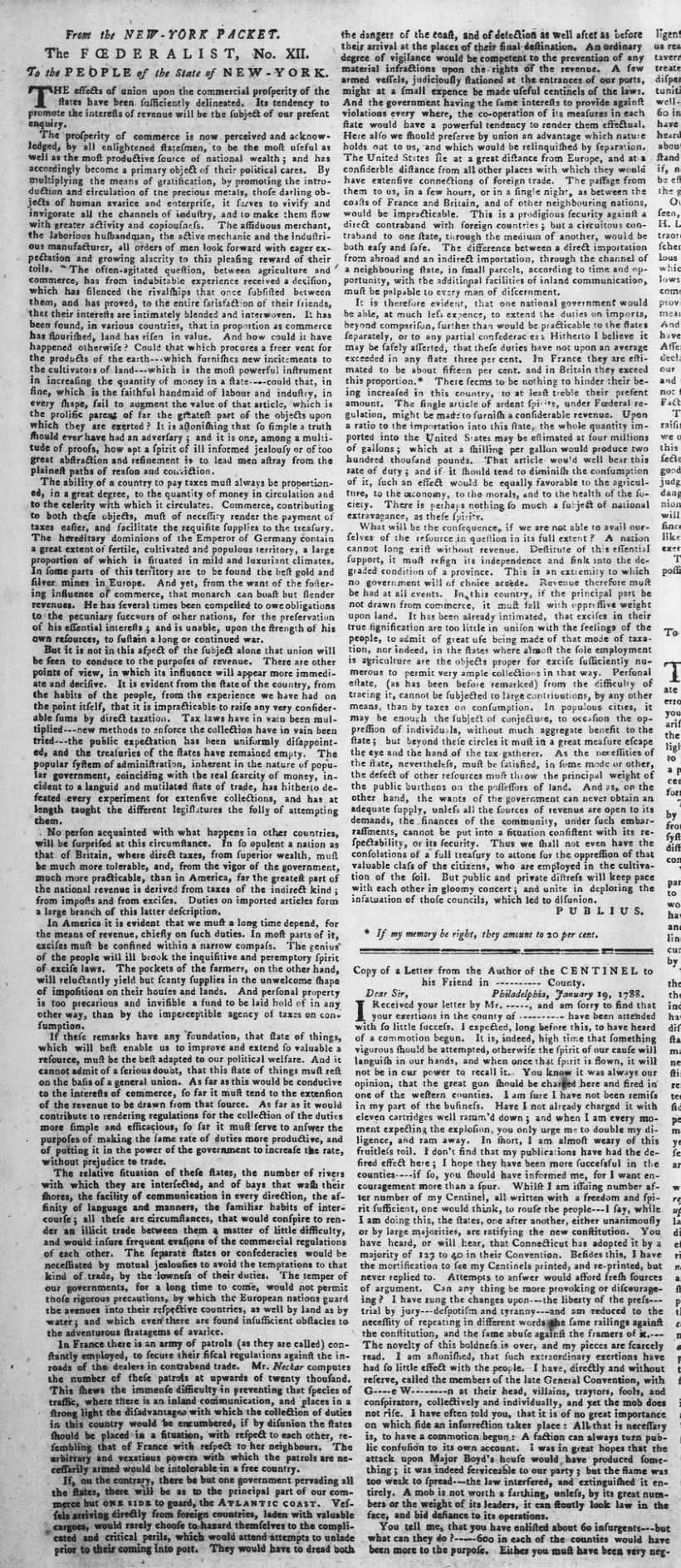
As we muse on malign mechanisms, we might recall that it was on this date in 1787 that the first in a series of eighty-five essays by “Publius,” the shared pen name of Alexander Hamilton, James Madison, and John Jay, appeared in the Independent Journal, a New York newspaper. Known collectively as The Federalist Papers, they were an effort to urge New Yorkers to support ratification of the Constitution approved by the Constitutional Convention on September 17, 1787. While aimed at New Yorkers, the essays were reprinted in newspapers (and pamphlets) across the fledgling nation.
In Federalist Paper #12, Alexander Hamilton (later the first Secretary of the Treasury) articulated an argument for the economic advantages of a united government under the proposed Constitution– and sketched the outline of the financial and commercial regime we’ve built since.

Your correspondent is heading into a series of meeting sufficiently intense that (R)D will be on brief hiatus. Regular service should resume on October 30.
“The question of whether a computer can think is no more interesting than the question of whether a submarine can swim”*…

Anil Dash, with a grounded view of artificial intelligence…
Even though AI has been the most-talked-about topic in tech for a few years now, we’re in an unusual situation where the most common opinion about AI within the tech industry is barely ever mentioned.
Most people who actually have technical roles within the tech industry, like engineers, product managers, and others who actually make the technologies we all use, are fluent in the latest technologies like LLMs. They aren’t the big, loud billionaires that usually get treated as the spokespeople for all of tech.
And what they all share is an extraordinary degree of consistency in their feelings about AI, which can be pretty succinctly summed up:
Technologies like LLMs have utility, but the absurd way they’ve been over-hyped, the fact they’re being forced on everyone, and the insistence on ignoring the many valid critiques about them make it very difficult to focus on legitimate uses where they might add value.
What’s amazing is the reality that virtually 100% of tech experts I talk to in the industry feel this way, yet nobody outside of that cohort will mention this reality. What we all want is for people to just treat AI as a “normal technology“, as Arvind Naryanan and Sayash Kapoor so perfectly put it. I might be a little more angry and a little less eloquent: stop being so goddamn creepy and weird about the technology! It’s just tech, everything doesn’t have to become some weird religion that you beat people over the head with, or gamble the entire stock market on…
Eminently worth reading in full: “The Majority AI View,” from @anildash.com.
Pair with: “Artificial Intelligences, So Far,” from @kevinkelly.bsky.social.
For an explanation of (some of) the dangers of over-hyping, see: “America’s future could hinge on whether AI slightly disappoints,” from @noahpinion.blog.web.brid.gy.
And for a peek at what lies behind each GenAI query: “Cartography of generative AI,” from @tallerestampa.bsky.social via @flowingdata.com.
While the arguments above are practical, note that a plethora of tech experts have weighed in with a a note of existential caution: “Statement on Superintelligence.”
Further to which (and finally), a piece from the Federal Reserve Bank of Dallas, projecting the economic impact of AI. It suggests that AI could provide a modest but meaningful boost to GDP over the next 25 years… if The Fed’s “Goldilocks Scenario” (in which, per Dash’s and Kelly’s comments, AI makes consistent incremental contributions to “keep living standards improving at their historical rate”) plays out. You’ll note that they also considered two other scenarios: a “benign singularity” scenario in which “AI eventually surpasses human intelligence, leading to rapid and unpredictable changes to the economy and society” and an “extinction singularity” in which “machine intelligence overtakes human intelligence at some finite point in the near future, the machines become malevolent, and this eventually leads to human extinction.”
Interesting times in which we live…

###
As we parse pumped prognostication, we might recall that it was on this date in 4004 BCE that the Universe was created… as per calculations by Archbishop James Ussher in the mid-17th century. Ussher, the head of the Anglican Church of Ireland at the time, attempted to calculate the dates of many important events described in the Old Testament. His calculations, which he published in 1650, were not that far off from many other estimates made at the time. Isaac Newton, for example, believed that the world was created in 4000 BC.
When Clarence Darrow prepared his famous examination of William Jennings Bryan in the Scopes trial [see here], he chose to focus primarily on a chronology of Biblical events prepared by a seventeenth-century Irish bishop, James Ussher. American fundamentalists in 1925 found—and generally accepted as accurate—Ussher’s careful calculation of dates, going all the way back to Creation, in the margins of their family Bibles. (In fact, until the 1970s, the Bibles placed in nearly every hotel room by the Gideon Society carried his chronology.) The King James Version of the Bible introduced into evidence by the prosecution in Dayton contained Ussher’s famous chronology, and Bryan more than once would be forced to resort to the bishop’s dates as he tried to respond to Darrow’s questions.

“Where all think alike there is little danger of innovation”*…

Last week, Northwestern Professor Joel Mokyr was awarded a half-share in The Nobel Prize in Economic Sciences (AKA The Sveriges Riksbank Prize in Economic Sciences in Memory of Alfred Nobel) “for having identified the prerequisites for sustained growth through technological progress.” Anton Howes explains why this is noteworthy…
Among today’s winners of the Nobel prize in Economics is Joel Mokyr, the professor at Northwestern whose name is indelibly associated with the primacy of innovation to modern economic growth – the gradual, sustained, and unprecedented improvement in living standards that first Britain, and then country after country, have enjoyed over the past few hundred years. It was reading Mokyr’s The Enlightened Economy that first opened my eyes to the importance of studying the history of invention to explaining the causes of the Industrial Revolution, which I have since made my career.
What makes this Nobel win so remarkable, and so pleasantly surprising, is that Mokyr’s work is not the kind that is often published by economics journals, or even many economic history journals anymore. Over the past few decades, journal editors and peer-reviewers have increasingly insisted that papers must present large datasets that have been treated using complex statistical methods in order to make even the mildest claims about what caused what. Although Mokyr is a master of such methods – he was one of the early pioneers of economic history’s quantitative turn – the work for which he has won the prize is firmly and necessarily qualitative.
Mokyr’s is the economic history that gets written up in books – his classics are The Lever of Riches, The Gifts of Athena, The Enlightened Economy, and A Culture of Growth – and in readable papers shorn of unnecessary formulae. His is history accessible to the layman, though rigorously applying the insights of economics. The prize is a clear signal from the economics profession that it doesn’t just value the application of fancy statistical methods; its highest prize can go to works of history.
Whereas most of the public, and even many historians, think of the causes of modern economic growth – the beginnings of the Industrial Revolution – as being rooted in material factors, like conquest, colonialism, or coal, Mokyr tirelessly argued that it was rooted in ideas, in the intellectual entrepreneurship of figures like Francis Bacon and Isaac Newton, and in the uniquely precocious accumulation in eighteenth-century Britain of useful, often mechanically actionable knowledge. Britain, he argued, through its scientific and literary societies, and its penchant for publications and sharing ideas, was the site of a world-changing Industrial Enlightenment – the place where progress was thoughtpossible, and then became real.
One of Mokyr’s big early insights, first appearing in Lever of Riches, was that many inventions could not be predicted by economic factors. Society could enjoy remarkable productivity improvements from simply increasing the size of the market, leading to division of labour and specialization – what he labelled ‘micro-inventions’ – in the vein popularised by Adam Smith. But this could not explain an invention that appeared out of the blue, like Montgolfier’s hot air balloon in the 1780s – what he called a ‘macro-invention’, not for the magnitude of its impact, but for its novelty. Macro-inventions often required further development to make them important, but the original breakthrough could not be predicted by looking at changes in prices or the availability of resources. It ultimately came down to advances in our understanding of the world. Mokyr put the Scientific Revolution – and the factors that contributed to it – on the economist’s map.
Mokyr also looked at the relationship between different kinds of knowledge. A scientist might know, through observation, that the air has a weight. A craftsman might know, through long training and experience with glass, how to make a long glass tube. Each could not get far alone. But combining them, by creating means to ensure that scientists and craftsmen talked with one another and collaborated – through connecting their propositional and prescriptive knowledge, their heads and hands – very quickly led to the invention of thermometers, barometers, and much more besides, in an ever expanding field of knowledge. What Mokyr taught economists is that it’s not knowledge per se that makes the difference, but the way it is organized. Much of his later work has shown just how deep a pool Britain’s scientists could draw on, of skilled artisans.
In a way, Mokyr himself has practised what he preached. As editor of Princeton University Press’s book series on the Economic History of the Western World, Mokyr has for decades provided an all-important space for economists and historians to write the kinds of research that would never have been publishable in economics journals – including of explanations of the Industrial Revolution that are the polar opposite to his own. He helped keep the connection between history and economics alive.
Mokyr’s case for the primacy of knowledge and ideas was not an easy one to make to economists. They are naturally drawn to data that can be counted, and not to narrative, often no matter how well evidenced. But it appears that Mokyr’s persistence, elevated by his infectious, irrepressible sprightliness, has paid off. His prize is a long overdue recognition of the historyin economic history, and a remarkable testament to the power of ideas to persuade…
A triumph for history and the importance of ideas: “Joel Mokyr’s Nobel,” from @antonhowes.bsky.social.
See also: “Why Joel Mokyr deserves his Nobel prize,” gift article from The Economist.
* Edward Abbey, Desert Solitaire
###
As we ponder the process of progress, we might send creative birthday greetings to one of the subjects Mokyr’s study, Sir Christopher Wren; he born on this date in 1632. A mathematician and astronomer (who co-founded and later served as president of the Royal Society), he is better remembered as one of the most highly acclaimed English architects in history; he was given responsibility for rebuilding 52 churches in the City of London after the Great Fire in 1666, including what is regarded as his masterpiece, St. Paul’s Cathedral, on Ludgate Hill.
Wren, whose scientific work ranged broadly– e.g., he invented a “weather clock” similar to a modern barometer, new engraving methods, and helped develop a blood transfusion technique– was admired by Isaac Newton, as Newton noted in the Principia.

“Neoliberalism: An ideology to absolve banks, landlords and monopolists from accusations of predatory behavior”*…

Neoliberalism has undoubtably contributed to remarkable economic growth, but it has also fostered inequality and “enshittification.” In any case, neoliberalism is, to put it politiely, showing strains. What’s next for the structure of the economy in the U.S. and the world? The estimable Branko Milanović…
Why did neoliberalism, in its domestic and international components, fail? I ask this question, in much more detail than I can do it in a short essay here, in my forthcoming The Great Global Transformation: National Market Liberalism in a Multipolar World. I am asking it for personal reasons too: some of my best friends are neoliberal. It was a generational project of Western baby-boomers which later got adopted by others, from Eastern Europe like myself, and Latin American and African elites. When nowadays I meet my aging baby-boomer friends, still displaying an almost undiminished zeal for neoliberalism, they seem like the ideological escapees from a world that has disappeared long time ago. They are not from Venus or Mars; they are from the Titanic.
When I say that neoliberalism was defeated I do not mean than it was intellectually defeated in the sense than there is an alternative ready-made project waiting in the wings to replace it. No: like communism, neoliberalism was defeated by reality. Real world simply refused to behave the way that liberals thought it should.
We need first to acknowledge that the project had many attractive sides. It was ideologically and generationally linked to the rebellious generation of the 1960s, so its pedigree was non-conformist. It promoted racial, gender and sexual equality. By its emphasis on globalization, it has to be credited by helping along the greatest reduction in global poverty ever and for helping many countries find the path to prosperity. Even its much-reviled Washington consensus—while some of its commandments were taken to an extreme length and other ignored—is fundamentally sound and has much to recommend itself. Not least that it provides an easily understandable shortcut to economic policy. It does not require more than an hour to explain it to the most economically ignorant person.
So, to go back to the original question, why did neoliberalism not remain the dominant ideology? I think there are three reasons: its universalism, hubris of its adherents (which always comes with universalism), and mendacity of its governments.
That neoliberalism is universal or cosmopolitan requires, I believe, little convincing. Liberal ideology treats, in principle, every individual and every nation the same. This is an asset: liberalism and neoliberalism can, again in principle, appeal to the most diverse groups, regardless of history, language or religion. But universalism is also its Achilles’ heel. The pretense that it applies to everybody soon comes into conflict with the realization that local conditions are often different. Trying to bend them to correspond to the tenets of neoliberalism fails. Local conditions (and especially so in social matters which are products of history and religion) are refractory to the beliefs founded under very different geographical and historical conditions. So in its encounter with the real world, neoliberalism retreats. The real world takes over.
But all universalists (communists among them too) refuse to accept that defeat. As they must because every defeat is a sign of non-universalism. That’s where the intellectual hubris kicks in. The defeat is seen as due to moral flaws among those who failed to adopt neoliberal values. To its votaries nothing short of its full acceptance qualifies one as a sane and morally righteous person. Whatever new social contract its votaries have determined is valid, were it only a week ago, must unconditionally be applied henceforth. The morality play combined with economic success that many proponents of neoliberalism enjoyed due to their age, geographical location, and education, gave it Victorian or even Calvinist undertones: becoming rich was seen not only as a sign of worldly success but as an indication of moral superiority. As Deng Xiaoping said, “getting rich is glorious”. This moral element implied lack of empathy with those who failed to find their right place within the new order. If one failed, it was because he deserved to fail. Faithful to its universalism, Western upper middle-class neoliberals did not treat co-citizens any differently from foreigners. Local failure was no less merited than the failure in a faraway place. This contributed more than anything else to the neoliberals’ political defeat: they simply ignored the fact that most politics is domestic.
The hubris which comes from success (and which got elevated to unheard-of heights after the defeat of communism) was reinforced by universalism—a feature shared by all ideologies and religions that by their very construct refuse to accept that local conditions and practices matter. Syncretism was not in the neoliberals’ playbook.
Finally, mendacity. The failure to observe, especially in international relations, even the self-defined and self-acclaimed “rules-based global order”, and the tendency to use these rules selectively—that is, to follow the old-fashioned policies of national interest without acknowledging it, created among many the perception of double standards. Western neoliberal governments refused to own to it and kept on repeating their mantras even when such statements were in glaring contradiction with what they were actually doing. In the international arena, they ended in a cul-de-sac, manipulating words, reinventing concepts, fabricating realities, all in the attempt to mask the truth. A part of that mendacity was present domestically too when people were told to shut up and not complain because the statistical data were not giving them reason and thus their subjective views were wrong and had to be ignored.
What next? I discuss that in The Great Global Transformation. I think there is one thing on which most people would agree: that the past fifty years have seen the debacles of two universalist ideologies: communism and neoliberalism. Both were defeated by the real world. The new ideologies will not be universal: they would not claim to apply to the entire world. They will be particularist, limited in scope, both geographically and politically and geared toward the maintenance of hegemony wherever they rule; not fashioning it into universal principles. This is why the talk about global ideologies of authoritarianism is meaningless. These ideologies are local, aiming at the preservation of power and of the status quo. This does not make them averse to the old imperialist temptation. But that temptation can never be extended to the world as a whole nor can various authoritarianisms work together to accomplish that. Moreover, since they lack universal principles, they are likely to clash. The only way for authoritarians not to fight with each other is to accept a very narrow set of principles, essentially those of non-interference in domestic affairs and absence of aggression, and leave it at that. Xi Jinping’s proclamation of five such narrow rules at the recent Shanghai Cooperation Organization meeting may be based on such a calculation…
Neoliberalism in crisis: “Defeated by reality,” from @brankomilan.bsky.social.
For a less certain perspective: “Will Trump Bring Neoliberalism’s Apocalypse, or Merely a New Iteration?” (source of the image above).
And apposite: “Why Neoliberalism Needs Neofascists,” “Has Liberalism’s Very Success in Delivering Human Flourishing Doomed It?,” and “The future of the world economy beyond globalization – or, thinking with soup.”
###
As we rethink, we might recall that it was on this date in 1975 that New York City came within two hours of bankruptcy. The city had payments due of $350 million, but had only a fraction of that available. Washington had refused craft a bailout package. It was estimated by some that 100 banks would fail if the city went bankrupt. A notice had been drafted and signed by the mayor:

But at the last minute, as creditors were lined up at government buildings and teachers were being notified to stay home, the teachers union pension fund came to the rescue, buying city bonds and giving the city the lifeline it needed to avoid default.

More at: “The Night NYC Saved Itself”
“The real danger is assuming that because you haven’t had a problem yet, you won’t have one soon”*…

Joan Didion once observed that “survivors look back and see omens, messages they missed.” That’s certainly true in investment arena… where stock indices have been hovering near all time highs while everyone awaits the falling of the shoe(s) from Trump’s tariffs and assorted other blows to the economy. Will we look back in the not-too-distant future to signs that it couldn’t, thus wouldn’t, continue?
Omens registered in advance are “early warning signs.” A classic on the economic front is the “cardboard box index“; the output of cardboard boxes is believed to be an indicator of future production of consumer goods, since cardboard containers are so common for packaging and shipping these goods. It’s down.
Mike Schuler, the managing editor of gCaptain weighs in with another…
The U.S. container shipping industry is heading toward what could be one of the most significant volume declines in its six-decade history, according to the latest analysis from shipping expert John McCown.
August data revealed only a slight 0.1% year-over-year increase in inbound container volume at the ten largest U.S. ports, following a temporary reprieve in July when volumes rose 3.2%. Meanwhile, outbound volume in August dropped 2.6%, continuing an erratic pattern that saw a 2.0% increase in July and a 1.7% decrease in June.
The marginal growth in August inbound volumes can be attributed to an exception for goods in transit after the August 7 implementation of revised reciprocal tariffs. “The new tariffs did not apply to containers that were loaded on vessels at their last foreign port of call before August 7 provided they entered the U.S. before October 5,” McCown explains.
This exemption artificially supported August figures, as “the large majority of boxes coming into the U.S. in August being exempt from the tariffs going into effect on August 7.” McCown adds that this mechanism may have even incentivized strategic deployment adjustments where “ships were loaded by August 7 and slow-steamed to the U.S.”
A stark contrast is emerging between U.S. container volumes and global shipping trends. “When U.S. container volume data is compared to global data and data in other major areas, there is a noticeable and widening gap as the downtrends in U.S. lanes are being significantly mitigated by increased volume in other areas,” notes McCown.
Evidence of this divergence can be seen in Far East export figures, which “set a new record and were 6.3% ahead of the same month last year” in July. McCown observes that “world container supply chains have already begun to adapt and reconfigure trading patterns. The U.S. is a less relevant player in world trade today than it was prior to these various tariff initiatives and will become more so as announced plans are implemented.”
The National Retail Federation has revised its projection for 2025, now expecting total inbound volume to decrease by 3.4%. When considering that year-to-date volume through August shows a 3.1% increase, this projection translates to “the remaining four months of 2025 being down 15.7% compared to the same four months in 2024.”
September will likely mark the beginning of more pronounced declines. In a September 17 presentation, the Port of Los Angeles director stated they expected inbound volume to drop 10% compared to the same month last year. Container bookings data supports this outlook, with bookings from China to the U.S. down 26% in the first week of September compared to the same period last year.
The situation could worsen if currently paused reciprocal tariffs on Chinese imports are implemented in mid-November. “If and when those tariffs are implemented, it is highly likely that they would lead to broader declines related to inbound containers to the U.S. from China,” McCown warns.
Adding another layer of complexity is the upcoming USTR ship fee plan targeting ships built in China or operated by Chinese carriers, set to take effect in mid-October. McCown describes this as “moving container volume related to trade lanes involving the U.S. into unchartered waters.” As these lanes account for more than a quarter of global container miles, “there will be a ripple effect that will be felt globally.”
The projected decline represents an unprecedented shift for an industry that has historically grown at rates exceeding U.S. GDP. “For a tangible metric that has consistently for decades grown above U.S GDP, most often at two, three or even more multiples of GDP, the unusual nature of an actual decline in inbound container volume into the U.S. cannot be overemphasized,” McCown states.
While the immediate volume impact is becoming clearer, the inflationary effects of the tariffs will take longer to manifest fully in economic data. McCown notes that “it will not be until at least when the inflation data is released in during the fourth quarter that the inflationary impact of the tariffs can begin to be accurately assessed.”
McCown concludes that the U.S. faces a difficult trade-off: “The more inbound container volume to the U.S. declines, the more commerce and growth will be impacted but the less inflation we will get. The less inbound container volume to the U.S. declines, the more inflation we will get but the less commerce and growth will be impacted. Unfortunately, there is simply no good place to be on that spectrum.”…
For what it’s worth, your correspondent does not share McCown’s confidence that a drop in container volume– in imported goods– will not raise prices. While the goods that don’t arrive won’t be passed along with tariffs baked into their prices, their substitutes, which will, per force, be scare for some time, seem likely to have their prices “bid” up…
“U.S. Container Imports Face Historic Decline as Tariff Effects Take Hold.”
All this said, prediction on the basis of indicators (and omens and signs and early warning signals and the like) is a tricky business. See, for example: “List of dates predicted for apocalyptic events.”
* G. Scott Graham, Early Warning Signals
###
As we batten down, we might recall that it was on this date in 2008 that U.S. stock markets, already on edge after the near failure of Wachovia Bank the day before, fell over the edge after the House rejected a bailout plan touted to help ease the ongoing financial crisis. Markets began their decline as soon as it became apparent the bill would fail. The Dow had its worst single day point decline in history, falling 777.68 points… the day that “The Crash of 2008” became real.

You must be logged in to post a comment.