Posts Tagged ‘Death’
“The Dunning-Kruger effect is the hemophilia of dynastic capitalism”*…

Anyone too scared to say Thanatos, Elizabeth Schambelan argues, might wind up with Theranos…
… Melinda Cooper thinks family capitalism is a useful term for comprehending our circumstances. The historian Steve Fraser proposes dynastic capitalism, which has a stronger sense of occasion. Either phrase seems like it could appease the nomenclatural martinets among us, the ones who think neo-feudalism is almost as vulgar a term as fascism, and that vulgar rubrics must be avoided as we strive to come to grips with such classy phenomena as private submarines that vaporize on their way to James Cameron’s favorite place, state officials obsessing about high school athletes’ menstrual cycles, children getting chemical burns while working the graveyard shift in slaughterhouses, and Sam Bankman-Fried paying somebody 700 million dollars to introduce him to Orlando Bloom. But I digress. With respect to family or dynastic capitalism, there is an incredible moment in The Inventor, the HBO documentary about Elizabeth Holmes, when one of her investors—the famous venture capitalist, the one in the cowboy hat, if that narrows it down, whose name is escaping me—defends his choice to give her millions of dollars by noting that one of her grandfathers ran a hospital and the other ran a bank (or something to that effect), “so you see, she came by it quite naturally!” Another of the VCs in the documentary is wearing a tie covered in Bitcoin logos, and says he invested in Theranos, Holmes’s company, because Holmes was friends with his daughter, and that if his gut cosigned, he’d be willing to invest in “a guy and a dog, or two girls and a cat,” though presumably only if at least one member of the team could claim friendship with his child or his labradoodle. The Dunning-Kruger effect is the hemophilia of dynastic capitalism. The dynasty is perhaps best understood expansively, as encompassing friends, and relatives’ friends, and loyal retainers with up to four legs, but nevertheless insular and exclusive, rarely open to true upstarts. Entrepreneurship in this system is a euphemism for a set of favors dispensed from above, from a consortium of patrons that might or might not include the innovator’s literal daddy.
Several years ago I read about a scientific study indicating that one out of three people have no internal monologue, no inner homunculus to offer a constant stream of unsolicited opinions and irritating queries. My guess is that a disproportionate number of dynastic scions enjoy this enviable yet hazardous self-congruence. There is no still small voice to muse, “Hmm, does Theranos sound kind of sinister” or “Does OceanGate sound like a Daytona Beach water park that opened in 1995?” Both Holmes and Rush evinced blasé contempt for regulatory agencies and accrediting organizations, because they stifle innovation, are run by bureaucrats, etc. And if a bureaucrat hadn’t shut Holmes down, Theranos would still be operating little slices of purgatory in Walgreens stores across the land. Holmes called them “wellness centers,” which is a weird name for a place where a person with syphilis has a thirty-five percent chance of getting a false negative on their syphilis test. Rush had a similar rhetorical bent. He said there were sensors all over the Titan to provide real-time monitoring of “hull health,” as if the hull were living tissue and the submersible perhaps a gigantic kernel of corn, which for all I know is the vibe his marketing team was going for—organic and plant-based, if a bit high-carb. More to the point, calling the sensors hull-health monitors is like calling a fire alarm a building-health monitor, except in this analogy if the fire alarm goes off, it means the building and everyone in it will cease to exist in two milliseconds.
…
I do think Holmes is a useful comparanda for Rush, but of course, she’s not the only one. Maybe she’s on my mind simply because of that recent profile that offered real-time monitoring of the health of her ability to gull journalists. Or maybe it’s because Theranos, the word, is a kind of twisted emblem for an entire ethos. Even if she never voiced it to herself, Holmes knew what the real namesake of her company was. I’m not the first person to comment on the similarities between the two words. The differences are typical of what is called taboo deformation—little changes to phonemes that permit a dangerous word to be safely said aloud. Persephone’s name was perilous to utter because she was queen of the underworld, so people used variations like Persephassa. Anyone too scared to say Thanatos might wind up with Theranos.
I’m sorry to speak ill of the dead and the recently incarcerated, but I just don’t have the energy for taboo deformations of my sentiments. I’m tired of the sensation of gradually sinking through an abyssopelagic murk where light is a memory kindled by queasy blips of bioluminescence. Lanternfish have bio-lamps attached to their heads by slim appendages; the orbs hang directly in front of their open mouths, attracting prey. But at least lanternfish aren’t pompous megalomaniacs who arrogate the right to steer us all into darkness and then expect to be thanked for letting us exist in the sickening phosphor of their tiny little privatized suns. That’s more than can be said for our era’s plutocratic class, as apotheosized by an unhinged emerald-mine heir who looks like he’s had a marginally successful face transplant—a chilling visage, once mystifying to me in its peculiar lifelessness, finally explicable as the mask of a psychopomp who’s here to usher all of us to the chthonic depths whence came his wealth and ego. On the scale of self-awareness, Stockton Rush was a veritable Socrates compared to the space captain who is currently the world’s richest man. As for the scale of the damage wreaked by each entrepreneur’s risky business—I am not going to engage in that calculus. It is hard to take much satisfaction in the knowledge that chaos agents are vulnerable to the chaos they create. I don’t think I could rejoice in mortal comeuppance even if the most richly deserving person were on the receiving end, and even if the circumstances were less horrific than what befell those aboard the Titan, and even if it really were comeuppance instead of the mere illusion of it. If there is going to be justice it will have to be in life, since death by definition just evens out the scales. Theranos is coming for us all…
Eminently worth reading and pondering in full: “Little Privatized Suns,” from @ESchambelan in @nplusonemag.
Via Ingrid Burrington‘s (@lifewinning) glorious newsletter, Perfect Sentences.
* Elizabeth Schambelan
###
As we reevaluate our esteem of estates, we might recall that it was on this date in 1834 that slavery was abolished in the British Empire, as the Slavery Abolition Act 1833 came into force (though it remained legal in the possessions of the East India Company until the passage of the Indian Slavery Act, 1843).

“When demons are required someone will always be found to supply the part”*…

… Interestingly, that role, Professor Martha Rampton explains, has evolved…
Christianity developed in a world with a well-articulated understanding of a multilayered and hierarchical universe that was, above all, animated. Most inhabitants of the ancient world envisioned cosmic energy as alive, meaning that the essence of physicality, spirituality and ethics rested in a host of supernatural sentient beings. Among those beings were demons who dwelt in the space between the earth and the Moon.
In the mid-2nd century, CE Justin Martyr explained the role of demons in Christian thought. The sons of God succumbed to intercourse with human women, and they begot children called the Nephilim (meaning giants). The progenies of the Nephilim were demons. These demons enslaved the human race, sowing wars, adulteries, licentiousness and every kind of evil. All the pagan gods, Justin warned, were, in fact, demons who haunt the earth. The North African bishop Augustine offered a different genealogy. He identified demons as the rebel angels who fought alongside and suffered the same fate as Lucifer (also known as Belial, Beelzebub, the Devil, Satan, and the ‘Day Star’) whom God cast out of heaven after he mounted a failed rebellion.
Both pagan and Christian ideologies envisioned demons in prominent roles but, for pagans, demons could be both good and bad. They resembled deities in that they shared in their immortality, but they were also subject to obnoxious, irrational cravings. Demons were positioned between humans and gods, and could act as guardian angels. Demons were corporeal, though of a material much lighter than, and superior to, the human form; they could move faster than mortals, read thoughts, and slip in and out of spaces impossible for the human body to occupy.
For the Church, all demons were malevolent. Christians saw demons as shape-shifters who copulated promiscuously with human beings, controlled the weather, sickened their victims, flew through the atmosphere, impersonated the dead, predicted the future, and were always to be feared…
Rampton then leads us through the shaping thoughts of Lactantius, Augustine, and others…
… The foundational metaphors of Christianity and paganism differed and conflicted with one another. The importance of place emerged for Christians as they crafted a new identity and a way to express it through ritual. Pagans looked to the natural world for meaning. Christian identity, on the other hand, was manifest in human-made consecrated structures such as churches and shrines. The new place of worship had to be one where demons did not feel welcome. When Christians established consecrated sites (the settings of ritual), they were often competing with pagan holy places that abounded in the world of nature – spots near lakes, beneath trees, at hallowed rocks, and in forests. Although Near Eastern and Mediterranean religions were temple-oriented with a sophisticated concept of enclosed ceremonial, the common person did not, as a rule, enter the hallowed domain, and most popular ritualistic, religious activity took place in the fields or outside the temple precinct – in short, out of doors.
Christians created a new kind of space where demons dared not tread and in which continuity with old rites and the worldview they stored were thwarted. These churches provided a clean slate on which Christians could write in the language of ritual. The building became a symbol for the new religion. It was more than just a different location from those frequented by pagan celebrants and inhabited by their demonic deities. It was a new concept of place particular to Christianity – cleansed of demons, consecrated to that special creator god who does not inhere in his creation (trees, rocks, springs) and should not be worshipped through it. Nothing filled demons with dread and kept them at bay like a sanctified church. The motif of demons fleeing in terror from a consecrating bishop was familiar in late antiquity when the fight against idolatry was a matter of openly confronting pagan cults. In the 3rd century, Gregory the Miracle-Worker prayed at the local temple, and the next morning the temple warden could not induce a lingering demon to enter. Christian structures were fortifications against demons.
…
The distinctive Christian approach to death emerged as a central feature in the competition with pagans for cultural dominance. Despite the radical differences in pagan and Christian notions of mortality, there were also similarities, and these frustrated the new religion in its effort to establish itself as unique.
Necromancy in the ancient world pertained to the practice of calling the dead back to life for the purpose of learning the future. Pagan works portray contact with the dead as ghoulish and repugnant, but, if approached gingerly and undertaken for desirable ends, it was justified. Revivification of the dead was a major feat that required concentrated syncopation with cosmic powers, and such collaboration was realised and made safe through carefully executed rituals. For example, in his novel The Golden Ass, the 2nd-century pagan philosopher Apuleius relates a story of the corpse of Thelyphron, whom the Egyptian prophet Zatchlas temporarily revivifies so that the deceased can solve a mystery regarding his sudden demise…
Many people in late antiquity saw Jesus and his followers as necromancers. This perception brought forth persistent denials from some of the best minds of the Patristic era. In one respect, pagans were right, Jesus had redefined death, and Christians did approach the deceased differently than their polytheistic neighbours. Whereas most pagan cults dreaded, shunned and burned the dead, Christians formed tender and mutually beneficial relationships with the spirits (and, in some cases, the material remains) of those who ceased to exist on a mortal plane. Rather than ostracising the dead beyond the city limits, by the 2nd century, Christians sought out the remains of their loved ones.
The idea that the dead could live again was a central tenet of Christian belief. Following his resurrection, Jesus assured humanity that they could have eternal life. In the Gospel of Matthew, Jesus invests the disciples with the power to emulate his miracles, including resuscitating the dead. In the Gospel of John, Jesus revivifies Lazarus who had been gone for four days.
…
Early Christians bristled when others censured them for necromancy, certainly because the efficacy of the necromantic art rested on demons of the lower air, but also because they sought to distinguish themselves from the many other religions and belief systems in the ancient world. Christian authors worked tirelessly to defend Jesus specifically and Christians generally against accusations of maleficium (malignant magic). Throughout the Early Middle Ages (c500-1000), Christian writers insisted that the power of their holy men and women rested not on demons that lurked between the Moon and the earth, and not on elaborate rites, but on faith, simple Christian rituals, and ultimately on God alone. Elaborate rituals equated to demonism…
Christians walked a tightrope on the issue of revivification. The earliest Christian theologians were univocally in harmony with their pagan neighbours on the evils of using (or trying to use) the deceased either for fortune-telling or to exploit the power of death’s liminal state for nefarious purposes. Dealings with reanimated corpses involved the worst sort of traffic with demons. Yet Jesus and his closest male followers resuscitated the deceased, and all Christians honoured the spirits and bodily remains of departed saints and fostered friendly relationships with these special dead. In the end, through sermons from the pulpit and private correction in the confessional, Christian intellectuals were able to convince converts that Christian resurrection was different from necromancy.
…
Christianity was ultimately successful at establishing itself as the only legitimate religion in the Roman world. However, the struggle for supremacy was protracted and hard fought. The Church was met with the challenge of facing down an ancient, finely-chiseled and much beloved cultural system of which demons and magic were a part. Christianity’s success was due, in part, to the development of a new and thoroughgoing system of rituals responsive to its own worldview…
The history of Christian belief- it took a tremendous effort to distinguish early Christianity from the finely tuned world of pagan beliefs and rituals: “Miracles not magic,” in @aeonmag.
* Margaret Atwood
###
As we go deep on demons, we might recall that it was on this date in 306 that Constantine I (AKA Constantine the Great) was proclaimed Roman emperor by his troops. Nine years later, on this date in 315, the Arch of Constantine was completed near the Colosseum in Rome to commemorate Constantine’s victory over rival emperor Maxentius at the Milvian Bridge.
In the meantime, Constantine had warmed and then converted to Christianity. He played an influential role in the proclamation of the Edict of Milan in 313, which declared tolerance for Christianity in the Roman Empire. And he convened the First Council of Nicaea in 325, which produced the statement of Christian belief known as the Nicene Creed.

“All is vanity”*…
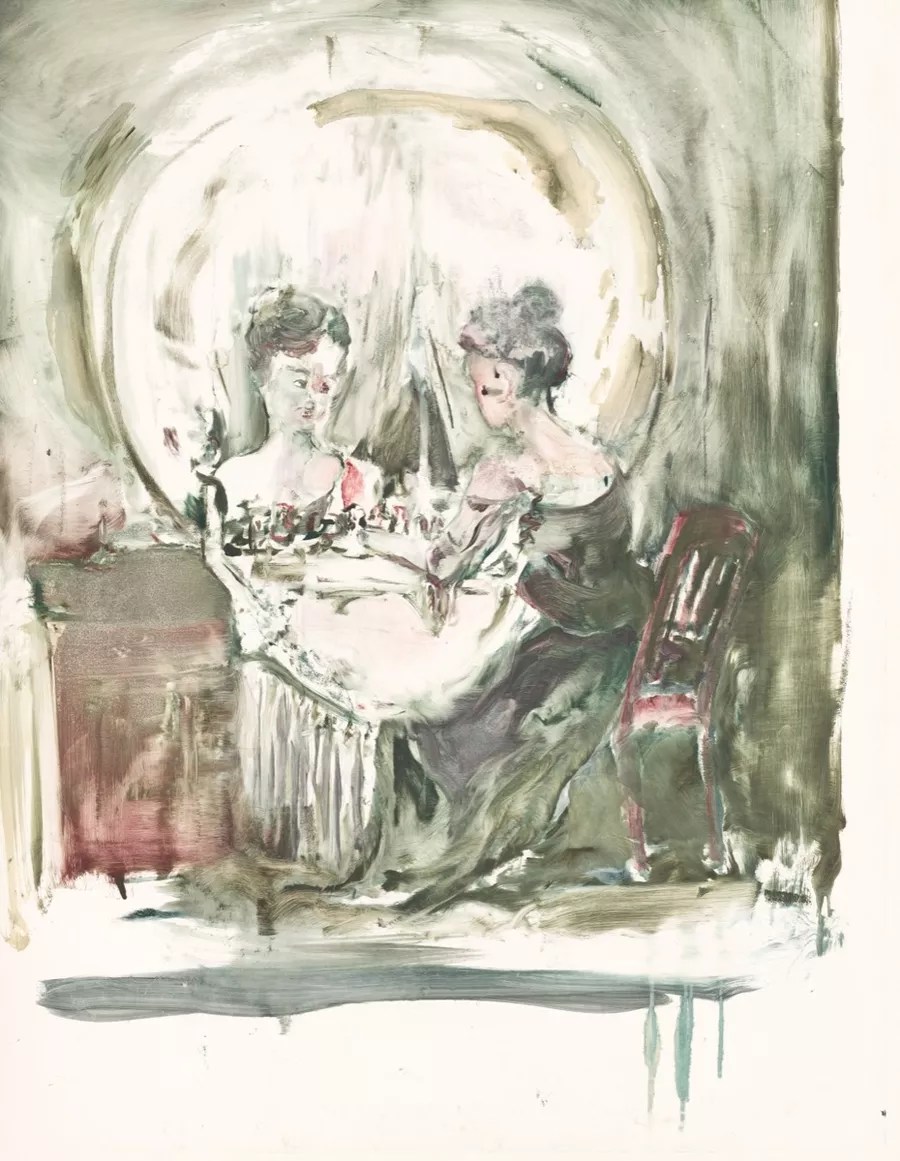
A growing number of modern artists would have us reflect on our lives and their meanings. Charlotte Jansen offers an example…
Oysters, lobsters, Louboutins—and death. At Cecily Brown’s current exhibition at the Metropolitan Museum Museum of Art, “Death and the Maid” (through December 3rd), the trappings of capitalist society seem to slip into oblivion under her lively, vigorous brushwork and lucid tableaus. Skulls, mirrors, and references to paintings of the past remind us of the madness of materialism and the certainty of death, recasting the classic theme of vanitas for the contemporary age.
Historically, the aim of a vanitas painting was to point out the vain pursuits of our mortal existence. Evolving out of a distaste for decadence and wealth, fueled by Calvinist attitudes in 16th-century Europe, these paintings imparted a clear moral message. The burgeoning middle classes had suddenly been able to afford jewels, quills, luxurious fabrics, sheet music, and books. But, these paintings warned, no matter how much pleasure those material possessions may bring, all is futile in the face of death. In these still-life compositions, the transience of life was commonly represented in depictions of skulls, burning candles, flowers, and soap bubbles.
Unlike memento mori—another genre of painting designed to remind the viewer of their mortality—vanitas works can be distinguished for their inclusion of displays of luxury and collections of items alluding to pleasure. It’s perhaps no surprise that vanitas is making its way into the works of contemporary artists—especially in bodies of work produced during the pandemic that are now being seen in public for the first time…
The human condition: “Contemporary Artists Are Reviving Vanitas, Reflecting on Death and Decadence,” in @artsy.
* Ecclesiastes 2:2
###
As we muse on mortality, we might send authentic birthday greetings to Hermann Hesse; he was born on this date in 1877. A book seller, poet, and painter, he is best known as a novelist– especially for Demian, Steppenwolf, Siddhartha, and The Glass Bead Game, all of which are animated by a search for meaning and self-knowledge (that’s thematically related to the Vanitas painters to the past and today). In 1946, he received the Nobel Prize in Literature.
You can find many of his paintings here.

“No one ever explained the octopuses”*…

We humans are forward-facing, gravity-bound plodders. David Borkenhagen wonders if the liquid motion of the octopus can radicalize our ideas about time…
… The octopus may navigate its ocean home with ease, but it can seem like a creature from another planet. It populates our popular visions of cosmic beings and extraterrestrial life, with its eight arms, three hearts, and a malleable body without bones. What’s more, its ability to camouflage itself, coupled with a propensity to hide in tight holes, make it a master of disguise. If seen, a water siphon that expels inhaled water can instantly propel the creature away from danger in any direction in three-dimensional aquatic space. Its web of radially symmetrical arms allow it to crawl in any direction with equal competence, regardless of how its head is oriented. Its soft and malleable body can move through any crevasse larger than its beak. And with its two eyes positioned on opposite sides of its head, it has a near-total field of vision with almost nothing hidden ‘behind’. These abilities give the octopus a radically different relationship to its surroundings compared with other species, human or otherwise. It is a relationship free of constraints.
And what about our bodies? Compared with the octopus, human beings appear corporeally constrained. We lack the fluid mobility and wide field of vision of our (very, very) distant cephalopod cousins. Instead, we have two eyes stuck in the front of our heads. We have a paltry two legs, hardwired for forward movement. And we are bound to our terrestrial ecological niche, where our bodies must continually counteract the downward pull of gravity.
It’s not only that our experiences of space are different. Our experiences of time are likely different, too. We think about the passage of time through our terrestrial experience of unidirectional motion through space – our metaphors of time are almost all grounded in the way our bodies move forward through the environment. Given this fact, how would an octopus, who can easily see and move in all directions, conceptualise time? Current research methods may be able to take us only part of the way toward an answer, but it’s far enough to consider a radical possibility: if we became more like an octopus, could we free time, metaphorically speaking, from its constraints? Could we experience it as multidimensional, fluid and free?…
[Borkenhagen reviews the research on octopuses and what it tells us about how their relationships with time and death]
… In many ways, the octopus represents a challenge, or a profound limit, to our conventional ways of thinking about time and death. But it’s more than a challenge. It’s also an invitation. With its unconstrained movements and semelparous lifecycle, the octopus offers a radically different perspective on the fluidity and flexibility of existence. Could we learn to move through time as an octopus moves through space? With equal access to the past, present and future – viewed wide or with sharp focus – we might better navigate the challenges of living and dying on Earth. The octopus invites us to think in a way that dissolves the boundaries between the present and the future, understanding our ‘ending’ less as a fixed point and more as a fluid process stretching across generations. As the boundary between life and death dissolves and becomes more porous, so do the boundaries between ourselves and others. The metaphors we used to inhabit our time here may seem impoverished, but there’s another way. It’s in the unconstrained movements of an octopus traveling through space – fluid, flexible and free…
“Octopus Time,” from @posts_modern in @aeonmag. Eminently worth reading in full.
Pair with The Mountain in the Sea by Ray Nayler and/or “Stories of Your Life” in the short story collection of the same title, by Ted Chiang
* Gail Garriger (@gailcarriger)
###
As we re-understand unfolding, we might recall that it was on this date in 1871 that the American Museum of Natural History opened to the public in New York City. Organized into a series of exhibits, the Museum’s collection–which had been gathered from the time of the Museum’s founding in 1869– went on view for the first time in the Central Park Arsenal, the Museum’s original home, on the eastern side of Central Park. The cornerstone of the Museum’s first building was laid in Manhattan Square (79th Street and Central Park West), the Museum’s current location, in 1874; but it is obscured from view by the many Museum buildings in the complex that today occupy most of the Square.

“To be ignorant of what occurred before you were born is to remain always a child”*…

There’s history… and then there’s deep history. C. Patrick Doncaster, a professor of ecology at Southampton University has created “Timeline of the human Condition- Milestones in Evolution and History.” Starting with the Big Bang (13.8 billion years ago) it marks significant events in Earth’s development, the evolution of life, and the development of human culture (science/technology, economics, politics, and art) all the way up to 2021.
It concludes with a trio of handy analogies…
Following the big bang 13.8 billion years ago, time passed two-thirds of the way to the present before the formation of the Sun 4.57 billion years ago. Rescaled to a calendar year, starting with the big bang at 00:00:00 on 1 January, the Sun forms on 1 September, the Earth on 2 September, earliest signs of life appear on 13 September, earliest true mammals on 26 December, and humans just 2 hours before year’s end. For a year that starts with the earliest true mammals, the dinosaurs go extinct on 17 August, earliest primates appear on 9 September, and humans at dawn of 25 December. For a year that starts with the earliest humans, our own species appears on 19 November, the first built constructions on 8 December, and agricultural farming begins at midday on 29 December.
“Timeline of the Human Condition- Milestones in Evolution and History.” (via @Recomendo6)
See also: “How We Make Sense of Time.”
* Marcus Tullius Cicero
###
As we prize perspective, we might spare a thought for James Hiram Bedford; he died on this date in 1967. A psychologist who wrote several books on occupational counseling, he is best remembered as the first person whose body was cryopreserved after legal death. He remains preserved at the Alcor Life Extension Foundation in Arizona.

You must be logged in to post a comment.