Posts Tagged ‘Death’
“The boundaries which divide Life from Death are at best shadowy and vague”*…

In the late 18th and early 19th centuries, people worried about the difficulty in measuring the line between life and death. Fearful that loved ones would be buried alive, people attached strings and bells to a finger of a person who appeared dead, so that they could detect any movement and commence or continue resuscitation.
There were also societies dedicated to the resuscitation of people who appeared to be dead, for example, the Institution of the Humane Society of the Commonwealth of Massachusetts (Humane Society) founded in 1788 and modeled after the Royal Humane Society of London founded in 1774. The Humane Society’s main purpose was to revive those apparently dead. In Boston and along the coastline, their concern lay first and foremost with the drowned. The London Society’s founders claimed that it had been successful in reviving 790 out of 1300 people “apparently dead from drowning.” The men who brought the Institution to Massachusetts hoped to replicate this effort, restoring loved ones to their friends and family members…
Early attempts to find the line between life and death: “Who is dead?”
The Premature Burial”
###
As we take our pulses, we might spare a thought for Sir Richard Blackmore; he died on this date in 1729. A physician of note, he argued that observation and the physician’s experience should take precedence over any Aristotelian ideals or hypothetical laws, and he rejected Galen’s humour theory. He wrote on plague, smallpox, and consumption.
But he is best remembered for his passion, poetry. A supporter of the Glorious Revolution, he wrote Prince Arthur, an Heroick Poem in X Books, a celebration of William III. Later he authored Blackmore produced The Nature of Man, a physiological/theological poem on climate and character (featuring the English climate as the best), and Creation: A Philosophical Poem.
While he was praised in his time by John Dennis, Joseph Addison, and, later, Samuel Johnson, history’s verdict has been written by his detractors– main among them Jonathan Swift, Alexander Pope, and John Dryden– all of whom found Blackmore’s poetry “grandeloquent,” “stupid,” and “leaden.”
(Readers can judge for themselves at the Internet Archive’s collection of his work.)

“I did not attend his funeral, but I sent a nice letter saying I approved of it”*…

The cost of burying a loved one in America has risen faster than virtually everything else over the last 30 years.
The Bureau of Labor Statistics just published a fascinating look at the cost of dying in the US… The chart below shows that the price index for funerals has risen almost twice as fast as consumer prices for all other items.
Producer prices for caskets rose 230% from December 1986 through September 2017, while prices for all commodities increased 95.1%. The data is not seasonally adjusted.
As casket costs surged, the rate of cremations surpassed burials in 2015 for a second straight year, according to the National Funeral Directors Association. Its data showed that the median cost of a funeral with viewing and burial in 2014 was $7,181, and $6078 for a funeral with viewing and cremation.
Dig in at: “It’s gotten a whole lot more expensive to die in America.”
See also: “The 10 Companies That Control the Death Industry.”
* Mark Twain
###
As we memento mori, we might spare a thought for Sir Samuel Wilks; he died on this date in 1911. Wilks, who served as President of the Royal College of Physicians in the UK., made his mark with the publication on his Lectures on Pathological Anatomy (1863)– for which he is remembered as a founding father of clinical science and modern pathology. He identified the visceral lesions of syphilis and improved the understanding of Addison’s, Bright’s and Hodgkin’s diseases. As Sir Thomas Barlow observed, “ [Wilks] started the systematic and practical teaching of morbid anatomy, and for nearly thirty years Wilks represented and embodied at Guy’s Hospital the important combination of a great morbid anatomist, and a great clinical physician and teacher.”

“I go to seek a Great Perhaps”*…

As we’ve noted before, 2016 seemed a bumper year for the Grim Reaper. Jason Crease tested that perception against the data…
It’s become cliché that unusually many prominent people died in 2016. Is this true?…
Find out at “Was 2016 especially dangerous for celebrities? An empirical analysis.“
[Image above: source]
* François Rabelais
###
As we usher in the new, we might spare a thought for the first woman in the Western world considered to be a mathematician: Maria Gaetana Agnesi, she died this date in 1799. While she thought and wrote broadly about natural science and philosophy, she is best remembered for her work in differential calculus– perhaps most particularly for her work on the cubic curve now know as the “witch of Agnesi.”

“The animals of the world exist for their own reasons. They were not made for humans any more than black people were made for white, or women created for men”*…

In 2015, more than 1.5 million people were killed by animals. That’s a startling figure. To put it in perspective, that’s about the same number of people who died from HIV/AIDS or diabetes last year.
Some of the culprits are the usual suspects of the animal kingdom. Lions, for instance, with their incredible ability to stalk prey, are responsible for the deaths of about 100 people. Hippos, very territorial, are more dangerous, claiming about 500 lives. Crocodiles are even more deadly, killing 1,000 people.
But take a look at this interactive chart [a portion of which is excerpted above] and you might be surprised to learn that the heavyweights of the animal kingdom do the least damage. Pound for pound, a shark isn’t that scary compared with many smaller creatures on the list…
The relative numbers of people killed by different animals: Bill Gates explains “Why I’d Rather Cuddle with a Shark than a Kissing Bug.”
* Alice Walker
###
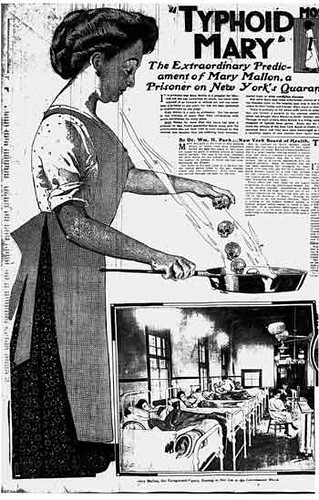
As we slather on the DEET, we might recall that it was on this date in 1938 that Mary Mallon– “Typhoid Mary”– died of a stroke on North Brother Island, where she he had been quarantined since 1915. She was the first person in the United States identified as an asymptomatic carrier of the pathogen associated with typhoid fever… before which, she inadvertently spread typhus for years while working as a cook in the New York area.
“I’m not afraid of death; I just don’t want to be there when it happens”*…

The life expectancy for the average woman in the United States is 81 years and 2 months. For men, it’s 76 years and 5 months. These are the most recent estimates from the Centers for Disease Control and Prevention. Just subtract your current age from those numbers for a rough estimate of how many years you have left.
It feels accurate. It feels precise.
But people die at various ages. Life is imprecise. Otherwise, you could just plan your days all the way up to your last.
Also, life expectancy is typically quoted “from birth.” It’s the number of years a baby is expected to live the moment he or she escapes from the womb into the wondrous realities of the outside world. This is a good measure for progress in countries and is a fine wideout view, but it’s just so-so for you and me, as individuals.
The range of your life expectancy is much more interesting…
See for yourself: toggle to your gender and age on Flowing Data‘s interactive graphic (based on data from the Social Security Administration), and see the “Years You Have Left to Live, Probably.”
* Woody Allen
###
As we memento mori, we might spare a thought for Giambattista Vico; he died on this date in 1744. A political philosopher, rhetorician, historian, and jurist, Vico was one of the greatest Enlightenment thinkers. Best known for the Scienza Nuova (1725, often published in English as New Science), he famously criticized the expansion and development of modern rationalism and was an apologist for classical antiquity.
He was an important precursor of systemic and complexity thinking (as opposed to Cartesian analysis and other kinds of reductionism); and he can be credited with the first exposition of the fundamental aspects of social science, though his views did not necessarily influence the first social scientists. Vico is often claimed to have fathered modern philosophy of history (although the term is not found in his text; Vico speaks of a “history of philosophy narrated philosophically”). While he was not strictly speaking a historicist, interest in him has been driven by historicists (like Isaiah Berlin).

You must be logged in to post a comment.