Posts Tagged ‘communication’
“‘When I use a word,’ Humpty Dumpty said in rather a scornful tone, ‘it means just what I choose it to mean — neither more nor less.'”*…
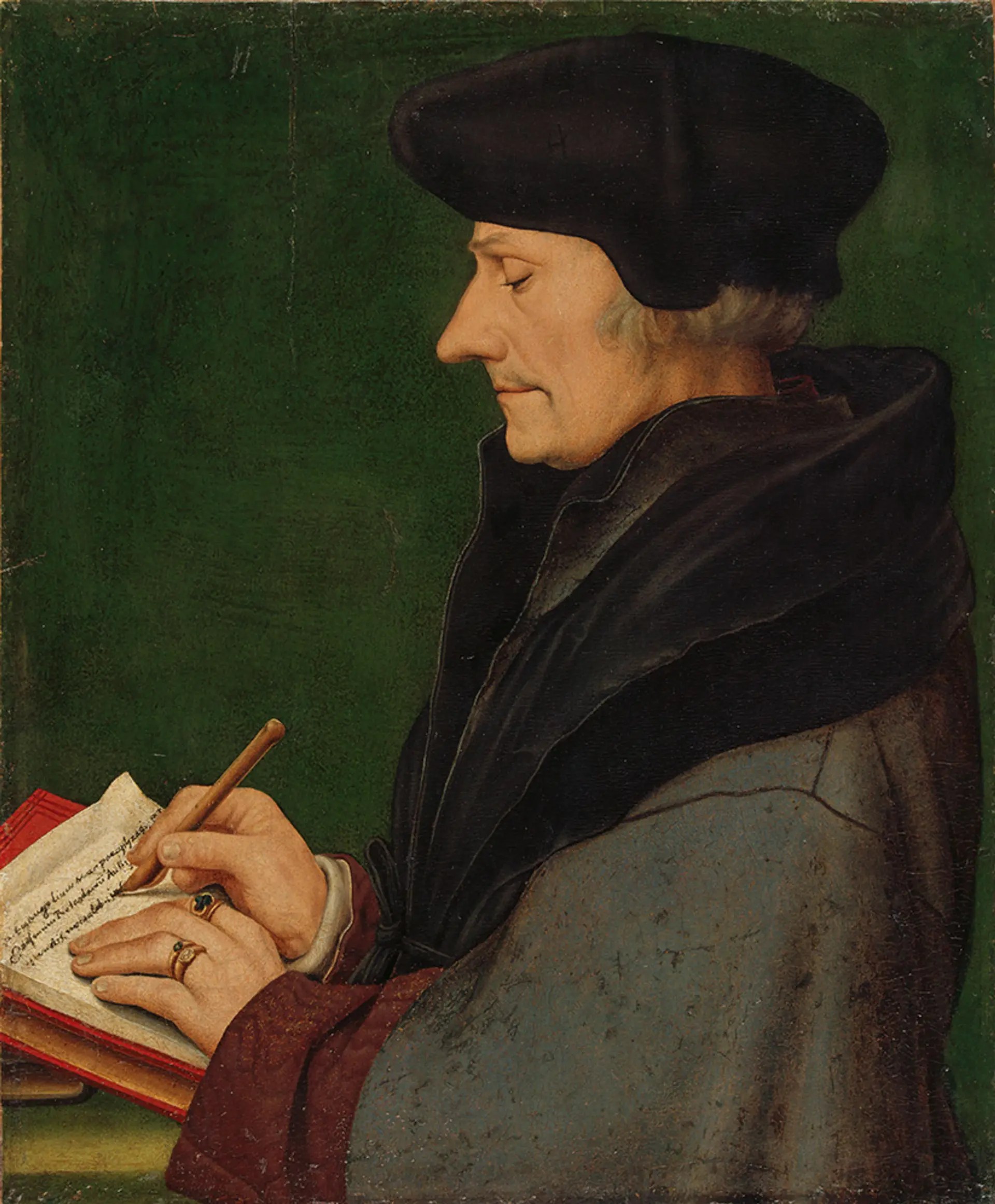
Like today’s large language models, some 16th-century humanists (like Erasmus) had techniques to automate writing. But as Hannah Katznelson explains, others (like Rabelais) called foul…
The Renaissance scholar and educator Erasmus of Rotterdam opens his polemical treatise The Ciceronian (1528) by describing the utterly dysfunctional writing process of a character named Nosoponus. The Ciceronianis structured as a dialogue, withtwo mature writers, Bulephorus and Hypologus, trying to talk Nosoponus out of his paralysing obsession with stylistic perfection. Nosoponus explains that it would take him weeks of fruitless writing and rewriting to produce a casual letter in which he asks a friend to return some borrowed books. He says that writing requires such intense concentration that he can do it only at night, when no one else is awake to distract him, and even then his perfectionism is so intense that a single sentence becomes a full night’s work. Nosoponus goes over what he’s written again and again, but remains so dissatisfied with the quality of his language that eventually he just gives up.
Nosoponus’s problem might resonate. Who has not spent too long going over the wording of a simple email, at some point or another? Today there is an easy fix: we have large language models (LLMs) to write our letters for us, helpfully proffering suggestions as to what we might say, and how we might phrase it. When I input Nosoponus’s intended request into GPT-4, it generated the following almost instantly:
Hey [Friend’s Name],
Hope you’re doing well! I just realised I never got those books back that I lent you a while ago. No rush, but whenever you get a chance, I’d love to get them back. Let me know what works for you! Thanks!
Nosoponus
But there was a solution in the 16th century, too. A humanist education on the Erasmian model could train its students to produce letters of any length, on any topic – quickly, easily and eloquently. The French humanist François Rabelais, a contemporary of Erasmus, appears to have understood these compositional techniques as automating the creating of text in a way that, retrospectively, looks a lot like how LLMs function. If we want to understand LLMs, and what they are and aren’t capable of, we can look at earlier versions of the same technology – like Erasmian humanism. We can also read authors like Rabelais, who is already thinking about automatic text-generation along these lines, as someone who appreciates the effectiveness of Erasmian generative technology, but at the same time sees it as vitiating the social force of language and, ultimately, ruining language as a tool for moral and political life…
[Katznelson recounts Erasmus’s efforts, Rabelais’s response, and unpacks the important differences between our own authentic speech language created to speak for us and their practical and moral implications…]
What lessons from the 16th century can tell us about AI and LLMs: “Methodical banality,” from @aeon.co.
* Lewis Carroll, Through the Looking Glass
###
As we honor authenticity, we might recall that it was on this date in 1886 that three U.S. patents were issued to Alexander Graham Bell’s Volta Labs for “recording and reproducing speech and other sounds.” The Graphophone, was an improved (and the first practical) version of the Edison phonograph (from 1877), and became the foundation on which the speech recording (e.g., dictaphone) and recorded music (and spoken word) industries began to grow.

“When words become unclear, I shall focus with photographs. When images become inadequate, I shall be content with silence.”*…

As Josh Begley elegantly demonstrates, silence may be nigh…
The New York Times published its first issue on September 18, 1851, but the first photos wouldn’t appear on the cover until the early 1900s over 60 years later. This visual timeline by self-described data artist Josh Begley captures the storied newspaper’s approach to layout and photography by incorporating every NY Times front page ever published into a single one-minute video. The timelapse captures decades text-only front pages before the newspaper began to incorporate illustrated maps and wood engravings. The liberal usage of black and white photography begins a century later and finally the first color photo appears in 1997. What a fascinating way to view history through image, over 60,000 front pages in all…
Showing instead of (simply) telling: “The Rise of the Image: Every NY Times Front Page Since 1852 in Under a Minute,” from @thisiscolossal.com (who found it via @kottke.org).
See the animated visualization here or here.
(TotH to EWW)
* Ansel Adams
###
As we ponder the prevalence of pictures, we might spare a thought for a man who made powerful– and beautiful– use of images, John James Audubon; he died on this date in 1851. An ornithologist, naturalist, and artist, Audubon documented all types of American birds with detailed illustrations depicting the birds in their natural habitats. His The Birds of America (1827–1839), in which he identified 25 new species, is considered one of the most important– and finest– ornithological works ever completed.

Happy Mozart’s Birthday!
“But if thought corrupts language, language can also corrupt thought”*…

In an excerpt from his book A Myriad of Tongues: How Languages Reveal Differences in How We Think, Caleb Everett on the underappreciated importance of syntax and recursion in our languages…
Words are combined into phrases and sentences in a dazzling array of patterns, collectively referred to as syntax. The complexity of syntax has long confounded researchers. Consider, for example, the previous sentence. There are all sorts of patterns in the order of the words of that sentence, patterns that are familiar to you and me and other speakers of English. Those patterns are critical to the transmission of meaning and to how we think as we create sentences. It was no coincidence that I put “complexity” after “the,” or “syntax” after “of,” or “researchers” after “confounded,” to cite just three examples of many in that sentence alone. You and I know that “researchers” should follow the main verb of this particular sentence, in this case “confounded.” If I put that word somewhere else it would change the sentence’s meaning or make it confusing. And we know that articles like “the” should precede nouns, as should prepositions like “of.” These and other patterns, sometimes referred to as “rules” as though they represented inviolable edicts voted on by a committee, help to give English sentences a predictable ordering of words. It is this predictable ordering that is usually referred to when linguists talk about a language’s syntax.
Without syntax, it would seem, statements could not be understood, because they would be transferred from speaker to hearer in a jumbled mess of words. This is, it turns out, a bit of an oversimplification since a number of the world’s languages do not have rule-governed word order to the extent that English does. Still, let us stick with the oversimplification for now, because it hints at something meaningful about speech…
An illuminating read: “What Makes Language Human?” via @lithub.
* George Orwell, 1984
###
As we contemplate cogitation and communication, we might spare a thought for Sigismund Schlomo “Sigmund” Freud; he died on this date in 1939. A neurologist, he was the founder of psychoanalysis– a clinical method for evaluating and treating pathologies seen as originating from conflicts in the psyche, through dialogue between patient and psychoanalyst, and the distinctive theory of mind and human agency derived from it.
Freud’s psychoanalysis further complicated our thinking about language: In his theory dreams are instigated by the daily occurrences and thoughts of everyday life. In what Freud called the “dream-work”, these “secondary process” thoughts (“word presentations”), governed by the rules of language and the reality principle, become subject to the “primary process” of unconscious thought (“thing presentations”) governed by the pleasure principle, wish gratification, and the repressed sexual scenarios of childhood.
Jacques Lacan built on Freud’s approach, emphasizing linguistics and literature. Lacan believed that most of Freud’s essential work had been done before 1905 and concerned the interpretation of dreams, neurotic symptoms, and slips, which had been based on a revolutionary way of understanding language and its relation to experience and subjectivity, and that ego psychology and object relations theory were based upon misreadings of Freud’s work. For Lacan (as, in a way, for the author above), the determinative dimension of human experience is neither the self (as in ego psychology) nor relations with others (as in object relations theory), but language.

.jpg)
“I’ll bet my autopsy reveals my mouth is too big”*…

MIT Press, with an excerpt from François Caradec‘s Dictionary of Gestures…
We might believe that the seat of speech (without considering ventriloquists and flatulists) has no need for the assistance of hand gestures when it comes to expressing emotions and sensations. Numerous adjectives confirm this to be true: foul, open, loud, smart, foaming, pouty, watering — the mouth can be all of these things and many more still…
The mouth also knows how to keep quiet: It is upon the mouth that the monkey of Chinese wisdom places its hands to signify that silence is always worth more than an imprudent word.
…
5. to bring one’s hand toward one’s mouth without quite touching it
Modesty. A gesture of eloquence employed by the great orators of antiquity.…
9. to insert the index finger into the mouth and use it to make the cheek “pop”
To make a face. Mockery. “Panurge bobbed and made mouths at him in token of derision” (Rabelais, “The Works of Rabelais, Book IV,” trans. Motteux, 1708). Called la babou in French, named for a witch with great big lips…
So much more at : “An Illustrated Guide to Mouth Gestures and Their Meanings Around the World,” from @mitpress.
* Calvin (Bill Watterson)
###
As we gesticulate, we might note that today is National Secretaries Day (more lately known also as Admin Day and Administrative Professional’s Day). It was created in 1952 by the National Secretaries Association, with the help of a variety of office products manufacturers, to recognize those office workers who, back then, made much of their contribution with dancing digits.

“The limits of my language means the limits of my world”*…

It seems clear that we are on the verge of an impactful new wave of technology. Venkatesh Rao suggests that it may be a lot more impactful than most of us imagine…
In October 2013, I wrote a post arguing that computing was disrupting language and that this was the Mother of All Disruptions. My specific argument was that human-to-human communication was an over-served market, and that computing was driving a classic disruption pattern by serving an under-served marginal market: machine-to-machine and organization-to-organization communications. At the time, I didn’t have AI in mind, just the torrents of non-human-readable data flowing across the internet.
But now, a decade later, it’s obvious that AI is a big part of how the disruption is unfolding.
…
Here is the thing: There is no good reason for the source and destination AIs to talk to each other in human language, compressed or otherwise, and people are already experimenting with prompts that dig into internal latent representations used by the models. It seems obvious to me that machines will communicate with each other in a much more expressive and efficient latent language, closer to a mind-meld than communication, and human language will be relegated to a “last-mile” artifact used primarily for communicating with humans. And the more they talk to each other for reasons other than mediating between humans, the more the internal languages involved will evolve independently. Mediating human communication is only one reason for machines to talk to each other.
And last-mile usage, as it evolves and begins to dominate all communication involving a human, will increasingly drift away from human-to-human language as it exists today. My last-mile language for interacting with my AI assistant need not even remotely resemble yours…
What about unmediated human-to-human communication? To the extent AIs begin to mediate most practical kinds of communication, what’s left for direct, unmediated human-to-human interaction will be some mix of phatic speech, and intimate speech. We might retreat into our own, largely wordless patterns of conviviality, where affective, gestural, and somatic modes begin to dominate. And since technology does not stand still, human-to-human linking technologies might start to amplify those alternate modes. Perhaps brain-to-brain sentiment connections mediated by phones and bio-sensors?
What about internal monologues and private thoughts. Certainly, it seems to me right now that I “think in English.” But how fundamental is that? If this invisible behavior is not being constantly reinforced by voluminous mass-media intake and mutual communications, is there a reason for my private thoughts to stay anchored to “English?” If an AI can translate all the world’s information into a more idiosyncratic and solipsistic private language of my own, do I need to be in a state of linguistic consensus with you?…
There is no fundamental reason human society has to be built around natural language as a kind of machine code. Plenty of other species manage fine with simpler languages or no language at all. And it is not clear to me that intelligence has much to do with the linguistic fabric of contemporary society.
This means that once natural language becomes a kind of compile target during a transient technological phase, everything built on top is up for radical re-architecture.
Is there a precedent for this kind of wholesale shift in human relationships? I think there is. Screen media, television in particular, have already driven a similar shift in the last half-century (David Foster Wallace’s E Unibas Pluram is a good exploration of the specifics). In screen-saturated cultures, humans already speak in ways heavily shaped by references to TV shows and movies. And this material does more than homogenize language patterns; once a mass media complex has digested the language of its society, starts to create them. And where possible, we don’t just borrow language first encountered on screen: we literally use video fragments, in the form of reaction gifs, to communicate. Reaction gifs constitute a kind of primitive post-idiomatic hyper-language comprising stock phrases and non-verbal whole-body communication fragments.
…
Now that a future beyond language is imaginable, it suddenly seems to me that humanity has been stuck in a linguistically constrained phase of its evolution for far too long. I’m not quite sure how it will happen, or if I’ll live to participate in it, but I suspect we’re entering a world beyond language where we’ll begin to realize just how deeply blinding language has been for the human consciousness and psyche…
Eminently worth reading in full (along with his earlier piece, linked in the text above): “Life After Language,” from @vgr.
(Image above: source)
* Ludwig Wittgenstein, Tractatus logigo-philosphicus
###
As we ruminate on rhetoric, we might send thoughtful birthday greetings to Bertrand Russell; he was born on this date in 1872. A mathematician, philosopher, logician, and public intellectual, his thinking has had a powerful influence on mathematics, logic, set theory, linguistics, artificial intelligence, cognitive science, computer science. and various areas of analytic philosophy, especially philosophy of mathematics, philosophy of language, epistemology, and metaphysics.
Indeed, Russell was– with his predecessor Gottlob Frege, his friend and colleague G. E. Moore, and his student and protégé Wittgenstein— a founder of analytic philosophy, one principal focus of which was the philosophy of language.

You must be logged in to post a comment.