Posts Tagged ‘climate’
“There are things done today in electrical science which would have been deemed unholy by the very men who discovered electricity, who would themselves not so long before have been burned as wizards”*…

Climate change continues. There is broad evidence (and consensus) that our environment, thus our ways of life, our livelihoods— indeed, our lives— are threatened. On the heels of a call from Trump to world leaders to abandon the climate fight, followed by a disappointing COP30 conference, it’s easy to be discouraged. But that, of course, is no answer.
Rather, we have to find ways to mitigate the damage that we’ve already locked in, even as we acclerate a transition to clean energy… which begins by (re-)framing and (re-)focusing the challenge. Ember, a clean energy think tank, suggests a candidate that, while it speaks to the moral obligations addressed by one of the models it means to augment/replace, has a more positive orientation…
Humanity is graduating from burning fossil commodities to harnessing manufactured technologies—from hunting scarce fossils to farming the inexhaustible sun, from consuming Earth’s resources to
merely borrowing them.This isn’t a marginal climate substitution. It’s an energy revolution.
The magnetic centre is the electron: we are revolutionising how we generate, use, and connect
electrons. Solar and wind are conquering electricity supply. EVs, heat pumps, and AI are electrifying major new uses. Batteries and digitalisation are connecting supply and demand.Three reinforcing shifts. One energy revolution. The electrotech revolution.
At its core, this revolution is driven by physics, economics, and geopolitics. After all, the arc of energy
history bends towards solutions that are leaner, cheaper and more secure.Short-terms setbacks matter, but fundamentals matter more. And the fundamentals are stacked in electrotech’s favour.
Physics. Electrotech makes a mockery of setting fossils on fire and losing two-thirds of the energy to heat. Electrotech is three times as efficient.
Economics. Technologies get cheaper with scale. Commodities get more expensive the deeper you dig.
Geopolitics. Three quarters of the world is dependent on fossil imports. 92% of countries have renewables potential over 10x their current demand.
Electrotech has grown exponentially for decades. The difference today is that it’s too cheap to contain and too big to ignore. If current exponentials hold for five more years, global fossil demand will fall off its plateau.
Welcome to the Age of Electrotech…
A long and meaty presentation: “The Electrotech Revolution- the shape of things to come,” from @ember-energy.org.
One notes that the electrification that Ember pushes has other advocates, many of whom have been vocal for years; c.f., e.g., Saul Griffin. Still, another voice in the chorus is welcome.
* Bram Stoker
###
As we plug in, we might send charged birthday greetings to Franz Aepinus; he was born on this date in 1724. A mathematician, scientist, and natural philosopher, he is best known for his research, both theoretical and experimental, into electricity and magnetism. Aepinus’ Tentamen theoriae electricitatis et magnetismi (1759; “An Attempt at a Theory of Electricity and Magnetism”) was the first work to apply mathematics to the theory of electricity and magnetism. And his experiments led to the design of the parallel-plate capacitor, a device used to store energy in an electric field.

“We are the first generation to feel the effect of climate change and the last generation who can do something about it”*…

One of the issues that vexes coordinated response is a paradox that lies at the heart of the phenomenon: Earth’s climate is chaotic and volatile. Climate change is simple and predictable. How can both be true? Joseph Howlett explains…
The Earth’s atmosphere is nothing but freely roaming molecules. Left alone, they would drift and collide, and eventually even out into a mixture that’s dynamic, yet stable and broadly unchanging.
The sun’s rays complicate things. Energy enters the Earth system in daily cycles, the bulk of it going to whichever half of the planet is tilted toward the sun (and experiencing summer). The molecules in that half acquire more energy than others, which sets the global atmosphere steadily swirling. Depending on the season and location, molecules in our atmosphere might traverse warm land, then cold seas. They might encounter a mountain range that forces them to high altitudes, where the air pressure is low and water condenses. Then they might become part of large-scale phenomena, such as currents, atmospheric rivers, turbulent jet streams and continental fronts.
These phenomena are erratic. They interact at every scale and manifest as weather, from clear sunny days to blustery blizzards and the anomalous events — from hurricanes and polar vortices to hailstorms and tornadoes — that are happening with increasing intensity. Any thought of stability is illusory; no patch of molecules dances in isolation.
The result, from seemingly simple inputs of molecules and energy, is emergent, incalculable chaos. Some individual molecule in the room you are sitting in is careening about blindly and colliding with its immediate neighbors. Zoom out — block to city, field to landscape, region to continent — and patterns appear and intermix. Complexity abounds and compounds. Nothing in the atmosphere is untethered from the rest of the global picture.
We live with this unpredictable mess of an atmosphere every day. We tote around unopened umbrellas, or refresh weather apps and watch our weekend plans dissolve. Anticipating conditions any further out than a week or two is a fool’s errand. The Earth is a complex dynamical system — an interwoven mass of moving parts, each of which requires a different branch of science to understand. Even with advanced knowledge, sophisticated algorithms and modern instruments, it defies and eludes us.
Yet this engine of chaos is now under our influence. It is incontrovertible fact that we are changing the Earth’s temperature by adding more carbon dioxide to the atmosphere. We know exactly how we are changing it — that when we double the proportion of carbon dioxide in the thin layer that rests over the surface of the Earth, the planet will become 2 to 4 degrees Celsius warmer, overall, than it is today. This conclusion has remained essentially unchanged since 1896, when the Swedish scientist Svante Arrhenius arrived at an estimate of 2 to 5 degrees. (Using an extraordinarily simplified picture of Earth, he made a number of mistakes that, in the end, balanced out.) Some details may remain uncertain, some chaos untamable, but the basic conclusion is a matter of unwavering scientific agreement — 97% is a rare degree of consensus on almost any subject. We are nearly as sure of this as we are of the causes of infectious disease, or how stars form, or the fact that life evolves through natural selection.
oth things are true: The climate system is vastly complex, and we’re certain about what we are doing to it. How can we be so confident in a hundred-year projection when we can’t predict the weather with any reliability more than a week out?
“How can it be that both are true?” said Nadir Jeevanjee, an atmospheric physicist at NOAA’s Geophysical Fluid Dynamics Laboratory, a leading institution for cutting-edge simulations of the atmosphere. “It’s a huge tension that’s lurking behind the whole conversation.”
It turns out that complexity can be a veil concealing more basic truths. An enormously complicated system can yield simple answers. You just have to ask a simple enough question…
Read on for Howlett’s fascinating– and important– explanation: “The Climate Change Paradox,” from @quantamagazine.bsky.social.
And for a reminder that this matters (as though we need one…): “Human-Caused Warming Tripled the Death Toll of European Heat Waves This Summer, New Report Shows,” from @insideclimatenews.org.
* Barack Obama
###
As face reality, we might recall that on this date in 1988, the #1 song in the U.S. was Bobby McFerrin‘s “Don’t Worry, Be Happy,” the first a cappella song to reach the top of the Billboard Hot 100 chart, a position it held for two weeks.
(Produced by Colossal Pictures, Directed by Drew Takahashi)
“Sooner or later everyone sits down to a banquet of consequences”*…
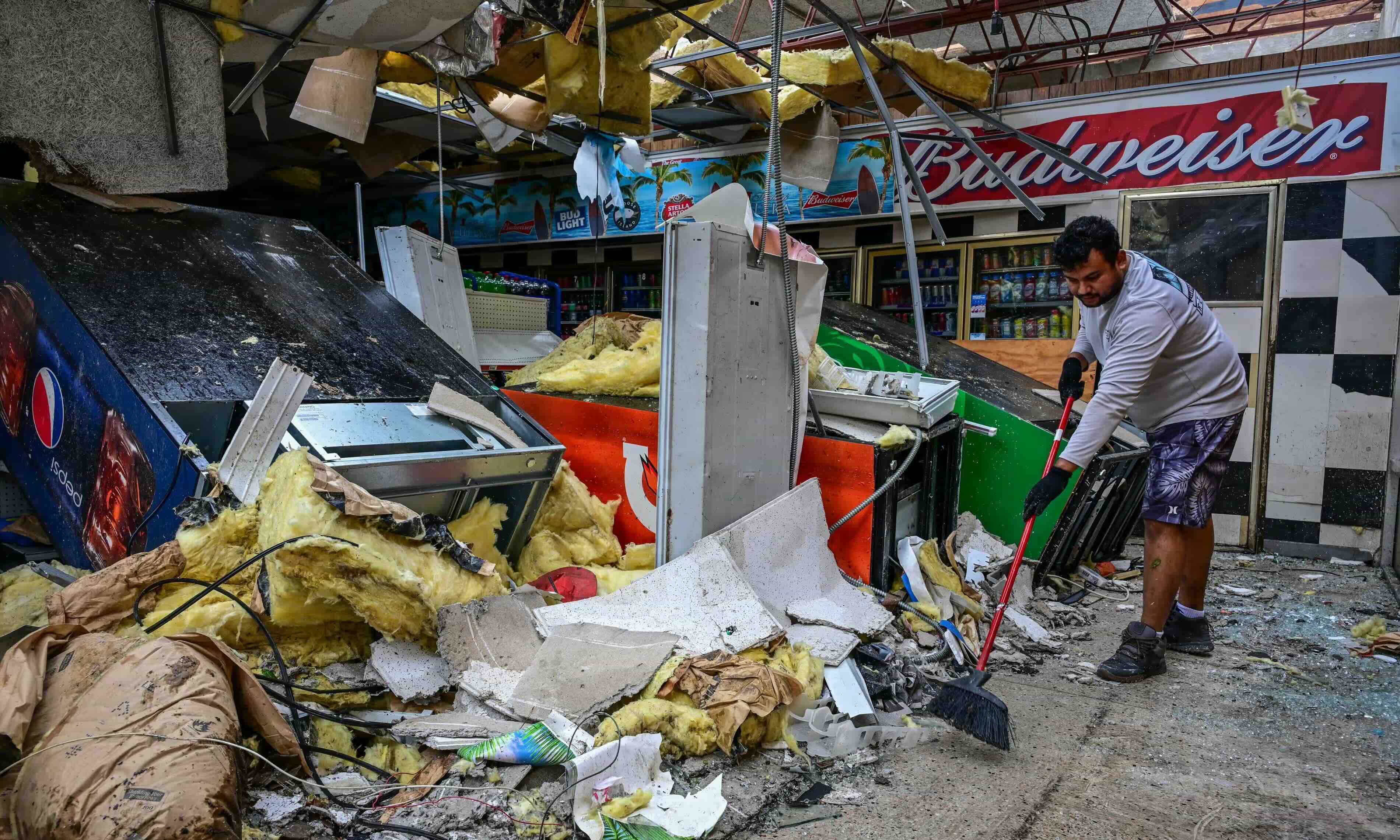
A report issued by International Chamber of Commerce late last year found that extreme weather cost $2tn globally over last decade; the U.S. suffered the greatest losses. As Damian Carrington reports, a leading insurance executive is warning that urgent action is needed to save the conditions under which markets – and civilization itself – can operate…
The climate crisis is on track to destroy capitalism, a top insurer has warned, with the vast cost of extreme weather impacts leaving the financial sector unable to operate.
The world is fast approaching temperature levels where insurers will no longer be able to offer cover for many climate risks, said Günther Thallinger, on the board of Allianz SE, one of the world’s biggest insurance companies. He said that without insurance, which is already being pulled in some places, many other financial services become unviable, from mortgages to investments.
Global carbon emissions are still rising and current policies will result in a rise in global temperature between 2.2C and 3.4C above pre-industrial levels. The damage at 3C will be so great that governments will be unable to provide financial bailouts and it will be impossible to adapt to many climate impacts, said Thallinger, who is also the chair of the German company’s investment board and was previously CEO of Allianz Investment Management.
The core business of the insurance industry is risk management and it has long taken the dangers of global heating very seriously. In recent reports, Aviva said extreme weather damages for the decade to 2023 hit $2tn, while GallagherRE said the figure was $400bn in 2024. Zurich said it was “essential” to hit net zero by 2050.
Thallinger said: “The good news is we already have the technologies to switch from fossil combustion to zero-emission energy. The only thing missing is speed and scale. This is about saving the conditions under which markets, finance, and civilisation itself can continue to operate.”
Nick Robins, the chair of the Just Transition Finance Lab at the London School of Economics, said: “This devastating analysis from a global insurance leader sets out not just the financial but also the civilisational threat posed by climate change. It needs to be the basis for renewed action, particularly in the countries of the global south.”
“The insurance sector is a canary in the coalmine when it comes to climate impacts,” said Janos Pasztor, former UN assistant secretary-general for climate change.
The argument set out by Thallinger in a LinkedIn post begins with the increasingly severe damage being caused by the climate crisis: “Heat and water destroy capital. Flooded homes lose value. Overheated cities become uninhabitable. Entire asset classes are degrading in real time.”
“We are fast approaching temperature levels – 1.5C, 2C, 3C – where insurers will no longer be able to offer coverage for many of these risks,” he said. “The math breaks down: the premiums required exceed what people or companies can pay. This is already happening. Entire regions are becoming uninsurable.” He cited companies ending home insurance in California due to wildfires.
Thallinger said it was a systemic risk “threatening the very foundation of the financial sector”, because a lack of insurance means other financial services become unavailable: “This is a climate-induced credit crunch.”
“This applies not only to housing, but to infrastructure, transportation, agriculture, and industry,” he said. “The economic value of entire regions – coastal, arid, wildfire-prone – will begin to vanish from financial ledgers. Markets will reprice, rapidly and brutally. This is what a climate-driven market failure looks like.”
No governments will realistically be able to cover the damage when multiple high-cost events happen in rapid succession, as climate models predict, Thallinger said. Australia’s disaster recovery spending has already increased sevenfold between 2017 and 2023, he noted.
The idea that billions of people can just adapt to worsening climate impacts is a “false comfort”, he said: “There is no way to ‘adapt’ to temperatures beyond human tolerance … Whole cities built on flood plains cannot simply pick up and move uphill.”
At 3C of global heating, climate damage cannot be insured against, covered by governments, or adapted to, Thallinger said: “That means no more mortgages, no new real estate development, no long-term investment, no financial stability. The financial sector as we know it ceases to function. And with it, capitalism as we know it ceases to be viable.”
The only solution was to cut fossil fuel burning, or capture the emissions, he said, with everything else being a delay or distraction. He said capitalism must solve the crisis, starting with putting its sustainability goals on the same level as financial goals.
Many financial institutions have moved away from climate action after the election of the US president, Donald Trump, who has called such action a “green scam”. Thallinger said in February: “The cost of inaction is higher than the cost of transformation and adaptation. If we succeed in our transition, we will enjoy a more efficient, competitive economy [and] a higher quality of life.”…
It’s time, if not past time, to act: “Climate crisis on track to destroy capitalism, warns top insurer,” from @dpcarrington.bsky.social in @theguardian.com.
Further to the point: “Get ready for several years of killer heat, top weather forecasters warn.”
See also: “Q&A: Kiley Bense on Climate Journalism in a New Information Environment.”
(Image above: source)
* Robert Louis Stevenson
###
As we contemplate craziness, we might recall that it was on this date in 2011 that the Wallow Fire started. A wildfire that started in the White Mountains near Alpine, Arizona, it was named for the Bear Wallow Wilderness area where the fire originated.
The fire eventually spread across the stateline into western New Mexico. By the time the fire was contained on July 8, it had consumed 538,049 acres of land, 522,642 acres in Arizona and 15,407 acres in New Mexico. It was the largest wildfire in Arizona history and did an estimated estimated cost was $109 million in damages. Smoke from the Wallow Fires and others in Arizona and New Mexico extended through Texas and Oklahoma up into the Great Lakes region, affecting air quality for large areas east of the Rocky Mountains.

“Every picture tells a story”*…

The world’s populations is unevenly spread across the globe. But, plotted by latitude (as per this visualization from Engaging Data), it’s a little more concentrated…

… which is interesting (perhaps better said, “bracing”) to consider aside this illustration from NOAA…

Global warming is coming for most of us: “World Population Distribution by Latitude and Longitude,” from @engagingdata.bsky.social and @climate.noaa.gov.
See also: “The world is heating up. How much can our bodies handle?” from @gristnews.bsky.social and “Understanding Climate Migration,” from RAND.
* traditional saying
###
As we feel the heat, we might spare a thought for John Graunt; he died on this date in 1674. A haberdasher turned statistician, he is considered by many to be the father of demography (the statistical study of human populations).
A charter member of The Royal Society, Graunt distributed a 90-page book, Natural and Political Observations Mentioned in a Following Index, and Made upon the Bills of Mortality at the February, 1662 Society meeting. He described his work as having “reduced several great confused volumes” of parish records into a few easily to understood tables, and “abridged such Observations… into a few succinct Paragraphs.” He initiated “life tables” of life expectancy. His use of demographics was further pioneered by his friend Sir William Petty and Edmond Halley, the Astronomer Royal.
Graunt’s work also gives him some claim to having been the first epidemiologist.

“The last act is the greatest treason: To do the right deed for the wrong reason”*…

Climate change is wreaking an increasing amount of havoc in the U.S. and around the world. Many are worried that the political turn to right in so much of the world will aggravate the situation. But Nathan Gardels suggests that, while the current political temper is out of sync with the planetary imperative, it may still present a path forward.
He begins by recounting his Berggruen Institute colleague Nils Gilman‘s call for a planetary response, then …
… [In sum] What is needed, says Gilman, “is a radical rethink of the very architecture of planetary governance in light of this condition of planetarity.” Or, as I put it… what is now called for is not the old “realpolitik” that seeks to secure the interests of nation-states against each other but a “Gaiapolitik” that aims at securing a livable biosphere for all.As logically compelling as this case may be, the paradigm shift underway is going in the opposite direction. Instead of the global interconnectivity forged in recent decades maturing into a planetary perspective, it is breaking up into a renewed nationalism more emphatic than before the advent of globalization.
In short… the present political temper across the world is out of sync with the planetary imperative.
All of this makes the politics of what can be called “planetary realism” a vexing endeavor. It entails both a recognition of the interdependence of the planetary condition as well as a realistic grasp of what it will take to navigate through what remains a world of nation-states.
This is where such alternative notions as decision-division allocated among appropriate scales of governance, sub-national as well as non-state networks of the willing, and a “partnership of rivals” come in.
For example, when President-elect Donald Trump formally pulled the U.S. out of the Paris climate accord during his last administration, then-California Governor Jerry Brown intensified the state’s cooperation with China’s provinces on de-carbonization strategies, including efforts, among others, to align the metrics of their carbon-trading markets so they could one day be integrated with each other. The present governor, Gavin Newsom, also visited China last year to meet President Xi Jinping to enhance and deepen that collaboration even as U.S.-China relations worsened at the national level.
Acting as a new breed of subnational statesmen, both Brown and Newsom have understood that while the U.S. and China may well survive the decoupling of their economies from each other, the world will not survive the decoupling of climate cooperation between the two largest carbon emitters on the planet. “Divorce is not an option,” Newsom declared in Beijing last year.
Despite all other tensions between these two incommensurate political systems, what Newsom calls the “fundamental and foundational” climate summons must bind the two together in partnership despite rivalry in other realms. This climate cooperation embodies the idea of “a partnership of rivals.”
California is just one case among many where trans-localism can circumnavigate geopolitics. We don’t have to wait for the nation-state as the cumulative causation of local, regional and non-state actors can move the needle. One saving grace of the climate challenge is that, as a distributed reality, it can be addressed in a distributed way.
While climate action does not have to wait for the nation-state, the capacity of nation-states to mobilize domestic populations and resources to shape outcomes remains decisive for crossing the threshold of effective mitigation.
Here, something new is emerging — “green nationalism” — that, in essence, does the right thing for other reasons. Or, to put it another way, it paradoxically advances the planetary agenda on nationalist grounds.
Industrial policies designed to make the green energy transition across America, Europe and China are all competing to protect and promote national self-interest vis-a-vis each other rather than collaborating as a species facing a common threat. Subsidies here are put in place to counter subsidies there. Tariffs or outright bans are blocking the spread of electric vehicles, batteries, solar panels and critical supply-chain minerals across borders. All these policies are aimed at building homegrown industries of the future.
Recently, Italy’s right-leaning prime minister, Giorgia Meloni, put a new twist on the issue. She argues that her country must implement serious climate policies as a key way to keep migrants from the Global South trekking north as climate refugees.
At the COP29 meeting in Azerbaijan, Viktor Orbán, declared Hungary was positioning itself to become “a significant player in electric vehicle development and electricity storage” as a basis for bolstering and sustaining national strength in the fiercely competitive times ahead. Unlike other Western nations, the pugnacious autocrat intends to do so through collaboration with his Chinese friends to leverage their prowess in green-tech development.
It is entirely conceivable that Elon Musk can sell the climate-denier-in-chief on the need for a robust EV industry and infrastructure in the U.S. as the best way to stay ahead of China and, for the same reason, Big Tech can sell him on a revival of non-fossil fuel nuclear energy to power its data centers as part and parcel of national security.
On the face of it, all this may seem a fatal fragmentation. But there may be another way we are compelled to look at it. We have the legitimacy framework we have — the nation-state — not the one we wish we had.
The hard truth seems to be that competitive green nationalism in the realpolitik mold possesses the kind of political legitimacy required for effective action that would take Gaiapolitik generations to achieve at the planetary level.
As the climate clock is ticking, green nationalism is beginning to appear as the most politically organic way to move forward as fast as possible at this historic juncture. In tandem with subnational and non-state networks, it in some ways manifests the very kind of distributed action that decision-division according to scale envisions. Though each may be going it alone, all are going in the same direction.
That is not an endorsement, but simply a recognition of the best we can probably hope for in the intermediate term.
Making lemonade from the lemons we have: “Green Nationalism,” from @noemamag.com @nilsgilman.bsky.social.
* T. S. Eliot, Murder in the Cathedral
###
As we search for silver linings, we might recall that it was on this date in 2021 that a rare and record-breaking derecho and tornado outbreak caused widespread damage that was focused across Kansas, Nebraska, Iowa, Minnesota, and Wisconsin. There were many reports of hurricane-force thunderstorm wind gusts and more than 50 tornadoes causing widespread damage to homes, vehicles, businesses and infrastructure (totaling roughly $2 Billion). This was the first December derecho on record to occur within the United States. This event also produced the first December tornado on record in Minnesota since 1950, with 17 tornadoes reported across southeast Minnesota.
(Your correspondent will note that yesterday, December 14, San Francisco experienced its first tornado warning in recorded history.)

You must be logged in to post a comment.