Posts Tagged ‘artificial intelligence’
“Without reflection, we go blindly on our way”*…

… or at least sociopathic. Indeed, Evgeny Morozov suggests, we may be well on our way. There may be versions of A.G.I. (Artificial General Intelligence) that will be a boon to society; but, he argues, the current approaches aren’t likely to yield them…
… The mounting anxiety about A.I. isn’t because of the boring but reliable technologies that autocomplete our text messages or direct robot vacuums to dodge obstacles in our living rooms. It is the rise of artificial general intelligence, or A.G.I., that worries the experts.
A.G.I. doesn’t exist yet, but some believe that the rapidly growing capabilities of OpenAI’s ChatGPT suggest its emergence is near. Sam Altman, a co-founder of OpenAI, has described it as “systems that are generally smarter than humans.” Building such systems remains a daunting — some say impossible — task. But the benefits appear truly tantalizing.
Imagine Roombas, no longer condemned to vacuuming the floors, that evolve into all-purpose robots, happy to brew morning coffee or fold laundry — without ever being programmed to do these things.Sounds appealing. But should these A.G.I. Roombas get too powerful, their mission to create a spotless utopia might get messy for their dust-spreading human masters. At least we’ve had a good run.Discussions of A.G.I. are rife with such apocalyptic scenarios. Yet a nascent A.G.I. lobby of academics, investors and entrepreneurs counter that, once made safe, A.G.I. would be a boon to civilization. Mr. Altman, the face of this campaign, embarked on a global tour to charm lawmakers. Earlier this year he wrote that A.G.I. might even turbocharge the economy, boost scientific knowledge and “elevate humanity by increasing abundance.”
This is why, for all the hand-wringing, so many smart people in the tech industry are toiling to build this controversial technology: not using it to save the world seems immoral. They are beholden to an ideology that views this new technology as inevitable and, in a safe version, as universally beneficial. Its proponents can think of no better alternatives for fixing humanity and expanding its intelligence.But this ideology — call it A.G.I.-ism — is mistaken. The real risks of A.G.I. are political and won’t be fixed by taming rebellious robots. The safest of A.G.I.s would not deliver the progressive panacea promised by its lobby. And in presenting its emergence as all but inevitable, A.G.I.-ism distracts from finding better ways to augment intelligence.
Unbeknown to its proponents, A.G.I.-ism is just a bastard child of a much grander ideology, one preaching that, as Margaret Thatcher memorably put it, there is no alternative, not to the market.
Rather than breaking capitalism, as Mr. Altman has hinted it could do, A.G.I. — or at least the rush to build it — is more likely to create a powerful (and much hipper) ally for capitalism’s most destructive creed: neoliberalism.
Fascinated with privatization, competition and free trade, the architects of neoliberalism wanted to dynamize and transform a stagnant and labor-friendly economy through markets and deregulation…
… the Biden administration has distanced itself from the ideology, acknowledging that markets sometimes get it wrong. Foundations, think tanks and academics have even dared to imagine a post-neoliberal future.Yet neoliberalism is far from dead. Worse, it has found an ally in A.G.I.-ism, which stands to reinforce and replicate its main biases: that private actors outperform public ones (the market bias), that adapting to reality beats transforming it (the adaptation bias) and that efficiency trumps social concerns (the efficiency bias).These biases turn the alluring promise behind A.G.I. on its head: Instead of saving the world, the quest to build it will make things only worse. Here is how…
[There follows a bracing run-down…]
… Margaret Thatcher’s other famous neoliberal dictum was that “there is no such thing as society.”The A.G.I. lobby unwittingly shares this grim view. For them, the kind of intelligence worth replicating is a function of what happens in individuals’ heads rather than in society at large.
But human intelligence is as much a product of policies and institutions as it is of genes and individual aptitudes. It’s easier to be smart on a fellowship in the Library of Congress than while working several jobs in a place without a bookstore or even decent Wi-Fi.
It doesn’t seem all that controversial to suggest that more scholarships and public libraries will do wonders for boosting human intelligence. But for the solutionist crowd in Silicon Valley, augmenting intelligence is primarily a technological problem — hence the excitement about A.G.I.
However, if A.G.I.-ism really is neoliberalism by other means, then we should be ready to see fewer — not more — intelligence-enabling institutions. After all, they are the remnants of that dreaded “society” that, for neoliberals, doesn’t really exist. A.G.I.’s grand project of amplifying intelligence may end up shrinking it.
Because of such solutionist bias, even seemingly innovative policy ideas around A.G.I. fail to excite. Take the recent proposal for a “Manhattan Project for A.I. Safety.” This is premised on the false idea that there’s no alternative to A.G.I.But wouldn’t our quest for augmenting intelligence be far more effective if the government funded a Manhattan Project for culture and education and the institutions that nurture them instead?
Without such efforts, the vast cultural resources of our existing public institutions risk becoming mere training data sets for A.G.I. start-ups, reinforcing the falsehood that society doesn’t exist…
If it’s true that we shape our tools, then our tools shape us, then it behooves us to be very careful as to how we shape them… Eminently worth reading in full: “The True Threat of Artificial Intelligence” (gift link) from @evgenymorozov in @nytimes.
Apposite: on the A. I. we currently have: “The LLMentalist Effect: how chat-based Large Language Models replicate the mechanisms of a psychic’s con,” from @baldurbjarnason.
[Image above: source]
* Margaret J. Wheatley
###
As we set aside solutionism, we might we might send thoroughly-organized birthday greetings to Josiah Wedgwood; he was born on this date in 1730. An English potter, businessman (he founded the Wedgwood company), and inventor (he designed the company’s process machinery and high-temperature beehive-shaped kilns), he is credited, via his technique of “division of labor,” with the industrialization of the manufacture of pottery– and via his example, much of British (and thus American) manufacturing. Wedgwood was a member of the Lunar Society, the Royal Society, and was an ardent abolitionist. His daughter, Susannah, was the mother of Charles Darwin.

“Nothing is so painful to the human mind as a great and sudden change”*…
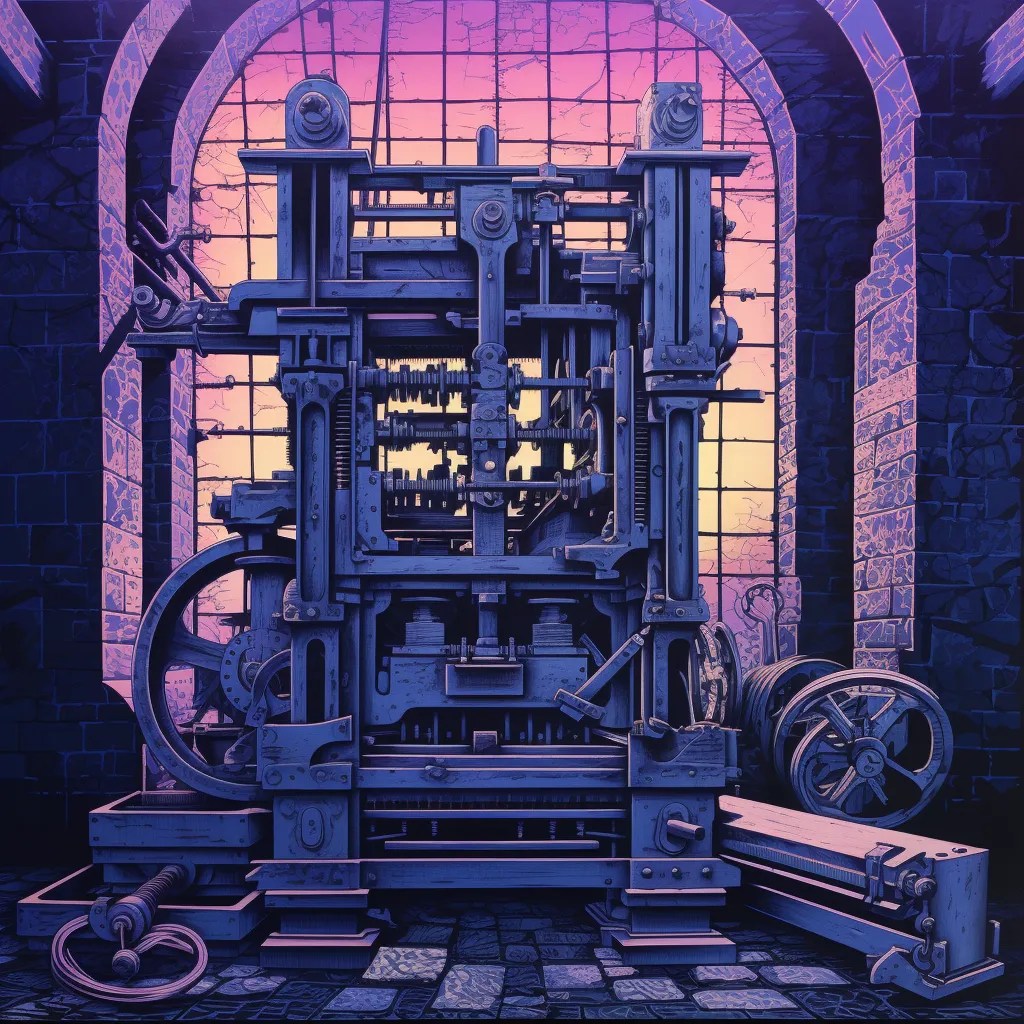
If an AI-infused web is the future, what can we learn from the past? Jeff Jarvis has some provocative thoughts…
The Gutenberg Parenthesis—the theory that inspired my book of the same name—holds that the era of print was a grand exception in the course of history. I ask what lessons we may learn from society’s development of print culture as we leave it for what follows the connected age of networks, data, and intelligent machines—and as we negotiate the fate of such institutions as copyright, the author, and mass media as they are challenged by developments such as generative AI.
Let’s start from the beginning…
In examining the half-millennium of print’s history, three moments in time struck me:
- After Johannes Gutenberg’s development of movable type in the 1450s in Europe (separate from its prior invention in China and Korea), it took a half-century for the book as we now know it to evolve out of its scribal roots—with titles, title pages, and page numbers. It took another century, until this side and that of 1600, before there arose tremendous innovation with print: the invention of the modern novel with Cervantes, the essay with Montaigne, a market for printed plays with Shakespeare, and the newspaper.
- It took another century before a business model for print at last emerged with copyright, which was enacted in Britain in 1710, not to protect authors but instead to transform literary works into tradable assets, primarily for the benefit of the still-developing industry of publishing.
- And it was one more century—after 1800—before major changes came to the technology of print: the steel press, stereotyping (to mold complete pages rather than resetting type with every edition), steam-powered presses, paper made from abundant wood pulp instead of scarce rags, and eventually the marvelous Linotype, eliminating the job of the typesetter. Before the mechanization and industrialization of print, the average circulation of a daily newspaper in America was 4,000 (the size of a healthy Substack newsletter these days). Afterwards, mass media, the mass market, and the idea of the mass were born alongside the advertising to support them.
One lesson in this timeline is that the change we experience today, which we think is moving fast, is likely only the beginning. We are only a quarter century past the introduction of the commercial web browser, which puts us at about 1480 in Gutenberg years. There could be much disruption and invention still ahead. Another lesson is that many of the institutions we assume are immutable—copyright, the concept of creativity as property, mass media and its scale, advertising and the attention economy—are not forever. That is to say that we can reconsider, reinvent, reject, or replace them as need and opportunity present…
Read on for his suggestion for a reinvention of copyright: “Gutenberg’s lessons in the era of AI,” from @jeffjarvis via @azeem in his valuable newsletter @ExponentialView.
* Mary Wollstonecraft Shelley, Frankenstein
###
As we contemplate change, we might spare a thought for Jan Hus. A Czech theologian and philosopher who became a Church reformer, he was burned at the stake as a heretic (for condemning indulgences and the Crusades) on this date in 1415. His teachings (which largely echoed those of Wycliffe) had a strong influence, over a century later, on Martin Luther, helping inspire the Reformation… which was fueled by Gutenberg’s technology, which had been developed and begun to spread in the meantime.

“The sad thing about artificial intelligence is that it lacks artifice and therefore intelligence”*…

Ah, but what about humor…
Humor is a central aspect of human communication that has not been solved for artificial agents so far. Large language models (LLMs) are increasingly able to capture implicit and contextual information. Especially, OpenAI’s ChatGPT recently gained immense public attention. The GPT3-based model almost seems to communicate on a human level and can even tell jokes. Humor is an essential component of human communication. But is ChatGPT really funny? We put ChatGPT’s sense of humor to the test. In a series of exploratory experiments around jokes, i.e., generation, explanation, and detection, we seek to understand ChatGPT’s capability to grasp and reproduce human humor. Since the model itself is not accessible, we applied prompt-based experiments. Our empirical evidence indicates that jokes are not hard-coded but mostly also not newly generated by the model. Over 90% of 1008 generated jokes were the same 25 Jokes. The system accurately explains valid jokes but also comes up with fictional explanations for invalid jokes. Joke-typical characteristics can mislead ChatGPT in the classification of jokes. ChatGPT has not solved computational humor yet but it can be a big leap toward “funny” machines…
Or can it? “ChatGPT is fun, but it is not funny! Humor is still challenging Large Language Models,” in @arxiv.
* Jean Baudrillard
###
As we titter, we might send birthday giggles to a man who don’t need no stinking LLM, Scott Thompson; he was born on this date in 1959. A comedian and actor, he is best known as a member of The Kids in the Hall and for playing Brian on The Larry Sanders Show.

“Men often applaud an imitation and hiss the real thing”*…

… a tendency with which Bjørn Karmann has some timely– and thought-provoking– fun…
Paragraphica is a context-to-image camera that uses location data and artificial intelligence to visualize a “photo” of a specific place and moment. The camera exists both as a physical prototype and a virtual camera that you can try…
The viewfinder displays a real-time description of your current location, and by pressing the trigger, the camera will create a scintigraphic representation of the description.

On the camera, there are three physical dials that let you control the data and AI parameters to influence the appearance of the photo, similar to how a traditional camera is operated…
The camera operates by collecting data from its location using open APIs. Utilizing the address, weather, time of day, and nearby places. Comining all these data points Paragraphica composes a paragraph that details a representation of the current place and moment.
Using a text-to-image AI, the camera converts the paragraph into a “photo”.
The resulting “photo” is not just a snapshot, but a complex and nuanced reflection of the location you are at, and perhaps how the AI model “sees” that place.
Interestingly the photos do capture some reminiscent moods and emotions from the place but in an uncanny way, as the photos never really look exactly like where I am…

Want to memorialize a moment? Why take a photo when you can have AI just imagine the scene for you? “Paragraphica,” from @BjoernKarmann.
Try it here.
* Aesop
###
As we point and click, we might recall that it was on this date in 1949 that George Orwell published his masterpiece of dystopian speculative fiction, Nineteen Eighty-Four, and introduced terms like “Big Brother,” “doublethink,” “thoughtcrime,” “Newspeak,” and “Memory hole” into the vernacular.

“Charisma is not so much getting people to like you as getting people to like themselves when you’re around”*…

Charisma: hard to define, but clear when one encounters it. Joe Zadeh looks at charisma’s history– both as a phenomenon and as a concept– and contemplates its future (spoiler alert– AI figures).
After recounting the story of Stephan George, a German poet and thought leader who was hugely consequential in Germany in the first half of the 20th century, he turns to pioneering sociologist Max Weber, who met George in 1910…
At the time, charisma was an obscure religious concept used mostly in the depths of Christian theology. It had featured almost 2,000 years earlier in the New Testament writings of Paul to describe figures like Jesus and Moses who’d been imbued with God’s power or grace. Paul had borrowed it from the Ancient Greek word “charis,” which more generally denoted someone blessed with the gift of grace. Weber thought charisma shouldn’t be restricted to the early days of Christianity, but rather was a concept that explained a far wider social phenomenon, and he would use it more than a thousand times in his writings. He saw charisma echoing throughout culture and politics, past and present, and especially loudly in the life of Stefan George…
Weber had died in 1920, before George truly reached the height of his powers (and before the wave of totalitarian dictatorships that would define much of the century), but he’d already seen enough to fatten his theory of charisma. At times of crisis, confusion and complexity, Weber thought, our faith in traditional and rational institutions collapses and we look for salvation and redemption in the irrational allure of certain individuals. These individuals break from the ordinary and challenge existing norms and values. Followers of charismatic figures come to view them as “extraordinary,” “superhuman” or even “supernatural” and thrust them to positions of power on a passionate wave of emotion.
In Weber’s mind, this kind of charismatic power wasn’t just evidenced by accounts of history — of religions and societies formed around prophets, saints, shamans, war heroes, revolutionaries and radicals. It was also echoed in the very stories we tell ourselves — in the tales of mythical heroes like Achilles and Cú Chulainn.
These charismatic explosions were usually short-lived and unstable — “every hour of its existence brings it nearer to this end,” wrote Weber — but the most potent ones could build worlds and leave behind a legacy of new traditions and values that then became enshrined in more traditional structures of power. In essence, Weber believed, all forms of power started and ended with charisma; it drove the volcanic eruptions of social upheaval. In this theory, he felt he’d uncovered “the creative revolutionary force” of history.
Weber was not the first to think like this. Similar ideas had been floating around at least as far back as the mid-1700s, when the Scottish philosopher David Hume had written that in the battle between reason and passion, the latter would always win. And it murmured in the 1800s in Thomas Carlyle’s “Great Man Theory” and in Nietzsche’s idea of the “Übermensch.” But none would have quite the global impact of Weber, whose work on charisma would set it on a trajectory to leap the fence of religious studies and become one of the most overused yet least understood words in the English language.
…
A scientifically sound or generally agreed-upon definition of charisma remains elusive even after all these years of investigation. Across sociology, anthropology, psychology, political science, history and theater studies, academics have wrestled with how exactly to explain, refine and apply it, as well as identify where it is located: in the powerful traits of a leader or in the susceptible minds of a follower or perhaps somewhere between the two, like a magnetic field…
…Weber himself would disagree with the individualized modern understanding of charisma. “He was actually using it in a far more sophisticated way,” he said. “It wasn’t about the power of the individual — it was about the reflection of that power by the audience, about whether they receive it. He saw it as a process of interaction. And he was as fascinated by crowds as he was by individuals.” In Weber’s words: “What is alone important is how the [charismatic] individual is actually regarded by those subject to charismatic authority, by his ‘followers’ or ‘disciples.’ … It is recognition on the part of those subject to authority which is decisive for the validity of charisma.”
…
The Eurocentric version of how Weber conceptualized charisma is that he took it from Christianity and transformed it into a theory for understanding Western culture and politics. In truth, it was also founded on numerous non-Western spiritual concepts that he’d discovered via the anthropological works of his day. In one of the less-quoted paragraphs of his 1920 book “The Sociology of Religion,” Weber wrote that his nascent formulation of charisma was inspired by mana (Polynesian), maga (Zoroastrian, and from which we get our word magic) and orenda (Native American). “In this moment,” Wright wrote in a research paper exploring this particular passage, “we see our modern political vocabulary taking shape before our eyes.”
Native American beliefs were of particular interest to Weber. On his only visit to America in 1904, he turned down an invitation from Theodore Roosevelt to visit the White House and headed to the Oklahoma plains in search of what remained of Indigenous communities there. Orenda is an Iroquois term for a spiritual energy that flows through everything in varying degrees of potency. Like charisma, possessors of orenda are said to be able to channel it to exert their will. “A shaman,” wrote the Native American scholar J.N.B. Hewitt, “is one whose orenda is great.” But unlike the Western use of charisma, orenda was said to be accessible to everything, animate and inanimate, from humans to animals and trees to stones. Even the weather could be said to have orenda. “A brewing storm,” wrote Hewitt, is said to be “preparing its orenda.”
This diffuse element of orenda — the idea that it could be imbued in anything at all — has prefigured a more recent evolution in the Western conceptualization of charisma: that it is more than human. Archaeologists have begun to apply it to the powerful and active social role that certain objects have played throughout history. In environmentalism, Jamie Lorimer of Oxford University has written that charismatic species like lions and elephants “dominate the mediascapes that frame popular sensibilities toward wildlife” and feature “disproportionately in the databases and designations that perform conservation.”
Compelling explorations of nonhuman charisma have also come from research on modern technology. Human relationships with technology have always been implicitly spiritual. In the 18th century, clockmakers became a metaphor for God and clockwork for the universe. Airplanes were described as “winged gospels.” The original iPhone was heralded, both seriously and mockingly, as “the Jesus phone.” As each new popular technology paints its own vision of a better world, we seek in these objects a sort of redemption, salvation or transcendence. Some deliver miracles, some just appear to, and others fail catastrophically.
Today, something we view as exciting, terrifying and revolutionary, and have endowed with the ability to know our deepest beliefs, prejudices and desires, is not a populist politician, an internet influencer or a religious leader. It’s an algorithm.
These technologies now have the power to act in the world, to know things and to make things happen. In many instances, their impact is mundane: They arrange news feeds, suggest clothes to buy and calculate credit scores. But as we interact more and more with them on an increasingly intimate level, in the way we would ordinarily with other humans, we develop the capacity to form charismatic bonds.
It’s now fairly colloquial for someone to remark that they “feel seen” by algorithms and chatbots. In a 2022 study of people who had formed deep and long-term friendships with the AI-powered program Replika, participants reported that they viewed it as “a part of themselves or as a mirror.” On apps like TikTok, more than any other social media platform, the user experience is almost entirely driven by an intimate relationship with the algorithm. Users are fed a stream of videos not from friends or chosen creators, but mostly from accounts they don’t follow and haven’t interacted with. The algorithm wants users to spend more time on the platform, and so through a series of computational procedures, it draws them down a rabbit hole built from mathematical inferences of their passions and desires.
…
The inability to understand quite how sophisticated algorithms exert their will on us (largely because such information is intentionally clouded), while nonetheless perceiving their power enables them to become an authority in our lives. As the psychologist Donald McIntosh explained almost half a century ago, “The outstanding quality of charisma is its enormous power, resting on the intensity and strength of the forces which lie unconscious in every human psyche. … The ability to tap these forces lies behind everything that is creative and constructive in human action, but also behind the terrible destructiveness of which humans are capable. … In the social and political realm, there is no power to match that of the leader who is able to evoke and harness the unconscious resources of his followers.”
In an increasingly complex and divided society, in which partisanship has hindered the prospect of cooperation on everything from human rights to the climate crisis, the thirst for a charismatic leader or artificial intelligence that can move the masses in one direction is as seductive as it has ever been. But whether such a charismatic phenomenon would lead to good or bad, liberation or violence, salvation or destruction, is a conundrum that remains at the core of this two-faced phenomenon. “The false Messiah is as old as the hope for the true Messiah,” wrote Franz Rosenzweig. “He is the changing form of this changeless hope.”…
How our culture, politics, and technology became infused with a mysterious social phenomenon that everyone can feel but nobody can explain: “The Secret History And Strange Future Of Charisma,” from @joe_zadeh in @NoemaMag. Eminently worth reading in full.
###
As we muse on magnetism, we might recall that it was on this date in 1723 that Johann Sebastian Bach assumed the office of Thomaskantor (Musical Director of the Thomanerchor, now an internationally-known boys’ choir founded in Leipzig in 1212), presenting his new cantata, Die Elenden sollen essen, BWV 75— a complex work in two parts, of seven movements each, marks the beginning of his first annual cycle of cantatas— in the St. Nicholas Church.

You must be logged in to post a comment.