Posts Tagged ‘New Deal’
“Unless we change direction, we are likely to end up where we are headed”*…

… And so, the estimable Cory Doctorow argues in his wonderful blog/newsletter Pluralistic, we’d better make ourselves ready.
Further, in a fashion to last week’s (R)D post on the arrival of authoritarianism in the U.S. (to which your correspondent would have added Garret Graff‘s powerful essay had it landed in time)…
As Trump rails against free trade, demands public ownership stakes in corporations that receive government funds, and (selectively) enforces antitrust law, some (stupid) people are wondering, “Is Trump a communist?”
In The American Prospect, David Dayen writes about the strange case of Trump’s policies, which fly in the face of right wing economic orthodoxy and have the superficial trappings of a leftist economic program.
The problem isn’t that tariffs are always bad, nor is it that demanding state ownership stakes in structurally important companies that depend on public funds is bad policy. The problem is that Trump’s version of these policies sucks, because everything Trump touches dies, and because he governs solely on vibes, half-remembered wisdom imparted by the last person who spoke to him, and the dying phantoms of old memories as they vanish beneath a thick bark of amyloid plaque.
Take Trump’s demand for a 10% stake in Intel (a course of action endorsed by no less than Bernie Sanders). Intel is a company in trouble, whose financialization has left it dependent on other companies (notably TMSC) to make its most advanced chips. The company has hollowed itself out, jettisoning both manufacturing capacity and cash reserves, pissing away the funds thus freed up on stock buybacks and dividends.
Handing Trump a 10% “golden share” does nothing to improve Intel’s serious structural problems. And if you take Trump at his word and accept that securing US access to advanced chips is a national security priority, Trump’s Intel plan does nothing to advance that access. But it gets worse: Trump also says denying China access to these chips is a national security priority, but he greenlit Nvidia’s plan to sell its top-of-the-range silicon to China in exchange for a gaudy statuette and a 15% export tax.
It’s possible to pursue chip manufacturing as a matter of national industrial policy, and it’s even possible to achieve this goal by taking ownership stakes in key firms – because it’s often easier to demand corporate change via a board seat than it is to win the court battles needed to successfully invoke the Defense Production Act. The problem is that Trumpland is uninterested in making any of that happen. They just want a smash and grab and some red meat for the base: “Look, we made Intel squeal!”
Then there’s the Trump tariffs. Writing in Vox EU, Lausanne prof of international business Richard Baldwin writes about the long and checkered history of using tariffs to incubate and nurture domestic production.
The theory of tariffs goes like this: if we make imports more expensive by imposing a tax on them (tariffs are taxes that are paid by consumers, after all), then domestic manufacturers will build factories and start manufacturing the foreign goods we’ve just raised prices on. This is called “import substitution,” and it really has worked, but only in a few cases.
What do those cases have in common? They were part of a comprehensive program of “export discipline, state-directed credit, and careful government–business coordination.”
In other words, tariffs only work to reshore production where there is a lot of careful planning, diligent data-collection, and review. Governments have to provide credit to key firms to get them capitalized, provide incentives, and smack nonperformers around. Basically, this is the stuff that Biden did for renewables with the energy sector, and – to a lesser extent – for silicon with the CHIPS Act.
Trump’s not doing any of that. He’s just winging it. There’s zero follow-through. It’s all about appearances, soundbites, and the libidinal satisfaction of watching corporate titans bend the knee to your cult leader.
This is also how Trump approaches antitrust. When it comes to corporate power, both Trump and Biden’s antitrust enforcers are able to strike terror into the hearts of corporate behemoths. The difference is that the Biden administration prioritized monopolists based on how harmful they were to the American people and the American economy, whereas Trump’s trustbusters target companies based on whether Trump is mad at them.
What’s more, any company willing to hand a million or two to a top Trump enforcer can just walk away from the charges.
In her 2023 book Doppelganger, Naomi Klein introduces the idea of a right-wing “mirror world” that offers a conspiratorial, unhinged version of actual problems that leftists wrestle with.
For example, the antivax movement claims that pharma companies operate on the basis of unchecked greed, without regard to the harm their defective products cause to everyday people. When they talk about this, they sound an awful like leftists who are angry that the Sacklers killed a million Americans with their opiods and then walked away with billions of dollars.
Then there are the conspiracy theories about voting machines. Progressives have been sounding the alarm about the security defects in voting machine since the Bush v Gore years, but that doesn’t mean that Venezuelan hackers stole the 2020 election for Biden.
When anti-15-minute-city weirdos warn that automated license-plate cameras are a gift to tyrants both petty and gross, they are repeating a warning that leftists have sounded since the Patriot Act.
The mirror-world is a world where real problems (the rampant sexual abuse of children by powerful people and authortiy figures) are met with fake solutions (shooting up pizza parlors and transferring Ghislaine Maxwell to a country-club prison).
Most of the people stuck in the mirror world are poor and powerless, because desperation makes you an easy mark for grifters peddling conspiracy theories. But Trump’s policies on corporate power are what happens in the mirror world inhabited by the rich and powerful.
Trump is risking the economic future of every person in America (except a few cronies), but that’s not the only risk here. There’s also the risk that reasonable people will come to view industrial policy, government stakes in publicly supported companies, and antitrust as reckless showboating, a tactic exclusively belonging to right wing nutjobs and would-be dictators.
Sociologists have a name for this: they call it “schismogenesis,” when a group defines itself in opposition to its rivals. Schismogenesis is progressives insisting that voting machines and pharma companies are trustworthy and that James Comey is a resistance hero.
After we get rid of Trump, America will be in tatters. We’re going to need big, muscular state action to revive the nation and rebuild its economy. We can’t afford to let Trump poison the well for the very idea of state intervention in corporate activity…
Trump’s mirror-world New Deal: “The capitalism of fools,” from @pluralistic.net.web.brid.gy.
And for a (think tank’s) take on the state of socio-political play: “U.S. Democratic Backsliding in Comparative Perspective.”
* Chinese proverb
###
As we ready ourselves, we might note (per the Garret Graff piece linked above) that…
Just months short of the nation’s 250th birthday, Donald Trump is close to batting a thousand at speed-running the very abuses of power that led the Founders to write the Declaration of Independence in the first place. Does any of this sound familiar:
- He has refused his Assent to Laws, the most wholesome and necessary for the public good.
- For taking away our Charters, abolishing our most valuable Laws, and altering fundamentally the Forms of our Governments
- He has kept among us, in times of peace, Standing Armies without the Consent of our legislatures.
- He has erected a multitude of New Offices, and sent hither swarms of Officers to harrass our people, and eat out their substance.
- He has obstructed the Administration of Justice, by refusing his Assent to Laws for establishing Judiciary powers.
- He has abdicated Government here, by declaring us out of his Protection and waging War against us.
- For cutting off our Trade with all parts of the world
- For imposing Taxes on us without our Consent
- For depriving us in many cases, of the benefits of Trial by Jury
- For transporting us beyond Seas to be tried for pretended offences
And so on…
And we might recall that it was on this date in 1752 that the Liberty Bell was officially placed in the Pennsylvania State House (now Independence Hall) in Philadelphia. In its early years, the bell was used to summon lawmakers to legislative sessions and to alert citizens to public meetings and proclamations. It is likely that the Liberty Bell was among the bells in Philadelphia to ring on July 8, 1776, when the Declaration of Independence was first read to the public, although no contemporary account of the ringing exists.


“Your silence will not protect you”*…

Characterized today by the noise of banging, buzzers, and the cries of inmates, solitary confinement was originally developed from Quaker ideas about the redemptive power of silence, envisioned as a humane alternative to the punitive violence of late-18th century jails. Revisiting Pennsylvania’s Eastern State Penitentiary, Jane Brox discovers the spiritual origins and reformist ambitions of solitary’s early advocates, and sees their supposedly progressive desires come to ruin by the 20th century…
On any given day in the United States, of the more than one million men and women incarcerated in jails and prisons, over 120,000 are locked in solitary confinement. None have been sentenced by a court to their isolation. They are serving a punishment within punishment, having been placed in solitary by prison officials for a variety of reasons: violent crime, petty theft, speaking out, gang involvement, political activism. Some are in protective custody; others have mental health issues and are considered too difficult to control. A disproportionate percentage are people of color. Their sentence might last weeks or months and is subject to extension. More than a few spend years, even decades in cells whose dimensions are commonly compared to the size of a parking space, but which are often smaller — six-by-nine feet, or eight-by-ten. Reading material is sparse. Confined prisoners don’t participate in educational or rehabilitation programs. Other than meals — which are often more meager than those provided to the general prison population — and an hour of exercise a day, little exists to distract them from the heaviness of time, and nothing at all suggests that the historic roots of such punishment can be traced to the concept of redemption.
The idea of the solitary cell as an integral part of the American prison system arose during the Early Republic, the specific vision of Philadelphia physician and Founding Father Benjamin Rush, who advocated for time in solitude and silence — the active, searching silence of Quakerism — as an alternative to the bodily pain, injury, and humiliation of public hangings and whippings. He saw it as a means not only of punishment but of reformation for housebreakers, forgers, highway robbers, horse thieves, and even murderers, and his vision of justice eventually led to the construction of the world’s first penitentiary, Eastern State, designed by architect John Haviland, and raised on the grounds of an old cherry orchard three miles outside of Philadelphia’s city limits.
When Cherry Hill — as it was sometimes called — admitted its first prisoners in 1829, it stood in stark contrast to traditional jails, where debtors and those awaiting trial were housed in filthy, noisy, and disorderly common rooms. In the penitentiary, not only were the confined to remain in their individual cells for the duration of their sentence, according to the board of inspectors for Philadelphia’s prisons, there was to be “such an entire seclusion of convicts from society and from one another, as that during the period of their confinement, no one shall see or hear, or be seen or heard by any human being, except the jailer, the inspectors, or such other persons, as for highly urgent reasons may be permitted to enter the walls of the prison.”…
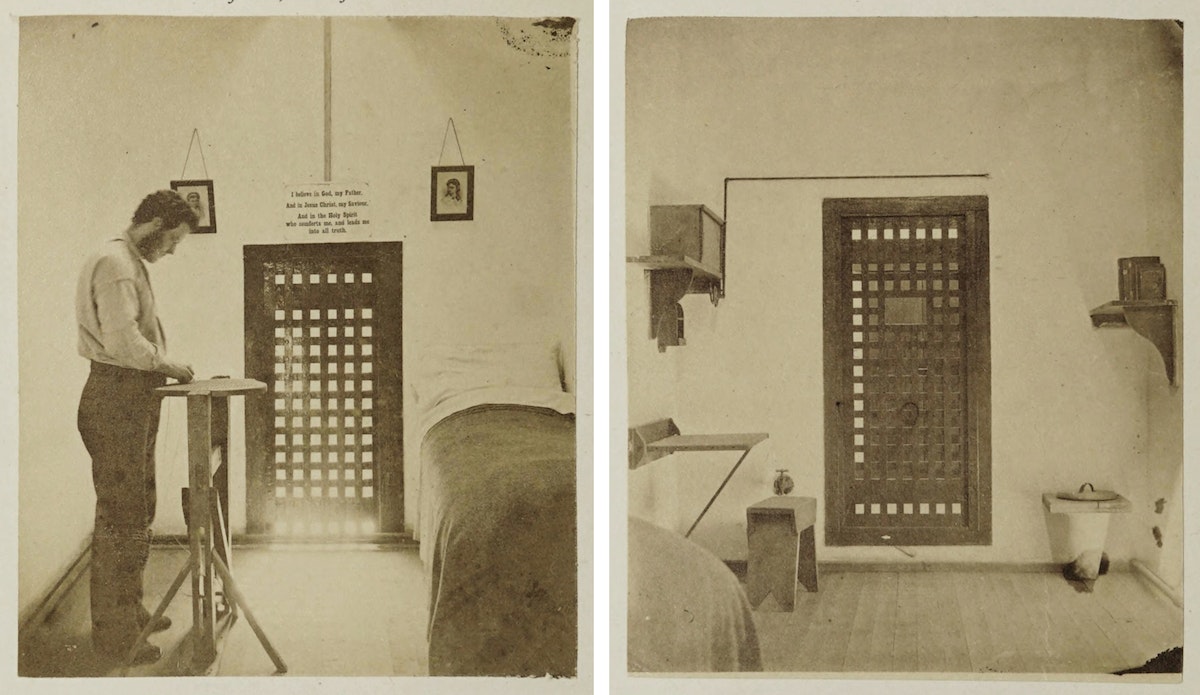
How a Quaker’s good intentions went awry: “The Silent Treatment- Solitary Confinement’s Unlikely Origins,” in @PublicDomainRev.
* Audre Lorde
###
As we ponder penitentiaries, we might send reformist birthday greetings to Roscoe Pound; he was born on this date in 1870. A lawyer and law school professor and Dean, he was one of the most cited legal scholars of the 20th century.
While serving as Dean of Harvard Law School, Pound founded the movement for “sociological jurisprudence” and was one of the early leaders of the movement for American Legal Realism, which argued for a more pragmatic and public-interested interpretation of law and a focus on how the legal process actually occurred, as opposed to (in his view) the arid legal formalism which prevailed in American jurisprudence at the time. In Pound’s view, these jurisprudential movements advocated “the adjustment of principles and doctrines to the human conditions they are to govern rather than to assumed first principles.” While Pound was dean, law school registration almost doubled, but his standards were so rigorous that one-third of those matriculated did not receive degrees. Among those that did were many of the great political innovators of the New Deal years.
Pound also had a PhD in botany, and before turning to the law, served as director of the Nebraska state botanical survey (1892-1903), during which time he discovered a rare fungus, subsequently named Roscopoundia.

“Bureaucracy defends the status quo long past the time when the quo has lost its status”*…

… which is one of the reasons that they’re hard to update. Kevin Baker describes a 1998 visit to the IRS Atlanta Service Center and ponders its lessons…
… the first thing you’d notice would be the wires. They ran everywhere, and the building obviously hadn’t been constructed with them in mind. As you walked down a corridor, passing carts full of paper returns and rows of “tingle tables,” you would tread over those wires on a raised metal gangway. Each work area had an off-ramp, where both the wires and people would disembark…
… The desks were covered with dot matrix paper, cartons of files, and Sperry terminals glowing a dull monochromatic glow. These computers were linked to a mainframe in another room. Magnetic tapes from that mainframe, and from mainframes all over the country, would be airlifted to National Airport in Washington DC. From there, they’d be put on trucks to a West Virginia town of about 14,000 people called Martinsburg. There, they’d be loaded into a machine, the first version of which was known colloquially—and not entirely affectionately—as the “Martinsburg Monster.” This computer amounted to something like a national nerve center for the IRS. On it programs called the Individual Master File and the Business Master File processed the country’s tax records. These programs also organized much of the work. If there were a problem at Martinsburg, work across the IRS’s offices spanning the continent could and frequently did shut down.
Despite decades of attempts to kill it, The IRS’s Individual Master File, an almost sixty-year old accumulation of government Assembly Language, lives on. Part of this strange persistence can be pegged squarely on Congress’s well-documented history of starving the IRS for funding. But another part of it is that the Individual Master File has become so completely entangled in the life of the agency that modernizing it resembles delicate surgery more than a straightforward software upgrade. Job descriptions, work processes, collective bargaining agreements, administrative law, and technical infrastructure all coalesce together and interface with it, so that a seemingly technical task requires considerable sociological, historical, legal, and political knowledge.
In 2023, as it was in the 1980s, the IRS is a cyborg bureaucracy, an entangled mass of law, hardware, software, and clerical labor. It was among the first government agencies to embrace automatic data processing and large-scale digital computing. And it used these technologies to organize work, to make decisions, and to understand itself. In important ways, the lines between the digital shadow of the agency—its artificial bureaucracy—and its physical presence became difficult if not impossible to disentangle….
Baker is launching a new Substack, devoted to exploring precisely this kind tangle– and what it might portend…
This series, called Artificial Bureaucracy, is a long-term project looking at the history of government computing in the fifty-year period between 1945-1995. I think this is a timely subject. In the past several years, promoters and critics of artificial intelligence alike have talked up the possibility that decision-making and even governance itself may soon be handed over to sophisticated AI systems. What draws together both the dreams of boosters and the nightmares of critics is a deterministic orientation towards the future of technology, a conception of technology as autonomous and somehow beyond the possibility of control.
These visions mostly ignore the fact that the computerization of governance is a project at least seventy years in the making, and that project has never been determined, in the first instance or the last, primarily by “technological” factors. Like everything in government, the hardware and software systems that make up its artificial bureaucracy were and are subject to negotiation, conflict, administrative inertia, and the individual agency of its users.
Looking at government computing can also tell us something about AI. The historian of computing, Michael Mahoney has argued that studying the history of software is the process of learning how groups of people came to put their worlds in a machine. If this is right—and I think it is—our conceptions of “artificial intelligence” have an unwarranted individualistic bias; the proper way to understand machine intelligence isn’t by analogy to individual human knowledge and decision-making, but to methods of bureaucratic knowledge and action. If it is about anything, the story of AI is the story of bureaucracy. And if the future of governance is AI, then it makes sense to know something about its past…
Is bureaucracy the future of AI? Check it out the first post in Artificial Bureaucracy, from @kevinbaker@mastodon.social.
* Laurence J. Peter
###
As we size up systems, we might recall that it was on this date in 1935 that President Franklin D. Roosevelt signed the Social Security Act. A key component of Roosevelt’s New Deal domestic program, the Act created both the Social Security program and insurance against unemployment.

“The real alchemy consists in being able to turn gold back again into something else; and that’s the secret that most of your friends have lost.”*…
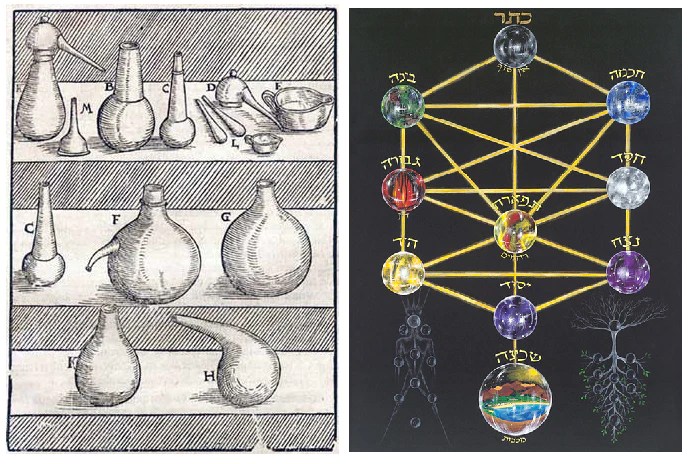
About a decade ago, the formidable Lawrence Weschler was a visiting scholar at the Getty Research Institute in Los Angeles, where he conceived a concept for an exhibit that, sadly, never materialized. Happily, he has shared the design in his wonderful newsletter, Wondercabinet…
Lead into Gold:
Proposal for a little jewel-box exhibit
surveying the Age-Old Quest
To Wrest Something from Nothing,
from the Philosopher’s Stone
through Subprime Loans
The boutique-sized (four-room) show would be called “Lead into Gold” and would track the alchemical passion—from its prehistory in the memory palaces of late antiquity through the Middle Ages

(those elaborate mnemonic techniques whereby monks and clerks stored astonishing amounts of details in their minds by placing them in ever-expanding imaginary structures, forebears, as it were, to the physical wondercabinets of the later medieval period—a sampling of manuscripts depicting the technique would grace a sort of foyer to the exhibition),

into its high classic phase (the show’s first long room) with alchemy as pre-chemistry (with maguses actually trying, that is, to turn physical lead into physical gold, all the beakers and flasks and retorts, etc.) to one side, and astrology as pre-astronomy (the whole deliriously marvelous sixteenth-into-seventeenth centuries) to the other, and Isaac Newton serving as a key leitmotif figure through the entire show (though starting out here), recast no longer in his role as the first of the moderns so much as “the Last of the Sumerians” (as an astonished John Maynard Keynes dubbed him, upon stumbling on a cache of thousands of pages of his Cambridge forebear’s detailed alchemical notes, not just from his early years before the Principia, but from throughout his entire life!).
The show would then branch off in two directions, in a sort of Y configuration. To one side:
1) The Golden Path, which is to say the growing conviction among maguses and their progeny during the later early-modern period that the point was allegorical, an inducement to soul-work, in which one was called upon to try to refine the leaden parts of oneself into ever more perfect golden forms, hence Faustus and Prospero through Jung, with those magi Leibniz and Newton riffing off Kabbalistic meditations on Infinity and stumbling instead onto the infinitesimal as they invent the Calculus, in turn eventually opening out (by way of Blake) onto all those Sixties versions, the dawning of the Age of Aquarius, etc., which set the stage for the Whole Earth Catalog and all those kid-maguses working in their garages (developing both hardware and software: fashioning the Calculus into material reality) and presently the Web itself (latter day version of those original memory palaces from back in the show’s foyer, writ large);
while, branching off to the other side, we would have:
2) The Leaden Path, in which moneychangers and presently bankers decided to cut to the chase, for, after all, who needed lead and who needed gold and for god’s sake who needed a more perfect soul when you could simply turn any old crap into money (!)—thus, for example, the South Sea Bubble, in which Newton lost the equivalent of a million dollars (whereupon he declared that he could understand the transit of stars but not the madness of men), tulipomania, etc., and thence onward to Freud (rather than Jung) and his conception of “filthy lucre” and George Soros (with his book, The Alchemy of Finance), with the Calculus showing up again across ever more elaborate permutations, leading on through Ponzi and Gecko (by way of Ayn Rand and Alan “The Wizard” Greenspan) to the whole derivatives bubble/tumor, as adumbrated in part by my own main man, the money artist JSG Boggs, and then on past that to the purest mechanism ever conceived for generating fast money out of crap: meth labs (which deploy exactly but exactly the same equipment as the original alchemists, beakers and flasks and retorts, to accomplish the literal-leaden version of what they were after, the turning of filth into lucre).
And I appended a xerox of that napkin sketch:

Eminently worth reading– and enjoying–in full. “The age-old human quest to turn nothing into something.”
* Edith Wharton
###
As we appreciate the abiding attraction of alchemy, we might recall that it was on this date in 1933 that President Franklin D. Roosevelt signed the act creating the Tennessee Valley Authority. A feature of the New Deal, the TVA was created to provide navigation, flood control, electricity generation, fertilizer manufacturing, regional planning, and economic development to the Tennessee Valley, a region (all of Tennessee, portions of Alabama, Mississippi, and Kentucky, and small areas of Georgia, North Carolina, and Virginia) which was particularly hard hit by the Great Depression relative to the rest of the nation. While owned by the federal government, TVA receives no taxpayer funding and operates similar to a private for-profit company.
The TVA has been criticized for its use of eminent domain, which resulted in the displacement of over 125,000 Tennessee Valley residents for the agency’s infrastructure projects. But on balance the TVA has been documented as a success in its efforts to modernize the Tennessee Valley and helping to recruit new employment opportunities to the region.

“All photographs are accurate. None of them is the truth.”*…

Of the 270,000 photographs commissioned by the US Farm Security Administration to document the Great Depression more than a third were “killed.” As we wrestle with the stories we’re being told, an update of an earlier post…
From his office at the Farm Security Administration (FSA) in Washington, D.C., Roy Stryker saw, time and again, the reality of the Great Depression, and the poverty and desperation gripping America’s rural communities. As head of the Information Division and manager of the FSA’s photo-documentary project, his job was to hire and brief photographers, and then select images they captured for distribution and publication. His eye helped shape the way we view the Great Depression, even today.
Professionally, Stryker was known for two things: preserving thousands of photographs from being destroyed for political reasons, and for “killing” lots of photos himself. Negatives he liked were selected to be printed. Those he didn’t—ones that didn’t fit the narrative and perspective of the FSA at the time, perhaps—were met with the business end of hole punch, which left gaping black voids in place of hog’s bellys, industrial landscapes, and the faces of farmworkers.
In 1935, the Resettlement Administration (RA) was established as part of the New Deal to provide relief, recovery, and reform to rural areas. The FSA, created in 1937, was its spiritual successor. The FSA’s duties included, but were not limited to, operating camps for victims of the Dust Bowl, setting up homestead communities, and providing education to more than 400,000 migrant families. Communicating about its efforts was also part of its mandate…
Stryker sought out photographers, among them Dorothea Lange, Gordon Parks, and Arthur Rothstein, and made their images readily available to the press. Given the lack of new photography and art being produced during the Great Depression, the photos regularly appeared in magazines such as LIFE and Look. He also had them displayed at the 1936 Democratic National Convention, the 1936 World’s Fair, the Museum of Modern Art, and other prominent venues. The publication of a series of early photographs, including Lange’s Migrant Mother, proved instrumental in pushing the federal government to provide emergency aid to migrant workers in California.
In the effort to represent the FSA and Roosevelt’s signature domestic achievement in a positive light, the chosen photos captured how the idealistic views of farm life were being tainted by poverty, and how the FSA programs were helping farmers reclaim their dignity. Common elements were decrepit housing conditions, the lack of food and clean water, and harsh work environments.
It was government propaganda, and there were certainly some within the government (both supporters and detractors) who saw it that way, and more who considered both the FSA and its photography project as communist and un-American. In a 1972 Interview, Stryker admits to having felt political pressure from the Department of Agriculture to portray the effectiveness of the New Deal. “Go to hell,” was his response. His photographers “were warned repeatedly not to manipulate their subjects in order to get more dramatic images, and their pictures were almost always printed without cropping or retouching.”
But there is a way to manipulate the story being told without altering the images themselves—the process of photo editing, of choosing which images to highlight and which to discard…
The fascinating story of one man’s (materially successful) effort to galvanize social and political opinion: “How a Hole Punch Shaped Public Perception of the Great Depression.”
See also “The Kept and the Killed.”
And for an equally-fascinating consideration of how emerging new visual technologies might similarly be used to sway sentiment, read Fred Turner‘s “The Politics of Virtual Reality.”
* Richard Avedon
###
As we contemplate cuts, we might recall that it was on this date in 1940 that the first Social Security check– for $22.54– was issued to Ida May Fuller.
The Social Security Program had been created in 1935, with qualification for eligibility (covered earnings) beginning in 1937. So Ms. Fuller, a teacher-turned legal-secretary, had been accumulating credit for three years. She lived to 100 years old and collected a total of $22,888.

You must be logged in to post a comment.