Posts Tagged ‘class’
“Food, culture, people, and landscape are all absolutely inseparable”*…

Further, in a fashion, to yesterday’s post: Stephen Lurie and our friends at The Pudding with an elegant and insightful looks at what America’s earliest restaurants can teach us about America…
The New York Public Library’s Buttolph Collection of menus, dated 1880-1920, captures the emergence of modern restaurant dining…
… A menu describes what a reataurant serves– but a menu also describes who is being served. [Collectively] they refect the class, gender, political, technological, and environmental shifts of history.
The thousands of menus in this collection document a period of fundamental transformation– and the birth of the society and the restaurant we know today.
I’ve searched through the archive to tell you that story in ten dishes. Your table is ready– right this way…
Restaurant dining in America was once an Imitation: wannabe aristocrats attempting French feasting. But as the 19th became the 20th century, the American middle class and the true American resaturant emerged: diverse, accessible, opinionated… and at times, chaotic.
From Bisque d’Ecrevisses and Celery in a Crystal Celery Vase through “cosmopolitan” and “ethnic” food to Potatoes O’Brien Au Gratin and Baked Alaska, the tasty (and illuminating) tale of dining out in America: “A History of Menus is a Menu of History,” from @luriethereal.bsky.social and @pudding.cool.
* Anthony Bourdain
###
As we dig in, we might send tasty birthday greetings to a man who has built a culinary domain that epitomizes (in its scale, at least one huge quadrant of) the current state of the restaurant business: Wolfgang Puck; he was born on this date in 1949. He made his name with Spago restaurant in Los Angeles in 1982. He now has more than 20 fine dining restaurants and dozens of pizza bars, bistros, cafes, airport restaurants, express outlets, catering services, cultural center cafes; he sells gourmet foods, cookware, and appliances; and he runs a catering empire (that has catered he official Academy Awards Governors Ball every year since 1994).

“Status is welcome, agreeable, pleasant, & hard to obtain in the world”*…

We live in a time when a certain kind of status– expertise– is under attack. Dan Williams suggests that by celebrating “common sense” over expert authority, populism performs a dramatic status inversion. It gifts uneducated voters the power of knowledge and deflates those who look down on them…
… As Will Storr argues in The Status Game, humiliation is the “nuclear bomb of the emotions”. When ignited, it can fuel everything from genocide to suicide, mass atrocities to self-immolation. There are few parts of human nature more chaotic, dangerous, or self-destructive. And yet, there is often a rationale underlying these reactions rooted in the strange nature of human sociality.
If humans were solitary animals, we would have evolved to approximate the behaviour of Homo economicus, the idealised rational agent imagined in much of twentieth century economics. We would act in ways that are predictable, sensible, and consistent. The characters depicted in Dostoevsky’s novels would be unintelligible to such a creature, except as victims of mental illness.
But we are not. We are social creatures, and almost everything puzzling and paradoxical about our species is downstream of this fact.
For one thing, we rely on complex networks of cooperation to achieve almost all our goals. Given this, much of human behaviour is rooted not in ordinary material self-interest but in the need to gain access to such networks—to win approval, cultivate a good reputation, and attract partners, friends, and allies. Human decision-making occurs within the confines of this social scrutiny. We evaluate almost every action, habit, and preference not just by its immediate effects but by its reputational impact.
At the same time, much of human competition is driven by the desire for prestige. In well-functioning human societies, individuals advance their interests not by bullying and dominating others but by impressing them. These high-status individuals are admired, respected, and deferred to. They win esteem and all its benefits. Their lives feel meaningful and purposeful.
In contrast, those who fail at the status game—who stack up at the bottom of the prestige hierarchy—experience shame and humiliation. If their position feels unfair, they become resentful and angry. In extreme cases, they might take vengeance on those who look down on them. Or they might take their own life. In some cases, such as mass killings by young men who “lose face” and run “amok” (a Malay word, illustrating the behaviour’s cross-cultural nature), they do both…
…
… The name of this newsletter, “Conspicuous Cognition”, is inspired by Veblen’s ideas about economics. Just as he sought to correct a misguided tendency to treat economics through a narrowly economic lens, my work and writings seek to correct a similarly misguided tendency to treat cognition—how we think, form beliefs, generate ideas, evaluate evidence, communicate, and so on—through a narrowly cognitive lens.
Much cognition is competitive and conspicuous. People strive to show off their intelligence, knowledge, and wisdom. They compete to win attention and recognition for making novel discoveries or producing rationalisations of what others want to believe. They often reason not to figure out the truth but to persuade and manage their reputation. They often form beliefs not to acquire knowledge but to signal their impressive qualities and loyalties.
Placed in this context of social competition and impression management, what might be called “epistemic charity”—the free offer of knowledge and expertise—takes on a different appearance. Although this charity can be driven by disinterested altruism (think of parents educating their children), it can also result from status competition and a desire to show off.
In some cases, people are happy to receive such epistemic charity and heap praise and admiration on those who provide it. The wonders of modern science emerge from a status game that celebrates those who make discoveries. However, we sometimes recoil at the thought of admitting someone has discovered something new, or—even worse—that they know better than we do. When that happens, we are not sceptical of the truth of their ideas, although we might choose to frame things that way. Rather, their offer of knowledge carries a symbolic significance we want to reject. It hurts our pride. It feels humiliating.
On a small scale, this feeling is an everyday occurrence. Few people like to be corrected, to admit they are wrong, or to acknowledge another’s superior knowledge, wisdom, or intelligence. On a larger scale, it might be implicated in some of the most significant and dangerous trends in modern politics.
Many of our most profound political problems appear to be entangled with epistemic issues. Think of our alleged crises of “disinformation”, “misinformation”, “post-truth”, and conspiracy theories. Think of the spread of viral lies and falsehoods on social media. Think of intense ideological polarisation, vicious political debates, and heated culture wars, disagreements and conflicts that ultimately concern what is true.
A critical aspect of these problems is the so-called “crisis of expertise”, the widespread populist rejection of claims advanced in institutions like science, universities, public health organisations, and mainstream media. Famously, many populists have “had enough of experts.” As Trump once put it, “The experts are terrible.”
This rejection of expertise goes beyond mere scepticism. It is actively hostile. The Trump administration’s recent attacks on Harvard and other elite universities provide one illustration of this hostility, but there are many others. Most obviously, there is the proud willingness among many populists to spread and accept falsehoods, conspiracy theories, and quack science in the face of an exasperated barrage of “fact-checks” from establishment institutions. Why are these corrections so politically impotent? Why do so many voters refuse to “follow the science” or “trust the experts”?
Experts have produced many theories. Some point to ignorance and stupidity. Some point to disinformation and mass manipulation. Some point to partisan media, echo chambers, and algorithms. And some suggest that the crisis might be related to objective failures by experts themselves.
There is likely some truth in all these explanations. Nevertheless, they share a common assumption: that the “crisis of expertise” is best understood in epistemic terms. They assume that populist hostility to the expert class reflects scepticism that their expertise is genuine—that they really know what they claim to know.
Perhaps this assumption is mistaken. Perhaps at least in some cases, the crisis of expertise is less about doubting expert knowledge than about rejecting the social hierarchy that “trust the experts” implies… some populists might sooner accept ignorance than epistemic charity from those they refuse to acknowledge as superior…
…
… If this analysis is correct, the populist rejection of expertise is not merely an intellectual disagreement over truth or evidence, even if it is typically presented that way. It is, in part, a proud refusal to accept epistemic charity from those who present themselves as social superiors.
In the case of populist elites and conspiracy theorists, this refusal is often driven by objectionable feelings of grandiosity and narcissism. However, for many ordinary voters, it may serve as a more understandable dignity-defence mechanism, a refusal to accept the social meanings implied by one-way deference to elites with alien values. It is less “post-truth” than anti-humiliation.
This would help to explain several features of the populist rejection of expertise.
First, there is its emotional signature. In many cases, the populist refusal to defer to experts appears to be wrapped up in intense emotions of resentment, indignation, and defiant pride, rather than simple scepticism.
Second, the rejection of expert authority often has a performative character. Experts are not merely ignored. They are actively, angrily, and proudly rejected. Like Captain Snegiryov, the populist publicly tramples on the expert’s offer of knowledge.
Third, there is the destructive aspect of many populist sentiments. If the issue were merely scepticism of experts and establishment institutions, the solution would presumably involve targeted reforms designed to make them more reliable. As recent Republican attacks on elite universities make clear, many populists prefer to take a sledgehammer to these institutions. The explosive hostility towards public health experts during the pandemic provides another telling example.
Finally, there is the fact that populists often embrace anti-intellectualism as an identity marker, a badge of pride. The valorisation of gut instincts, the proposed “revolution of common sense”, and the embrace of slogans like “do your own research” affirm the status of those who prioritise intuition over experts. The demonisation of “ivory tower academics”, “blue-haired”, “woke” professors, and the “chattering classes” are crafted to have a similar effect. This all looks more like status-inverting propaganda than intellectual disagreements over truth and trustworthiness.
To understand is not to forgive. Just as we can empathise with Snegiryov’s refusal of much-needed money whilst condemning it as short-sighted and self-destructive, we can try to understand the populist rejection of expertise without endorsing or justifying it.
To be clear, there are profound problems with our expert class and elite institutions. They routinely make errors, sometimes catastrophic ones, and often wield their social authority in ways that advance their own interests over the public good. The Iraq war, the financial crisis, and the many failures of policy and communication throughout the pandemic provide powerful illustrations of these expert failures, but there are many others.
Moreover, the social and political uniformity of experts today creates legitimate concerns about their trustworthiness. When scientific journals, public health authorities, and fact-checking organisations are obviously shaped by the values, partisan allegiances, and sensibilities of highly educated, progressive professionals, it is reasonable for those with very different values and identities to become mistrustful of them.
Nevertheless, there is no alternative to credentialed experts in complex, modern societies. To address the political challenges we confront today, we need specialised training, rigorous standards of evidence, and coordinated activity within institutions carefully engineered to produce knowledge. Although these institutions must be reformed in countless ways, they are indispensable.
Given this, the populists’ rejection of expertise does not liberate them from bias and error. It guarantees bias and error. Gut instincts, intuition, and “common sense” are fundamentally unreliable ways of producing knowledge. As we see with the MAGA media ecosystem today, the valorisation of such methods means returning to a pre-scientific, medieval worldview dominated by baseless conspiracy theories, snake oil medicine, economic illiteracy, and know-nothing punditry.
And yet, the dangers associated with this style of politics underscore the importance of understanding its causes. If the crisis of expertise is partly rooted in feelings of status threat, resentment, and humiliation, this has significant implications for how we should think about—and address—this crisis.
Most obviously, it suggests that purely epistemic solutions will have limited efficacy. You cannot fact-check your way out of status competition. And as long as the acceptance of expert guidance is experienced as an admission of social inferiority, there will be a lucrative market for demagogues and bullshitters who produce more status-affirming narratives.
Moreover, it suggests that rebuilding trust in experts means more than improving their reliability, as crucial as that is. Institutions dominated by a single social class and political tribe will inevitably face resistance and backlash in broader society, regardless of their technical competence.
We do not just need better ways of producing knowledge. We need to rethink how knowledge is offered: in ways that respect people’s pride and minimise the humiliations of one-sided epistemic charity…
Eminently worth reading in full: “Status, class, and the crisis of expertise,” from @danwphilosophy.bsky.social.
(Image above: source)
* Buddha (Ittha Sutta, AN 5.43)
###
As we dig dignity, we might send classy birthday greetings to George Bryan “Beau” Brummell; he was born on this date in 1778. An important figure in Regency England (a close pal of the Prince Regent, the future King George IV), he became the the arbiter of men’s fashion in London and in the territories under its cultural sway.
Brummell was remembered afterwards as the preeminent example of the dandy; a whole literature was founded on his manner and witty sayings, e.g. “Fashions come and go; bad taste is timeless.”

“No one knows toward what center human things are going to gravitate in the near future, and hence the life of the world has become scandalously provisional”*…

The estimable Ted Gioia has pulled a 2022 essay from his newsletter up from behind the paywall. It was very relevant then; if anything, more relevant now…
Back in 2014, I sketched out a widely-read outline of an alternative interpretation of cultural conflict. Curiously enough, the conceptual tools I used came from a 1929 book from philosopher José Ortega y Gasset entitled The Revolt of the Masses—a work that offers surprisingly timely insights into our current situation.
That article stirred up a lot of debate at the time, but the whole situation has intensified further since 2014. Everything I’ve seen in those eight years has made painfully clear how insightful Ortega had been. The time has come to revisit that framework, summarizing its key insights and offering predictions for what might happen in the future.
Here’s part of what I wrote back in 2014:
First, let me tell you what you won’t find in this book. Despite a title that promises political analysis, The Revolt of the Masses has almost nothing to say about conventional party ideologies and alignments. Ortega shows little interest in fascism or capitalism or Marxism, and this troubled me when I first read the book. (Although, in retrospect, the philosopher’s passing comments on these matters proved remarkably prescient—for example his smug dismissal of Russian communism as destined to failure in the West, and his prediction of the rise of a European union.) Above all, he hardly acknowledges the existence of ‘left’ and ‘right’ in political debates.
Ortega’s brilliant insight came in understanding that the battle between ‘up’ and ‘down’ could be as important in spurring social and cultural change as the conflict between ‘left’ and ‘right’. This is not an economic distinction in Ortega’s mind. The new conflict, he insists, is not between “hierarchically superior and inferior classes…. upper classes or lower classes.” A millionaire could be a member of the masses, according to Ortega’s surprising schema. And a pauper might represent the elite.
The key driver of change, as Ortega sees it, comes from a shocking attitude characteristic of the modern age—or, at least, Ortega was shocked. Put simply, the masses hate experts. If forced to choose between the advice of the learned and the vague impressions of other people just like themselves, the masses invariably turn to the latter. The upper elites still try to pronounce judgments and lead, but fewer and fewer of those down below pay attention.
This dynamic is now far more significant than it was eight years ago. So I want to share 15 observations on the emerging vertical dimension of cultural conflict—these both define the rupture and try to predict how it will play out…
Read on for: “15 Observations on the New Phase in Cultural Conflict” from @tedgioia.bsky.social.
(Image above: source)
* José Ortega y Gasset in The Revolt of the Masses… where he also observed: “Liberalism – it is well to recall this today – is the supreme form of generosity; it is the right which the majority concedes to minorities and hence it is the noblest cry that has ever resounded in this planet. It announces the determination to share existence with the enemy; more than that, with an enemy that is weak. It was incredible that the human species should have arrived at so noble an attitude, so paradoxical, so refined, so acrobatic, so antinatural. Hence, it is not to be wondered at that this same humanity should soon appear anxious to get rid of it. It is a discipline too difficult and complex to take firm root on earth.”
###
As we contend with contention, we might send rational birthday greetings to an avatar of the Enlightenment (which did so much to spawn liberalism), Francois-Marie Arouet, better known as Voltaire; he was born on this date in 1694. The Father of the Age of Reason, he produced works in almost every literary form: plays, poems, novels, essays, and historical and scientific works– more than 2,000 books and pamphlets (and more than 20,000 letters). He popularized Isaac Newton’s work in France by arranging a translation of Principia Mathematica to which he added his own commentary.
A social reformer, Voltaire used satire to criticize the intolerance, religious dogma, and oligopolistic privilege of his day, perhaps nowhere more sardonically than in Candide.

“An imbalance between rich and poor is the oldest and most fatal ailment of all republics”*…

Plutarch’s warning is one to take seriously–as then, now. So, how is the American Dream doing?…
In late 20th-century music, the elusiveness of the American Dream is a recurring theme. From Stevie Wonder’s ode to a boy “born in hard time Mississippi” in 1973 to Bruce Springsteen’s anthems to the working class in factory-shuttered towns in the 1980s, frustration with people’s inability to outgrow their circumstances is rife. The timing of the peak of that genre is no coincidence: whereas nearly all American children born in 1940 could still expect to do better than their parents, only two in five could by 1984…
… A new study by Raj Chetty, of Harvard University, and colleagues provides fresh data on how America’s landscape of opportunity has shifted sharply over the past decades. Although at the national level there have been only small declines in mobility, the places and groups that have become more (or less) likely to enable children to rise up have changed a lot. The most striking finding is that, compared with the past, a child’s race is now less relevant for predicting their future and their socioeconomic class more so.
The greatest drops in mobility have been not in the places evoked in song, but on the coasts and the Great Plains, which historically provided pathways up (see maps). “Fifteen years ago, the American Dream was alive and well for white children born to low-income parents in much of the North-east and West Coast,” says Benjamin Goldman of Cornell University, one of the co-authors. “Now those areas have outcomes on par with Appalachia, the rustbelt and parts of the South-east.”
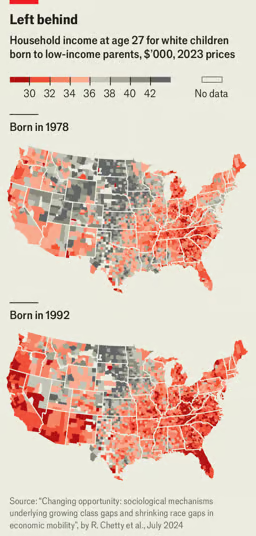
The fact that white children have become more likely to remain in poverty than before, whereas for black children the reverse is true, raises many questions. The finding comes from tracing the trajectories of 57m children born in America between 1978 and 1992 and looking at their outcomes by the age of 27. “This is really the first look with modern big data into how opportunity can change within a place over time,” says Mr Goldman. For children born into high-income families, household income increased for all races between birth cohorts. Yet among those from low-income families, earnings rose for black children and fell for white children.
A black child born to poor parents in 1992 earned $1,400 a year more than one born in 1978. A similar white child earned $2,000 less than one born in 1978. But on average, a poor white child still earned $9,500 more than a poor black child.
This pattern has played out in virtually every county, though with big regional differences. As a result, the earnings gap between rich and poor white children (the “class gap”) grew by 27%, whereas the earnings gap between poor white and poor black children (the “race gap”) fell by 28%…
… None of this means that race is no longer relevant for Americans’ chances in life. Although the reversal of the direction of travel is striking, a young black American born in 1992 to poor parents was still four percentage points more likely to remain in poverty than a poor white peer, down from a 15 percentage-point gap for those born in 1978. And while the near doubling in rates of mortality among young, lower-income white Americans is deeply alarming, mortality rates for their black counterparts have increased too, and they are still (a bit) more likely to die young…
… Convergence has not yet brought equality. Despite improvements across America for poor black children, there is still no county where their outcomes match those of poor white ones. Yet the decline of the white working class is steep, and bound to cause grief. Telling a young white man with lower life outcomes than previous generations that he is still doing better than the average black peer is about as useful as telling a young black man that he’s doing well “for a black man”.
Another possible misconception is that social mobility is a zero-sum game: that poor white children are doing worse because poor black children are doing better. The authors tackle this by showing how in places where black children have done well, white children’s outcomes have remained stable; and in places where white children have done particularly poorly, their black peers have also not thrived.
In his previous work Mr Chetty demonstrated [see here for a summary of his 2018 study] just how much a child’s chances of outperforming their parents depended on their race and where they grew up. One of the questions the authors were left with was how “sticky” these effects would be over time: could opportunities for the next cohorts of children change within these same places, or were they fixed? The new study’s most hopeful finding is that, far from being fixed, opportunities within a place can change significantly and rapidly. Neither history nor place is destiny…
… Americans love a rags-to-riches story. In his acceptance speech [at the Republican Convention], Mr Vance pledged to “make this country a place where every dream…will be possible once again”. In his bestselling book “Hillbilly Elegy” he writes that the assumption “that only a truly extraordinary person could have made it to where I am today…I think that theory is a load of bullshit.”
But the story of Mr. Vance, who grew up in a poor part of the rustbelt, rose to be a venture capitalist and now, at 39, is a potential American president, remains extraordinarily rare. While there has been a reshuffling of opportunities for Americans trying to escape the lowest rung, there has been no progress at all for routes into the upper class. For the vast majority of poor black children, who continue to have a 3% chance of rising from the bottom to the top quintile, and poor white children, whose chances have fallen from 14% to 12%, that door remains firmly shut…
“Class, race and the chances of outgrowing poverty in America,” a big-data analysis– a gift article from @TheEconomist.
* Plutarch
###
As we optimize opportunity, we might send mortgaged birthday greetings to Charles Darrow; he was born on this date in 1889. He designed (in 1933) and patented (in 1935) the board game Monopoly. He later sold his patent to Parker Brothers, which credits him as its creator.
In fact, the history of Monopoly is much longer. It can be traced back to 1903, when American anti-monopolist Lizzie Magie created a game called The Landlord’s Game that she hoped would explain the single-tax theory of Henry George. It was intended as an educational tool to illustrate the negative consequences of concentrating land in private monopolies.
After losing his job at a sales company following the Stock Market Crash of 1929, Darrow worked at various odd jobs. Seeing his neighbors and acquaintances play a board game in which the object was to buy and sell property, he decided to publish his own version of the game.
In fact, Darrow and his friends were just a few of many people in the American Midwest and East Coast who had been playing a game of buying and trading property– all based on Magie’s original… but most having morphed as warnings of that sort too often do) into the opposite of Magie’s intent– a celebration of accumulation. The game was used by college professors and their students, and another variant, called The Fascinating Game of Finance, was published in the Midwest in 1932. From there the game traveled back east, where it had remained popular in Pennsylvania, and became popular with a group of Quakers in Atlantic City. Darrow was taught to play the game by Charles Todd, who had played it in Atlantic City, where it had been customized with that city’s street and property names– to wit Monopoly‘s nomenclature.

“H as in How in the World Are We Going to Escape?”*…

A treatise on the the letter “H,” on the occasion of its becoming an arbiter of class in the later 19th century…
In George Bernard Shaw’s Pygmalion (1913), which inspired the musical My Fair Lady, a fictional linguist describes a phonetic endemic: missed employment opportunities due to the connotations of a person’s accent. Addressing the “many thousands of men and women who have sloughed off their native dialects and acquired a new tongue”, the professor insists that “the thing has to be done scientifically, or the last state of the aspirant may be worse than the first”. Shaw’s wit shows through in the near homonym: aspirations of social mobility, in this period, often included pronunciationary emulation — the breathy aitch sounds of aspirated consonants.
Alfred Leach, who Steven Connor, in Beyond Words, calls one of the “doughiest defenders of the h”, believed that English’s aspirated aitch (or rather, haitch) signaled a direct inheritance from Classical antiquity. In the pronounced h of words like “herb” — notably lacking from American English — he heard the “spiritus asper” of Hellenism. Leach was writing in a period when linguists began reflecting on the shifting history of aspirates and the role they played in indicating status, class, and education. These traits continue into our present day. The historian of language Henry Hitchings, whose own name is uncannily reminiscent of Shaw’s Henry Higgins, argues that the pronunciation of this letter is “still a significant shibboleth”, and quotes Leach’s contemporary, Oxford scholar Henry Sweet, who called it “an almost infallible test of education and refinement”.
Why so much huffing about the letter H? Throughout the nineteenth century, this aspirated sound was on the rise. At the end of the previous century, Received Pronunciation (RP) became known as the accent of aristocracy, leading to aspirational elocution guides like Poor Letter H (1854). While words like “hotel” had once been pronounced in the French style (oh-tell), English speakers had begun to exhale audibly, as if yawning at the continued Norman influence on British tongues. Leach led the charge against “English Grammarians” who “conspired to withhold from us the means of propitiating this demon Aspirate”. In The Letter H, he ridicules those he calls “H-droppers”, speakers whose phonetic errors seem to snowball: “lost H’s have a knack of turning up in wrong places, when they return at all”. Leach is prone to hyperbole — “the early aspirative labours of a converted H-dropper give birth to monstrosities” — and sneers at Cockney speech: “Horkney hoysters, ‘amshire ‘am, and ‘am and heggs”…
More, from Hunter Dukes (@hunterdukes) in @PublicDomainRev: “Aspirated Aspirations: Alfred Leach’s The Letter H (1880)“
(image above: source)
* Lemony Snicket (Daniel Handler), The Hostile Hospital
###
As we ponder pronunciation, we might recall that it was on this date in 1961 that Coronation Street premiered in ITV in the UK. It holds the Guinness World Record for longest running soap opera.

You must be logged in to post a comment.