Posts Tagged ‘New York’
“Photography helps people to see”*…

Your correspondent was in New York last week and ducked into Grand Central Station (or more formally, Grand Central Terminal)… to find it transformed. Sarah Cascone has the backstory…
For the first time possibly ever, there is not a single ad to be seen in Grand Central Terminal. “Humans of New York,” Brandon Stanton‘s popular social media art series of photographs of people he’s interviewed on the city’s streets, has taken over each and every one of the 150 video billboards in the grand concourse, as well as the subway ads below in Grand Central Station for “Dear New York.”
“This beautiful art installation transforms the terminal into a photographic display of New Yorkers telling their stories from all walks of life—serving as a powerful reminder of our shared humanity,” MTA director of commercial ventures Mary John said in a statement. “It is the first time an artist has unified digital displays in both the terminal and subway station below, and the MTA coordinated across many corners of our organization to make this happen.”
It’s New York’s largest public art installation in 20 years, since The Gates by Christo and Jeanne-Claude, a magical pathway of saffron-colored fabric in Central Park. And it’s all the more impressive in that Stanton paid for it all out of pocket, as a gift to the city.
“If it provides even the slightest amount of joy, solace, beauty, or connection to the 750,000 people who pass through Grand Central every day—we have achieved our goal,” he wrote on Facebook.
The original plan was to use the proceeds from his new book, Dear New York, but Stanton ended up having to dip into his life savings to cover the total cost, which included space rental and covering the station’s lost ad revenue. The artist and journalist, who wrote the best-selling book Humans of New York, declined to provide an exact figure, but told the New York Times that “I no longer have any stocks.”
Stanton has shot portraits of 10,000 people across the five boroughs and beyond since beginning “Humans of New York” in 2010, creating a kind of photographic census of the city. (He has since expanded the project’s scope internationally, to 40 countries and counting.)…


More– and more photos– at: “‘Humans of New York’ Transforms Grand Central Into a Monumental Photo Show.” The remarkable show is up through tomorrow…
###
As we see, we might spare a thought for a photographer with a different– but also crucially-important– focus, Edwin Way Teale; he died on this date in 1980. A naturalist, photographer, and writer, his works serve as primary source material documenting environmental conditions across North America from 1930–1980. He is perhaps best known for his series The American Seasons, four books documenting over 75,000 miles of automobile travel across North America following the changing seasons.
Teale’s Hampton, CT home, “Trail Wood” (chronicled in his A Naturalist Buys an Old Farm and further described in A Walk through the Year) is now managed as a nature preserve by the Connecticut Audubon Society. His papers, housed in the University of Connecticut Archives & Special Collections, take up 238 feet of shelf space and include field notes and drafts for each of his books, early childhood writings, professional writings for magazines, newspapers and book reviews, correspondence- both personal and professional, personal and family documents, scrapbooks, and memorabilia, as well as his photographs (prints, negatives, and transparencies) and his personal library. But he bequeathed to the Concord (MA) Free Public Library his collection of Henry David Thoreau books, letters, correspondence, mementos and any other material dealing with Thoreau and Ralph Waldo Emerson and other material relating to Concord, Massachusetts– 12 containers and 108 printed books and pamphlets.

“If you can make it here, you can make it anywhere.”*…

Hannah Frishberg, in Gothamist, on a labor of love…
Reno may be “the biggest little city in the world,” but it’s got some serious competition from the miniature New York City that hobbyist Joseph Macken built in his upstate New York basement over two decades.
“I sat down in my basement, turned the camera on on my phone and just started talking about my first section, which was Downtown Manhattan,” the Clifton Park resident said on a recent Thursday about his viral TikToks on his roughly 50-by-30-foot scale model of the city. “It just took off.”
The intricate model features what Macken says are hundreds of thousands buildings, landmarks and geographic elements across the five boroughs and their surroundings, including bridges, airports, the Hudson and East rivers, New York Harbor, Central Park, One World Trade Center and the original World Trade Center, the Statue of Liberty and Empire State Building. The work consists of 350 handmade sections that are pieced together and can be taken apart and moved…
… Macken, a 63-year-old truck driver who grew up in Middle Village and has no formal carpentry or engineering training, said he dreamed of replicating the Queens Museum’s famous “Panorama” after an elementary school trip when he was a kid. He embarked on the endeavor in 2004, armed with little more than balsa wood, Elmer’s glue and Styrofoam. His first building was “the RCA building at Rockefeller Center,” he said, referring to 30 Rock, which was formerly named for its longtime tenant, the Radio Corporation of America.
Macken said it took him about 10 years to build Manhattan alone and 11 years for the rest of the boroughs. He completed his opus in April, and said he’s confident every building in the city is represented. (Gothamist could not independently verify this claim; the city has more than 1 million buildings, according to the Department of Buildings.)…
… Macken is now working on a mini Minneapolis: “‘Mary Tyler Moore’ was one of my favorite shows growing up,” he said, adding that he plans to eventually do Los Angeles, Las Vegas and Chicago as well.
Macken said he’s still figuring out what he’ll do next with the model, but he’s in talks with the Museum of the City of New York in Manhattan about an exhibit there. A museum spokesperson confirmed this, praising his “ingenuity, creativity and skill.”
“ I don’t wanna put it back in storage,” Macken said. “That’s for damn sure.”…
More– and more photos– at: “This trucker built a scale model of NYC over 21 years. It’s drawing museums’ attention” from @gothamist.com.
* “Theme from New York, New York” composed by John Kander, with lyrics by Fred Ebb; performed in the film by Liza Minnelli and famously covered by Frank Sinatra
###
As we get small, we might recall that on this date in 1776– in the early days of the military occupation of the city by British forces during the Revolutionary War– the “Great Fire of New York” raged on the West Side of what then constituted New York City at the southern end of the island of Manhattan.
The fire destroyed from 10 to 25 percent of the buildings in the city, and some unaffected parts of the city were plundered. Many believed or assumed that the fire was deliberately set; British leaders accused revolutionaries– and used the pretext to declare martial law, to confiscate surviving uninhabited homes of known Patriots and assign them to British officers; to convert chuches (other than Church of England sanctuaries), into prisons, infirmaries, or barracks; and to billet regular soldiers with civilian families… all of which continued until the British evacuated the city on November 25, 1783.

“We moralize among ruins”*…
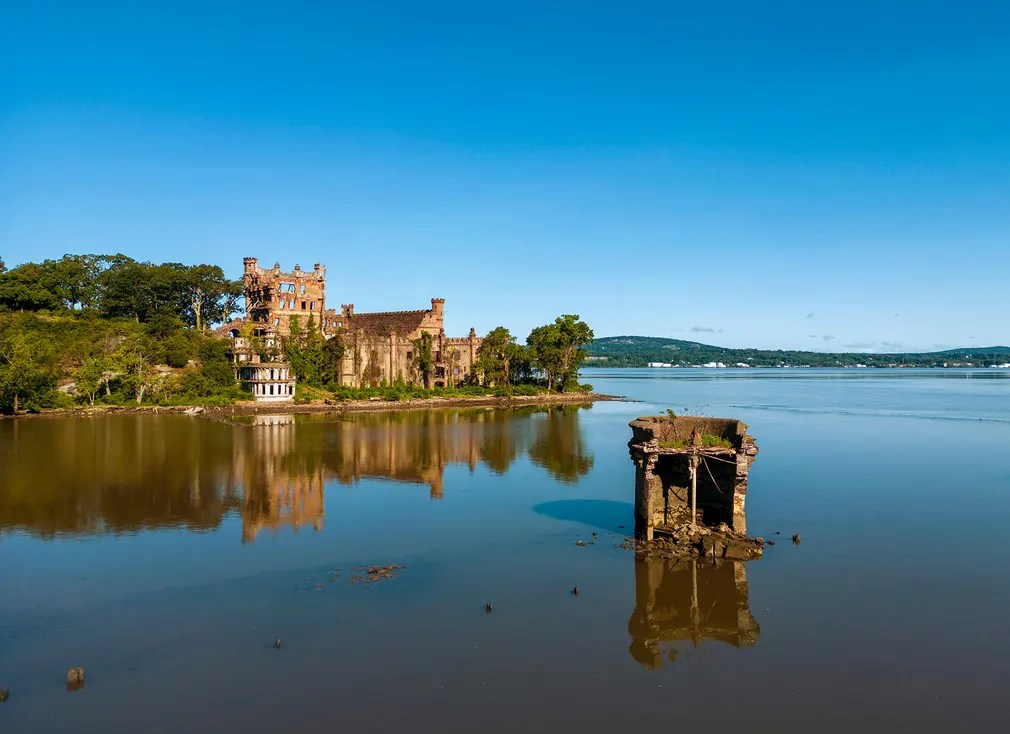
Via The Guardian…
Photographer Phillip Buehler, who captured the death of the American mall in a 2022 photo series, has a new exhibition of pictures from the last 50 years that trace the often forgotten history of the islands surrounding Manhattan. No Man Is an Island: Poetry in the Ruins of the New York Archipelago is now on show until 23 June at the Front Room Gallery in Hudson, New York…
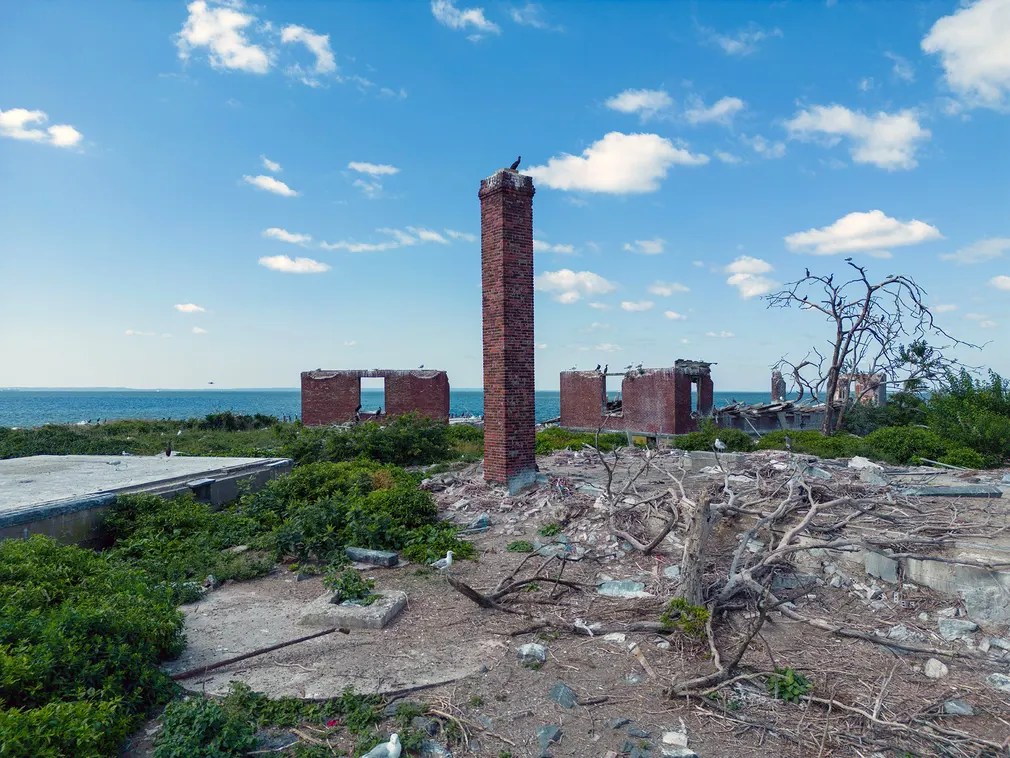

All photos by Phillip Buehler (and here). More of this series: “The inaccessible and abandoned islands of New York – in pictures,” via @guardian.
And for companions to Buehler’s earlier series on abandoned malls, see here and here.
* Benjamin Disraeli
###
As we ponder passage, we might recall that it was on this date in 1878, the original Tay Bridge was officially opened by Queen Victoria. It carried a single rail line across the Forth of Tay on the east coast of Scotland. At almost 2 miles in overall length, it was the world’s longest bridge at the time.
It’s designer, Sir Thomas Bouch, a railway engineer and executive, was knighted for engineering and overseeing the building of the bridge— on which an estimated 75 people died when, the following year, unable to withstand high winds, it collapsed. An enquiry found Bouch to be liable, by virtue of bad design and construction; he died four months after the verdict.
Bouch and his creation are thus also indirectly responsible for the best-known poem, “The Tay Bridge Disaster,” by the gentleman widely considered to have been the worst published poet in British history, William Topaz McGonagall (and here).

“History is what we choose to remember”*…

In the mid-1940s, Edmund S. Morgan, a mild-mannered young historian, was teaching at Brown and making a name in the quiet field of early American studies. Having published a slim, well-received collection of essays on the New England Puritans, he might have seemed the very model of the unassuming scholar at the outset of a modest career, satisfied to refine the work of great forebears in a narrow field. That wasn’t Edmund Morgan. The Second World War was over. The United States was developing an energetic vision, which would come to fruition in 1960 with the election of John F. Kennedy, of its new global leadership role. In keeping with that vision, Morgan launched a bold new interpretation of the nation’s founding.
Throwing out elder historians’ prevailing focus on the founding generation’s self-interest (Clarence Alvord had said that George Washington became a patriot to defend speculations in Indian land) and on its class conflicts (Carl Becker had said that the Revolution was not only over British rule but also over the rule of elite Americans), Morgan sought to identify the grand principles that the revolutionary generation agreed on. “What the colonists had to say about Parliamentary power and about their own rights deserved to be taken seriously,” he explained later.
As the U.S. began to exercise new power around the world, Morgan set out to show that the protests in the 1760s and ’70s against the Stamp Act and other British policies offered slam-dunk evidence of a founding American consensus on principles of rights. Inherent to the American character, that consensus unified the colonists, he said, inspired the Revolution, and brought about the United States. In the larger context of his work, and the work of similarly minded colleagues, the lesson was that the founding American commitment to rights persisted in postwar U.S. commitments to modern liberal democracy.
The impact of this interpretation was by no means limited to the late 1940s and the 1950s. Historians who built out what Morgan largely began—what became known as the consensus approach—turned early American history into a booming field and made big names for themselves. Born about a century ago, in Morgan’s generation, were Douglass Adair, Daniel Boorstin, Richard Hofstadter, Forrest McDonald, and Bernard Bailyn. Born in succeeding decades were Pauline Maier, Gordon Wood, Carol Berkin, Sean Wilentz, and Akhil Reed Amar, among others. As dissertation advisers for scores of scholars, many of them have held great sway in their profession.
Even more striking is their success in shaping conceptions of the American founding widely held among the American public. That power and some of its complications were seen in recent controversies involving two of the younger members of the group (though not young anymore), Wood and Wilentz. In late 2019, Wilentz organized a letter, also signed by Wood and three other historians, criticizing The New York Times Magazine’s much-discussed 1619 Project, which frames slavery, racism, and Black Americans’ struggles for equality as the key drivers of American history. The signers said the 1619 Project ignored objective historical fact and was steeped in politically influenced bias. In early 2020, Wilentz followed up with an essay in The Atlantic whose title put the issue bluntly: “A Matter of Facts.” Because these objections to the 1619 Project were made not on the basis of a competing framework but on the basis of plain fact revealed by deep expertise, they struck many readers as insurmountable on their face.
That’s how consensus history works. Anyone hoping to explore the depths of America’s not-so-consensus-filled past will run into this presumption, on the part of widely respected scholars, of their superior objectivity as a basis for higher authority. The roots of that presumption can be found in the approach launched by Edmund Morgan about 70 years ago…
William Hogeland (@WilliamHogeland) explains how not to learn about the American past: “Against the Consensus Approach to History.” Eminently worthy of reading in full (soft pay-wall).
* “In fact, the past is not history, but a much vaster region of the dead, gone, unknowable, or forgotten. History is what we choose to remember, and we have no alternative but to do our choosing now.” -Pulitzer Prize-winning historian Joseph J. Ellis
###
As we ponder our past, we might recall that it was on this date in 1653 that a Dutch settlement on the southern tip of Manhattan Island was incorporated as New Amsterdam. It became the seat of the colonial government in New Netherland… and in 1664, after the English took over from the Dutch, New York City.

“An ordinary life isn’t ordinary when you put a frame around a moment”*…

Joel Meyerowitz is a pioneer of street photography. He started in the early 1960s in New York City, using color film when most other photographers were shooting in black-and-white. He’s had exhibitions of his work all over the world, and has published more than 30 books. A retrospective of his work is scheduled to be shown in Berlin later this year, and he’s working on a new project of self-portraits. At age 82, he’s continuing to explore the medium of photography every day…

An interview with Meyerowitz, including his thoughts on street photography in the time of coronavirus (with memories of 9/11): “Ready for Surprise.”
* Joel Meyerowitz
###
As we capture the moment, we might spare a thought for another extraordinary street photographer, Vivian Dorothy Maier; she died on this date in 2009. A nanny, mostly in Chicago’s North Shore, she took more than 150,000 photographs during her lifetime, primarily of the people and architecture of Chicago, New York City, and Los Angeles– photographs that weren’t recognized until after her death.
A Chicago collector, John Maloof, acquired some of Maier’s photos in 2007, while two other Chicago-based collectors, Ron Slattery and Randy Prow, also found some of Maier’s prints and negatives in her boxes and suitcases around the same time. Maier’s photographs were first published by Slattery on the Internet in July 2008; but the work received little response. In October 2009, Maloof linked his blog to a selection of Maier’s photographs on Flickr [now collected on this site], and the results went viral, with thousands of people expressing interest. Maier’s work subsequently attracted critical acclaim, and since then, has been exhibited around the world. Her life and work have been the subject of books and documentary films, including the Academy Award-nominated Finding Vivian Maier.


Self-portrait
You must be logged in to post a comment.