Posts Tagged ‘entropy’
“This was not that the subject was simple enough to be explained without mathematics, but rather that it was much too involved to be fully accessible to mathematics.”*…
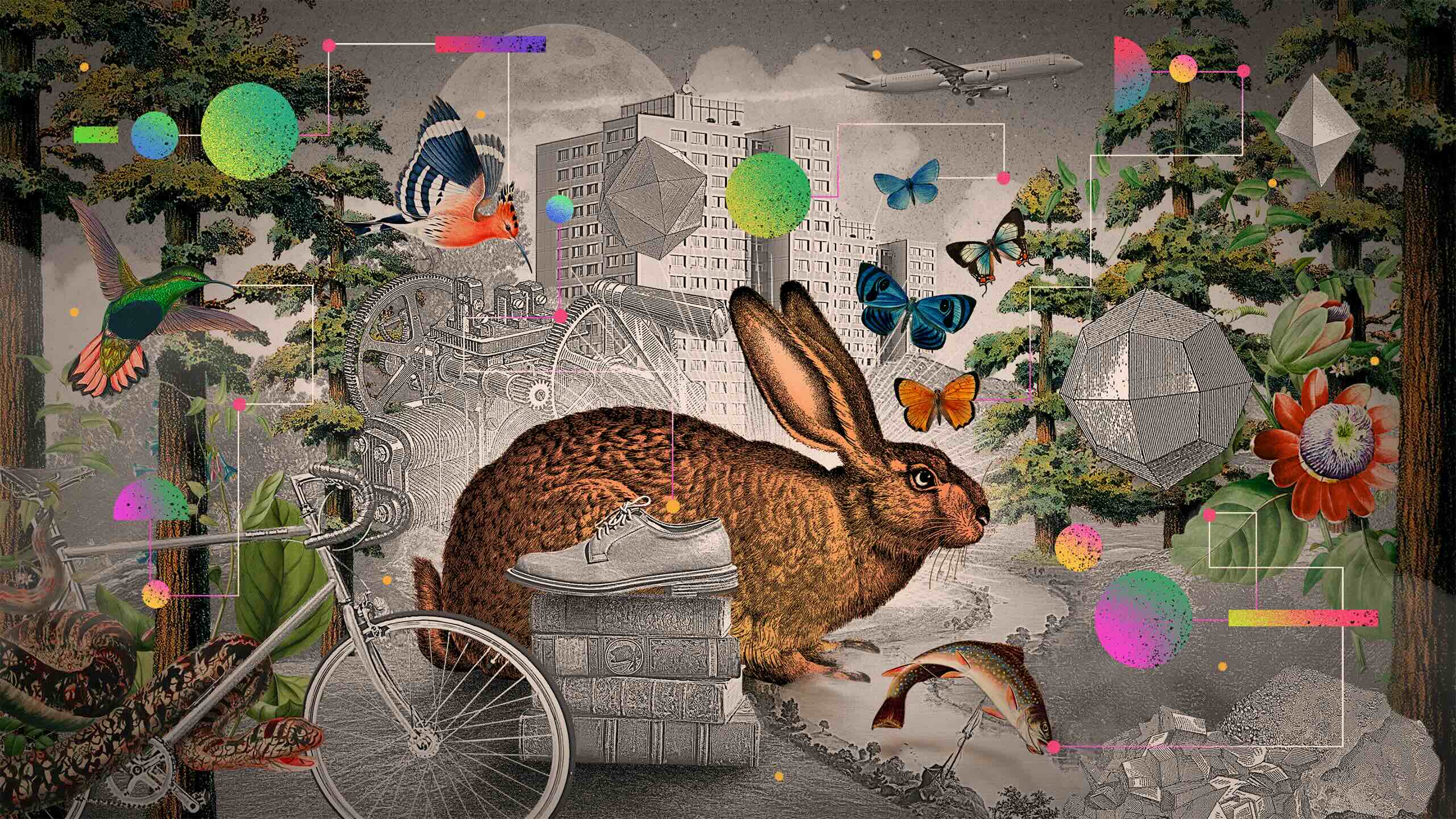
The idea of ‘biological agency’ — that life devises its own goals and behaves accordingly — complicates our understanding of what it means to be alive. But, Philip Ball asks, does it serve a scientific purpose?…
In 1993, a team led by the planetary scientist Carl Sagan tentatively concluded that there is life on Earth. Not much of a deduction, you might think — except that the researchers confined their evidence to observations made by the Galileo spacecraft, which had flown past our planet three years earlier on a looping journey to Jupiter. So great is the transformative power of life that its presence can be detected just from the light and radio waves our planet emits or reflects into space. Today we scan the cosmos for some of these telltale signatures light-years away.
Life leaves a mark, yet even now there’s no scientific consensus about what makes living things so different from inorganic substances like the rocks, gases, and oceans that are the sole components of dead worlds. Many scientists cite properties such as replication or metabolism. Others speak in more abstract terms about the way life is out of thermodynamic equilibrium with its surroundings. But some give another kind of answer. Living organisms are different because they do stuff for reasons.
It’s not enough to say that life is a nonequilibrium organized state through which there’s a constant flux of matter and energy. That description applies to hurricanes, too. But hurricanes just are. Only living entities have goals: to find food, to reproduce, to survive, sometimes simply to experience good things. (Dog owners will recognize that this is not just a human attribute.)
One way to express this idea is to say that living organisms have “agency.” It’s a hotly contested term. Some biologists reject it outright, at least for any organisms except humans, because we decide on our actions with conscious deliberation. (Whether we’re truly the only species to do so is another issue.) Others think that agency is a fundamental attribute of all life. Since there’s no agreed-upon definition of the term, to some extent it can mean whatever you want it to mean. But the debate about biological agency touches on fundamental issues in our understanding of what it means to be alive, because agency evokes a notion that biologists and philosophers have always wrestled with: teleology, the apparent purposiveness of life. If we admit agency into biology, do we open the floodgates to ideas about design, vitalism, or cosmic meaning? Or is it just a recognition of what makes life such a special state of matter?
To me, the notion of agency indeed speaks to our intuitive sense of what makes living things so special: not mere machines pushed around by environment and circumstance. I suspect that aversion to agency betrays a queasiness about confronting life as something more than some kind of genetic program. But there’s danger in the idea, too: It could so easily derail the work of studying the mechanistic explanations of how life works. I’m not looking to either bury or praise agency, but to explore whether it can be a scientifically productive idea…
[Ball unpacks the idea of agency, then reviews both scientific observations and the theories that they have provoked. He concludes…]
… I’m cautiously optimistic about the prospects of uniting such theoretical ideas with biological mechanisms. It seems unlikely to be coincidental, for example, that organisms that seem to show more agency also have molecular pathways that permit more openness to the influence of context and external information.
If we can get a clearer idea of what makes an agent, this could help us to understand how collective goals arise — as they did when multicellular organisms first arose long ago — and how they can break down, as in cancer. What’s more, a proper theory of agency might give us a clearer idea of what’s needed to make genuine artificial agents, not just computers and machines programmed with our own goals, but ones that can formulate their own. We might then also get a clearer idea of the potential benefits and dangers such truly agential machines might bring. But perhaps the most compelling argument for recognizing agency is that it might help us understand what makes life so different — not just humans, but life — that it is able to shape an entire planet in a manner visible from outer space.
Purpose? Goals? On the idea of “biological agency”: “Is Life Just Different?” from @philipcball.bsky.social in @quantamagazine.bsky.social.
* Erwin Schrödinger in What Is Life? (in which he wrestled, in his way, with Ball’s question, contending that life feeds on negative entropy) Full text here.
###
As we wonder why, we might send frustrated birthday greetings to Ernő Rubik; he was born on this date in 1944. An architect and inventor, he created the Rubik’s Cube (in 1974), which has become the world’s best-selling puzzle game, with over half a billion sold.
A Rubik’s Cube consists of 26 small cubes that rotate on a central axis; nine colored cube faces, in three rows of three each, form each side of the cube. After the cube arrangement is randomized (the highest level of entropy), the player must restore order (that’s to say, practice “negative entropy”), returning it to the original condition of faces with matching colors on each side — which is one among 43 quintillion possible configurations.
“Reality is that which, when you stop believing in it, doesn’t go away”*…

Reality is tough. Everything eats and is eaten. Everything destroys and is destroyed.
In a way that challenges lots of our deeply-seated conceptions (your correspondent’s, anyway), philosopher (and self-proclaimed pessimist) Drew Dalton invokes the laws of thermodynamics to argue that it is our moral duty to strike back at the Universe…
Reality is not what you think it is. It is not the foundation of our joyful flourishing. It is not an eternally renewing resource, nor something that would, were it not for our excessive intervention and reckless consumption, continue to harmoniously expand into the future. The truth is that reality is not nearly so benevolent. Like everything else that exists – stars, microbes, oil, dolphins, shadows, dust and cities – we are nothing more than cups destined to shatter endlessly through time until there is nothing left to break. This, according to the conclusions of scientists over the past two centuries, is the quiet horror that structures existence itself.
We might think this realisation belongs to the past – a closed chapter of 19th-century science – but we are still living through the consequences of the thermodynamic revolution. Just as the full metaphysical implications of the Copernican revolution took centuries to unfold, we have yet to fully grasp the philosophical and existential consequences of entropic decay. We have yet to conceive of reality as it truly is. Instead, philosophers cling to an ancient idea of the Universe in which everything keeps growing and flourishing. According to this view, existence is good. Reality is good.
But what would our metaphysics and ethics look like if we learned that reality was against us?…
Read on for his provocative argument that philosphers must grapple with the meaning of thermodynamics: “Reality is evil,” from @dmdalton.bsky.social in @aeon.co.
Dalton further explores these ideas in his book The Matter of Evil: From Speculative Realism to Ethical Pessimism (2023)
* Philip K. Dick
###
As we wrestle with reality, we might send somewhat sunnier birthday greetings to Stephen William Hawking CH CBE FRS FRSA; he was born on this date in 1942. A theoretical physicist and cosmologist, he is probably best known in his professional circles for his work with Roger Penrose on gravitational singularity theorems in the framework of general relativity, for his theoretical prediction that black holes emit radiation (now called Hawking radiation), and for his support of the many-worlds interpretation of quantum mechanics.
But Hawking is more broadly known as a popularizer of science. His A Brief History of Time stayed on the British Sunday Times best-seller list for over four years (a record-breaking 237 weeks), and has sold over 10 million copies worldwide.
“We have this one life to appreciate the grand design of the universe, and for that, I am extremely grateful.”

“Gravity. It’s not just a good idea; it’s the law!”*…

… But what is gravity? George Musser unpacks a new argument that explores how the growth of disorder could cause massive objects to move toward one another– one that has left some physicists interested, and some skeptical…
Isaac Newton was never entirely happy with his law of universal gravitation. For decades after publishing it in 1687, he sought to understand how, exactly, two objects were able to pull on each other from afar. He and others came up with several mechanical models, in which gravity was not a pull, but a push. For example, space might be filled with unseen particles that bombard the objects on all sides. The object on the left absorbs the particles coming from the left, the one on the right absorbs those coming from the right, and the net effect is to push them together.
Those theories never quite worked, and Albert Einstein eventually provided a deeper explanation of gravity as a distortion of space and time. But Einstein’s account, called general relativity, created its own puzzles, and he himself recognized that it could not be the final word. So the idea that gravity is a collective effect — not a fundamental force, but the outcome of swarm behavior on a finer scale — still compels physicists.
Earlier this year, a team of theoretical physicists put forward what might be considered a modern version of those 17th-century mechanical models. “There’s some kind of gas or some thermal system out there that we can’t see directly,” said Daniel Carney of Lawrence Berkeley National Laboratory, who led the effort. “But it’s randomly interacting with masses in some way, such that on average you see all the normal gravity things that you know about: The Earth orbits the sun, and so forth.”
This project is one of the many ways that physicists have sought to understand gravity, and perhaps the bendy space-time continuum itself, as emergent from deeper, more microscopic physics. Carney’s line of thinking, known as entropic gravity, pegs that deeper physics as essentially just the physics of heat. It says gravity results from the same random jiggling and mixing up of particles — and the attendant rise of entropy, loosely defined as disorder — that governs steam boilers, car engines and refrigerators.
Attempts at modeling gravity as a consequence of rising entropy have cropped up now and again for several decades. Entropic gravity is very much a minority view. But it’s one that won’t die, and even detractors are loath to dismiss it altogether. The new model has the virtue of being experimentally testable — a rarity when it comes to theories about the mysterious underpinnings of the universal attraction…
[Musser explains the hypothesis, traces is origin, and reviews other scientists’ reactions, and traces possible approaches to testing it…]
… if this long-shot theory does work out, physicists will need to update the artist Gerry Mooney’s famous gravity poster, which reads: “Gravity. It isn’t just a good idea. It’s the law.” Perhaps gravity is not, in fact, a law, just a statistical tendency…
“Is Gravity Just Entropy Rising? Long-Shot Idea Gets Another Look” from @georgemusser.com in @quantamagazine.bsky.social.
###
As we fumble with forces, we might send insightful birthday greetings to a man who encourages us to see in different ways, M. C. Escher; he was born on this date in 1898. A graphic artist inspired by mathematics, he created woodcuts, lithographs, and mezzotints, that— while largely ignored by the art world in his lifetime, have become widely celebrated. He’s been recognized as an heir to Parmigianino, Hogarth, and Piranesi.
His work features mathematical objects and operations including impossible objects, explorations of infinity, reflection, symmetry, perspective, truncated and stellated polyhedra, hyperbolic geometry, and tessellations. And though Escher believed he had no mathematical ability, he interacted with the mathematicians George Pólya, Roger Penrose, and Donald Coxeter, and the crystallographer Friedrich Haag, and conducted his own research into tessellation.
For more on (and more examples of) Escher’s work, see here.


“Those who are not shocked when they first come across quantum theory cannot possibly have understood it”*…
A scheduling note: your correspondent is headed onto the road for a couple of weeks, so (Roughly) Daily will be a lot more roughly than daily until September 20th or so.
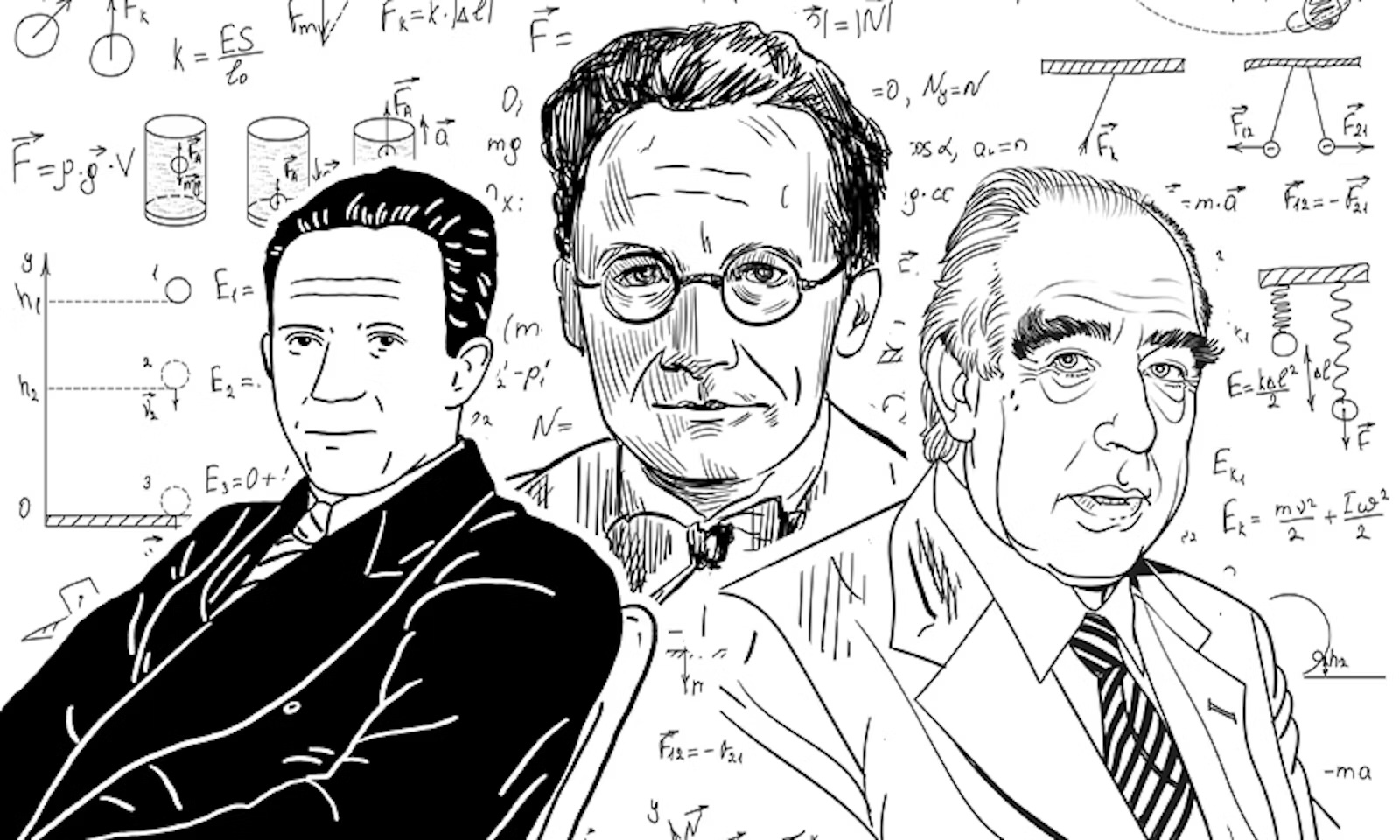
100 years ago, a circle of physicists shook the foundation of science. As Philip Ball explains, it’s still trembling…
In 1926, tensions were running high at the Institute for Theoretical Physics in Copenhagen. The institute was established 10 years earlier by the Danish physicist Niels Bohr, who had shaped it into a hothouse for young collaborators to thrash out a new theory of atoms. In 1925, one of Bohr’s protégés, the brilliant and ambitious German physicist Werner Heisenberg, had produced such a theory. But now everyone was arguing with each other about what it implied for the nature of physical reality itself.
To the Copenhagen group, it appeared reality had come undone…
[Ball tells the story of Niels Bohr’s building on Max Planck, of Werner Heisenberg’s wrangling of Bohr’s thought into theory, of Einstein’s objections and Erwin Schrödinger’s competing theory; then he homes in on the ontological issue at stake…]
Quantum mechanics, they said, demanded we throw away the old reality and replace it with something fuzzier, indistinct, and disturbingly subjective. No longer could scientists suppose that they were objectively probing a pre-existing world. Instead, it seemed that the experimenter’s choices determined what was seen—what, in fact, could be considered real at all.
In other words, the world is not simply sitting there, waiting for us to discover all the facts about it. Heisenberg’s uncertainty principle implied that those facts are determined only once we measure them. If we choose to measure an electron’s speed (more strictly, its momentum) precisely, then this becomes a fact about the world—but at the expense of accepting that there are simply no facts about its position. Or vice versa…
…A century later, scientists are still arguing about this issue of what quantum mechanics means for the nature of reality…
[Ball recounts subsequent attempts to reconcile quantum theory to “reality,” including Schrödinger’s wave mechanics…]
… Schrödinger’s wave mechanics didn’t restore the kind of reality he and Einstein wanted. His theory represented all that could be said about a quantum object in the form of a mathematical expression called the wave function, from which one can predict the outcomes of making measurements on the object. The wave function looks much like a regular wave, like sound waves in air or water waves on the sea. But a wave of what?
At first, Schrödinger supposed that the amplitude of the wave—think of it like the height of a water wave—at a given point in space was a measure of the density of the smeared-out quantum particle there. But Born argued that in fact this amplitude (more precisely, the square of the amplitude) is a measure of the probability that we will find the particle there, if we make a measurement of its position.
This so-called Born rule goes to the heart of what makes quantum mechanics so odd. Classical Newtonian mechanics allows us to calculate the trajectory of an object like a baseball or the moon, so that we can say where it will be at some given time. But Schrödinger’s quantum mechanics doesn’t give us anything equivalent to a trajectory for a quantum particle. Rather, it tells us the chance of getting a particular measurement outcome. It seems to point in the opposite direction of other scientific theories: not toward the entity it describes, but toward our observation of it. What if we don’t make a measurement of the particle at all? Does the wave function still tell us the probability of its being at a given point at a given time? No, it says nothing about that—or more properly, it permits us to say nothing about it. It speaks only to the probabilities of measurement outcomes.
Crucially, this means that what we see depends on what and how we measure. There are situations for which quantum mechanics predicts that we will see one outcome if we measure one way, and a different outcome if we measure the same system in a different way. And this is not, as is sometimes implied (this was the cause of Heisenberg’s row with Bohr), because making a measurement disturbs the object in some physical manner, much as we might very slightly disturb the temperature of a solution in a test-tube by sticking a thermometer into it. Rather, it seems to be a fundamental property of nature that the very fact of acquiring information about it induces a change.
If, then, by reality we mean what we can observe of the world (for how can we meaningfully call something real if it can’t be seen, detected, or even inferred in any way?), it is hard to avoid the conclusion that we play an active role in determining what is real—a situation the American physicist John Archibald Wheeler called the “participatory universe.”..
… Heisenberg’s “uncertainty” captured that sense of the ground shifting. It was not the ideal word—Heisenberg himself originally used the German Ungenauigkeit, meaning something closer to “inexactness,” as well as Unbestimmtheit, which might be translated as “undeterminedness.” It was not that one was uncertain about the situation of a quantum object, but that there was nothing to be certain about.
There was an even more disconcerting implication behind the uncertainty principle. The vagueness of quantum phenomena, when an electron in an atom might seem to jump from one energy state to another at a time of its own choosing, seemed to indicate the demise of causality itself. Things happened in the quantum world, but one could not necessarily adduce a reason why. In his 1927 paper on the uncertainty principle, Heisenberg challenged the idea that causes in nature lead to predictable effects. That seemed to undermine the very foundation of science, and it made the world seem like a lawless, somewhat arbitrary place….
… One of Bohr’s most provocative views was that there is a fundamental distinction between the fuzzy, probabilistic quantum world and the classical world of real objects in real places, where measurements of, say, an electron with a macroscopic instrument tell us that it is here and not there.
What Bohr meant is shocking. Reality, he implied, doesn’t consist of objects located in time and space. It consists of “quantum events,” which are obliged to be self-consistent (in the sense that quantum mechanics can describe them accurately) but not classically consistent with one another. One implication of this, as far as we can currently tell, is that two observers can see different and conflicting outcomes from an event—yet both can be right.
But this rigid distinction between the quantum and classical worlds can’t be sustained today. Scientists can now conduct experiments that probe size scales in between those where quantum and classical rules are thought to apply—neither microscopic (the atomic scale) nor macroscopic (the human scale), but mesoscopic (an intermediate size). We can look, for example, at the behavior of nanoparticles that can be seen and manipulated yet are small enough to be governed by quantum rules. Such experiments confirm the view that there is no abrupt boundary of quantum and classical. Quantum effects can still be observed at these intermediate scales if our devices are sensitive enough, but those effects can be harder to discern as the number of particles in the system increases.
To understand such experiments, it’s not necessary to adopt any particular interpretation of quantum mechanics, but merely to apply the standard theory—encompassed within Schrödinger’s wave mechanics, say—more expansively than Bohr and colleagues did, using it to explore what happens to a quantum object as it interacts with its surrounding environment. In this way, physicists are starting to understand how information gets out of a quantum system and into its environment, and how, as it does so, the fuzziness of quantum probabilities morphs into the sharpness of classical measurement. Thanks to such work, it is beginning to seem that our familiar world is just what quantum mechanics looks like when you are 6 feet tall.
But even if we manage to complete that project of uniting the quantum with the classical, we might end up none the wiser about what manner of stuff—what kind of reality—it all arises from. Perhaps one day another deeper theory will tell us. Or maybe the Copenhagen group was right a hundred years ago that we just have to accept a contingent, provisional reality: a world only half-formed until we decide how it will be…
Eminently worth reading in full: “When Reality Came Undone,” from @philipcball in @NautilusMag.
See also: When We Cease to Understand the World, by Benjamin Labatut.
* Niels Bohr
###
As we wrestle with reality, we might spare a thought for Ludwig Boltzmann; he died on this date in 1906. A physicist and philosopher, he is best remembered for the development of statistical mechanics, and the statistical explanation of the second law of thermodynamics (which connected entropy and probability).
Boltzmann helped paved the way for quantum theory both with his development of statistical mechanics (which is a pillar of modern physics) and with his 1877 suggestion that the energy levels of a physical system could be discrete.

“You can swim (uncomfortably) in water at a temperature slightly above freezing; a tiny drop in temperature—or a miracle—allows you to walk on water.”*…

As Elise Cutts explains, making ice requires more than subzero temperatures. The unpredictable process takes microscopic scaffolding, random jiggling and often a little bit of bacteria…
We learn in grade school that water freezes at zero degrees Celsius, but that’s seldom true. In clouds, scientists have found supercooled water droplets as chilly as minus 40 C, and in a lab in 2014, they cooled water to a staggering minus 46 C before it froze. You can supercool water at home: Throw a bottle of distilled water in your freezer, and it’s unlikely to crystallize until you shake it.
Freezing usually doesn’t happen right at zero degrees for much the same reason that backyard wood piles don’t spontaneously combust. To get started, fire needs a spark. And ice needs a nucleus — a seed of ice around which more and more water molecules arrange themselves into a crystal structure.
The formation of these seeds is called ice nucleation. Nucleation is so slow for pure water at zero degrees that it might as well not happen at all. But in nature, impurities provide surfaces for nucleation, and these impurities can drastically change how quickly and at what temperature ice forms.
For a process that’s anything but exotic, ice nucleation remains surprisingly mysterious. Chemists can’t reliably predict the effect of a given impurity or surface, let alone design one to hinder or promote ice formation. But they’re chipping away at the problem. They’re building computer models that can accurately simulate water’s behavior, and they’re looking to nature for clues — proteins made by bacteria and fungi are the best ice makers scientists know of.
Understanding how ice forms is more than an academic exercise. Motes of material create ice seeds in clouds, which lead to most of the precipitation that falls to Earth as snow and rain. Several dry Western states use ice-nucleating materials to promote precipitation, and U.S. government agencies including the National Oceanic and Atmospheric Administration and the Air Force have experimented with ice nucleation for drought relief or as a war tactic. (Perhaps snowstorms could waylay the enemy.) And in some countries, hail-fighting planes dust clouds with silver iodide, a substance that helps small droplets to freeze, hindering the growth of large hailstones.
But there’s still much to learn. “Everyone agrees that ice forms,” said Valeria Molinero, a physical chemist at the University of Utah who builds computer simulations of water. “After that, there are questions.”…
More at: “The Enduring Mystery of How Water Freezes,” from @elisecutts in @QuantaMagazine.
Even more at “Cold, colder and coldest ice” (source of the image above)
* Meteorologist Craig Bohren
###
As we contemplate crystallization, we might send chilly birthday greetings to a man fascinated by ice and its crystalline structure, Walther Hermann Nernst; he was born on this date in 1864. A physicist and physical chemist, he made material contributions to thermodynamics, physical chemistry, electrochemistry, and solid-state physics. But he is best remembered for the Nernst heat theorem, which stated that the entropy (a thermodynamic measure of disorder) in a system approaches zero as the temperature goes towards absolute zero… which led to the development of what Nernst himself called “the third law of thermodynamics,” and to Nernst’s receiving the 1920 Nobel Prize in Chemistry.

You must be logged in to post a comment.