Posts Tagged ‘Tim O’Reilly’
“Something is happening here / But you don’t know what it is / Do you, Mister Jones?”*…
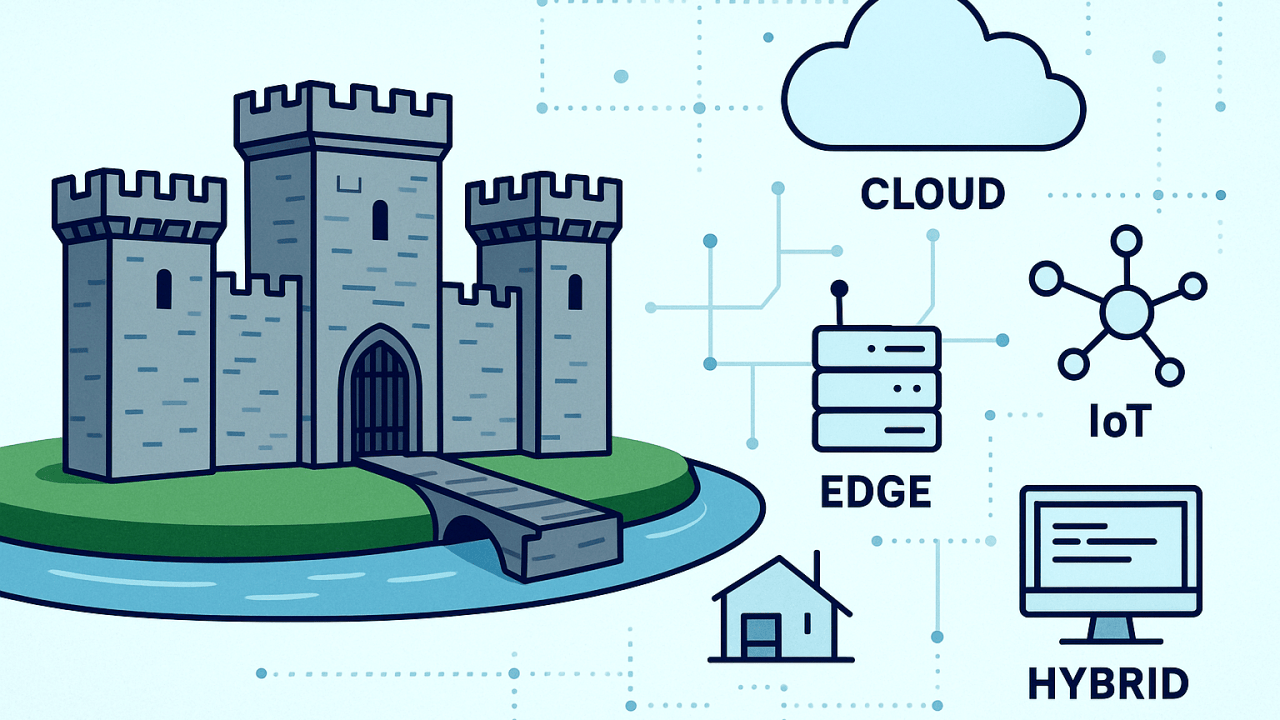
Further to the post of Septmeber 15: on trying to understand what might lie on the other side of a transformation driven by AI (and related technologies). Microsoft’s Deputy CTO, Sam Schillace, suggests that organizations are about to change completely…
… Here’s a nerdy TL;DR if you want it: I think AI will enable a switch from what is essentially circuit switching today, in all kinds of organizations, to something that will look and feel a lot more like packet switching. This will happen partially because it can now (AI is to this problem what fast processors were to distributed networking protocols), and because networks are almost always more powerful, flexible, and scalable. This idea is going to feel super uncomfortable and be rejected by business leaders, employers and academics in much the same way that network engineers rejected the idea of packet-switched networks…
… In 1965, making a long-distance phone call in America was a feat of engineering coordination. A call from New York to Los Angeles required a dedicated copper path, physically reserved, for the duration of the conversation, and AT&T had to employ armies of switching engineers to manage this. The Bell System was one of the great technical achievements of the twentieth century, and the people who built it were not fools. They worked ferociously for what they were optimizing for: guaranteed, high-quality, reliable connections between two points.
It seemed fine – expensive, but that’s what everyone was used to. If you are my age, you remember when long-distance was even a thing, and those calls cost more and were precious. I still get a tiny bit nervous talking to my parents 3000 miles away in Michigan, that was so deeply ingrained. Part of me still can’t believe that phone calls all cost the same.
Then a small group of researchers, largely funded by ARPA, mostly working in universities, proposed something that sounded to the Bell engineers like a joke. Instead of reserving a dedicated path, you would break messages into small pieces, label each piece with a destination, and release them into the network to find their own way. Different pieces of the same message might travel completely different routes. They might arrive out of order. There was no guarantee that any particular piece would arrive at all. A phone call, under this scheme, would be like mailing a letter by tearing it into a hundred pieces and dropping each one in a different mailbox, hoping they’d all show up. (Kind of like training a giant AI model on lots of small fragments of language (tokens) and hoping that somehow intelligence would emerge from putting them back together randomly – which largely worked).
The Bell engineers had a name for this general idea: chaos. They had a specific critique too, which was that you couldn’t make any guarantees about quality of service. Voice needs low, consistent latency: you can’t have some syllables arriving seconds after others. And of course, data needs reliability: a corrupted file is useless. The engineers were right about all of this. Packet switching, in its early forms, was genuinely worse at the things circuit switching was designed to do.
It also, within a few decades, made the Bell System irrelevant. The internet didn’t improve on the telephone network; it made the telephone network a minor application running on top of something much larger. Today your phone calls travel as packets (which is why they all cost the same – there’s no such thing as a “long circuit” now), just like everything else. The Bell engineers optimized for the wrong thing. I love that this also has a flavor of “worse is better”. The Bell engineers were optimizing for “correct, complete, but complex and rigid” and the internet is more “simple and recoverable beats correct and complex”.
What actually happened was a philosophical shift about where intelligence should live. Circuit switching is a centralized control philosophy. Someone, somewhere, reserves the path before any message travels it. The network takes responsibility for delivery. The endpoints are dumb; they just send and receive. All the complexity, all the guarantee-making, lives in the infrastructure itself. This works, and it scales up to a point, and then it hits a wall, because the central system has to know everything about every connection, and that knowledge becomes impossible to manage as the network grows. (Sound familiar? This is how we build companies these days. We’ll come back to that idea)
Packet switching inverts this entirely. The network is dumb and the endpoints are smart. A router doesn’t understand the content of the packets it handles – it reads a destination address and forwards the packet one hop closer. The intelligence about what the message means, whether it arrived correctly, what to do if it didn’t – all of that lives at the edges, in the devices doing the communicating. The protocol defines what the endpoints must do. The network just moves bits.
You have seen this argument before, in a different domain. Central planning versus markets is the same disagreement. The Soviet planning apparatus tried to do for an economy what circuit switching does for a telephone network: reserve resources, guarantee outcomes, manage the whole system from the center. It failed not because the planners were stupid but because the information required to run a complex system centrally exceeds what any center can hold (it also failed because many of them were corrupt, and centralized systems are vulnerable to this, since there’s no way to build in mechanisms to correct, outcompete or otherwise reverse that corruption).
Prices, in a market, are packets. They carry information about supply and demand from the edges without anyone at the center having to understand or coordinate it. Markets are chaotic, wasteful, frequently unfair, and they consistently outperform central planning at scale for the same reason the internet outperformed the Bell System. The network always wins, eventually, because the network is where the information actually lives.
Let’s think about companies now. Companies love to do re-orgs. Or at least, they have to do them. They’re a lot of work, just like it was a lot of work to organize and change the old Bell network, and for the same reasons. Companies have to deal with the pain of organizational overhead, because to a large extent, they try to do central planning – circuit switching.
A manager, in an org chart, is a leased line. From an organizational perspective, they’re like a circuit between strategy and execution, reserved whether or not signal is flowing. The org chart is the circuit map. It tells you the paths that exist, which means it also tells you the paths that don’t. If you need to get information or work from point A to point B and there’s no line between them on the chart, you have a problem – you need to go up to a common node and back down, or you need to get someone to lay a new line. When a company needs to change how it behaves, it rewires the circuit map, which we call a reorg.
Why do we do this? This is not because companies are stupid or because the people running them lack imagination (hopefully). It’s because circuit-switched organizations are the only kind that could be managed without the infrastructure that packet-switched organizations require (which isn’t unlike what happened with the internet – we needed cheap processors to be able to build routers that could handle packets fast enough. Before we had that, we had no choice but to set up dedicated circuits).
If you can’t do the things an organization needs – observing and judging work, finding capabilities, holding people accountable – without the overhead of a fixed org chart, well, you just have to have it.
The cost of this solution is enormous and mostly invisible because it’s so normalized…
[Schillace expands on this idea…]
… When packet switching was proposed, the experts who objected most loudly were the most qualified people in the room. They were “right” in an engineering sense, but wrong in the systems sense. And they did what most people do, asking a “why not” question (against the old design and constraints) instead of a “what if” one: what if the new processors could enable a new network design?
Most people looking at AI are making the same mistake, and I predict we will see a lot of this from the orthodox “business advisor” community. I hear this from engineers and leaders already, and it sounds just like the Bell folks: You can’t guarantee accountability in a decentralized system. You can’t audit a network that routes around hierarchy. Regulators will never accept this. Sophisticated investors will raise concerns about governance.
All of these objections will be correct in the short term and beside the point in the long term. They are right from some kind of local engineering perspective but wrong from an emergent systems perspective. The question is not whether packet-switched organizations perform better on the metrics that circuit-switched organizations were built for. They won’t, at least at first, just like packet-switched networks didn’t at first. The question is whether the new architecture unlocks things the old one couldn’t do at all. And I think it will – I think we will get levels of scale, creativity and responsiveness by using these new tools to push intelligence to the edge of all kinds of organizations – not just businesses but political, social, educational and creative ones…
…There is a useful heuristic here, which is that disruptive ideas tend to produce a room that’s roughly split in half. Usually something like half the people think the idea is obviously correct (the folks asking “what if”), and half think it’s obviously wrong (the “why not” crowd). I’ve written about this kind of bifurcation before – this is the sign of something that is genuinely disruptive, and the split is between people who are rejecting it because it feels threatening, and people who have internalized the new world view and are beginning to extrapolate it…
[Schillace considers earlier, unsuccessful attempts at “packet-switched organizations,” concluding that “AI is [the] missing piece – cheap enough intelligence to put “everywhere” and enable a bunch of these ideas for real. It’s the equivalent of those cheap processors [that enabled packet switching] finally showing up, except it’s a much more complete stack arriving all at once” and that the next few years will consist in discovering the new protocols that will allow “packet-switched organizations” to succeed…]
… The Bell engineers who resisted packet switching were not, in the end, wrong about what they said. Voice quality did suffer in early VoIP, packets did get dropped a lot, and for a while, quality was worse. But they were wrong about what would matter in ten years, and catastrophically wrong about what would be possible in thirty.
Email was not a better telegram, the web was not a better encyclopedia, and streaming was not a better cable network. Each of these looks, in retrospect, like an obvious evolution, but none of them were conceivable from inside the circuit-switched world (I remember the freak out about how video was going to break even the highly scalable new internet. It wasn’t even thinkable in the circuit switched world). They required the new infrastructure before anyone could imagine what to build on it.
The organizational equivalent is similarly hard to see in advance. It is likely that packet-switched, AI-native organizations will not just do existing organizational things more efficiently, but that they will do things that are not currently possible. There might be organizations that form around specific problems and dissolve when the problem is solved, rather than persisting as structures in search of purpose, or expertise that routes to where it is needed rather than being allocated by headcount. We might have large groups with a degree of strategic flexibility and sophistication that have never existed together – we might get political or creative movements in radically different shapes because of that. We are definitely going to see an evolution in the creation, management and use of institutional memory. Training will probably look very different, as will job descriptions.
And almost certainly: we will get things we cannot name yet. Nobody in 1975 could have described Google, or Facebook, or VOIP, or even Google Docs.
The phone company’s engineers built something extraordinary. The Bell System was a genuine engineering achievement, and the people who designed it were some of the best technical minds of their era. They lost anyway. Networks are more robust, once the infrastructure to support them exists, and the right protocols to create and maintain them are adopted.
My bet is that the organizations of the future, the ones that compete and thrive, will make use of AI to build networks the same way the internet made use of those cheap processors and new protocols to build huge scale and new capabilities.
This will feel controversial, and might even be worse at first, but networks always win. The age of centrally planned organizations is coming to an end…
Eminently worth reading in full. Chaos that scales: “The Network Always Beats the Castle,” via @timoreilly.bsky.social.
See also: Benedict Evans‘ “AI, tools and transformation“:
… With every new technology, we start by using it for the work we already have, and we just do that more and faster. But then, over time, you make entirely new things. We will use AI to automate broad classes of stuff inside existing workflows and existing companies (although, as I’ve outlined above, that will be enormously more trouble and work than just giving everybody a model). But with every previous platform shift, the stuff that actually mattered was the stuff that wasn’t even possible before and that no-one even imagined…
And by way of keeping all of this in perspective, see Henry Farrell‘s “Machine god metaphors eat your brain” and Max Read‘s “Between 5 and 14 thoughts about AI and the discourse cycle.”
(Image above: source)
* Bob Dylan, “Ballad of a Thin Man” (from Highway 61 Revisited, 1965)
###
As we try to peer over the horizon, we might send carefully-calculated birthday greetings to a man whose work has helped propel the advances we’re pondering: James Hardy Wilkinson; he was born on this date in 1919. A mathematician, he is best known for his pioneering work in numerical analysis and numerical linear algebra, especially in the context of high-speed digital computing. In 1970 he won the ACM Turing Award.

“Always create more value than you capture”*…

There are, of course, myriad ways to rank people. Increasingly these days, the preferred scale seems to be one’s wealth. The Forbes 400, which ranks the richest Americans by their wealth, has become the scorecard of our zeitgeist. But one of its denizens (currently #4), Jeff Bezos, suggested in 2024, “somebody needs to make a list where they rank people by how much wealth they’ve created for other people.”
Sakshyam Patro has obliged…
… this is that list: [It ranks] founders by Wealth Created For Others (WCFO): the dollar value their companies generated for shareholders other than themselves…. every number traceable to an SEC filing, an academic dataset, or a named data source — refreshed every fifteen minutes while markets are open. Each figure is the shareholder wealth a founder’s company created, now held by index funds, pensions, employees and co-founders, minus what the founder kept. It’s not a claim that one person built the company alone…
See the list here. (Teaser: as of this writing, Bezos moves up one slot, from #4 to #3); the current Forbes #1, Elon Musk, drops to #28 (his wealth is $798B; his investors have lost $243B). And see the details of the methodology here.
Patro adds some important context– the first point especially:
- It is the Forbes billionaires list, re-sorted — not a ranking of humanity’s benefactors. The universe is living billionaires with a trackable public company. Norman Borlaug, Linus Torvalds, vaccine developers, and public-sector reformers created enormous value and belong at the top of a different list; they are absent here because they are not billionaires with public equity, not because the metric judges them small. This list answers exactly one question Bezos posed: among the people Forbes already ranks by personal wealth, who created the most for others versus kept for themselves?
- Not a measure of consumer surplus, wages, or societal value beyond shareholders (those are larger still — Nordhaus [see here] estimates innovators capture only ~2.2% of the social surplus they create — but they are not reliably measurable per person, so we do not headline them).
- Not a moral scoreboard. It measures one thing: dollars of shareholder wealth created beyond a risk-free benchmark, minus dollars kept.
- Not affiliated with Forbes or with any prior ranking site.
Ranked by the wealth they built for other investors: “The Anti‑Forbes List.”
To observe the obvious, the numbers at play here are big… so big as to be hard to understand. Amanda Shendruk urges us to make the effort and offers some helpful tips: “Understanding large values: It’s our ethical duty.”
###
As we re-evaluate, we might recall that it was on this date in 1598 that Shakespeare’s The Merchant of Venice was entered on the Stationers’ Register. By decree of Queen Elizabeth, the Stationers’ Register licensed printed works, giving the Crown tight control over all published material. In those days, “copyright” mainly meant “the right to make copies”; secondarily, it conferred intellectual property rights (though in those days, mainly to the guild printers who got the permissions).
In some cases, the companies of actors appear to have registered plays through co-operative stationers, with the express purpose of forestalling the publication of a play when publication was not in their interest. This seems to have been the case with The Merchant of Venice and Shakespeare’s company, The Lord Chamberlain’s Men: the copyright was granted to James Roberts, who printed the company’s playbills and held copyrights on five of their plays (two by Shakespeare). But Roberts transferred the copyright to fellow stationer Thomas Heyes in 1600, and Hayes published first quarto edition of the play before the end of the year.

“Technology doesn’t force us… it merely opens the door”*…
The estimable Tim O’Reilly reminds us to think deeply about how AI could and should turn out. He suggests that Jeff Ding‘s diffusion theory of the role of technology in great-power competition also applies to AI adoption– and that it suggests that companies obsessed with the frontier might be optimizing for the wrong thing…
In the 1980s, Japan led the world in semiconductors, consumer electronics, and computer hardware, the industries everyone assumed would decide the next phase of economic power. Japan won them and still did not overtake the United States in the information revolution that followed. Jeff Ding, a political scientist at George Washington University, opens his book Technology and the Rise of Great Powers with the history of the first and second industrial revolutions and the third, the information revolution. The explanation he gives for who wins and who loses applies to companies as well as it does to nations, and very much to the current trajectory of AI.
Ding contrasts two theories of how technological revolutions reshape economic power. The conventional one he calls the leading sector model, or LS theory. It goes like this: New technologies create fast-growing new industries like steel and railroads and automobiles and semiconductors, and the country that dominates invention in those sectors captures the monopoly profits and the upstream and downstream economic linkages that come with them. As the story goes, if you win the leading sector, you win the era. Britain won in the first industrial revolution through its mastery of steam power, and then was surpassed by the US in the second through its leadership in electrification, the internal combustion engine, and mass manufacturing. The US kept its lead over Japan in the information systems revolution not by competing in the “leading sector” of electronic hardware but by diffusing “up the stack” via software that took the power of computing into every sector of the economy. (OK, that last bit is my explanation of what happened rather than Ding’s, but it’s consistent with his theory.)
Leading Sector theory is pretty clearly the working hypothesis of today’s AI industry and the national strategy that is forming around that industry. The company and the country with the biggest and best models wins. Everyone else is an also-ran.
Ding offers another explanation, which he calls diffusion theory. He points out that general-purpose technologies, foundational ones like the steam engine, electricity, and the computer, don’t just create massive profits and productivity gains in a single industry but instead spread across the whole economy. National economic leadership comes not from inventing the new sector but from diffusing the general-purpose technology more quickly and more broadly than your rivals. This happens over decades. The win goes to whoever most successfully embeds the technology into a wide range of ordinary productive work. This is how the US kept its lead over Japan rather than being surpassed by it.
This is obviously aligned with the thinking of Arvind Narayanan and Sayash Kapoor in “AI as Normal Technology,” which Ding cites in his book.
A big part of what enables diffusion is what Ding calls skill infrastructure, the education and training systems that widen the pool of people who can actually work with the technology. When the priority is widespread adoption rather than invention, he argues, the institutions that matter are the ones that build engineering skill at scale, standardize good practice, and tie research to industry. He writes:
GPT diffusion theory highlights the importance of GPT [General Purpose Technology] skill infrastructure. Education and training systems that widen the pool of engineering skills and knowledge linked to a GPT. When widespread adoption of GPTs is the priority, it is ordinary engineers, not heroic inventors, who matter.
Music to my ears, as it should be to yours: “It is ordinary engineers, not heroic inventors, who matter.”
That is not how the current AI narrative goes. Everyone is fixated on the labs, the frontier models, and the most famous researchers. And that fixation shapes enterprise strategy. Inside many companies AI strategy is a procurement decision: Which model and which vendor and which flagship tool should we choose? Or it’s a moonshot to stand up a lab and build an impressive demo and hire your own famous developer. Both approaches treat AI as a sector to be won. Ding’s argument is that the breakthrough sector itself is not where the long-term value for national power lives. And I believe that the same applies to corporate success. The value is in how widely and how well the technology gets embedded into the work of the people you already employ. The company that puts AI to work in finance and support and legal and sales and operations, across every unglamorous process, as well as in product and engineering, outperforms its competitors and drives its industry forward.
The reason diffusion takes a long time is that it is an organizational problem and not a technical one…
[Tim elaborates, and specifies the requirements for successful management of what is an “enterprise transformation problem”; he then unpacks the geopolitics of AI. He concludes…]
… Sovereign AI is not just a matter of national power. It is a predictable consequence of diffusion. A technology that diffuses widely will be adapted by different societies, firms, and institutions to suit their own needs, values, and constraints. Sovereign AI is AI designed for diffusion, not just raw increases in capability.
This is one reason the arms-race framing is unhelpful. It encourages us to treat AI as if it were a weapons system or a scarce strategic asset. But if AI is closer to electrification, computing, or the written word, the important thing is how the technology is embedded into the ordinary life of economies and institutions, and whether that embedding happens in ways that increase agency broadly rather than concentrating it in a few hyperpowerful companies.
There are a few additional lessons we can take from the history of electrification. While motors became decentralized, factories stopped generating their own power and bought it from a centralized grid. The unit-drive revolution decentralized application, not generation. This limitation, which we are now working to overcome to some extent with decentralized solar generation, is perhaps ironically showing up most strongly in the strain that AI data centers are placing on the grid. Let’s learn from that misstep. You can diffuse AI into every workflow via API calls to a big centralized model, or it can be diffused by a network of smaller models that turbocharge every part of the economy.
We should design for a future of multiple AIs, not a single universal system. Different countries will want systems shaped by different legal regimes, languages, histories, and cultural assumptions. So will companies. So will professions and communities of practice. The instinct of some frontier labs is to imagine that the right answer is to homogenize the technology, purge it of bias, and offer a single sanitized intelligence layer for the world. But AI is a social and cultural technology. The differences are not a defect to be smoothed away.
We do need to think about standards and interoperability. The historical analogy that comes to mind is railroad gauge. When real world systems are built to incompatible standards, the result is not healthy diversity but decades of friction, kludges, and retrofitting. The same may prove true for AI. If we force the future into a choice between one universal model and a patchwork of disconnected sovereign systems, we will get the worst of both worlds. We need a layer between uniformity and fragmentation, which can come from standardized protocols that allow different models, tools, and institutions to interoperate without requiring them to become identical.
This is also why open source matters, but only if it is properly understood. Open source is not just about licenses. My earliest introduction to the shared development of software that now goes by that name came from the research community that grew up around Bell Labs’ Unix operating system despite AT&T’s proprietary (albeit permissive) licensing. Because of that experience, I became convinced that it was the modular, protocol-centric architecture of Unix that was a key driver of collaborative, internet-enabled software development.
Open source AI depends on far more than open models. It depends on the architecture of participation built into the systems above and around them: the protocols, servers, interfaces, and shared technical conventions that let many different actors build on common foundations. The Open Source AI Gap Map shows just how rich that open source AI ecosystem is becoming. But open source can also coexist with proprietary, de facto standards like the OpenAI and Anthropic APIs. Like the electric grid we are now beginning to rebuild, the AI future will be a mix of centralized and decentralized systems. Cooperation and competition can coexist. Different actors can build different systems, for different purposes, under different forms of governance, while still participating in a shared technical and economic order.
This is how the future can belong not just to the inventors of AI but to the people who make it usable, adaptable, interoperable, and worth adopting.
Eminently worth reading in full. AI for all of us: “Ordinary Engineers, Not Heroic Inventors,” from @timoreilly.bsky.social
Apposite: “How to talk about “AI” without adding to the anthropomorphization“
###
As we amplify access, we might we might spare a thought for someone who launched more than one central technology into braod diffusion: the Serbian-American electrical engineer and inventor Nikola Tesla; he died on this date in 1943. Tesla is probably best remembered for his rivalry with Thomas Edison: Tesla invented and patented the first AC motor and generator (c.f.: Niagara Falls); Edison promoted DC power… and went to great lengths to discredit Tesla and his approach. In the end, of course, Tesla was right.
Tesla patented over 300 inventions worldwide, though he kept many of his creations out of the patent system to protect their confidentiality. His work ranged widely, from technology critical to the development of radio to the first remote control. At the turn of the century, Tesla designed and began planning a “worldwide wireless communications system” that was backed by J.P. Morgan… until Morgan lost confidence and pulled out. “Cyberspace,” as described by the likes of William Gibson and Neal Stephenson, is largely prefigured in Tesla’s plan. On Tesla’s 75th birthday in 1931, Time put him on its cover, captioned “All the world’s his power house.” He received congratulatory letters from Albert Einstein and more than 70 other pioneers in science and engineering. But Tesla’s talent ran far, far ahead of his luck. He died penniless in Room 3327 of the New Yorker Hotel.

“The present is pregnant with the future”*…

The estimable Tim O’Reilly uses scenario planning to create an insightful look at AI, our futures, and the choices that will define them…
We all read it in the daily news. The New York Times reports that economists who once dismissed the AI job threat are now taking it seriously. In February, Jack Dorsey cut 40% of Block’s workforce, telling shareholders that “intelligence tools have changed what it means to build and run a company.” Block’s stock rose 20%. Salesforce has shed thousands of customer support workers, saying AI was already doing half the work. And a Stanford study found that software developers aged 22 to 25 saw employment drop nearly 20% from its peak, while developers over 26 were doing fine.
But how are we to square this news with a Vanguard study that found that the 100 occupations most exposed to AI were actually outperforming the rest of the labor market in both job growth and wages, and a rigorous NBER study of 25,000 Danish workers that found zero measurable effect of AI on earnings or hours?
Other studies could contribute to either side of the argument. For example, PwC’s 2025 Global AI Jobs Barometer, analyzing close to a billion job ads across six continents, found that workers with AI skills earn a 56% wage premium, and that productivity growth has nearly quadrupled in the industries most exposed to AI.
This is exactly the kind of contradictory, uncertain landscape that scenario planning was designed for. Scenario planning doesn’t ask you to predict what the future will be. It asks you to imagine divergent possible futures and to develop a strategy that improves your odds of success across all of them. I’ve used it many times at O’Reilly and have written about it before with COVID and climate change as illustrative examples. The argument between those who say AI will cause mass unemployment and those who insist technology always creates more jobs than it destroys is a debate that will only be resolved by time. Both sides have evidence. Both are probably right at some level. And both framings are not terribly helpful for anyone trying to figure out what to do next…
[O’Reilly explains the scenario approach, then applies it to our future with AI (see the image above), astutely assessing the conflicting signals that we’ve experiencing; he explores the “robust strategy” for our uncertian future (strategic choices that make sense regardless of which future unfolds); then he concludes…
… I’ll return to the theme that I sounded in my book WTF? What’s the Future and Why It’s Up To Us.
Every time a company uses AI to do what it was already doing with fewer people, it is making a choice for the lower half of the scenario grid. Every time a company uses AI to do something that wasn’t previously possible, to serve a customer who wasn’t previously served, to solve a problem that wasn’t previously solvable, it is making a choice for the upper half. These choices compound, for good or ill. An economy that uses AI primarily for efficiency will slowly hollow itself out.
Looking at the news from the future, both sets of signals are present. The question is which will dominate. AI will give us both the Augmentation Economy and the Displacement Crisis, in different measures in different places, depending on the choices we make.
Scenario planning teaches us that we don’t have to predict which future we’ll get. We do have to prepare for a very uncertain future. But the robust strategy, the one that works across every quadrant, is to focus on doing more, not just doing the same with less, and to find ways that human taste still matters in what is created. As long as there is unmet demand, as long as there are problems we haven’t solved and people we haven’t served, AI will augment human work rather than replacing it. It’s only when we stop looking for new things to do that the machines come for the jobs…
Eminently worth reading in full. Indeed, speaking as a long-time scenario planner, your correspondent can only wish that everyone who wields “scenarios” applies the approach as appropriately, adriotly, and acutely as Tim has: “Scenario Planning for AI and the ‘Jobless Future‘,” from @timoreilly.bsky.social.
* Voltaire
###
As we take the long view, we might send formative birthday greetings to Mark Pinsker; he was born on this date in 1923. A mathematician, he made impoprtant contributions to the fields of information theory, probability theory, coding theory, ergodic theory, mathematical statistics, and communication networks. This work, which helped lay the foundation for AI-as-we-know-it, earned him the IEEE Claude E. Shannon Award in 1978, and the IEEE Richard W. Hamming Medal in 1996, among other honors.

“The best way to predict the future is to invent it”*…

Dario Amodei, the CEO of AI purveyor Anthropic, has recently published a long (nearly 20,000 word) essay on the risks of artificial intelligence that he fears: Will AI become autonomous (and if so, to what ends)? Will AI be used for destructive pursposes (e.g., war or terrorism)? Will AI allow one or a small number of “actors” (corporations or states) to seize power? Will AI cause economic disruption (mass unemployment, radically-concentrated wealth, disruption in capital flows)? Will AI indirect effects (on our societies and individual lives) be destabilizing? (Perhaps tellingly, he doesn’t explore the prospect of an economic crash on the back of an AI bubble, should one burst– but that might be considered an “indirect effect,” as AI development would likely continue, but in fewer hands [consolidation] and on the heels of destabilizing financial turbulence.)
The essay is worth reading. At the same time, as Matt Levine suggests, we might wonder why pieces like this come not from AI nay-sayers, but from those rushing to build it…
… in fact there seems to be a surprisingly strong positive correlation between noisily worrying about AI and being good at building AI. Probably the three most famous AI worriers in the world are Sam Altman, Dario Amodei, and Elon Musk, who are also the chief executive officers of three of the biggest AI labs; they take time out from their busy schedules of warning about the risks of AI to raise money to build AI faster. And they seem to hire a lot of their best researchers from, you know, worrying-about-AI forums on the internet. You could have different models here too. “Worrying about AI demonstrates the curiosity and epistemic humility and care that make a good AI researcher,” maybe. Or “performatively worrying about AI is actually a perverse form of optimism about the power and imminence of AI, and we want those sorts of optimists.” I don’t know. It’s just a strange little empirical fact about modern workplace culture that I find delightful, though I suppose I’ll regret saying this when the robots enslave us.
Anyway if you run an AI lab and are trying to recruit the best researchers, you might promise them obvious perks like “the smartest colleagues” and “the most access to chips” and “$50 million,” but if you are creative you might promise the less obvious perks like “the most opportunities to raise red flags.” They love that…
– source
In any case, precaution and prudence in the pursuit of AI advances seems wise. But perhaps even more, Tim O’Reilly and Mike Loukides suggest, we’d profit from some disciplined foresight:
The market is betting that AI is an unprecedented technology breakthrough, valuing Sam Altman and Jensen Huang like demigods already astride the world. The slow progress of enterprise AI adoption from pilot to production, however, still suggests at least the possibility of a less earthshaking future. Which is right?
At O’Reilly, we don’t believe in predicting the future. But we do believe you can see signs of the future in the present. Every day, news items land, and if you read them with a kind of soft focus, they slowly add up. Trends are vectors with both a magnitude and a direction, and by watching a series of data points light up those vectors, you can see possible futures taking shape…
For AI in 2026 and beyond, we see two fundamentally different scenarios that have been competing for attention. Nearly every debate about AI, whether about jobs, about investment, about regulation, or about the shape of the economy to come, is really an argument about which of these scenarios is correct…
[Tim and Mike explore an “AGI is an economic singularity” scenario (see also here, here, and Amodei’s essay, linked above), then an “AI is a normal technology” future (see also here); they enumerate signs and indicators to track; then consider 10 “what if” questions in order to explore the implications of the scenarios, honing in one “robust” implications for each– answers that are smart whichever way the future breaks. They conclude…]
The future isn’t something that happens to us; it’s something we create. The most robust strategy of all is to stop asking “What will happen?” and start asking “What future do we want to build?”
As Alan Kay once said, “The best way to predict the future is to invent it.” Don’t wait for the AI future to happen to you. Do what you can to shape it. Build the future you want to live in…
Read in full– the essay is filled with deep insight. Taking the long view: “What If? AI in 2026 and Beyond,” from @timoreilly.bsky.social and @mikeloukides.hachyderm.io.ap.brid.gy.
[Image above: source]
* Alan Kay
###
As we pave our own paths, we might send world-changing birthday greetings to a man who personified Alan’s injunction, Doug Engelbart; he was born on this date in 1925. An engineer and inventor who was a computing and internet pioneer, Doug is best remembered for his seminal work on human-computer interface issues, and for “the Mother of All Demos” in 1968, at which he demonstrated for the first time the computer mouse, hypertext, networked computers, and the earliest versions of graphical user interfaces… that’s to say, computing as we know it, and all that computing enables.
You must be logged in to post a comment.