Posts Tagged ‘politics’
“Anarchism is democracy taken seriously”*…
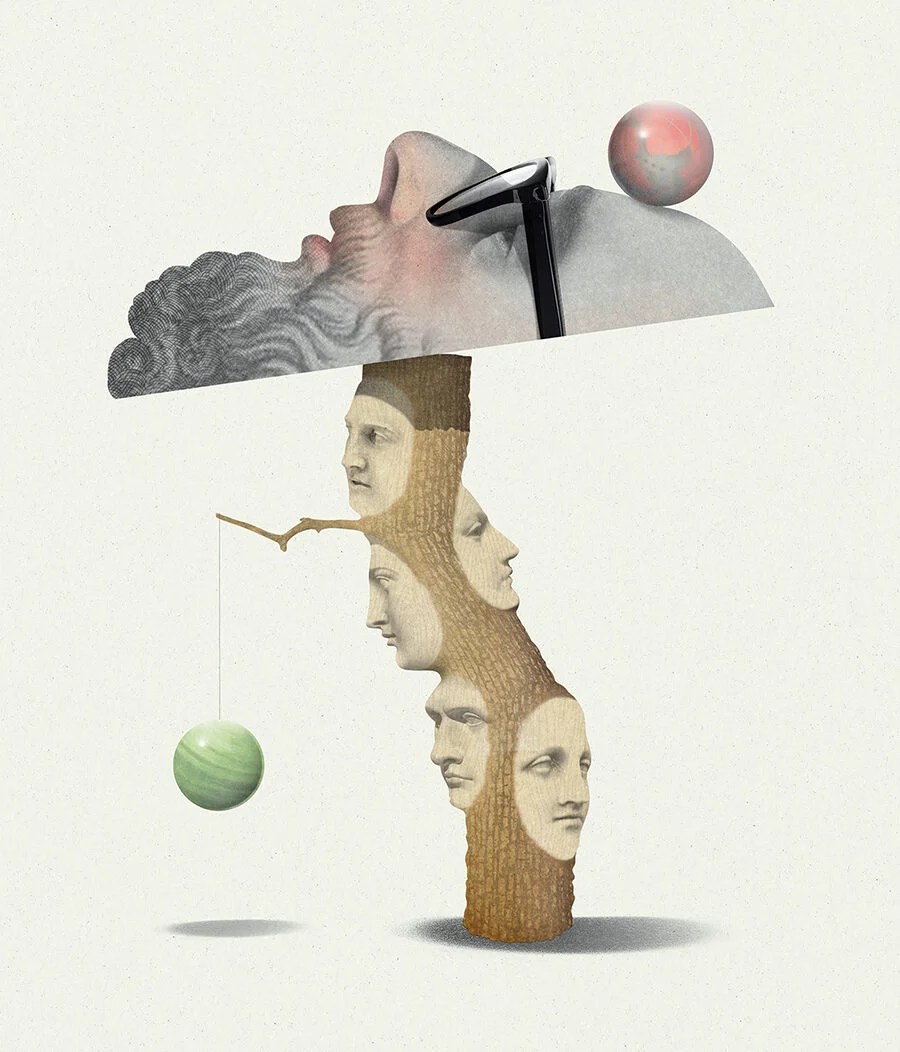
Further (and to some extent, contra) to yesterday’s post– Martin Gurri on the need to reground Liberal Democracy— the estimable Alan Jacobs, who suggests that we need to get in touch with our “inner anarchist.” In a recent post, he shares a “mini-manifesto”…
I am temperamentally and morally a conservative, which is to say: I believe that I am charged with preserving my inheritance, nurturing it, and passing it along to the next generation. That inheritance is spiritual, cultural, natural, and political. (It may or may not be financial; that matters little.) Our largest social problems stem from the fact that our political economy promotes the concentration of power and money, and the concentration of power and money militates against the preservation of any spiritual, cultural, and natural inheritance. That is how we get an unprecedentedly rich and theoretically free society that also features corrupt religious institutions, insipid art, and dying rivers. I will continue to do my best to conserve and promote my Christian faith, my convictions about art, and my natural environment, but I must do so in unpropitious conditions. We need an alternative political economy that encourages rather than inhibiting the work of conservation, and I think anarchism, properly understood, is that alternative.
Citing his “major guides” to thinking about anarchism– Peter Marshall, Demanding the Impossible: A History of Anarchism; James Scott, Two Cheers for Anarchism; and David Graeber, essays— he notes that, on his old blog he posted often on the subject, and directs us to “this essay [source of the image above] and then this reflection on Christian anarchy” for his fundamental thoughts.
But the meat of the post is the “notebook” of thoughts on anarchism that follow. A few examples:
It is vitally important to distinguish anarchism from libertarianism. The highest goods of the libertarian are freedom of action and freedom to own property, both conceived as belonging to the individual. The anarchist, by contrast, seeks some form of the good life in collaboration and cooperation with others. Anarchism is therefore intrinsically social, pluralistic, and unplanned. Because, as Isaiah Berlin says, the Great Goods are not always compatible with one another, you collaborate with people who share your priorities, understanding and accepting that others will find other structures of collaboration. And in pursuing those goods you have the humility to recognize that you don’t know how they may be achieved; that is something you discover through your collaboration. (Related by me: this and this.)
Anarchism is therefore not a system of government but a practice, and one can practice it at any level of social interaction. The parent who tells two squabbling children to work out their differences themselves, rather than appealing to a parental verdict, is practicing anarchism, and a very important form of it too. (See my comments on machi no hoiku and mimamoru in this post. Anarchist pedagogy!)…
The true anarchist can never throw bombs, because when you do that you are making decisions for other people without their consent, which is anthithetical to anarchism…
Anarchism can never be revolutionary in the sense in which political systems (communism, socialism, fascism) can be revolutionary. But the ultimate effects of anarchism can be far greater than the effects of any of those other movements. As Hannah Arendt said, every revolutionary becomes a conservative the day after the revolution; as The Who said, “Meet the new boss, same as the old boss.” Anarchism declines bosses [but importantly, not leaders] altogether. And that is truly revolutionary – but it is only brought about by means so slow and patient that no one can see them at work…
So much more, eminently worth reading in full: “Anarchist Notebook.”
Extra credit opportunity: recognizing that Jacobs’ critique of the status quo is not inconsistent with Gurri’s, how might we take up Gurri’s challenge to reground Democracy in a way that stirs in the “commons” thinking of anarchism?
###
As we rebuild better, we might send revolutionary birthday greetings to Nestor Makhno (AKA Bat’ko Makhno); he was born on this date in 1888 (O.S.). He was a Ukrainian anarchist revolutionary and the commander of the Revolutionary Insurgent Army of Ukraine during the Ukrainian War of Independence (a war to regain independence by the Ukrainian People’s Republic against the Bolsheviks, who had annexed Ukraine into the Soviet Union). He established the Makhnovshchina (loosely translated as “Makhno movement”), a mass movement in the Ukrainian peasantry to establish an anarchist system in the country between 1918 and 1921.
Sadly, that struggle for independence continues to this day.

“They paved paradise / And put up a parking lot”*…

For 60 years, Section 106 of the National Historic Preservation Act has required federal agencies to “take into account” the effects of their actions on historic properties and places, enabling public participation and comment in the process, and empowering state and local governments and Tribal communities to have a voice in the process– often leading to project improvements and better outcomes. Now, the Trump Administration is working to remove that requirement, as it is to eliminate other heritage and environmental safeguards.
The impacts are already being felt, and wholly unsurprisingly, in a sector that has been consolidated by private equity players…
Chronicle Heritage, the largest cultural resources management company in the United States, abruptly announced it was shutting down, Science has learned. The October 1 move, which has not been announced publicly [as of October 7], came as a surprise to the firm’s more than 600 employees, including numerous archaeologists and paleontologists who were recalled from digs and other projects around the world.
“Our response was absolutely shock, anger, sadness, and fear,” said one employee who asked to remain anonymous.
Chronicle Heritage, which was backed by venture capitalists and formed through the merger of several smaller firms, was a major player in the for-profit cultural heritage industry. It had more than 20 offices and an estimated annual revenue of $100 million. Such firms are often contracted to conduct legally required archaeological surveys and other reviews prior to major development projects. They have been a major source of archaeological data, and some observers estimate they conducted up to 90% of the archaeological research performed in the U.S. each year.
The mass layoff will leave many archaeologists without work just as the warm weather field season comes to a close. The shutdown could also complicate the stewardship of archaeological, Indigenous, and paleontological collections that the firm helped manage.
The closure also comes as the cultural resource management industry is facing profound uncertainty. President Donald Trump’s administration has proposed changes to preservation laws that could vastly reduce the number of federally funded or federally permitted projects requiring archaeological reviews. And a bipartisan group of senators has unveiled legislation, designed to streamline the issuing of federal development permits, that could also lead to fewer archaeological surveys. A broad coalition that includes archaeology organizations, historic preservation groups, and tribal nations has formed to oppose the changes…
“Archaeology megafirm abruptly shuts down“- The largest “cultural resources management” firm in the U.S. deserts the field. From @tmitchellbrown.bsky.social in @science.org.
* Joni Mitchell, “Big Yellow Taxi”
###
As we honor heritage, we might recall that it was on this date in 2024 that archaeologists from the National Academy of Sciences of Armenia and the University of Münster uncovered the remains of a previously unknown early (4th century CE) Christian church in the ancient city of Artaxata, in the heart of Armenia. This remarkable find, the oldest documented Christian church in the country, offers new insights into the spread of Christianity in the region, which was one of the earliest nations to adopt the faith.

“If you do not resist the apparently inevitable, you will never know how inevitable the inevitable was.”*…

Ah, but how best to resist?
In a short piece adapted from his recent book, On Resistance- A Manifesto, Curtis White offers a plain-spoken, almost playful– but at the same time provocative– prescription in the form of “seven theses on resistance”…
(1) Our politics are a binary melodrama: humanist against evangelical, Democrat against Republican, socialist against fascist, woke against racist, Kimmel against Trump, comedians against reality-show celebrities. By dominating the stage, these dramas exclude other ways of understanding who we are and what we want, in other words, what we lack.
(2) These melodramatic struggles distract us from the real question—what values shall we live by? Our true values are not to be found in what we think, or in what we say we believe, but in how we live.
(3) This contradicts the idea, common among us, that we are a free country rich in belief. “I believe X,” we are told, with the expectation that others will respect that belief, even if it makes no sense. It is as if belief has been reserved only for the unbelievable.
(4) The value we live through in the present moment is no different from the foundational value of ancient Greece and Rome: the “right of conquest.” This may sound hyperbolic, but the people of Gaza, Venezuela, and even Greenland understand it well. This value instructs friend and foe alike, “You can do whatever you want on the condition that you make your desires fit my ends, or else.” As Trump aide Stephen Miller acknowledged in a CNN interview in January 2026, “We live in a world … that is governed by strength, that is governed by force, that is governed by power.” Vae victis, woe to the victims.
(5) The worst psychopathology of everyday life is to be treated unjustly and not to know it. This injustice inevitably concerns money, its inequities, and its specious allure. Buddhist philosopher David Loy writes, “Money is the flight from emptiness that makes life empty.” This is the truth, but it is also something that we don’t know.
(6) Rather than seeing emptiness as a mark of failure, can we see it as something to reclaim? Emptiness is a fundamental human joy if we feel free to respond to it. Freedom to play, to create, to live in our own strength. As Tibetan Buddhist Tarthang Tulku thought, “Life is the play of energy in the void.” Children are primed for life through play, but their play only prepares them for a world that doesn’t exist.
(7) Jesus was a heretic because he hated hypocrites, those whose “throats were open graves.” In Nietzsche’s estimation, this made him “the noblest of men.” Jesus made himself useless to the ways of the Temple and useless to the ways of Empire. He encouraged us to take back our emptiness from the ethical absolutes of the Mosaic Law and from the false gods of Rome. He began the very human remaking of his Father’s earthly kingdom without any ethical guidance beyond the primordial aspirations of love. As Saint Augustine taught, simply, “Love and do what you will.”
Make yourself useless! Take back your emptiness! Make something beautiful!
As universities rid themselves of the arts, humanities, and social sciences, they become glorified vocational schools for those seeking jobs in tech or business. One might object that there is no human interest in the skills developed in such schools, but at least the people are employed, we’re told, and they’re getting the “good jobs.”
But even that logic is in doubt when so many students find that entry-level employment has been monopolized by AI, and, amid the West’s never-ending Industrial Revolution, by automation. This reality is leaving tens of thousands of people, heads filled with expensive skills that nobody wants or needs, living in their childhood bedrooms or their parents’ basement, gloomily doom-scrolling through the day, wondering how in the world their student loans will ever be repaid, and feeling just generally unneeded and unwanted. Not surprisingly, the consequences for mental health have been bad. According to a 2023 Gallup poll, 47 percent of Gen Z adults are anxious or depressed “often or always” because of social media, financial stress, and isolation.
But the numbers are, indeed, brow-raising: in late 2025, the unemployment rate among college graduates stood at nearly 6 percent, while the general unemployment rate was just over 4 percent. So, why go to college at all? Sure, apprentice to one of the trades. Go for construction, as if there were no downside to manual labor.
Techno-capitalism’s circle in hell is the hole (or parental basement) of the Empty Self. Imagine Dante walking in this hell, wondering about the devilish devices that the damned are staring into, fingers flying, and Virgil commenting, “They’re looking for themselves.”
Dante asks, “What are they seeing, master?”
Virgil replies, “Ghosts.”
“And what sin did they commit for this punishment?”
“Their sin was their lifelessness.”
Virgil has Bob Dylan’s “Desolation Row” on heavy rotation.
Gen Z youth imagine that their future is dependent on studying subjects for which they have no living interest. They have only the failing assumption that writing code, analyzing data, programming, or engineering software will eventually lead to prosperous material lives—or just survival, no matter how dull the reality is.
This is made even more hellish by the fact that the people in it are alone. My generation had to disengage from television, but a life lived online is another level of insidious alienation and, worse yet, it is all on the inside, eroding inner life, leaving nothing for the soul, nothing for soul-work, everything for addictive pleasure and profit. As David Foster Wallace commented in a 1996 interview with David Lipsky for Rolling Stone, sounding out a now familiar doom:
At a certain point we’re going to have to build up some machinery inside our guts to help us deal with this. The technology is just going to get better and better. And it’s going to get easier and easier and more and more convenient, and more and more pleasurable, to be alone with images on a screen, given to us by people who do not love us but want our money. If we don’t do that, then (a) as individuals, we’re going to die, and (b) the culture’s going to grind to a halt.
But Wallace didn’t mean to blame the young. The difference between Gen Z and earlier generations is that our young have to suffer the effects of techno-alienation much more intensely because the technology has indeed gotten “better and better.” They will be caught within it for a much longer time, and without the helpful memory of any sort of “time before tech.” Perhaps this is why Gen Z is currently experiencing a paradoxical nostalgia for the analogue world of the 1990s.
Well, then, what are we to do? How about, “Workers of the world, relax! Make yourselves useless, you have nothing to lose but your virtual chains!”
In On Tyranny, Timothy Snyder asks us to say no to rising fascism by preserving liberal democratic institutions. But he never imagines that there might be reasons to say no to those institutions, to our “managers of despair,” as well. He offers little understanding of the importance of a resistant culture, innately anarchic, opposing all that is anti-human. Resistant cultures seek to provide a place where we can become who we really are, a place where we are not mere functions of the world we happened to be born into, not diminished creatures whose being has been reduced to a marketable “skill set.”
Resistant cultures work through honesty, intelligence, and beauty. They ask of us what Buddha asked of his followers: listen, consider, and cultivate. Listen to what we have discovered; consider what you have heard; and if you like what you have heard and considered, if it speaks to you, then join with others in the sangha, the Buddhist community, where you can cultivate a path that others in their turn may follow. This is the ideal way to join any human group: not by thoughtlessly inhabiting its damaged forms and conditions, but by freely engaging, considering, choosing, and, with this freedom in place, making something beautiful. As Thich Nhat Hanh taught, “The next Buddha will be a sangha” [community].
I have written this manifesto in what Vladimir Nabokov called “a state of aesthetic bliss,” which he defined as: a sense of being somehow, somewhere, connected with other states of being where art (curiosity, tenderness, kindness, ecstasy) is the norm.
That’s the hill I intend to die on, for all the good intending will do me. Because that hill may already be gone. I have reclined in its grasses for so long—gazing down on moving water, assuming that all I had to do was turn and I’d be looking up toward the crest—that I may have missed the moment when the earthmovers came in, noisy though they are, and the mountaintop removal began. And then a guy in an orange vest and a hard hat comes up and explains to me that, “Son, you’re living in the world of yesterday.”
Stefan Zweig’s complaint in The World of Yesterday was exactly this: A form of moral beauty had disappeared beneath him and he was left suspended in air. As Goth Rock legend Robert Smith of the Cure sings in “Endsong,” the last song on their album Songs of a Lost World (2024): it’s gone, gone, “Nothing left of all I loved.”
And yet, I hope that this manifesto, in its playfulness, its nonlinear anarchy, expresses not a longing for the work of the past but energy for the future. Not illustrations for an ideology, but the pure energy of worldmaking. In a sense, we need to “forget the Beatles” and the countercultures they inspired. Presently, that culture lives only a gray half-life through Spotify playlists, Hollywood biopics about Dylan and the Doors (et tu, Led Zep?), and the blasphemous productions of corporate giants like Universal Music Group, selling us our own past. That music has been, in tech parlance, the victim of “enshittification,” the apotheosis of which will be that quickly approaching time when music’s “zone” is flooded with AI slop. As one AI music generator named “imoliver” commented, “I have no musical talent at all. I can’t sing, I can’t play instruments, and I have no musical background.” All this under the cover of “democratizing songmaking,” never mind that the mark of the best music has heretofore been its soulful heresies. What was once alive and full of the warmth of sharing is now only about creating a brand and making a buck in a world where anyone, anywhere, could make the next big hit.
You’ve heard of the Land of Cockaigne, that fanciful place where abundance reigns [see image at top, and here]. Well, welcome to the Land of Cliché, where AI rummages through all that has been said and sung and then throws it against the wall to see what sticks. Someone should be ashamed, but we’re all too excited about this brave new world to know it.
The arts need to de-shittify and return to peasant energies, ready to be changed, changed utterly, into something a new generation can live in and live through. In the Imagination, a new comedy will rise, because its loving playfulness, its caring embrace of others, is always with us, regardless of every inhuman distortion of the world as it stands. Hegel called this comedy the “World in Love.” Ultimately, that is what Nietzsche’s “transvaluation of all values” seeks, too: love not as an ethical command but as an artful metaphysic.
Suddenly it is at an end. THE WORLD IS NEW!”—William Carlos Williams, Spring and All
Seven theses on resistance: “Song of a Lost World,” from @laphamsquarterly.bsky.social.
Triangulate with: “Planetary Politics Now,” from Susan Buck-Morss (“The planet is indifferent to political discourses. It counts time in eons, not presidential tenures. Planetary-thinking forces awareness that the cognitive maps of modernity no longer make sense. Neither conservative nor liberal political positions are up to the task of the present.”)
… to all of which your correspondent would humbly add, yes and– VOTE.
###
As we ponder positive possibilities, we might recall that on this date in 1635, in Massachusetts, the General Court of the then-Colony banished Roger Williams for speaking out for the separation of church and state and against the right of civil authorities to punish religious dissension and to confiscate Indian land. Williams moved out to edge of the Narragansett Bay, where with the assistance of the Narragansett tribe, he established a settlement at the junction of two rivers near Narragansett Bay, located in (what is now) Rhode Island. He declared the settlement open to all those seeking freedom of conscience and the removal of the church from civil matters– and many dissatisfied Puritans came. Taking the success of the venture as a sign from God, Williams named the community “Providence.”
Williams stayed close to the Narragansett Indians and continued to protect them from the land greed of European settlers. His respect for the Indians, his fair treatment of them, and his knowledge of their language enabled him to carry on peace negotiations between natives and Europeans, until the eventual outbreak of King Philip’s War in the 1670s. And although Williams preached to the Narragansett, he practiced his principle of religious freedom by refraining from attempts to convert them.

“Unless you strip bodies of their corporeal nature and impart corporeal nature to incorporeal beings, nothing you expect will take place”*…

In 1965, Hubert Dreyfus wrote the first widely-considered critique of artificial intelligence, Alchemy and Artificial Intelligence, a report for RAND. He updated and expanded the work for broad publication in 1972 as What Computers Can’t Do (which was further updated and revised for two subsequent reissues) and a “sequel,” Mind Over Machine (in 1986). For a precis of Dreyfus’ views on AI, see here.
His invocation of alchemy resonates still, for example in the estimable Henry Farrell‘s consideration of Adam Becker‘s (great) recent book More Everything Forever…
Adam Becker’s “More Everything Forever” begins by describing the ideas of Eliezer Yudkowsky, an AI guru who Sam Altman thinks deserves a Nobel Prize. Yudkowsky’s ambitions for humanity include “[p]erfect health, immortality,” and a future in which “[i]f you imagine something that’s worse than mansions with robotic servants for everyone, you are not being ambitious enough.” According to Yudkowsky and his peers, a “glorious transhumanist future” awaits us if we get AI right, although we face extinction if we get it wrong.
“AI” and “transhumanist” are new terms for rather older ambitions. As the seedy occultist Dr. Trelawney remarks in Anthony Powell’s 1962 novel, “The Kindly Ones,” “[t]o be forever rich, forever young, never to die … Such was in every age the dream of the alchemist.” Renaissance alchemists won the support of monarchs like Rudolf II, the Holy Roman Emperor who squandered his realm’s money on a futile quest to discover the Philosopher’s Stone. Now, as Becker explains, AGI, or artificial general intelligence, has become the means through which philosophers might transubstantiate our mundane reality into a realm in which the apparently impossible becomes possible: living forever, raising the dead, and remaking the universe in the shape of humanity.
These ideas would be a curiosity, if they weren’t reshaping the world, and policymakers’ understanding of national security…
[Farrell explains, elaborating on the beliefs in play and explaining how they played in the Biden Administration (which, he argues, largely internalized them) and now in Trump’s…]
… The Biden administration’s policies rested on risky bets. AI may not be the universal solvent for vexing and complex technological problems promised by Altman, Amodei, and their peers. Some (including most members of the Association for the Advancement of Artificial Intelligence, as well as myself and colleagues) believe that current approaches will not lead to anything like self-improving AGI anytime soon. As DeepSeek’s success in building AI models suggests, semiconductors may not provide the chokehold on AI that American policymakers believed.
In any event, the Trump administration has seemingly opted for a different approach, replacing a grand plan for a global AI order with a loose approach based on the ever-shifting convergence between notions of American greatness and the particular interests of well-connected companies. This currently involves leveraging control of technology to maintain American domination, cutting deals with Gulf states, while trying to cut China out. When Trump toured the Gulf states with an entourage of tech CEOs, he offered access to top-end semiconductors in exchange for promises of massive investment, graciously accepting a jet plane, and a large-scale money transfer routed, with fees, through his family stablecoin.
This emerging blend of imperium, magical technology, and self-dealing too is reminiscent of the Renaissance. The English wizard John Dee, who claimed to have turned mercury into gold in the presence of Rudolf II, is also credited with coining the term “British Empire.” As a member of the court of Queen Elizabeth I, he combined alchemical experiment and indirect conversation with angels with more mundane plans to extend British power across the Atlantic and enrich himself.
The alchemists’ quest for immortality and universal transformation is again entangled with the struggle among empires. The dreams of perfect health, the conquest of death, and mansions with robot servants that Becker describes inspire visions of a radically transformed far future and a near present in which America can use advanced technologies to bolster its power. Such visions stem from an ideology of salvation that has indeed fueled important technological advances but may be quite wrong about where those advances will bring us.
We are being ushered into a world where AI models offer new and useful means to summarize the information of the world and draw nonobvious connections across it, but can also weave new syncretic religious beliefs together from the myriad human sources that they summarize. In the early 20th century, Weber argued that rationalized Calvinism had led to the defeat of the old gods and the inexorable disenchantment of a world dominated by bureaucracy and organized capitalism. In the early 21st, just the opposite is happening as AI draws open the gate for the return of the fantastical. Yudkowsky’s eschatology is just one of the prophetic visions attendant on AI. The practical changes that AI will bring to bureaucracy and markets will go hand in hand with religious ecstasy and fervor, as some people come to believe that they can speak to God through the machine, while others use it to elaborate their own extended fantasies about politics. As Becker’s book shows, technology is not just an abstract force changing the world, but a mirror in which human beings see their dreams and ambitions made manifest. We’re starting to discover what that looks like at scale.
Eminently worth reading full: “What AI debates have to do with alchemy,” from @himself.bsky.social.
Then consider this, from Nicklas Lundblad, a senior exec at Deep Mind, Google, Stripe, and elsewhere, recently turned public policy Fellow. In a piece adapted from a lecture in a series of talks on the philosophy of artificial intelligence that he gave at Mid-Sweden University), he puts Dreyfus’s thought into context, tracing the history of arguments with/against it over the years, as both technology and thinking about technology advanced. He concludes…
… So, we may say, what is Dreyfus answer?… That he is obsessed with showing that machines are incapable of being human?
In fact, his conclusion, already in 1965 – and then repeated in the 1972 book – is much more interesting. Here is how Dreyfus concludes his critique:
If the alchemist had stopped poring over his retorts and pentagrams and had spent his time looking for the deeper structure of the problem, as primitive man took his eyes of the moon, came out of the trees, and discovered fire and the wheel, things would have been set moving in a more promising direction. After all, three hundred years after the alchemists we did get gold from lead (and we have landed on the moon), but only after we abandoned work on the alchemic level, and worked to understand the chemical level and the even deeper nuclear level instead.
Dreyfus’ answer is not to get stuck in the question of what computers can’t do – but to reject even that last piece of thick ontology and ask if we are making a fundamental conceptual mistake. He suggests that we find what is to intelligence as chemistry is to alchemy and look for another set of concepts, another language, to describe what we are doing.
We would, in Dreyfus view, be much better of trying to build alien intelligence or replicate animal intelligence or even jettisoning the idea of intelligence entirely in favour of a new concept – perhaps something like cognicity – that removes the Difference from the research program.
Dreyfus recommendations would imply that we should drop the benchmarks that distract us and instead focus on simpler, thinner ontologies around tasks and interactions. What we need, he would suggest, is a conceptual shift into that simpler ontology – at least if we want to make real progress.
The shift into modern machine learning seems to prove that when the thicker ontology was abandoned we did discovered things obscured by the idea of man as a symbolic animal.
What if we abandon both the idea of man and machine?…
Also worthy of a full review: “Reading Dreyfus,” from @nicklaslundblad.
* Zosimos of Panopolis, an alchemist (and Gnostic mystic)
###
As we think about transmutation, we might recall that it was on this date in 1954 (only 11 years before Dreyfus wrote Alchemy and Artificial Intelligence) that IBM introduced the “IBM 608,” the first calculating machine to use only solid-state transistors instead of vacuum tubes (thus needing only about 5% of the power to perform the same operations). The machine was housed in several large cabinets and could be purchased for $83,210 (or rented for $1,760 per month)… that’s just over $1,000,000 on an inflation-adjusted basis (or about $22,000 per month). It used more than 3,000 germanium transistors and could store 40 nine-digit numbers and perform 4,500 additions per second, among other operations.

“But what kind of freedom does one have if one can use it only as someone else prescribes?”*…

As Ravi Somaiya suggests, Ted Kaczynski— the Unabomber– and his manifesto, Industrial Society and Its Future, were uncomfortably prescient about modern politics…
I was going through some old papers last week, when I came across two handwritten letters I received from Ted Kaczynski, better known as the Unabomber, in 2017 and 2018.
My address was filled out in Kaczynski’s own stark, strangely spaced block capitals, precise and somehow odd. The return address was Florence Supermax prison in Colorado, a highly controlled and secured facility which houses a 9/11 conspirator, the cartel boss Joaquin “El Chapo” Guzman, and the leaders of the Latin Kings and the Aryan Brotherhood, among other notorious, or notoriously dangerous, criminals.
Kaczynski was a gifted mathematician — he went to Harvard at 16 — and a loner, who abandoned his career to live in isolation and pursue a bombing campaign against the rise of technology, and the fall of the natural world, from 1978 until 1995. He was caught in 1996, and was serving several life sentences when he died in custody in 2023.
I wrote to him because I was fascinated by his combination of breathtaking prescience — his 35,000-word manifesto, published in 1995, is absolutely correct and reads like a description of modern life — and a cruelty and contempt for his fellow man that led him to squander that gift and kill three people and wound dozens of others in the service of fomenting a moronic fantasy revolution.
It’s a combination that defines modern politics — a solid basic intuition, matched with an idiot desire to hurt anyone who disagrees. And it gets at something in modern culture, which often asks whether we can enjoy the work of someone whose other actions we find morally lacking. I guess I thought if I understood Kaczynski better, I’d understand all that better too.
It was the wrong question, and thus an endeavor doomed to failure. But when I opened one of the letters I found that it had led me to ask him what he thought about Donald Trump. His answer was brilliant and also made me uncomfortable in a way that I still can’t quite describe.
He started by apologizing for the delay in replying. (Even if you find killing people acceptable, you still get a twinge if you keep someone waiting for a message.)
“There’s a lot to be said in regard to DT and the social and political phenomenon that he represents, but I don’t have the time to say it all here,” he wrote. “So I’ll just call your attention to the paragraph that appears on pages 52-53 of my book.”
This, in my limited experience, was very Kaczynski. He loved to be awkward, and elliptical. He also pointed out that the paragraph was written long before the notion of Trump as a political figure became a realistic one.
I got a copy of his book, and have to admit to a frisson as I opened it. I confirmed that he’d written the section in 2010. Then I found the pages he’d cited. It was one short paragraph. To understand it, you have to understand the underlying theory he has, which is detailed on pages 28 and 29:
“Biological organisms, evolving through natural selection, eventually invade every niche in which biological survival is possible at all, and, whatever measures may be taken to suppress them, some organisms will find ways of surviving nonetheless. Within any complex, large-scale society, a similar process will produce self-propagating systems that will invade every corner and circumvent all attempts to suppress them. These systems will compete for power without regard to the objectives of any government (or other entity) that may try to steer the society. Our argument—admittedly impossible at present to prove conclusively—is that these self-propagating systems will constitute uncontrollable forces that will render futile in the long run all efforts to steer the society rationally.”
The precise paragraph he cited goes on:
“Two competing, entirely legal self-prop systems that have arisen in the U.S. during the last few decades are the politically correct left and the dogmatic right (not to be confused with the liberals and conservatives of earlier times in America). This book is not the place to speculate about the outcome of the struggle between these two forces; suffice it to say that in the long run their bitter conflict may do more to prevent the establishment of a lastingly peaceful world order than all the bombs of Al Qaeda and all the murders of the Mexican drug gangs.”
He’s … right. Or, rather, I agree with him. I covered the rise of the Tea Party on the right, and Occupy on the left, at around the time he wrote it. And they have since risen from niche movements to define the entirety of our politics.
Each needs the other to secure its support and push it to greater extremes of ideology and violence. And the love-hate conflict between them is so destructive and widespread that it leaves little room for anything else.
And now I’m making the political argument of a conspiracist murderer. I spent a few days troubled over this, and then remembered that theory rarely survives contact with reality, no matter how brilliant the theorist.
Kaczynski was making the same mistake as the political groups he describes — he failed to understand that people fundamentally want to be happy, and get along with other people, and that they will find unexpected and unpredictable ways to get to that spot. He also failed to understand that nothing is permanent, and that nature works in cycles.
Intellectual humility was not his strong suit. In that, he was a man of our era, more than of his own…
“The Unabomber on Donald Trump,” from Bungalow Magazine.
Further to Somiya’s conclusion– and in fairness to Kaczynski– elsewhere in Industrial Society and Its Future, Kaczynski channels Jane Jacobs and Christopher Alexander:
A new kind of society cannot be designed on paper. That is, you cannot plan out a new form of society in advance, then set it up and expect it to function as it was designed to do. People do not consciously and rationally choose the form of their society. Societies develop through processes of social evolution that are not under rational human control…
Full text of Kaczynski’s manifesto is here.
(Images above: left source; right source)
* Theodore J. Kaczynski, Industrial Society and Its Future
###
As we fumble into the future, we might that it was on this date in 1582 that Italy, Spain, Portugal, and Poland introduced the Gregorian calendar. While this was “October 5” in the rest of the world, those four countries, adopting Pope Gregory XIII’s innovation, skipped ten days– so that there, the date shifted from October 4 the day before to October 15. With the shift, the calendar was aligned with the equinoxes, and the lunar cycles used to establish the celebration of Easter. Britain and its colonies resisted this Popish change, and used the Julian calendar for another century and a half, until September 2, 1752.

You must be logged in to post a comment.