Posts Tagged ‘algorithms’
“It’s easy to meet expenses – everywhere we go, there they are.”*…

… And those expenses seem to keep rising. Ben Brubaker weighs in on one ever-more-timely culprit…
Imagine a town with two widget merchants. Customers prefer cheaper widgets, so the merchants must compete to set the lowest price. Unhappy with their meager profits, they meet one night in a smoke-filled tavern to discuss a secret plan: If they raise prices together instead of competing, they can both make more money. But that kind of intentional price-fixing, called collusion, has long been illegal. The widget merchants decide not to risk it, and everyone else gets to enjoy cheap widgets.
For well over a century, U.S. law has followed this basic template: Ban those backroom deals, and fair prices should be maintained. These days, it’s not so simple. Across broad swaths of the economy, sellers increasingly rely on computer programs called learning algorithms, which repeatedly adjust prices in response to new data about the state of the market. These are often much simpler than the “deep learning” algorithms that power modern artificial intelligence, but they can still be prone to unexpected behavior.
So how can regulators ensure that algorithms set fair prices? Their traditional approach won’t work, as it relies on finding explicit collusion. “The algorithms definitely are not having drinks with each other,” said Aaron Roth, a computer scientist at the University of Pennsylvania.
Yet a widely cited 2019 paper showed that algorithms could learn to collude tacitly, even when they weren’t programmed to do so. A team of researchers pitted two copies of a simple learning algorithm against each other in a simulated market, then let them explore different strategies for increasing their profits. Over time, each algorithm learned through trial and error to retaliate when the other cut prices — dropping its own price by some huge, disproportionate amount. The end result was high prices, backed up by mutual threat of a price war.
Implicit threats like this also underpin many cases of human collusion. So if you want to guarantee fair prices, why not just require sellers to use algorithms that are inherently incapable of expressing threats?
In a recent paper, Roth and four other computer scientists showed why this may not be enough. They proved that even seemingly benign algorithms that optimize for their own profit can sometimes yield bad outcomes for buyers. “You can still get high prices in ways that kind of look reasonable from the outside,” said Natalie Collina, a graduate student working with Roth who co-authored the new study…
Read on for more on recent findings that reveal that even simple pricing algorithms can make things more expensive: “The Game Theory of How Algorithms Can Drive Up Prices,” from @benbenbrubaker.bsky.social in @quantamagazine.bsky.social.
See also the charmingly-understatedly-titled “AI-Driven Personalized Pricing May Not Help Consumers.“
* anonymous
###
As we muse on malign mechanisms, we might recall that it was on this date in 1787 that the first in a series of eighty-five essays by “Publius,” the shared pen name of Alexander Hamilton, James Madison, and John Jay, appeared in the Independent Journal, a New York newspaper. Known collectively as The Federalist Papers, they were an effort to urge New Yorkers to support ratification of the Constitution approved by the Constitutional Convention on September 17, 1787. While aimed at New Yorkers, the essays were reprinted in newspapers (and pamphlets) across the fledgling nation.
In Federalist Paper #12, Alexander Hamilton (later the first Secretary of the Treasury) articulated an argument for the economic advantages of a united government under the proposed Constitution– and sketched the outline of the financial and commercial regime we’ve built since.
Your correspondent is heading into a series of meeting sufficiently intense that (R)D will be on brief hiatus. Regular service should resume on October 30.
“Algorithms are the culprits, influencers are the accomplices, language is the weapon, and readers are the victims”*…
On the occasion of the publication of his new book, Algospeak: How Social Media is Transforming the Future of Language, Adam Aleksic — aka the “Etymology Nerd” — talks with Liz Mineo about how social media algorithms are transforming language…
… I’m a big believer that the medium is the message. The way the information is being diffused is going to affect how we communicate. For example, with the arrival of writing, there was this big shift away from us telling stories with rhyme and meter. Plato said that writing was going to make us worse at remembering things. With the printing press, information is diffused more quickly, and more people have the ability to be literate, but there are still gatekeepers, which is affecting who gets to tell the story. And then the internet allows us to lose the gatekeepers; anybody can tell the story now, and that’s another paradigm shift in language. Algorithms are a new paradigm shift because the centralization of the internet that occurred in the late 2010s, coupled with how these algorithms push content through personalized recommendation feeds, are changing how we understand the very act of communication…
… Algorithms are shaping the way we speak. Platforms’ priorities play an important role in organizing and shaping how our language develops. The algorithm pushes more trends, creates more in-groups that then create new language. New trending words are amplified by social media; creators replicate words that they know are going viral, because it helps them go more viral, and then they push the words more into existence. This is the cycle that we’re constantly in. I think it’s because of the algorithm, which amplifies trends, that we’re getting more rapid language change than before. The biggest takeaway from my book is that algorithms are deeply affecting our society right now, and we should be paying attention to them…
When I say algorithms are the culprits, I mean that they are, in this metaphor, responsible for the perpetuation of slang at this speed, and influencers are being accomplices because we’re playing a part. The algorithm doesn’t do anything by itself; it doesn’t come up with the words or spread the words by itself. It’s humans who are doing that, with our own ideas of what the algorithm is or should be, and that pushes the words faster than otherwise. Eventually, those words enter your vocabulary, and that, I guess, makes you the victim…
What concerns you about the way social media and its algorithms are changing language?
As a linguist, I have no concerns because language is the means by which humans connect with one another. As a cultural critic, I’m pretty concerned by the way in which language is more commodified than ever before, and I’m concerned that certain groups are influencing our language more than other groups, like incels. Words that are part of the incel vocabulary like “pilled,” “maxxing,” or “sigma” are very popular. For example, if I like burritos, I can say, “I’m so burrito-pilled,” or if I want to eat more burritos, I can say “I’m burrito-maxxing.” The fact that we are using these words is an indicator that this culture is influencing us, and it also indicates that the way ideas spread and percolate in the online space can be dangerous. Incels are incredibly misogynistic and have a worldview that causes them to dehumanize other people. They have been able to spread their ideology because of the nature of the internet right now. If we pay attention to how language is changing, we should also pay attention to how culture is changing.
As a linguist, I’m very excited to see that language is developing faster than before. To me, language is almost a form of resistance. Every single new meme that emerges is a reactive cultural force to the over-organization of society. This summer, the term “clanker,” which is a speculative slur for artificial intelligence, became very popular. In March, we saw “Italian Brain Rot,” a meme that uses AI subversively to generate ridiculous cartoon characters. Both of these memes create a commentary about our current state of technological progress. A lot of memes and slang words are emerging in reflection to our current cultural moment. There’s something really beautiful about that…
“Our viral vocabulary,” from @etymology.substack.com.web.brid.gy (TotH to J O’D)
Apposite: “Understanding the new economics of attention” (gift article from The Economist)
(Image above: source)
* Adam Aleksic, Algospeak: How Social Media is Transforming the Future of Language
###
As we pause to parse, we might note that today is International Talk Like a Pirate Day… that’s to say, a day on which to speak in English with a stereotypical West Country accent.
Created in 1995 by John Baur and Mark Summers of Albany, Oregon, it has since been adopted as an official holiday by the Pastafarianism movement.


“Whatever happens to musicians happens to everybody”*…

Further, In a fashion, to yesterday’s post (and for that matter, to “Nature doesn’t feel compelled to stick to a mathematically precise algorithm; in fact, nature probably can’t stick to an algorithm.”), a provocative proposal from Justin Patrick Moore…
We don’t have enough Dada in this world of too much data. Something is needed to break-through the over-curated simulacrum that is the online world in order to let in a bit of non-artificial light. One way to make a break is through the deliberate cultivation of the glitch.
The exact etymology of the word glitch is not known, though it may derive from the Yiddish “glitsh” which means a “slippery place.” In the mid-twentieth century the word first started showing up in technical texts and related to sudden surges of voltage within an electrical circuit causing it to overload. Today a glitch is any kind of malfunction in hardware or error in software.
In the 1990’s glitch music became a kind of sub-genre of electronic music found at the meeting points of the avant-garde, noise, and more popular forms. This type of music, and the methods surrounding it, including circuit-bending, can provide a window, cracked as it is, for looking out at adjacent electronic worlds, including the internet…
[Moore explains circuit-bending and it’s history…]
… Digital natives need chance like a body needs water. Algorithms have taken the fun out of what was once unplanned and unstructured; internet surfing has been made accident proof, as if it were run by insurance agents and safety specialists. Spots of possible slippage are mopped up in favor of putting forth pre-chewed opinions and junk food clickbait. A similar environment prevails for electronic musicians. The hardware and software being made more often than not makes it difficult to fail. Sound libraries, instrument and effect presets, samplers pre-loaded with perfect pulsing patterns, make it hard to even play in the wrong pitch. These fully loaded tools make it a possible to become a producer of music in a matter of minutes.
Preconfigured musical gear may make it easier to get grooving right off the bat, but the gift of instant gratification steals the sense of accomplishment and intimacy that comes from knowing every inch and crevice of an instrument. And while on first meeting, a run in with a run of the mill modular set up might cause sparks to fly, the slow burn of excitable electrons grows even further from long association. The nuance and subtlety available to those who explore in depth comes across in the very sounds. Circuit-bending is one way to go into those depths, down to the wire.
Prefab music is low risk music. Something might be made from it that could be used as a backdrop to a car commercial or fit into a DJ set at a dance club, as filler, but without investigating the underlying assumptions of a piece of gear, or software, the things that come out of it will tend to not have the rewards associated with riskier behavior. Disfigured musical gear gives the gift of decomposition and recomposition to electronic composers. With their materials mangled and mutilated, the gear becomes a mutt, with all the natural advantages over thoroughbred, store bought, off-the-shelf kit. The system may be less predictable, but that is the point…
[Moore unpacks examples, and explains how, as the solution was itself absorbed into the problem…]
Kim Cascone pointed this out in his inspired essay The Aesthetics of Failure [here] that glitch is just the latest way of investigating the creative misuse of technology. Yet as the internet grew, the process by which those techniques spread happened much faster than in previous decades. In sharing technique of glitch, some of the imaginative grain within the music was lost as it became just another commodity. With the widespread availability of digital music software, “the medium is no longer the message in glitch music: the tool has become the message.”
Failure had reached a point of failure.
If our own thinking can be glitched then perhaps it is still possible to create systems that embrace the slippage. If we don’t want the “tool to become the message” than a third element beyond the digital must be added into the mix.
The technopoly runs on data. Is there a way to make it more Dada? The artists of the Dada movement rejected many things, but logic and reason were chief among them. Where was the logic in the atrocities of World War I? The founders of the movement had lived through the war and in reaction against it, sought to elevate nonsense and the irrational above cruel, cold logic.
In our own time reason and logic have failed to deliver the utopia of technology as promised and promoted by Big Techs advertisers and PR specialists. It can seem that humanities dystopian nightmares are what are actually manifesting. Perhaps part of technologies failure is due to the fact that the digital world is built on binaries.
Logic circuits or gates are the brick and mortar of digital systems. They are electronic circuits that have one or more than one input, but only one output. Logic gates are the switches that turn ON or OFF depending on what the user does. A logic gates turn ON when a certain condition is true, and OFF when the condition is false. A logic gate is able to check whether or not the information they get follows a certain rule, and the output is thus determined.
There are several types of logic gates, but the three most common are the NOT gate, the AND gate, and the OR gate. The NOT gate is the simplest. It’s sole function is to take an input that is either ON or OFF and give it back as the opposite, what the original signal is NOT. The AND circuit requires two inputs. It can only turn on when both inputs are ON. If only one input is on it turns OFF, and when both inputs are off, it turns OFF.
The OR circuit also requires two inputs. It needs one input to be on for it be ON, and is also still ON when both inputs are ON, and it is only OFF when both inputs are OFF.
While variations from these basic circuits have been used to build complex systems, they still have at their core, the binary which undergirds the entire techonosphere. It is rather difficult for the unknown to break through when only two outcomes are possible. A third position between ON and OFF is never arrived at. This would require ternary logic, and as far as I know, a ternary computer has yet to be built.
In lieu of a ternary computer, a third element needs to be added to digital systems: that is the human component. This is also where I think modes of artistic creation in the spirit of Dada can help. By moving away from pure logic and reason, by letting a bit of nonsense or irrationality slip through, the human tendency to also think in binaries can be glitched.
So much of the creative process is automated when working with digital tools, but it has little in common with the methods of automatism that came out of the Surrealist milieu. The various methods of automatism developed by the Surrealists put a person in touch with the unknown, whether it be the unconscious or from beyond the fragile borders of this world. Bringing these techniques back into play could give back a sense of humanity to the sounds of dead electric emitted from programmed machines.
Automatism came in part from the method of automatic writing or spirit writing, when mediums and others of their psychic ilk were said to be in touch with disembodied spirits. The writing came through them from the other side. For the Surrealists tapping into these forces became a source of creativity. The results were often startling as they bypassed logic and reason.
To the point of this essay, in artistic creation, logic is rarely the principle that needs to be abided. Automation needs to be bypassed in favor of automatism. In electronic music strategies and interventions need to be used to work around and supplant the built-in binary biases of the tools, otherwise the music being made on them ends up just sounding like a commercial for the tool…
[Moore offers examples from Ben Chasney and Max Ernst…]
Whatever the source may be, if we are to glitch the circuit, we need to open ourselves up to the slippage that comes in from the unknown. Otherwise people might as well just let AIs design the music for them. And while generative music systems can be built that produce startling beauty, such as Wotja and Brian Eno’s Bloom, they leave too little for unintended influences from outside the confines of the system. For that a human really does have to put themselves into line with the flow of the circuit path.
To create something new, we need to become conduits, connect and plug into to an outside source…
Putting the Dada into data: “Glitching the Circuit,” from @igloomag.bsky.social.
* Bruce Sterling (@bruces.mastodon.social.ap.brid.gy)
###
As we explore, we might recall that it was on this date in 1977 that Iggy Pop, former frontman of The Stooges, released his debut solo album, The Idiot. It was produced by Pop’s friend David Bowie, who also wrote much of the album’s music (to which Pop added most of the lyrics). Described by Pop as “a cross between James Brown and Kraftwerk”, The Idiot marked a departure from the proto-punk of the Stooges to a more subdued, mechanical sound with electronic overtones.

“Nature doesn’t feel compelled to stick to a mathematically precise algorithm; in fact, nature probably can’t stick to an algorithm.”*…

Just over 30 years ago, my GBN partner Stewart Brand and I were discussing the then-new web affordance Pointcast, an active screensaver that displayed news and other information tailored to a user’s expressed interests and delivered live over the Internet. It was big news at the time; and while it failed, it prefigured the emergence of the algorithms that today feed “preferences” that we don’t even need (nor for that matter have the opportunity) to articlulate.
The problem, we mused, is that a system like that becomes a trap, one that (by simply satisfying expressed desires) impicitly works against discovery of the altogether new, of the thing we didn’t yet know might interest (or benefit) us. A system like that pulls us more deeply into holes instead of helping us explore broader horizons– it is biased against discovery, against learning (in its broadest sense). Our most important discoveries are often the books somewhere on the library shelp near the one we were seeking, the article in the (old print) newpaper next to the one to which we were intially drawn.
The answer, we imagined, wasn’t to skip such systems altogether; they can play a useful role; rather, it was to introduce a complementary “dial-up randomness”– to create ways to feed ourselves a stream of surprises.
Benj Edwards reports on just such an affordance…
[Recently] a New York-based app developer named Isaac Gemal [here] debuted a new site called WikiTok, where users can vertically swipe through an endless stream of Wikipedia article stubs in a manner similar to the interface for video-sharing app TikTok.
It’s a neat way to stumble upon interesting information randomly, learn new things, and spend spare moments of boredom without reaching for an algorithmically addictive social media app. Although to be fair, WikiTok is addictive in its own way, but without an invasive algorithm tracking you and pushing you toward the lowest-common-denominator content. It’s also thrilling because you never know what’s going to pop up next.
WikiTok, which works through mobile and desktop browsers, feeds visitors a random list of Wikipedia articles—culled from the Wikipedia API—into a vertically scrolling interface. Despite the name that hearkens to TikTok, there are currently no videos involved. Each entry is accompanied by an image pulled from the corresponding article. If you see something you like, you can tap “Read More,” and the full Wikipedia page on the topic will open in your browser.
For now, the feed is truly random, and Gemal is currently resisting calls to automatically tailor the stream of articles to the user’s interests based on what they express interest in.
“I have had plenty of people message me and even make issues on my GitHub asking for some insane crazy WikiTok algorithm,” Gemal told Ars. “And I had to put my foot down and say something along the lines that we’re already ruled by ruthless, opaque algorithms in our everyday life; why can’t we just have one little corner in the world without them?”
The breadth of topics you’ll encounter on WikiTok is staggering, owing to the wide range of knowledge that Wikipedia covers…
… Gemal posted the code for WikiTok on GitHub, so anyone can modify or contribute to the project. Right now, the web app supports 14 languages, article previews, and article sharing on both desktop and mobile browsers. New features may arrive as contributors add them. It’s based on a tech stack that includes React 18, TypeScript, Tailwind CSS, and Vite.
And so far, he is sticking to his vision of a free way to enjoy Wikipedia without being tracked and targeted. “I have no grand plans for some sort of insane monetized hyper-calculating TikTok algorithm,” Gemal told us. “It is anti-algorithmic, if anything.”
WikiTok cures boredom in spare moments with wholesome swipe-ups: “Developer creates endless Wikipedia feed to fight algorithm addiction,” @benjedwards.com in @arstechnica.com.
###
As we supersize serendipity, we might recall that it was on this date in 1967 that a remarkably warm and open new neighbor moved into the neighborhood: Misteroger’s Neighborhood premeired nationally on public television stations.
Fred McFeely Rogers was born in Latrobe, Pennsylvania on March 20, 1928. After earning his bachelor’s degree in music from Rollins College in 1951, he began working for NBC for a short time in New York. In 1953, he began working at the new public television station WQED for the show, The Children’s Corner where he learned that wearing sneakers were a lot quieter on the set than his dress shoes.
In 1961, Rogers moved to Toronto, Ontario to work on a new 15-minute show called Misterogers for CBC Television. In 1966, Rogers went back to WQED to create Misteroger’s Neighborhood.
In 1970, the show was renamed Mister Rogers’ Neighborhood. The series ended again in 1976 but was picked up three years later when Rogers felt as if his work speaking to children wasn’t done. The show continued from 1979 through 2001. Mr. Rogers passed away on February 27, 2003.
In 2011, PBS created an animated “spinoff” of the show called Daniel Tiger’s Neighborhood featuring the characters Rogers had created in his “land of make-believe”; and in 2019, Tom Hanks portrayed Rogers in the film, A Beautiful Day in the Neighborhood,” a role that earned him an Oscar nomination.

“Don’t throw the baby out with the bath water”*…
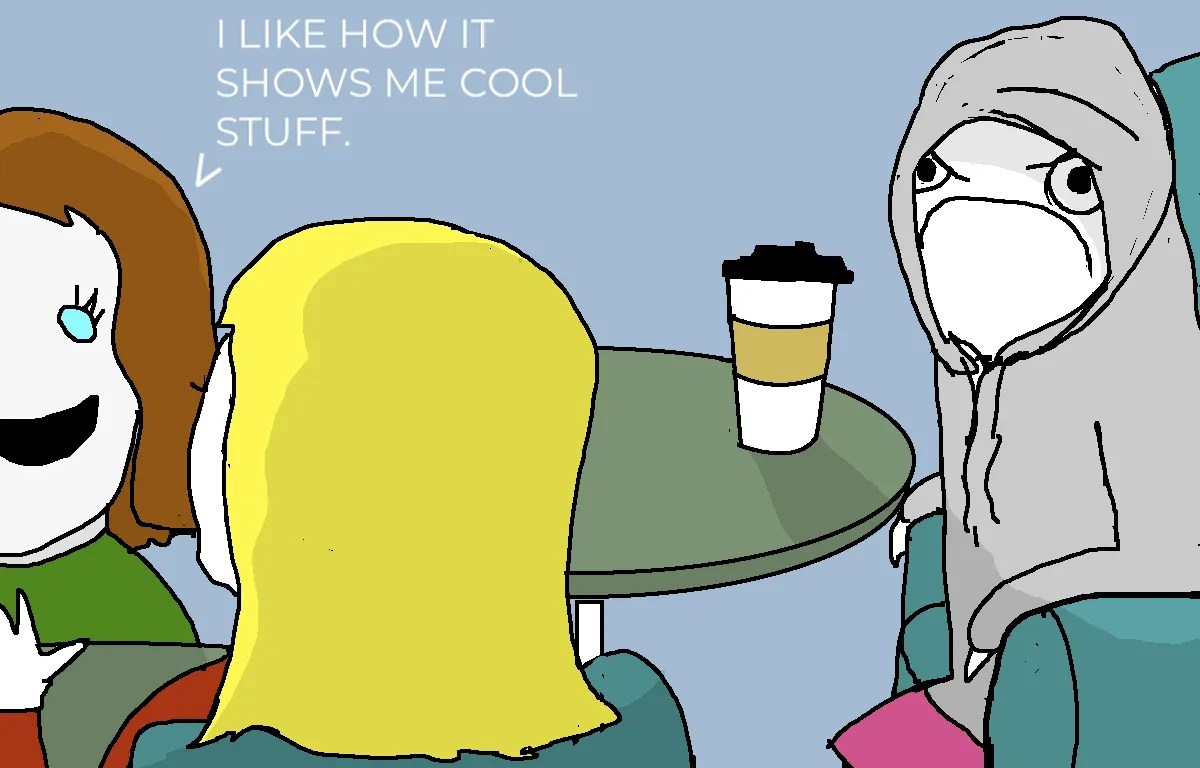
From Dynomight (and here), an argument that algorithms, while problematic today, aren’t necessarily evil…
What does “algorithmic ranking” bring to mind for you? Personally, I get visions of political ragebait and supplement hucksters and unnecessary cleavage. I see cratering attention spans and groups of friends on the subway all blankly swiping at glowing rectangles. I see overconfident charlatans and the hollow eyes eyes of someone reviewing 83 photo she just made her boyfriend take of her in front of a sunset. Most of all, I see dreams of creative expression perverted into a desperate scramble to do whatever it takes to please the Algorithm.
Of course, lots of people like algorithmic ranking, too.
I theorize that the skeptics are right and algorithmic ranking is in fact bad. But it’s not algorithmic ranking per se that’s bad—it’s just that the algorithms you’re used to don’t care about your goals. That might be an inevitable consequence of “enshittification”, but the solution isn’t to avoid all algorithms, but just to avoid algorithms you can’t control. This will become increasingly important in the future as algorithmic ranking becomes algorithmic everything…
Dynomight elaborates on the problem, its genesis, and a plausible answer: “Algorithmic ranking is unfairly maligned,” from @dynomighty.bsky.social.
###
As we rethink rankings, we might recall that on this date in 1969 a group at the top of most lists took it to the roof: The Beatles performed on the rooftop of their Apple Corps headquarters at 3 Savile Row, in central London’s office and fashion district. Joined by guest keyboardist Billy Preston, the band played a 42-minute set before the Metropolitan Police arrived and ordered them to “reduce the volume.” It was the final public performance of their career. The concert ended with “Get Back,” after which John Lennon quipped, “I’d like to say thank you on behalf of the group and ourselves, and I hope we’ve passed the audition.”
The full concert footage is available at the invaluable Internet Archive. Here, a taste of “Get Back”…
You must be logged in to post a comment.