Mardean Isaac, in The Republic of Letters, on chess and what it can– and can’t– teach us. He begins by recounting his personal history with the Royal Game, culminating in an intense period of play…
… Soon after I started my spree, I could already feel subtle cognitive re-wiring beginning to take place. The shape of those changes seemed to align with the objective lessons chess imparts; as if contemplating the findings on a psychedelic drug trip, the issue then becomes whether this is really the case.
People read themselves into interpretations of the greater significance of the game. For Vladimir Nabokov, like the sentence, chess reaches its most elevated form in the perfect rendering of problems into compositions. Stanley Kubrick, who used to put in 12 hour days playing in Washington Square Park, had a stab at life lesson stuff in an old Playboy interview: “Among a great many other things that chess teaches you is to control the initial excitement you feel when you see something that looks good. It trains you to think before grabbing, and to think just as objectively when you’re in trouble.” A 1966 profile of the director in the New Yorker reveals the grubbier material underneath that prudence. At the end of the piece, Kubrick sees the reporter eyeing what he perceives as a killer move, and breaks out in agony to encourage him to make it. But it turned out to be a trap; the move opened a pathway for Kubrick to win. The game’s laws are objective, and can be understood by analysing the outcomes of actions and potential actions. But while players are necessarily guided by explicit rules, they often gain their edge from covert ones. The edge-seeking on display there, rooted in an absence of institutional cushioning, would never leave Kubrick, as he strove to reach the apex of the most logistically burdensome and patronage dependent of art forms.
Chess is primarily a strategic, not a cultural, phenomenon. That is the key to its longevity: where culture changes and evolves, strategy survives and persists—merely as itself. Chess reveals the chiselled edges of strategic veracity: the failures that ensue from not registering your adversary; the complacency that sets in when seemingly comfortably in control; not recognising that risk is a constant, meaning that a good move, coming at the expense of a great one, can also harm you.
The logic of chess exists outside of us; and yet every move feels so personal. Is there an illustration of personal limits more acutely painful than making a truly dumb move, or not spotting a killer one? Not seeing things objectively is not only a guarantor of psychic torment—it often also leads to a kind of self-defeat anyway, because it shuts off routes to our own self-advancement, even if the solipsistic voice in your head might tell us otherwise.
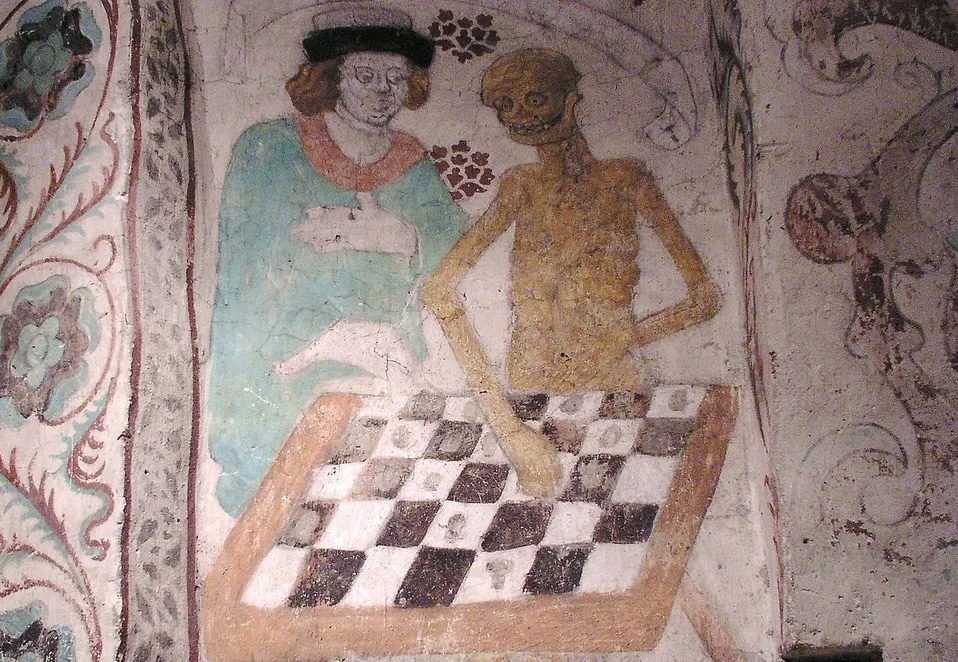
This is where zugzwang (“move compulsion” in German) comes in. This strategic concept refers to a situation in which you have no choice but to make a move that will worsen your position. For example: you are in check, and have to protect your king by moving over a piece that will certainly be taken, reducing your pool of available pieces to the point where victory is made more difficult or impossible. (The only way out of zugzwang—resignation—is no way out at all: a fact which carries a dark metaphorical valence.) It seems to reach into the ultimate dynamic: biology set against time. The problem is: the onus is always on you—you who are always either preparing, or executing, the move you must make. The issue of needing to make a move; there being no such thing as stasis; and each one either advancing or worsening, is a kind of approximation of our biological existence. It’s a reminder that everything is advancing or hurting your cause. Whether or not you are creating the conditions for zugzwang boils down to the accumulated consequences of your own actions. It affirms that you are always responsible for advancing yourself—even, and especially, into oblivion. Worst of all, it affirms that you were responsible for creating the objective conditions that brought about your own drive towards defeat.
I can’t hang onto this moment any longer. It is up to me to decide whether I’ve played too many games for that, or too few. I can either accept that I now have to drive on into the endless forest of chess—or step back altogether, leaving this essay as the only footprint of my ramble across its periphery. As I contemplate the problems with either position, I realise I have already entered my own personal zugzwang…
Perhaps we’d do well to sort the “games” we play into those like chess worth playing, win or lose, and those that are not… Of those latter– especially of those the present themselves not so much as games, but as “the way things are”– as “Joshua / WOPR,” the computer in War Games, observes to “David Lightman” (Matthew Broderick) after thermonuclear annihilation is narrowly avoided: “A strange game. The only winning move is not to play.”
As we make a move, we might recall that it was on this date in 1964 that The Addams Family premiered on ABC. Based on a series of single-paneled cartoons by cartoonist Charles Addams for The New Yorker magazine that began in 1938, the series took the unnamed characters in the single-panel gag cartoons and gave them names, backstories, and a household setting. The main cast was: Gomez (John Astin), Morticia (Carolyn Jones), Lurch (Ted Cassidy), Pugsley (Ken Weatherwax), and Wednesday (Lisa Loring).
The show went off the air in 1966, but The Addams Family’s popularity never really died. Since that time, Hanna-Barbera created two different cartoon series based on the show, three feature films were released in 1991, 1993, and 1998 plus a direct-to-video movie in 1998. In 2019, MGM released a brand new full-length animated film which was pretty good followed by a sequel two years later which wasn’t. In 2022, Jenna Ortega starred in a Netflix show centering on the character of Wednesday Addams, but all of the Addams have supporting roles for the series Wednesday including Luis Guzman (Gomez), Catherine Zeta-Jones (Morticia) and Isaac Ordonez (Pugsley).
And then reminds us that Jeremy Bentham was no slouch with a neologism himself…
It’s pretty amazing. Shakespeare really shaped the English language!
So did Jeremy Bentham. He’s best-known for inventing utilitarianism and the panopticon [see here], but he also coined the words:
Minimize
International
Percentage
Pluralism
Monetary
Locating
Marginalize
Codify
The prefix ‘self-’
Maximize
The prefix ‘post-’
The prefix ‘infra-’
Exhaustive
Insurable
Collaborator
Alleviating
Unaffordable
Exclusionary
Inexclusively
Antagonising
Deontology
Disambiguation
Eudemonic
Evidentiary
Characterizable
Perusable
Preferability
Remediation
Astuteness
Uncalculating
Uncoerced
Unbridgeable
Subvariety
You can find even more Bentham coinages at my source [lots more].
And as if all that weren’t enough, Bentham kind of invented jogging:
Bentham appears to have been a regular jogger—or, as he put it, ‘circumgyrater’. According to the journalist George Wheatley, who stayed with the eighty-one year-old Bentham in March 1831, before both breakfast and dinner Bentham would take ‘a few turns in the garden, which … he calls circumgyrating’, which Wheatley described as a ‘trotting or taking up a kind of trotting step’.
As we commend contrivers, we might recall that it was on this date in 1940 that another colossal coiner of phrases appeared: the Warner Bros. Merrie Melodies animated short “A Wild Hare”– the first “official” Bugs Bunny cartoon– premiered (though long-time readers will recall that Bugs [or at least, his prototype] made his inaugural screen appearance two years earlier). Directed by Tex Avery, “A Wild Hare” was nominated for an Academy Award.
A few months ago I had the fleeting thought to write a post about Stephen Biesty, the DK books cross-section legend. After learning he’d passed only just last year, I was disheartened to discover his personal website and galleries had gone offline, and there were no significant retrospectives of his career that I could find.
Now, after having looked through nearly every single work he produced and having read literally everything I could find online about him, I have come to find his quiet denouement rather touching. He certainly seemed to be private by design, offering only a handful of interviews in his lifetime. The longest profile I could find is weirdly condemning of his workmanlike ethos:
The artist himself is not quite as immediately engaging. Biesty is 35, with the smooth face and straight jeans of a Microsoft programmer. He lives in a Somerset cottage of grey-gold stone between a village church and a pair of wandering geese.
Biesty’s garden glows in the late-summer sun, yet he leads the way straight up to his studio and questions about his business. The room is almost bare of artist’s clutter, more an office with fax and easel and three paintbrushes laid parallel on a tissue to dry. ‘I don’t collect stuff,’ says Biesty.
He talks about his illustrating with a stern set to his chin, as if filling out a tricky detail. He doesn’t sketch – “There isn’t time to be doing reams of doodles” – but expands his work straight from thumbnail ideas to full-scale final pieces. These he completes, eyes close to the paper and hand in rhythm, layer by repetitive layer, between 7.30am and 5.30pm every weekday. “At lunchtime I go downstairs for half an hour and a sandwich.”
Biesty makes all this sound like mass production. “You’re employed to do one thing,” he says, straight as a factory manager. “Something that’s going to sell.” There are no posters of his pictures on his studio walls.
[…] Often, he answers with “we” rather than “I”.
I have to confess a great soft spot for all this. My great grandfather was studying technical illustration at Pratt before he was drafted into the war and lost at sea. His daughter became a graphic designer, as did her daughter — my mom. I appreciate that we all sat somewhere between art and science, heart and mind. Biesty’s seeming indifference towards an artistic identity gives his work more credibility for my tastes.
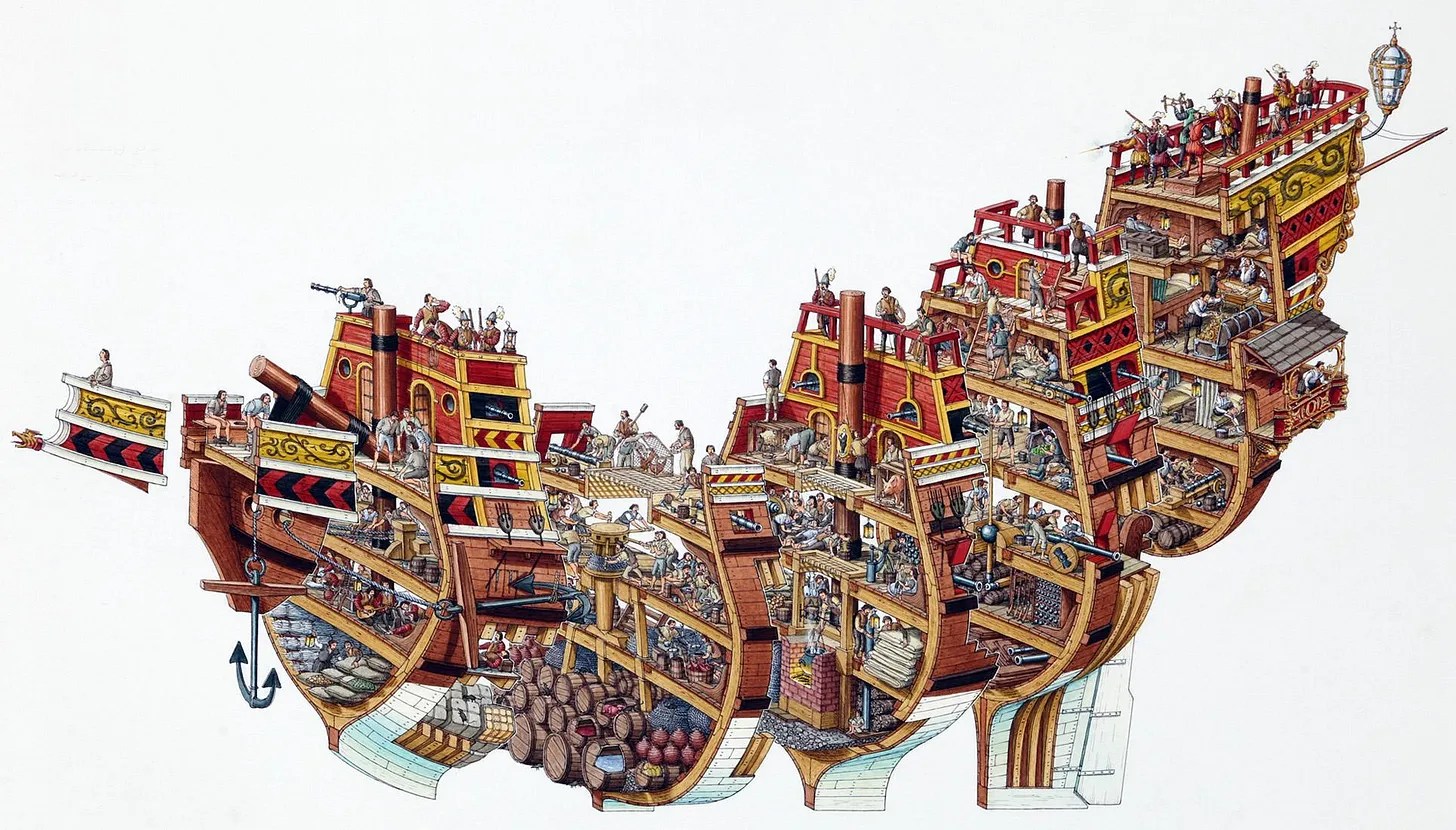
Biesty’s breakout moment came when the K of DK books asked Biesty to draw a steamboat in cross section. “I tried it lengthways and he said, ‘Fine. But try it the other way, like a loaf.’” And lo:
This became the centerpiece for his first book, Incredible Cross-Sections [here], and the seed for the rest of his career. Anyone around my age and above a certain threshold of autistic will have burned much library time on this amazing ‘90s run of DK books…
[Cole goes on to show and discuss other examples of Biesty’s work and to examine his influences…]
… Later in life, Biesty was able to admit some of the depth so evident in the work, as he accepted an award in 2011 for Into the Unknown [here]:
In a world where most information is stored and conveyed electronically, conventional non-fiction books for young people have taken a heavy hit. So is Into The Unknown a dinosaur, a final example of a Dying Breed? I believe not. In the years ahead, certainly fewer paper books will be produced. But those that are designed, written, and manufactured will be a bit like medieval manuscripts — special creations, works of art, unique, beautiful products to be collected and cherished. Into the Unknown, therefore, is not the end of a line but the beginning of a new, fresh and very beautiful one, and you have so kindly recognized that fact. Thank you all very much indeed…
* Robert J. Bezucha, The Art of the July Monarchy: France, 1830 to 1848
###
As we show (in addition to telling), we might spare a thought for an illustrator of a different ilk, William Steig; he died on this date in 2003. A cartoonist (most notably, in The New Yorker), and illustrator and writer of children’s books, he’s best known for Shrek!, which inspired the film series of the same name, as well as others that included Sylvester and the Magic Pebble (which won the Caldecott Medal), Abel’s Island, and Doctor De Soto. He was the U.S. nominee for the biennial and international Hans Christian Andersen Awards, as both a children’s book illustrator in 1982 and a writer in 1988.
When asked his opinion about the movie based on his picture book, Shrek!, William Steig responded: “It’s vulgar, it’s disgusting — and I loved it.” (With the release of Shrek 2 in 2004, Steig became the first sole-creator of an animated movie franchise that went on to generate over $1 billion from theatrical and ancillary markets after only one sequel.)
Your correspondent is headed off on the road, so (R)D will be in temporary hiatus. Regular service should resume on/around October 13. To keep you occupied until then, this tasty tidbit from Neal.fun (Neal Agarwal): “I’m not a robot.”
Long-time readers will know of your correspondent’s love for animator extraorinaire Chuck Jones (e.g., here). “Ellsworth Toohey” in Boing Boing reminds us that the master’s range was broad…
Rejected, the line enrolls in self-improvement boot camp, bending, flexing and inventing dazzling angles until he can sketch cathedrals with a single stroke. When the squiggle tries to match the precision, his chaotic scribbles collapse, and the dot chooses discipline over disorder.
Narrated with champagne-dry wit by Robert Morley, the film unfolds on spare backgrounds that feel lifted from a Mondrian canvas, while the squiggle’s jittery form was drawn on rice paper so the ink could literally misbehave. Norton Juster, author of the 1963 book, adapted his own text, seasoning math jokes with romantic wisdom: “To the vector belong the spoils.”
The short captured the 1965 Oscar for Best Animated Short, one of MGM’s final cartoons and proof that Jones could do more than torment coyotes. Decades later, its crisp pop-art minimalism still inspires…
As we learn from the best, we might recall that it was on this date in 1967 that Chuck Jones gave AFI Report an edited and slightly abridged copy of the speech he had just given at the the World Animation Retrospective, held in Montreal in 1967. (That year was Canada’s 100th birthday and the country celebrated by hosting Expo ’67 in Montreal. The animation retrospective, curated by Louise Beaudet for the Cinémathèque Québecoise was part of the celebration.) The quarterly publication of the American Film Institute subsequently published it, under the title “Animation is a Gift Word,” in a 1974 issue devoted to animation.
Animation festivals were a relatively new idea at the time. Annecy had started in 1960, but festivals in Zagreb and Hiroshima were still in the future. The Montreal event may have been the first international animation gathering on North American soil. Close to 200 animation professionals attended from North America, Europe and Asia.
The list of attendees can only be described as impressive. The U.S. was represented by people from both coasts: Chuck Jones, Bob Clampett, Ward Kimball, Ub Iwerks, Abe Levitow, Pete Burness, June Foray, Paul Frees, Bill Hurtz, Steven Busustow, Les Goldman, Dave Hilberman, Jimmy Murakami, Milt Gray, Michael Lah, Fred Wolf, Walter Lantz, Bill Littlejohn, Art Babbitt, Bill Tytla, J.R. Bray, Otto Messmer, Pepe Ruiz, Edith Vernick, Shamus Culhane, John Culhane, I. Klein, Ruth Gench, Arnold Gillespie, Grim Natwick, Tissa David, Barrie Nelson, Dave Fleischer, Paul Terry, Mordi Gerstein, Ed Smith, Robert Breer, Richard Rauh, Phil Klein, Al Stahl, and Ruth Kneitel.
Canadian attendees included Norman McLaren, Grant Munro, Gerry Potterton, Mike Miller, and Ron Tunis.
Europeans included Len Lye, Peter Foldes, Fedor Khitruk, Jean Image, Bretislaw Pojar, John Halas, Bruno Bozzetto, Dusan Vukotic, Zelimir Matko, Ivan Ivanov-Vano, and S. Mancian.
A historian present on the site could have written a history of animation just by talking to the attendees…
Antropologist Kristin Bell explores laughter as a far more complex phenomenon than simple delight, reflecting on its surprising power to disturb and disrupt…
… As an anthropologist specializing in health and medicine, laughter isn’t really in my professional wheelhouse—unless you subscribe to the view that laughter is the best medicine. My interest in the topic is more personal, not just because of my history as a former Giggling Gertie, but because it’s a behavior that is much less straightforward than it seems.
Ideally, laughter is something we share. According to anthropologist Munro Edmonson, laughter is sociable; it ideally invites a similar response. Indeed, it has contagious qualities: When we hear someone laugh, we often laugh, or at least smile, ourselves—an effect consistently shown through psychological research. This is how we ended up with canned laughter on sitcoms. Studios realized that the sound of laughter made their shows seem funnier to their audiences, while also giving them a degree of control over when people laughed…
… According to the anthropologist Munro Edmonson, the central feature of laughter is aspiration: We release a forceful puff of air as we laugh.
But laughter is also characterized by repetition. In fact, given the extraordinary variability in the sounds people make when they laugh, repetition is what makes laughter universally recognizable. This is why writers conventionalize laughter as “he-he-he,” “ha-ha-ha,” and “ho-ho-ho” (well, at least if you’re Santa Claus). Notably, this feature isn’t exclusive to English representations. Edmonson observed that laughter is represented in Russian as xe, xe, xe; in Tzotzil—a Mayan language spoken in Mexico—it’s ‘eh ‘eh ‘eh.
We don’t fully understand why humans make this sound when we laugh. When 19th-century biologist Charles Darwin set out to explore the biology of feelings in The Expression of the Emotions in Man and Animals, he wrote, “why the sounds which man utters when he is pleased have the peculiar reiterated character of laughter we do not know.” However, the response seems to occur well before culture is embedded in our behaviors: Recognizable laughter is evident in babies from 4 months old.
Nor is laughter unique to humans. Great apes respond to being tickled in much the same way that humans do. Of course, because chimps, bonobos, et cetera have a different vocal apparatus than humans, it sounds more like a dog panting or a person having an asthma attack or energetic sex. However, these primate sounds have the same “peculiar, reiterated character” that Darwin highlighted in humans. This is why laughter is characterized by scientists as a cross-species phenomenon.
Yet, while laughter is evident in the play of other primates, it’s unclear whether they have a sense of humor. Recent research provides evidence of a capacity for teasing through nonverbal behavior. But, as the evolutionary psychologist Robert Provine noted, “there is no evidence that they respond to apparently humorous behavior, their own or that of others, with laughter.”
Giving meaning to laughter seems to be distinctively human.
While some laughter is deliberate, much of it is outside conscious control—an attribute that goes a long way toward explaining the widespread Euro-American ambivalence toward the act. According to the literary scholar Sebastian Coxon, a growing anxiety about mirth is evident in the European historical record from the late Middle Ages. For example, the 16th-century Dutch philosopher Desiderius Erasmus, better known for advising children to “replace farts with coughs,” also warned against “loud laughter and immoderate mirth.”
Notably, Erasmus singled out the “neighing sound that some people make when they laugh” for particular opprobrium—an impulse evident in the contemporary tendency to compare unrestrained laughter with the cries of animals: “howling” with laughter, “hooting” in delight, “snorting” with amusement, and so on. Indeed, while the term “guffaw” might not be borrowed from animal noises, it certainly sounds like it could be.
These characterizations reveal an attempt to draw laughter into the realm of taste and civility—categories that are strongly tied to gender and class strictures. For instance, in an 1860 etiquette guide titled The Ladies’ Book of Etiquette and Manual of Politeness: A Complete Hand Book for the Use of the Lady in Polite Society, readers are counseled to moderate their laughter during a dinner party so that it’s neither too loud nor too soft: “To laugh in a suppressed way, has the appearance of laughing at those around you, and a loud, boisterous laugh is always unlady-like.”
Social judgments abound not just in relation to how we laugh but what we laugh at—as an early 19th-century artwork attests. “Laughter,” etched by British artist and social commentator Thomas Rowlandson, depicts a man laughing at his cat adorned in a bonnet and cloak.
The caption reads: ‘Laughter is one of the most pleasing of the Passions and is with difficulty accounted for, as risibility is frequently excited from the most simple causes—as is the case with the Countryman and his Cat.’ The implication is that “unsophisticated” countrymen lack “class” and are therefore easily amused. (For the record, I am equally unsophisticated, because I will never not find cats pictured with human props funny.)
Still, despite the association between humor and taste, it’s often physical comedy that gets the most laughs. It’s not a coincidence that the first truly global hit comedy was The Gods Must Be Crazy, whose sublime “Tati-like slapstick routines” drew audiences from New York and Caracas to Tokyo and Lagos, despite being widely condemned by film reviewers as apartheid propaganda.
Indeed, screenwriters have long predicted that physical humor will become increasingly prominent in Hollywood comedies because it “transcends dialogue and even most cultural differences,” and movies must increasingly appeal to a global market to produce reliable returns. (As far as I can tell, the future of Hollywood films is basically Marvel movies and slapstick comedies.)…
… As McDonald observes, laughter disrupts the notion of a stable, coherent self—reflected in terms like “cracking up” and “bursting.” Moreover, unrestrained laughter doesn’t just signify a lack of personal control; it can be politically dangerous as well. The literary historian Joseph Butwin writes of “seditious laughter” as a weapon of the oppressed that can serve to destabilize hierarchies and power relations.
In the end, it’s clear that laughter is a deeply curious thing. It’s simultaneously the most social of human expressions and the one most disruptive of social edifices and rules. Shared, sanctioned laughter might bring us together, but unsanctioned laughter shows the cracks, revealing that we’re not quite who we think…
As we muse on mirth (and lest we forget that sometimes laughter is simply a function of simple delight), we might recall that it was on this date in 1929 that Rube Goldberg‘s “The Inventions of Professor Lucifer Gorgonzola Butts, A.K.,” cartoon series first published in Colliers Weekly.






You must be logged in to post a comment.