Posts Tagged ‘damage’
“Sooner or later everyone sits down to a banquet of consequences”*…
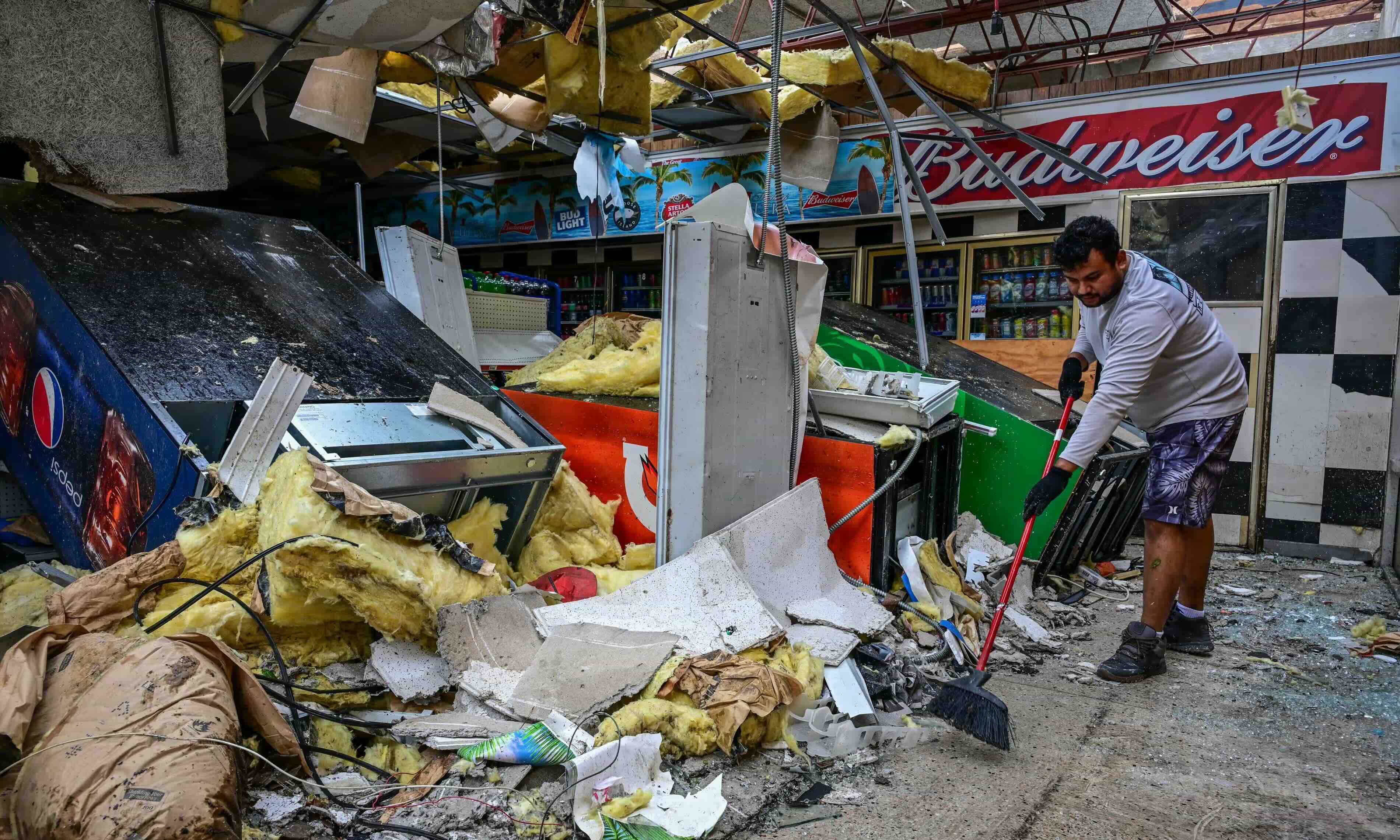
A report issued by International Chamber of Commerce late last year found that extreme weather cost $2tn globally over last decade; the U.S. suffered the greatest losses. As Damian Carrington reports, a leading insurance executive is warning that urgent action is needed to save the conditions under which markets – and civilization itself – can operate…
The climate crisis is on track to destroy capitalism, a top insurer has warned, with the vast cost of extreme weather impacts leaving the financial sector unable to operate.
The world is fast approaching temperature levels where insurers will no longer be able to offer cover for many climate risks, said Günther Thallinger, on the board of Allianz SE, one of the world’s biggest insurance companies. He said that without insurance, which is already being pulled in some places, many other financial services become unviable, from mortgages to investments.
Global carbon emissions are still rising and current policies will result in a rise in global temperature between 2.2C and 3.4C above pre-industrial levels. The damage at 3C will be so great that governments will be unable to provide financial bailouts and it will be impossible to adapt to many climate impacts, said Thallinger, who is also the chair of the German company’s investment board and was previously CEO of Allianz Investment Management.
The core business of the insurance industry is risk management and it has long taken the dangers of global heating very seriously. In recent reports, Aviva said extreme weather damages for the decade to 2023 hit $2tn, while GallagherRE said the figure was $400bn in 2024. Zurich said it was “essential” to hit net zero by 2050.
Thallinger said: “The good news is we already have the technologies to switch from fossil combustion to zero-emission energy. The only thing missing is speed and scale. This is about saving the conditions under which markets, finance, and civilisation itself can continue to operate.”
Nick Robins, the chair of the Just Transition Finance Lab at the London School of Economics, said: “This devastating analysis from a global insurance leader sets out not just the financial but also the civilisational threat posed by climate change. It needs to be the basis for renewed action, particularly in the countries of the global south.”
“The insurance sector is a canary in the coalmine when it comes to climate impacts,” said Janos Pasztor, former UN assistant secretary-general for climate change.
The argument set out by Thallinger in a LinkedIn post begins with the increasingly severe damage being caused by the climate crisis: “Heat and water destroy capital. Flooded homes lose value. Overheated cities become uninhabitable. Entire asset classes are degrading in real time.”
“We are fast approaching temperature levels – 1.5C, 2C, 3C – where insurers will no longer be able to offer coverage for many of these risks,” he said. “The math breaks down: the premiums required exceed what people or companies can pay. This is already happening. Entire regions are becoming uninsurable.” He cited companies ending home insurance in California due to wildfires.
Thallinger said it was a systemic risk “threatening the very foundation of the financial sector”, because a lack of insurance means other financial services become unavailable: “This is a climate-induced credit crunch.”
“This applies not only to housing, but to infrastructure, transportation, agriculture, and industry,” he said. “The economic value of entire regions – coastal, arid, wildfire-prone – will begin to vanish from financial ledgers. Markets will reprice, rapidly and brutally. This is what a climate-driven market failure looks like.”
No governments will realistically be able to cover the damage when multiple high-cost events happen in rapid succession, as climate models predict, Thallinger said. Australia’s disaster recovery spending has already increased sevenfold between 2017 and 2023, he noted.
The idea that billions of people can just adapt to worsening climate impacts is a “false comfort”, he said: “There is no way to ‘adapt’ to temperatures beyond human tolerance … Whole cities built on flood plains cannot simply pick up and move uphill.”
At 3C of global heating, climate damage cannot be insured against, covered by governments, or adapted to, Thallinger said: “That means no more mortgages, no new real estate development, no long-term investment, no financial stability. The financial sector as we know it ceases to function. And with it, capitalism as we know it ceases to be viable.”
The only solution was to cut fossil fuel burning, or capture the emissions, he said, with everything else being a delay or distraction. He said capitalism must solve the crisis, starting with putting its sustainability goals on the same level as financial goals.
Many financial institutions have moved away from climate action after the election of the US president, Donald Trump, who has called such action a “green scam”. Thallinger said in February: “The cost of inaction is higher than the cost of transformation and adaptation. If we succeed in our transition, we will enjoy a more efficient, competitive economy [and] a higher quality of life.”…
It’s time, if not past time, to act: “Climate crisis on track to destroy capitalism, warns top insurer,” from @dpcarrington.bsky.social in @theguardian.com.
Further to the point: “Get ready for several years of killer heat, top weather forecasters warn.”
See also: “Q&A: Kiley Bense on Climate Journalism in a New Information Environment.”
(Image above: source)
* Robert Louis Stevenson
###
As we contemplate craziness, we might recall that it was on this date in 2011 that the Wallow Fire started. A wildfire that started in the White Mountains near Alpine, Arizona, it was named for the Bear Wallow Wilderness area where the fire originated.
The fire eventually spread across the stateline into western New Mexico. By the time the fire was contained on July 8, it had consumed 538,049 acres of land, 522,642 acres in Arizona and 15,407 acres in New Mexico. It was the largest wildfire in Arizona history and did an estimated estimated cost was $109 million in damages. Smoke from the Wallow Fires and others in Arizona and New Mexico extended through Texas and Oklahoma up into the Great Lakes region, affecting air quality for large areas east of the Rocky Mountains.

“No great thing is created suddenly… If you tell me that you desire a fig, I answer you that there must be time. Let it first blossom, then bear fruit, then ripen.”*

What is true of many blessings is also, Andrew Dessler explains, true of many curses…
If you’re struggling to understand why the impacts of climate change suddenly seem so awful, it’s time we discuss a key scientific term: non-linearity.
In a linear system, changes occur in a straight line. If climate impacts were linear, each 0.1°C increase in temperature would produce the same increment of damage. In this world, things slowly get worse over decades until, later this century, the accumulations of slow impacts becomes truly terrible.
But impacts of climate change are different — they are non-linear. In a rain event [as pictured above], for example, the first few inches of rain typically produce no damage because existing infrastructure (e.g., storm drains) were designed to handle that much rain.
As rainfall continues to intensify, however, it eventually exceeds the capacity of the storm runoff infrastructure and the neighborhood floods. You go from zero damage if the water stops half an inch below the front door of your house to tens of thousands of dollars of damage if the water rises one additional inch and flows into your house.
Thus, the correct mental model is not one of impacts slowly getting worse over decades. Rather, the correct way to understand climate change is that things are fine until they’re not, at which point they’re really terrible. And the system can go from “fine” to “terrible” in the blink of an eye.
The key to this is recognizing the thresholds that exist in the systems around us. For example, when engineers of the 20th century designed the infrastructure that we live with today (bridges, dams, storm runoff systems), they designed it for the range of climate conditions that existed at the time, adding in a small margin for unforeseen weather extremities. But not too much of a margin — they wanted to keep costs down.
…
The speed of us passing limits is mind bending. People who are impacted are often shocked and we frequently see people bemoaning the fact that some impact never happened before — this is the calling card of non-linear effects…
Rain, snow, wind, heat– we’re living in a non-linear world: “Why are climate impacts escalating so quickly?“, from @AndrewDessler.
* Epictetus
###
As we steel ourselves, we might recall that it was on this date in 1969 that Hurricane Camille, the 2nd most intense and one of only four Category 5 hurricanes to make landfall in the continental U.S., came ashore along the Mississippi Gulf Coast near Waveland, MS.

“Neuroscience for the last couple hundred years has been on the wrong track”*…

In 2009, researchers at the University of California, Santa Barbara performed a curious experiment. In many ways, it was routine — they placed a subject in the brain scanner, displayed some images, and monitored how the subject’s brain responded. The measured brain activity showed up on the scans as red hot spots, like many other neuroimaging studies.
Except that this time, the subject was an Atlantic salmon, and it was dead.
Dead fish do not normally exhibit any kind of brain activity, of course. The study was a tongue-in-cheek reminder of the problems with brain scanning studies…
More on why we should be cautious of the “breakthrough insights” in neuroeconomics, neuromarketing, et al. at “BOLD Assumptions: Why Brain Scans Are Not Always What They Seem.”
Pair with “Electrified- Adventures in transcranial direct-current stimulation.”
###
As we practice phrenology, we might send thoughtful birthday greetings to John Hughlings Jackson; he was born on this date in 1835. A neurologist, he was one of the first to observe that abnormal mental states may result from structural brain damage; and his studies of epilepsy, speech defects, and nervous-system disorders arising from injury to the brain and spinal cord remain among the most useful and highly documented in the field. Jackson’s definition (in 1873) of epilepsy as “a sudden, excessive, and rapid discharge” of brain cells has been confirmed by electroencephalography; his epilepsy studies initiated the development of modern methods of clinical localization of brain lesions and the investigation of localized brain functions.

“Adults are only kids grown up”*…

Childhood distorts your memories in strange ways — everything seems bigger, more extensive, more dramatic. Take the seminal comic strip, Calvin and Hobbes, for example. Much of its 1985 – 1995 run lined up with my own childhood; I eagerly waited for the newspaper (yes, comics in the newspaper!) every day from about 1989 on. When I started reading, I was only a year or two older than Calvin himself, thus making the strip eminently relatable in a way that few other pieces of art have ever been for me. (And make no mistake, Calvin and Hobbes is art.)
Of course, it was an exaggerated version of being a kid — in particular the amount of destruction that Calvin heaped on his poor, unwitting parents. My memories tell me that nary a week went by without some incredible amount of damage caused to Calvin’s home. An article and chart published to the ridiculously-named PNIS (Proceedings of the Natural Institute of Science, which claims to be a “part-serious, part-satirical journal publishing science-related articles”) backs up those assumptions, and even puts a dollar figure on it. According to these calculations, Calvin’s destructive tendencies cost his parents approximately $15,955.50 over the course of the strip’s 10 years…

Read more at Nathan Ingraham‘s “Calvin and Hobbes were even more destructive than you think.” (and read the full scientific paper here.)
* Walt Disney
###
As we find humor in the hyperbole, we might recall that it was on this date in 1916 that Margaret Sanger, her sister, Ethel Byrne, both nurses, and an associate, Fania Mindell opened the Brownsville Clinic in Brooklyn– the first family planning and birth control clinic in the United States. (The first such clinic in the world opened in Amsterdam in 1885.) The police quickly closed the facility; Sanger served 30 days in jail. But she and her colleagues gamely re-opened; and in 1917, Sanger helped organize the National Birth Control League, which would later become the Planned Parenthood Federation of America.

Sanger (center) at the Brownsville Clinic
You must be logged in to post a comment.