Archive for June 2019
“Thou art a very ragged Wart”*…
Few painters have created as rich a world as Hieronymus Bosch did in The Garden of Earthly Delights. The late 15th- or early 16th-century triptych, which depicts the creation of man, the licentious frolicking of all creatures on a paradisiacal Earth, and the subsequent fall into damnation, draws a scrutiny — and causes an amusement — as intense as ever…
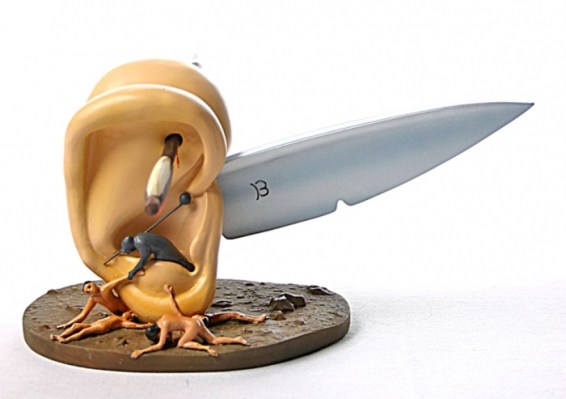
Bosch not only created a world with The Garden of Earthly Delights, he populated it thoroughly. And despite the human-centric story the work appears to take as its basis, the cast with which it retells it extends far beyond mere humanity: the panels feature not just wildlife of all shapes and sizes but a variety of mythical grotesques, from imps to chimeras to hybrids of man and animal to much more besides. He drew from the same surreal imaginative well to fill his other paintings, and you can now pull out a few of these colorful, menacing, preposterous, and darkly humorous characters yourself in collectible figurine form…

More (including a link to the figurines) at “Hieronymus Bosch Figurines: Collect Surreal Characters from Bosch’s Paintings & Put Them on Your Bookshelf.” [TotH to Mark S]
You can also take a virtual tour of the painting (there’s even an app for it), see it brought to life with modern animation, and hear the song tattooed on the posterior of one of the work’s many characters.
See also: “Bosch is great because what he imagines in color can be translated into justice.”
* Shakespeare, Henry IV, Part 2
###
As we get weird, we might recall that it was on this date in 1859 that Jean-Francois Gravelet (stage name, Charles Blondin) became the first person to cross Niagara Falls on a tightrope. Then he did it again.
On the morning of June 30, 1859, about 25,000 thrill-seekers arrived by train and steamer and dispersed on the American or Canadian side of the falls, the latter said to have the better view. Both banks grew “fairly black” with swarms of spectators, among them statesmen, judges, clerics, generals, members of Congress, capitalists, artists, newspaper editors, professors, debutantes, salesmen and hucksters. Vendors hawked everything from lemonade to whiskey, and Colcord gave tours to the press, explaining the logistics of what the Great Blondin was about to attempt.
A light rope, not even an inch thick, had been attached to one end of his hempen cable so it could be conveyed across the Niagara River. On the American side the cable was wound around the trunk of an oak tree in White’s Pleasure Grounds, but securing it on the Canadian side presented a problem. Blondin’s assistants feared that the light rope wouldn’t bear the weight of the cable as it was drawn up the gorge for anchorage in Canada, but the rope dancer, to the delight of his audience, executed a daring solution.
After tying another rope around his waist, he rappelled 200 feet on the small rope, attached the second rope to the end of the cable, and then blithely climbed back to Canadian ground and secured the cable to a rock. To prevent swaying, guy ropes ran from the cable at 20-foot intervals to posts on both banks, creating the effect of a massive spider web. Blondin could do nothing, however, about the inevitable sag in its center, approximately 50 feet of cable to which it was impossible to fasten guy ropes. At that spot, in the middle of his crossing, he would be only 190 feet above the gorge. “There were hundreds of people examining the rope,” reported one witness, “and, with scarcely an exception, they all declared the inability of M. Blondin to perform the feat, the incapacity of the rope to sustain him, and that he deserved to be dashed to atoms for his desperate fool-hardiness.”
Shortly before 5 p.m., Blondin took his position on the American side, dressed in pink tights bedecked with spangles. The lowering sun made him appear as if clothed in light. He wore fine leather shoes with soft soles and brandished a balancing pole made of ash, 26 feet long and weighing nearly 50 pounds. Slowly, calmly, he started to walk. “His gait,” one man noted, “was very like the walk of some barnyard cock.” Children clung to their mothers’ legs; women peeked from behind their parasols. Several onlookers fainted. About a third of the way across, Blondin shocked the crowd by sitting down on his cable and calling for the Maid of the Mist, the famed tourist vessel, to anchor momentarily beneath him. He cast down a line and hauled up a bottle of wine. He drank and started off again, breaking into a run after he passed the sagging center. While the band played “Home, Sweet Home,” Blondin reached Canada. One man helped pull him ashore and exclaimed, “I wouldn’t look at anything like that again for a million dollars.”
After 20 minutes of rest Blondin began the journey to the other side, this time with a Daguerreotype camera strapped to his back. He advanced 200 feet, affixed his balancing pole to the cable, untied his load, adjusted it in front of him and snapped a likeness of the crowd along the American side. Then he hoisted the camera back into place and continued on his way. The entire walk from bank to bank to bank took 23 minutes, and Blondin immediately announced an encore performance to take place on the Fourth of July… [source]

Blondin and his camera, as rendered in “Blondin: His Life and Performances.” [source]
“Let It Snow! Let It Snow! Let It Snow!”*…

The Chacaltaya Ski Resort was once the only ski resort in Bolivia. The popular resort also had the honor of being both the highest ski resort in the world and home to the world’s highest restaurant. But when the mountain’s glacier melted, it was all but abandoned.
The ski resort was opened in the late-1930s, and soon middle- and upper-class residents of nearby La Paz were flocking to its slopes. For seven or eight months of the year, people came to ski and go sledding down the Chacaltaya Glacier, at least until the cold and extreme altitude made them return to lower ground.
At 17,519 feet above sea level, the Chacaltaya Ski Resort was higher than the North Base Camp of Mount Everest. For decades it held the record as the world’s highest ski resort, and the resort’s restaurant is still recognized by Guinness as the highest restaurant in the world.
But in the 1990s, scientists at the Mount Chacaltaya Laboratory began to make some stark predictions. By 2015, they warned, the Chacaltaya Glacier would be gone. As it turned out, they were being optimistic. By 2009, the 18,000-year-old glacier was completely gone…
The sad story in full– and more photos– at “Abandoned Chacaltaya Ski Resort.”
* lyrics by Sammy Cahn; music by Jule Styne– written in 1945, in Hollywood, California as Cahn and Styne imagined cooler conditions during a heat wave
###
As we try to beat the heat, we might recall that it was on this date in 1613 that the Globe Theater in London, built in 1599 by Shakespeare’s playing company, the Lord Chamberlain’s Men, was destroyed by fire. The venue went up in flames during a performance of Henry VIII; a theatrical cannon, set off during the performance, misfired, igniting the wooden beams and thatching. The theater was rebuilt the following year.
The Globe was the initial stage for most of Shakespeare’s plays, but for other playwrights as well. Indeed, the first performance for which a firm record remains was Ben Jonson’s Every Man out of His Humour—with its first scene welcoming the “gracious and kind spectators”—at the end of 1599.

The second Globe, preliminary sketch (c. 1638) for Hollar’s 1647 Long View of London
“Once, during Prohibition, I was forced to live for days on nothing but food and water”*…

Americans tend to have a pretty jaundiced view of Prohibition…
… driven by extremists, the country was pushed into an extreme experiment — to ban the sale, production, and transportation of alcohol in the US in 1919 through a constitutional amendment, the 18th. The policy was a political failure, leading to its repeal in 1933 through the 21st Amendment.
There’s also a widespread belief that Prohibition failed at even reducing drinking and led to an increase in violence as criminal groups took advantage of a large black market for booze.
“‘Everyone knows’ that Prohibition failed because Americans did not stop drinking,” historian Jack Blocker wrote in the American Journal of Public Health. He summarized what’s now the conventional wisdom: “Liquor’s illegal status furnished the soil in which organized crime flourished.”
But there’s a lot wrong with these present-day assumptions about Prohibition.
People like [Carry] Nation, as extreme as they were, were driven by real problems caused by excessive drinking, including alcohol-induced domestic violence and crime as well as liver cirrhosis and other health issues. This was perceived as a widespread problem, at least in popular media: George Cruikshank’s 1847 series of drawings, The Bottle, portrayed a father spending all his family’s money drinking and, eventually, killing his wife by attacking her with a bottle. And as historian David Courtwright documented in The Age of Addiction, per capita alcohol consumption increased by nearly a third from 1900 to 1913, largely due to advancements in brewing that helped make beer much cheaper.
Contrary to the conventional wisdom, the evidence also suggests Prohibition really did reduce drinking. Despite all the other problems associated with Prohibition, newer research even indicates banning the sale of alcohol may not have, on balance, led to an increase in violence and crime.
It’s time to reconsider whether America’s “noble experiment” was really such a failure after all…
America’s anti-alcohol experiment cut down on drinking and drinking-related deaths– and it may have reduced crime and violence overall. Vox takes a sober look at the an episode in American history clouded in received ideas that may not be altogether accurate, making the case that: “Prohibition worked better than you think.”
* W.C. Fields
###
As we muse on moderation, we might recall that it was on this date in 1894 (after 30 states had already enshrined the occasion) that Labor Day became a federal holiday in the United States.

The country’s first Labor Day parade in New York City on Sept. 5, 1882. This sketch appeared in Frank Leslie’s Illustrated Newspaper.
source (and source of more on the history of Labor Day)
“Let It Bleed”*…

Science sometimes goes down an incorrect path. Though the path is wrong, a detailed superstructure of learning gets built on top of the incorrect premise. Such was the case with the medical practice of bloodletting in the early 1800s, where detailed procedures were developed regarding which veins to open for a given set of symptoms. One leader in this practice was America’s Dr. Benjamin Rush:
Early in the [1800s], … physicians put their faith in bloodletting, to draw out the evil humors which were believed to cause disease. With bloodletting, it took years of learning to know precisely which veins, by what rituals, were to be opened for what symptoms. A superstructure of technical complication was erected in such deadpan detail that the literature still sounds almost plausible.
However, because people, even when they are thoroughly enmeshed in descriptions of reality which are at variance with reality, are still seldom devoid of the powers of observation and independent thought, the science of bloodletting, over most of its long sway, appears usually to have been tempered with a certain amount of common sense. Or it was tempered until it reached its highest peaks of technique in, of all places, the young United States. Bloodletting went wild here. It had an enormously influential proponent in Dr. Benjamin Rush, still revered as the greatest statesman-physician of our revolutionary and federal periods, and a genius of medical administration. Dr. Rush Got Things Done. Among the things he got done, some of them good and useful, were to develop, practice, teach and spread the custom of bloodletting in cases where prudence or mercy had heretofore restrained its use. He and his students drained the blood of very young children, of consumptives, of the greatly aged, of almost anyone unfortunate enough to be sick in his realms of influence.
His extreme practices aroused the alarm and horror of European bloodletting physicians. And yet as late as 1851, a committee appointed by the State Legislature of New York solemnly defended the thoroughgoing use of bloodletting. It scathingly ridiculed and censured a physician, William Turner, who had the temerity to write a pamphlet criticizing Dr. Rush’s doctrines and calling ‘the practice of taking blood in diseases contrary to common sense, to general experience, to enlightened reason and to the manifest laws of the divine Providence.’ Sick people needed fortifying, not draining, said Dr. Turner, and he was squelched…
As in the pseudoscience of bloodletting, just so in the pseudoscience of city rebuilding and planning, years of learning and a plethora of subtle and complicated dogma have arisen on a foundation of nonsense…
Via DelanceyPlace.com, an excerpt from Jane Jacobs’ classic The Death and Life of Great American Cities: “Bloodletting.”
* The Rolling Stones
###
As we drip, we might recall that it was on this date in 1949 that the first science fiction series debuted on American television, the DuMont Network’s Captain Video and His Video Rangers. Written by such luminaries as Isaac Asimov, Arthur C. Clarke, James Blish, and Jack Vance, it was– even in its time, when early television productions often were thrown-together affairs– considered crude, owing much to the fact that the daily show was done live on a meager budget. Indeed, the actors were paid so little they actually made more money from appearing in character at supermarket openings, county fairs, and the like than they did from their salaries.
Still, it ran for a total of 1,537 episodes, and quickly spawned competitive sci-fi offerings like Tom Corbet, Space Cadet and Space Patrol.

“We never live; we are always in the expectation of living”*…

Sure that hold music was annoying, grating, a punishment to brain cells, especially if it loops tightly or is particularly in-your-face, but you know what’d be worse? If there was no sound at all.
That was the point that a man named Alfred Levy made when he filed a patent application in 1962 for the “Telephone hold program system,” which is the very patent that led to the creation of hold music.
A 2014 Slate piece helpfully filled in the gaps on this story: Levy, a factory employee, stumbled upon the basic idea for hold music after a freak incident involving a wire and a steel girder. Oddly enough, when the wire touched the steel, it effectively turned the building into a giant radio, leading people on hold waiting for phone calls to actually hear music on the line, rather than waiting in silence.
It might sound far-fetched, but that’s the tale, apparently. Nonetheless, his patent filing, granted in 1966, does a great job of explaining why such a tool is necessary. He noted that switchboards and telephone operators increasingly were using hold buttons, which allow time to properly route calls through a switchboard. However, little consideration was being given to the person on the other end of the line, who understandably might get frustrated or concerned the call dropped if they don’t hear back after a while.
“Courteous telephone practice requires that a held caller be assured at reasonable intervals that the party to whom he wishes to speak still is busy but the pressure of her duties may prevent the operator from so advising the incoming caller so that he may be bereft of even this small consolation,” the patent filing stated. “In any event, listening to a completely unresponsive instrument is tedious and calls often are abandoned altogether or remade which leads to annoyance and a waste of time and money.”
A telephone hold system, he continues, is basically a way to pacify the person waiting for assistance, as it “assures the incoming caller that his call is being held and that he is not disconnected or forgotten.”
The timing of his invention was basically perfect, coming along right as the call center was making its first appearance…
Via @ShortFormErnie and his always-illuminating Tedium, the unusual state of hold music, which works pretty much the opposite way that every other kind of music does, for reasons both technical and psychological: “Holding Patterns.”
* Voltaire
###
As we wait, we might recall that it was on this date in 1976 that the CN Tower in Toronto opened. At 1,815.3 ft it held the record for the world’s tallest free-standing structure for 32 years until 2007, when it was surpassed by the Burj Khalifa and was the world’s tallest tower until 2009 when it was surpassed by the Canton Tower. In 1995, the CN Tower was declared one of the modern Seven Wonders of the World by the American Society of Civil Engineers. (It also belongs to the World Federation of Great Towers.) It serves as a communications tower, the site of numerous broadcast (and reception) antennae for TV, radio, cell phone and microwave providers… and, of course, it is a signature icon of Toronto’s skyline.

You must be logged in to post a comment.