Posts Tagged ‘design’
“Fast gets all our attention, slow has all the power”*…

Coleman McCormick on a framework that can help us understand change in systems– and build resiliance…
A forest is a complex ecosystem made up of thousands of organisms living, evolving, interacting with each other, and changing over time.
At the top of the hierarchy are the leaves, changing annually, growing, dying, and shedding in a year-long seasonal cycle. Next there are branches, fewer in number and slower in growth. Then the whole tree itself, changing over decades. The tree sits in a stand of dozens, and the stand in a forest of thousands of individual trees. The forest within a biome, the biome in a region with a particular climate.
You get the idea.
All natural ecosystems evolve in layers like this that connect to each other, but move at different speeds. You can imagine other systems with similar structures: your body is made up of proteins, DNA strands, organelles, cells, membranes, organs, a skeleton, and eventually, your whole body. Cells are being generated but also dying off at almost the same rate. Slower layers like the nervous system take a long time to heal (if ever) when subjected to injury.
Seeing complex systems this way — as layered collections of variable-speed elements — is a useful framework for understanding why we have a hard time changing them.
Stewart Brand [and here and here] noticed this recurring pattern in the anatomy of systems, which he called pace layering.
The concept builds on an observation made by architect Frank Duffy, who noticed a hierarchy in the components of buildings. In his book How Buildings Learn, Brand expanded this observation into a model he termed “shearing layers,” which describes how different parts of a structure change at varying speeds. Site → Structure → Skin → Services → Space plan → Stuff. Each must survive or adapt on different timelines. When architecture fails to account for the different rates at which users need to modify these layers, it results in rigid, non-functional design. Buildings where Services or the Space Plan are overly inflexible are difficult to adapt to users’ changing needs.

In his later book The Clock of the Long Now, Brand expanded the concept of shearing layers to a civilizational scale:

At the bottom, nature moves along on its own eons-level time scale. In the middle, governance and culture shift with generations. Infrastructure and commerce in the range of years. And on the surface, fashionable trends flare up and die out with sometimes daily regularity, like the turbulent wave tops in a stormy ocean. Each layer serves a function:
Fast learns, slow remembers. Fast proposes, slow disposes. Fast is discontinuous, slow is continuous. Fast and small instructs slow and big by accrued innovation and by occasional revolution. Slow and big controls small and fast by constraint and constancy. Fast gets all our attention, slow has all the power...
… Seeing the world through this lens — not only of scale, but also of time — has distant reach to so many other domains. It’s a fundamental characteristic of how systems work and adapt to change.
The fast flurry of activity at the top of a pace layered system creates a testbed for new ideas. In the forest, each individual tree can try out different evolutionary adaptations. New survival strategies are tested in numbers not possible if entire ecosystems had to move together. If one tree tests a new trait that turns out not to work, only a single organism is at risk, not the whole forest.
Because upper layers move faster they can also rebound faster. A forest fire or a passing herd of elk causes some damage, but only at the surface level upper crust of our strata. The bark and branches and leaves may get eaten or burn off, but in a few weeks they bounce back.
Pace layering builds resiliency into complex systems. The fast layers shield the slower ones from shocks, while selectively transmitting changes down through the layers, allowing slower ones to incorporate those adaptations. But some changes propagate too fast.
Some of the worst cases of system shock happen when change shakes to lower levels too rapidly. Look at the collapse of the Soviet Union. A rapid change in the governance layer caused wreaked havoc in the layers above: massive instability on a national scale, rippling through the whole system for decades. In this case, a totalitarian government imposed rigidity on commerce, infrastructure, and even fashion, and didn’t allow for the necessary shifting and experimentation required for the system to maintain resilience.
Drawing sharp lines between layers actually draws an inaccurate picture of how a thriving system works. A more accurate diagram would show smoother gradients across the transitions between layers.
Resilience comes from allowing this gradient — this slippage — at the junctions between layers. Each layer, above and below, must allow for give and take from its neighbors. Slow layers must permit some influence at the edges, and fast layers must slow down to maintain a workable interface with the slower. The layers need to be able to negotiate with one another. If the fast ignores the constraints of the slow, you get discontinuous instability. If the slow never bends to the fast, you get stifling stagnation…
[McCormick explores the applicability of this framework to governance and to corporate activity…]
… With age, my mind seems to sink to lower levels in the hierarchy. “Current things” are more likely to hit me and bounce off. We come around to new ideas more slowly. Above us are the teenagers, trying new technologies, listening to new music, pushing new memes, on a weekly or daily basis. We parents underneath can’t keep up.
But “keeping up” isn’t our role! Fast learns, slow remembers. Fast tries things, slow preserves what works. Resilient, sustainable systems balance this learning and remembering.
Not every meme or new song or fashion trend has staying power, but some do. The ones with notable resonance absorb and influence the culture below. Youth play the role of experimenters, continuously throwing new ideas at the wall — some good, many terrible. The elders carry the torch of tradition, and provide the stable platform of time-tested solutions on top of which the innovators can explore.
Pace layering is one of those ideas with such broad reach that once you learn about it, you see it everywhere…
The hidden architecture of resilient systems: “Pace Layers,” from @colemanm.
For Stewart’s own essay on Pace Layers, see here; and for more, here.
* Stewart Brand
###
As we take the long view, we might send connective birthday greetings to Alexander MacMillan; he was born on this date in 1818. MacMillan was cofounder (in 1843) with his brother Daniel, of Macmillan Publishers, one of the “Big Five” English language publishers.
Though not himself a professional scientist, MacMillan did much to promote science in the Victorian times– especially when he established the journal Nature (in 1869), enabling communication between men of science. The journal had the support of many influential contributors, including Thomas Huxley. Yet, it remained a financial challenge for Macmillan. Other scientific quarterlies had short lives, but Macmillan tolerated losses for three decades, committed to the journal’s mission “to place before the general public the grand results of scientific work and scientific discovery; and to urge the claims of science to move to a more general recognition in education and in daily life.” That mission continues to the present day.

“The large print giveth and the small print taketh away”*…

As Christine Ro explains, this timeless wisdom may be about to invert: Revisiting typography…
A typical paperback book accounts for around 1kg of carbon dioxide, according to sustainability expert Mike Berners-Lee.
Perhaps that does not sound like much. But in the US alone, where 767 million paperback books were sold in 2023, this is equivalent to the electricity use of more than 150,000 homes for a year.
Forest loss, paper production and printing, and transport of books are generally the largest contributors to the carbon emissions of printed books.
So, using less wood fibre, and shipping lighter loads, are important ways to reduce the emissions of print books (as well as the costs of producing them).
One simple method is reducing the thickness of the paper. Some publishers are turning to subtly thinner paper. There are limits to this: the most lightweight paper may be less durable. And for certain types of books, including art books, there’s a preference for heavier paper.
Yet between these extremes, most readers are unlikely to notice the difference.
Nor would most readers notice the design tweaks that allow more text to fit onto each page – as long as designers ensure that the text remains easy to read.
The publisher HarperCollins has experimented with compact typefaces that require less ink and paper. This has resulted in savings of hundreds of millions of pages.
A leader in this field is Sustainable Typesetting, a project of the design and typesetting company 2K/DENMARK. One of the company’s focus areas is complex typesetting for long texts, including Bibles.
Andreas Stobberup, project lead at 2K/DENMARK, says that Sustainable Typesetting can achieve page count reductions of up to 50%, although he recommends less dramatic changes for novels.
While it’s common to simply increase the point size to make text easier to read, Mr Stobberup says that readability is actually determined by x-height. The x-height is the height of most lowercase letters in the Latin alphabet, and makes up nearly all of the printed marks on a page.
The x-height can be increased without enlarging all of the text. For many designers, increasing the x-height is key to increasing legibility…

Reducing point size is not always the optimal way to reduce the physical size of a book, Mr Stobberup emphasises.
Perhaps some lessons can be drawn from large print books, which are aimed at older readers or those with visual impairments.
They feature larger point sizes, which can lead to bigger books.
But other design features of large print books include more blocked letters and, if images are involved, more attention to the contrast between the foreground and the background.
“It’s a totally different typeface,” says Greg Stilson, head of global technology innovation for the American Printing House for the Blind.
Mr Stobberup concedes that incorporating such design in regular books “will not look as aesthetic”.
But he believes that most readers will not care about the typeface used for the bulk of the book. Meanwhile, more artistic fonts could be used on places like book covers.
And the savings might well justify the change – according to Mr Stobberup, a 20% reduction in pages would be equivalent to a roughly 20% reduction in carbon emissions.
However, the saving depends on many factors, including the size of the print run, the type of energy used for printing, the transport distances, and even the ink used.
Then there’s the word count: a textbook or Bible can achieve more drastic reductions in weight than a book of poetry.
Mr Stobberup is keenly aware of the financial pressures affecting the publishing industry.
“We need to make sustainability cheaper,” he says. “We simply need to show that we don’t think it’s a compromise. We think it’s a better product.”
David Miller is the president and publisher of Island Press, a small non-profit publisher of environment-themed nonfiction.
Printing costs have soared in the last few years, he says. The Covid-19 pandemic led to supply chain issues.
Meanwhile, paper manufacturers have been switching over to making cardboard due to the boom in the delivery businesses.
This has driven up the expense of producing books. In some cases Island Press has simply had to absorb the extra costs itself rather than passing them onto consumers, according to Mr Miller.
Initially he wasn’t sure about Sustainable Typesetting. But after seeing that a 19% reduction in pages could lead to at least a 10% cost savings, while readability actually improved, Mr Miller has become a fan.
Sustainable Typesetting has been applied to two Island Press books published so far. And he’s interested in going even further than a 19% trimming.
Mr Miller calls this a technology that is “only starting to poke its nose out behind the door” within different segments of the publishing industry.
“It’s a sort of revolution in thinking about what typography can be and how it can be put to use in a very productive way.”…
Using design to address climate change, one page at a time: “Publishers try skinnier books to save money and emissions,” from @BBC.
* Tom Waits
###
As we conserve, we might note that today is the annual celebration of a set of books that are strong candidates for this sort of type redesign: it is Hobbit Day, a reference to its being the birthday of the hobbits Bilbo and Frodo Baggins, two characters in J. R. R. Tolkien‘s popular set of books The Hobbit and The Lord of the Rings. In the books’ lore, Bilbo was born in the year of 2890 and Frodo in the year of 2968 in the Third Age (in Shire-Reckoning). Tolkien Week is the week containing Hobbit Day.

“A doctor can bury his mistakes, but an architect can only advise his clients to plant vines.”*…

Actually, sometimes architecture is buried– or at least demolished. And occasionally, as in the “refurbishing” of the Sainsbury Wing of London’s National Gallery, that unearths a surprise. Martin Bailey reports…
A “time capsule” has been discovered at London’s National Gallery, buried deep in a column in the foyer of the Sainsbury Wing. It is a letter recording that one of the wing’s funders, John Sainsbury (Lord Sainsbury of Preston Candover), believed the architects had committed a serious “mistake”. The 1990 letter, typed on Sainsbury’s supermarket notepaper, has recently been deposited in the gallery’s archive as an historic document.
John Sainsbury is critical in the letter of the American post-Modernist architect Robert Venturi and his professional partner and wife Denise Scott Brown for inserting two large false columns in the gallery’s foyer that served no structural purpose. Other than the false columns, John Sainsbury was happy with the Venturi and Scott Brown design.
While building work was under way, Sainsbury gained access to the site and dropped his letter into a concrete column that was under construction. The letter, protected in a plastic folder, was discovered last year, when the foyer was being reconfigured.
The Sainsbury letter of 26 July 1990 was addressed “To those who find this note”—who turned out to be the 2023 demolition workers.
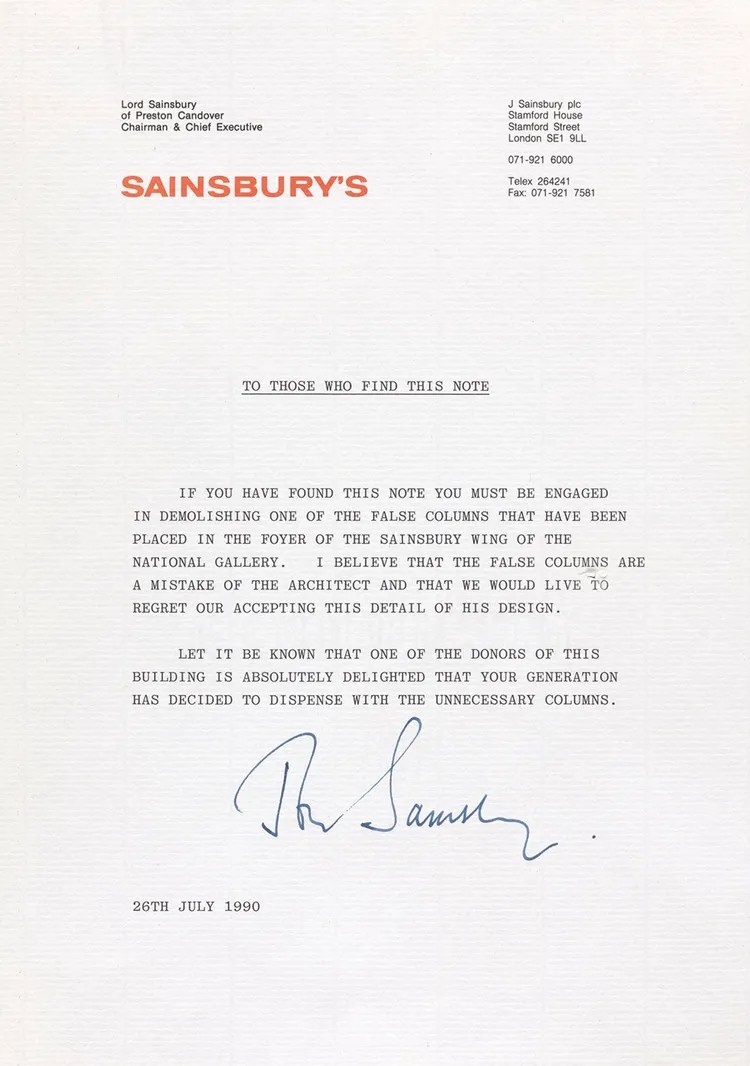
John and his wife Anya presumably never imagined that the demolition of the Sainsbury Wing foyer might take place during their lifetimes. John, one of the most generous UK donors to the arts, died in 2022, aged 94. His widow Anya, a former ballerina, was present when her husband’s note was removed. “I was so happy for John’s letter to be rediscovered after all these years,” she says, “and I feel he would be relieved and delighted for the gallery’s new plans and the extra space they are creating.”…
From the annals of architecture– a dissenting voice from the past: “Sainsbury Wing contractors find 1990 letter from donor anticipating their demolition of false columns,” from @TheArtNewspaper.
But lest we forget that when one critic is assuaged, others are appalled: “Eight Prestigious Architects Blast Annabelle Selldorf’s Proposed $40 Million Redesign of London’s National Gallery, Likening It to an ‘Airport Lounge’,” from @artnet.
(Image above: source)
* Frank Lloyd Wright
###
As we deconstruct design, we might send peaceful birthday greetings to Stephen Geary; he was born on this date in 1797. An architect who designed everything from gin palaces to the (short-lived) monument to King George IV that gave King’s Cross its name, he is best remembered for Highgate Cemetery, opened in 1839, and later to be his resting place, where he designed the Egyptian Avenue and the Terrace Catacombs. He also designed Gravesend, Nunhead, and Brompton Cemeteries, and founded the London Cemetery Company, established by Act of Parliament in 1836, which owned Highgate Cemetery and Nunhead Cemetery.

“Nature does not hurry, yet everything is accomplished”*…

Paul Constance on a chain of dedicated scientists who are building data sets on the natural world around us, and how– coupled with emerging new nature apps that enable citizen scientists– they are expanding our ecological attention span into the long now…
Every two weeks from March to November, Chris Halsch walks a ten-mile loop near the Donner Pass, high up in California’s Sierra Nevada, for the sole purpose of counting butterflies.
It is one of five sites at various altitudes that Halsch, a PhD candidate at the University of Nevada, Reno, has been visiting with metronomic regularity for the past five years. At each one he retraces his steps, pausing every so often to jot down species and numbers in a notebook.
Along the way, he sometimes meets recreational birders or hikers who take photographs and use nature apps to identify species for fun. But unlike those random snapshots, Halsch’s notes are a coveted resource for scientists. Once he types them into a spreadsheet, each of his data points adds a new segment to a chain of observations that has been growing without interruption for half a century, in one the world’s longest-lived efforts to monitor butterfly populations. Like a relay runner, Halsch is extending a marathon of sustained attention that began 20 years before he was born.
Multi-decadal time-series of field observations are among the rarest and most valuable artifacts in ecosystem science because they help to overcome a peculiar weakness in our ability to perceive and interpret the natural world. Humans have developed powerful methods for reconstructing events in the distant past, from the birth of a galaxy to mass extinctions in the Devonian. We have built instruments that can parse the present down to the zeptosecond. But when it comes to the modest timescale of our own lifespans, we are like near-sighted moles.
Weren’t there more birds in this meadow when we were kids?
Doesn’t it seem like spring is a lot rainier than it used to be?
Are you sure it’s safe to eat fish from this river?
Our answers to these types of questions are notoriously unreliable. Think of the tendency to describe a single weather event as evidence for (or against) climate change, or the panic caused by invasive zebra mussels that, 20 years later, turns out to have been misplaced. Perceptions are distorted by selective memories, cognitive biases, political agendas and shifting baseline syndrome—the propensity of each generation to gradually forget past environmental conditions and accept present ones as normal. In an essay published in 01990, the zoologist John J. Magnuson wrote that this temporal myopia can trap us in the “invisible present,” a space where we fail to see slow changes and are unable to interpret effects that lag years behind their causes. “In the absence of the temporal context provided by long-term research, serious misjudgments can occur not only in our attempts to understand and predict change in the world around us, but also in our attempts to manage our environment,” he warned.
Magnuson was echoing a group of mid-century scientists who believed that some of the biggest questions in ecology could only be answered with field observations that were carefully structured and repeated at the same sites for at least two decades. The longer the time-series, the greater likelihood that the invisible present will “melt away,” exposing the complex and often unexpected dynamics of ecosystem change….
[Constance describes a variety of efforts underway…]
… Collectively, these efforts are widening the aperture of our ecological attention, enabling scientists to find and stitch together scattered fragments of temporal data into panoramas that tell a more illuminating story about the interactions that drive change. Unfortunately, the emerging picture is still largely focused on wealthy countries—particularly ones with long histories of field-based science. A map of the International LTER network, an association of 750 field stations that, like their U.S. counterparts, are making long-term observations, shows that more than two thirds are concentrated in Western Europe. Numerous countries in Asia, Africa and Latin America have no stations at all. Moreover, even as scientists like Moran and Grames are exploiting the new wealth of temporal evidence, it is not clear how this research will influence the wider culture, where the blinkered perceptions of the “invisible present” are still pervasive.
The trend that may ultimately overcome both of these limitations is driven, paradoxically, by smartphones. Non-scientists have long been a critical source of field labor for long time-series, most famously for the Audubon Society’s 122-year-old Christmas Bird Count, but also in hundreds of smaller projects that monitor other kinds of flora and fauna. Now, smartphones with powerful cameras and apps such as eBird, iNaturalist, Seek and Picture Insect have enabled millions of casual observers to supplement this pool of dedicated volunteers. Despite the lively debate on whether smartphone usage in the outdoors enhances or interferes with people’s appreciation of nature, one fact is clear: because nature apps automatically time-stamp, geo-reference and store each observation in a robust database, they are generating potential time-series at an unprecedented scale.
In the 20 years since the Cornell Lab of Ornithology launched eBird, the app has amassed more than one billion observations by 700,000 birders from every country in the world. Carrie Seltzer, who heads stakeholder engagement at iNaturalist, says that more than 2.4 million people have made observations on the app, at a rate that has grown between 50 percent and 100 percent per year since 02012… This torrent of raw field data vastly exceeds what even well-funded researchers could ever dream of gathering with traditional methods…
Understanding the world around us: “Peering into The Invisible Present,” from @presentbias and @longnow. Eminently worth reading in full– then browsing the other remarkable pieces available on the Long Now website.
* Lao Tzu
###
As we take the long view, we might send insightful birthday greetings to a man who encourages us to see in different ways, M. C. Escher; he was born on this date in 1898. A graphic artist inspired by mathematics, he created woodcuts, lithographs, and mezzotints, that— while largely ignored by the art world in his lifetime, have become widely celebrated. He’s been recognized as an heir to Parmigianino, Hogarth, and Piranesi.
His work features mathematical objects and operations including impossible objects, explorations of infinity, reflection, symmetry, perspective, truncated and stellated polyhedra, hyperbolic geometry, and tessellations. And though Escher believed he had no mathematical ability, he interacted with the mathematicians George Pólya, Roger Penrose, and Donald Coxeter, and the crystallographer Friedrich Haag, and conducted his own research into tessellation.
For more on (and more examples of) Escher’s work, see here.


“Start with something simple and small, then expand over time. If people call it a ‘toy’ you’re definitely onto something.”*…

From the always-illuminating Ernie Smith, a survey of 10 portable electronic toys—some well-known, some obscure—that highlighted how creative toy-makers were when the canvas was completely open.
For a moment, consider the evolutionary space between the original Game Boy and the iPad. Both defined the way kids would experience computers in a portable format, but were so defining that they kind of set the template for everyone else. But it was clear that the Game Boy was a mere plateau of technological advancement, which allowed some technological wiggle room. Meanwhile, the iPad was considered such a technological ideal that many companies just copied its basic design, killing off true evolution until, say, the Nintendo Switch. That leaves a gap of about 22 years in which handheld gadgets for kids were really freaking experimental and interesting…
[Ernie reviews ten toys, each of which pushed the envelope; several of which inspired features/interfaces we use use today…]
… Admittedly, most devices on this list highlight the potential positive effects of technology on how we approach life, while others are clearly designed to work against the tension technology was creating.
Your kid may want a laptop, but a laptop is expensive, so get them a VTech device instead. They want a cell phone, but cell phones come with risks and data plans. So, it’s better to give them a walkie-talkie that carries itself like a cell phone, rather than expose them to the real thing, right?
There’s also something to be said about the fact that many of these devices have practical limits. You’re not talking to the open internet with most of these gadgets, and most are designed to only work with a handful of people around you. That limits the addiction factor of these gadgets for the most part.
But these designs are ultimately designed to be outgrown. If you really get into a Barbie digital camera, eventually you’re going to want a real one. And if a kid gets into a PDA-style device or creativity tool, they’re going to pick up a computer and figure out that they can do way more.
Electronic toys still abound, but one gets the feeling that convergence cost us some of the more fascinating ideas on this list. I mean, there’s only so much an iPad can do, right?…
Looking back at a bunch of toy electronics that may have latently inspired the tech that we use today… take the tour: “Digital Training Wheels,” from @ernie@writing.exchange (on Mastodon).
* Aaron Levie (co-founder and CEO of Box) @levie
###
As we hook ’em young, we might recall that it was on this date in 1931 that the state legislature in Nevada legalized casino gambling in the state. In fact, gambling had been legal in Nevada until 1909 (by which time it was the only state with legal gambling), when an earlier instantiation of the legislature outlawed it.
Casino revenues– gambling, hospitality, and entertainment– in the U.S. generated nearly $329 billion in economic activity in 2022.
(Coincidentally, it was on this date in 1942 that Alfred G. Vanderbilt and a number of horse racing luminaries established the Thoroughbred Racing Associations of North America.)

You must be logged in to post a comment.