Posts Tagged ‘design’
“The world of reality has its limits; the world of imagination is boundless”*…
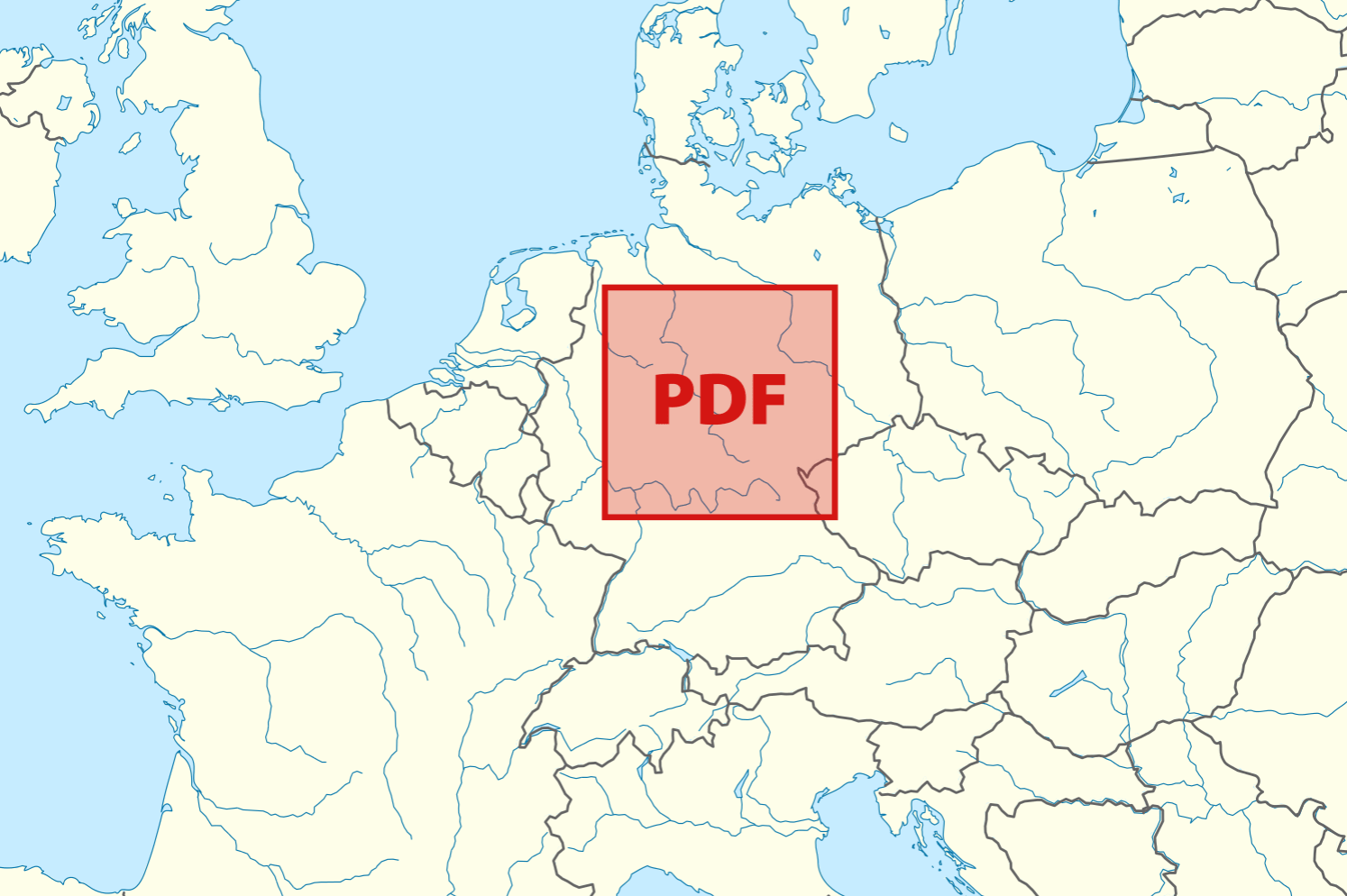
… and the digital world? Maybe, as Rob Beschizza reports, somewhere in between…
Alex set out to debunk the given wisdom that the maximum dimensions of a PDF are 381 km2, which is smaller than Germany. She presents her conclusions in an article titled “Making a PDF that’s larger than Germany,” so you know from the outset she succeeded. It’s a fascinating example of the disalignment of specifications, implementations, and reality. You can make one by hacking the postscript, and while Adobe Acrobat won’t like it, other apps will…
Borges would be delighted…
“On exactitude in PDFs“
Just how big was Alex [Chan] able to make her PDF?…
… unlike Acrobat, the Preview app doesn’t have an upper limit on what we can put in MediaBox. It’s perfectly happy for me to write a width which is a 1 followed by twelve 0s…
If you’re curious, that width is approximately the distance between the Earth and the Moon. I’d have to get my ruler to check, but I’m pretty sure that’s larger than Germany.
I could keep going. And I did. Eventually I ended up with a PDF that Preview claimed is larger than the entire universe – approximately 37 trillion light years square. Admittedly it’s mostly empty space, but so is the universe. If you’d like to play with that PDF, you can get it here.
Please don’t try to print it.
“Making a PDF that’s larger than Germany“
* Jean-Jacques Rousseau
###
As we scale up, we might spare a thought for Émile Borel; he died on this date in 1956. A mathematician (and politician who served as French Minister of the Navy), he is remembered for his foundational work in measure theory and probability. He published a number of research papers on game theory and was the first to define games of strategy.
But Borel may be best remembered for a thought experiment he introduced in one of his books, proposing that a[n immortal] monkey hitting keys at random on a typewriter keyboard will – with absolute certainty – eventually type every book in France’s Bibliothèque Nationale de France. This is now popularly known as the infinite monkey theorem.

“Everything in the physical environment—everything—either raises our spirits or dampens them”*…

The venerable Witold Rybczynski on how, starting with Adolf Loos and the Vienna Secession, ornament was “banished” from modernist architecture– and on what that’s cost us…
… The abandonment of ornament has levied a heavy toll on the practice of architecture, tantamount to misplacing a crucial instrument of one’s toolbox. With ornament, an architect could give meaning to a building not only by incorporating specific references to what went on inside… but also by simply dialing the intensity up or down. Thus the main entrance of the Philadelphia Board of Education Building is not merely larger than the service entrance, it is more elaborately decorated, topped by two winged female figures and a medallion containing what looks like a coat of arms. Without subjunctive ornament, a building risks being less nuanced, but without meaningful ornament, it risks becoming, well, meaningless.
The banishment of ornament means an end to the close collaboration between architects and artists. It is difficult to imagine an architect today saying, “I should like to do the plan and the massing of the building; then … turn the ornament over to a perfectly qualified sculptor, and the color and surface direction to an equally qualified painter.” Today, the art in public buildings tends to be divorced from the architecture. A large travertine sculpture, Henry Moore’s Reclining Figure, stands outside Marcel Breuer’s UNESCO Building in Paris. Inside is a Picasso mural, The Fall of Icarus. The sculpture and the mural are beautiful works of art, but they have nothing to do with the architecture. They are simply “a Henry Moore” and “a Picasso.” The days when architects and artists worked closely together are long gone, and the results are not necessarily architecture that is worse, but architecture that is more one-dimensional: a long solo unenlivened by the occasional duet.
Take away ornament, and what are you left with? When we get close to a building today, we are confronted by gaskets, caulking, nuts and bolts—the minutiae of building construction. Or worse: exit signs, ventilation grills, and fire-hose cabinets. There is an architectural consequence to this. Traditionally, buildings were built as relatively straightforward boxes, their distinctive quality provided by ornament. Lacking the latter, architects feel obliged to provide dramatic cantilevers, unusual shapes, vertiginous space, and soaring roofs. But these big moves are not balanced by the finer-grained experience of small moves—that is, by ornament…
Why ornament matters in architecture: “Give Us Something to Look At,” from @witoldr in @TheAmScho. Eminently worth reading in full.
* Christopher Alexander, in conversation with Rybczynski
###
As we make with meaning, we might spare a thought for Pier Luigi Nervi; he died on this date in 1979. An exemplar of the trend against which Rybczynski argues, Nervi was an architect who drew on his deep engineering expertise– especially in reinforced concrete– to create notable “thin shell” structures worldwide.


“Tools have their own integrity”*…

And now, thanks to Theodore Gray, they have their own taxonomy…
… The arrangement follows loosely the characteristic of the regular periodic table: tools with similar functions in each column, getting heavier as you move down the rows. The diagonal line between metals and non-metals on the right side becomes a line between drills and wrenches. The fiery 17th column, the halogens, is a column of tools that use heat, including soldering, welding, casting, and 3D printing…
Find a zoomable version here. See (and buy) this beauty and his other posters and books here.
And for a satisfying companion piece: “Let a Hundred Mechanisms Bloom,” a lovely celebration of 19th Century apple parers.
* Vita Sackville-West
###
As we do it ourselves, we might spare a thought for Edmund Gunter; he died on this date in 1626. A clergyman, mathematician, geometer, and astronomer, his mathematical contributions included the invention of the Gunter’s chain, the Gunter’s quadrant, and the Gunter’s scale.
But he is best remembered for creating the forerunner of that once-ubiquitous tool, the slide rule (IYKYK)…
Known as Gunter’s Rule, or simply a “Gunter”, [it was] the invention of Edmund Gunter (1581-1626), a London scholar and contemporary of John Napier, the Scottish inventor of Logarithms. Napier published he first table of logarithms in 1614, and armed with it one could replace multiplication and division with addition and subtraction of the equivalent logarithms — a clear benefit if you have to calculate by hand, as they certainly did in the 17th century. Still, it was one boring and laborious task, which Gunter did away with.
Gunter’s rule has many scales, but the revolutionary one is the one marked “NUM”, which has the numbers from 1 through 100 laid out as a two-cycle logarithmic scale. Now, instead of looking up the logarithms in a table, adding them and looking up the result of the multiplication, all you had to do was use a pair of dividers to add the lengths representing the two multiplicands on the NUM scale; the result could be read right off the same scale.
The true slide rule, invented by William Oughtred shortly afterward, is simply a pair of Gunter scales juxtaposed to allow adding the lengths without the dividers.
“Gunter’s rule”


“Everything is designed. Few things are designed well.”*…

Those of us in the U.S. are used to molded plastic seating on public transport. Not so in the U.K, where moquette, a velvet-like material, is favored by upholsterers for its durability. Artists like Paul Nash and Enid Marx were commissioned to create intricate designs that gave trains and buses a modish visual identity. And the tradition continues: new moquette can still be found on the seats that zoom beneath the city….
Moquette is the durable, woolen seating material that is used in upholstery on public transport all over the world.
Coming from the French word for carpet, moquette has been seen and sat upon by millions of commuters on buses, trains, trams and trolleybuses for over 100 years.
It is produced on looms using the Jacquard weaving technique, with a pile usually made up of 85% wool mixed with 15% nylon.
Moquette was chosen for public transport for two reasons. First, because it is hard wearing and durable. Second, because its colour and patterns disguise signs of dirt, wear and tear. On top of this moquette had the advantage of being easy and cheap to mass-produce.
Moquette was first applied to public transport seating in London in the 1920s when the patterns were designed by the manufacturers…
“A history of moquette“
Riding in style on the upholstery that gives London Transport its unique look and feel: “A history of Moquette,” from @ltmuseum and @TheBrowser.
###
As we settle in, we might spare a thought for William “Willy” A. Higinbotham; he died on this date in 1994. A physicist who was a member of the team that developed the first atomic bomb, he later became a leader in the nuclear non-proliferation movement.
But Higinbotham may be better remembered as the creator of Tennis for Two— the first interactive analog computer game, one of the first electronic games to use a graphical display, and the first to be created as entertainment (as opposed to as a demonstration of a computer’s capabilities). He built it for the 1958 visitor day at Brookhaven National Laboratory.
It used a small analogue computer with ten direct-connected operational amplifiers and output a side view of the curved flight of the tennis ball on an oscilloscope only five inches in diameter. Each player had a control knob and a button.


“Cyberspace undeniably reflects some form of geography”*…

Your correspondent in stepping again into the rapids, so (Roughly) Daily is going into a short hiatus. Regular service should resume on or around Nov 4. Here, something to enjoy in the meantime…
Our old friend Neal Agarwal has created an interactive museum of sorts, a stroll through the history of the internet, as manifest in the artifacts of important “firsts”– the first smiley, the first MP3, the first “LOL.” the first live-steamed concert, and so, so much more…
Browse through Internet Artifacts, from @nealagarwal.
* Sandra Day O’Connor
###
As we touch the exhibits, we might send imperial birthday greetings to William Henry Gates III; he was born on this date in 1955. Gates is, of course, best known for co-founding the technology giant Microsoft, along with his childhood friend Paul Allen. He led the company from its packaged software beginnings onto the internet. After leaving the company in 2008, he founded several other companies, including BEN, Cascade Investment, TerraPower, bgC3, and Breakthrough Energy; but he has increasingly turned his attention to philanthropy.

You must be logged in to post a comment.