Posts Tagged ‘Writing’
“Somebody gets into trouble, then gets out of it again. People love that story. They never get tired of it.”*…

Kurt Vonnegut took an early interest in what he considered the fundamental “shapes” of stories…
Stories have very simple shapes, ones that computers can understand.
This was the basic idea behind the master’s thesis that Kurt Vonnegut submitted to the anthropology department at the University of Chicago. It was rejected, however, “because it was so simple and looked like too much fun,” Vonnegut said…
“Kurt Vonnegut on the 8 ‘shapes’ of stories“
He never abandoned the idea. Years later, in a 2004 lecture at Case Western University, he shared his theory– a recording of which has washed around the internet ever sense…
Now, a group of academics have used AI to analyze hundreds of published stories, and have confirmed Vonnegut’s contention (sort of: he argued for 8 “shapes”; they found 6), as they explain in the abstract of their paper…
Advances in computing power, natural language processing, and digitization of text now make it possible to study a culture’s evolution through its texts using a ‘big data’ lens. Our ability to communicate relies in part upon a shared emotional experience, with stories often following distinct emotional trajectories and forming patterns that are meaningful to us. Here, by classifying the emotional arcs for a filtered subset of 1,327 stories from Project Gutenberg’s fiction collection, we find a set of six core emotional arcs which form the essential building blocks of complex emotional trajectories. We strengthen our findings by separately applying matrix decomposition, supervised learning, and unsupervised learning. For each of these six core emotional arcs, we examine the closest characteristic stories in publication today and find that particular emotional arcs enjoy greater success, as measured by downloads…
“The emotional arcs of stories are dominated by six basic shapes” (where you can read/download the full paper).
* Kurt Vonnegut
###
As we agnize archetypes, we might spare a thought for a master of the entertaining tale, Jean-Baptiste Poquelin (or as he’s better known by his stage name, Molière); he died on this date in 1673. A playwright, actor, and poet, he is widely regarded as one of the greatest writers in world history, and possibly the greatest writer in French history. His extant works include comedies, farces, tragicomedies, comédie-ballets, and more. His plays have been translated into every major living language and are performed at the Comédie-Française more often than those of any other playwright today. His influence is such that the French language is often referred to as the “language of Molière.”

“I don’t think academic writing ever was wonderful”*…

Academic writing is famously abstruse. But, Stefan Washietl, founder of Paperpile, reminds us, it isn’t always so. As Rob Beschizza observes…
Stefan Washietl collected the shortest scientific papers. Some are unvarnished mathematical proofs, some are humor to amusing or incisive ends, others are clever-dickery that shoves the conclusion into the abstract. All are wonderful!…

Accessible academia: treat yourself to “The Shortest Papers Ever Published,” from @washietl and @paperpile via @Beschizza in @BoingBoing.
* Stephen Jay Gould
###
As we go for the gist, we might send voluminous birthday greetings to Constantine Samuel Rafinesque; he was born on this date in 1783. An autodidact naturalist, traveler, and writer who, in spite of work of variable reliability, substantially expanded knowledge via his extensive travels, collecting, cataloging, and naming huge numbers of plants and some animals. Among these are many new species he is credited with being the first to describe.
Years ahead of Charles Darwin’s theory of evolution, Rafinesque conceived his own ideas. He thought that species had, even within the timeframe of a century, a continuing tendency for varieties to appear that would diverge in their characteristics to the point of forming new species. Accordingly, he was over-enthusiastic at distinguishing what he called new species.
Rafinesque wrote prolifically, and often self-published. His work varied from brilliant insightfulness to carelessness, and raised the eyebrows– and sometimes the ire– of his scientific contemporaries. Indeed, he so incensed John James Audubon with his belief that Audubon has included unnamed species in his sketches of birds, that Audubon pranked him, feeding him sketches of imaginary fish… which Rafinesque believed and included in his writings, where (for 50 years or so) they remained as part of the scientific record.

“The avant-garde always has a bad time of it.”*…

Whither the innovative, the experimental, the challenging in our arts and culture? The Drift explores…
It’s commonplace to note that sociopolitical upheaval and artistic experimentation often flourish side by side. But today — despite an alleged “polycrisis” — new modes of cultural production don’t seem to be emerging. Three years after the start of the Covid-19 pandemic and the subsequent George Floyd rebellion, the arts seem stagnant and stubbornly centralized: franchise fare dominates at the box office; literary output is hampered by monopolized publishers; even the obsession with so-called nepo babies suggests a cultural bloodline without disruption. The internet, meanwhile, tends to both homogenize art and silo audiences by algorithm. We’ve begun to wonder if we’re overlooking experimental movements, or if they’re going extinct.
For Issue Ten, we asked artists and thinkers across disciplines — novelists, sculptors, composers, dancers, critics — to reflect on the current state of the avant-garde. What’s to blame for the lack of a coherent movement? If the avant-garde is dead, what killed it — and what’s been lost along the way? In politics, nothing seems to surprise us anymore. In art, can we still be shocked? Should we?…
An example, from the contribution by Liza Batkin (@LizaBatkin), a writer, attorney, and former dancer…
When dancers refer to the avant-garde, they tend, counterintuitively, to mean something old: experimental artists in the 1960s and 1970s in New York, who worked largely out of lofts and Judson Memorial Church. Modern dance, by that point, had moved beyond ballet’s pointe shoes, tilted heads, and sweet violins, but the avant-gardists went further. Yvonne Rainer wrote a manifesto in 1965 that rejected spectacle and virtuosity. Trisha Brown strung unremarkable motions together into what she called “accumulations.” A lot of the work, like Lucinda Childs’s “Dance,” a mesmerizing collaboration with Philip Glass and Sol LeWitt, was slouchy, cool, and organic. It didn’t express emotion or match its music, and no one smiled.
Avant-garde dance had gone so far past ballet that it may have seemed it could go no further. But then it aged into the establishment. When “Dance” was restaged at the Joyce Theater in 2021, the performers were so virtuosic that they strained to recreate Childs’s nonchalance, and a show of Trisha Brown’s works on Rockaway Beach last summer, against sparkling blue water, could hardly be seen through the crowd. Choreography invented a half century ago — thrown limbs that propel the body, controlled movements that break into swinging, relaxed ones — is now vernacular.
Even as it borrows from the past, today’s dance has found new rules to break…
What Happened to the Avant-Garde? “Publicists, Manifesto Pushers, Propagandists,” the current issue of @thedrift_mag.
* Anton Chekhov
###
As we explore the edge, we might send envelope-pushing birthday greetings to László Moholy-Nagy; he was born on this date in 1895. An artists and educator, his pioneering work in painting, drawing, photography, collage, sculpture, film, theater, and writing, was, in the words of art critic Peter Schjeldahl, “relentlessly experimental” and was hugely influential in the European avant-garde. His artworks were included in the infamous 1937 “Degenerate art” exhibition held by Nazi Germany in Munich.
Moholy-Nagy taught, in the 1920s, in the Bauhaus school. In 1937, fleeing the Nazis, he emigrated to Chicago, where he founded the School of Design in Chicago, which survives today as part of the Illinois Institute of Technology, and which art historian Elizabeth Siegel called “his overarching work of art.”

“There is nothing more tentative, nothing more empirical (superficially, at least) than the process of establishing an order among things; nothing that demands a sharper eye or a surer, better-articulated language”*

James Vincent on the emergence of earliest writing and its impact on culture, with special attention to the phenomenon of the “list” and its role in the birth of metrology…
Measurement was a crucial organizing principle in ancient Egypt, but metrology itself does not begin with nilometers. To understand its place in human culture, we have to trace its roots back further, to the invention of writing itself. For without writing, no measures can be recorded. The best evidence suggests that the written word was created independently thousands of years ago by a number of different cultures scattered around the world: in Mesopotamia, Mesoamerica, China, and Egypt. But it’s in Mesopotamia—present-day Iraq—where the practice is thought to have been invented first.
…
There’s some debate over whether this invention of writing enabled the first states to emerge, giving their rulers the ability to oversee and allocate resources, or whether it was the demands of the early states that in turn led to the invention of writing. Either way, the scribal arts offered dramatic new ways to process knowledge, allowing for not only superior organization, but also superior thinking. Some scholars argue that the splitting of noun and number on clay tablets didn’t just allow kings to better track their taxes but was tantamount to a cognitive revolution: a leap forward that allowed humans to abstract and categorize the world around them like never before.
Lists may not seem like cognitive dynamite, but their proliferation appears to have helped develop new modes of thought in early societies, encouraging us to think analytically about the world. “The list relies on discontinuity rather than continuity,” writes anthropologist Jack Goody. “[I]t encourages the ordering of the items, by number, by initial sound, by category, etc. And the existence of boundaries, external and internal, brings greater visibility to categories, at the same time as making them more abstract.”…
More at: “What If… Listicles Are Actually an Ancient Form of Writing and Narrative?” from @jjvincent in @lithub
* Michel Foucault
###
As we organize, we might recall that it was on this date in 1872 that the Mary Celeste (often erroneously referred to as Marie Celeste, per a Conan Doyle short story about the ship), an American-registered merchant brigantine, was discovered adrift and deserted in the Atlantic Ocean off the Azores Islands.
The Canadian brigantine Dei Gratia found her in a dishevelled but seaworthy condition under partial sail and with her lifeboat missing. The last entry in her log was dated ten days earlier. She had left New York City for Genoa on November 7 and was still amply provisioned when found. Her cargo of alcohol was intact, and the captain’s and crew’s personal belongings were undisturbed. None of those who had been on board were ever seen or heard from again.
At the salvage hearings in Gibraltar following her recovery, the court’s officers considered various possibilities of foul play, including mutiny by Mary Celeste‘s crew, piracy by the Dei Gratia crew or others, and conspiracy to carry out insurance or salvage fraud. No convincing evidence supported these theories, but unresolved suspicions led to a relatively low salvage award.
The inconclusive nature of the hearings fostered continued speculation as to the nature of the mystery. Hypotheses that have been advanced include the effects on the crew of alcohol fumes rising from the cargo, submarine earthquakes, waterspouts, attack by a giant squid, and paranormal intervention.
After the Gibraltar hearings, Mary Celeste continued in service under new owners. In 1885, her captain deliberately wrecked her off the coast of Haiti as part of an attempted insurance fraud.

The ship in 1861 (source)
“One day I will find the right words, and they will be simple”*…
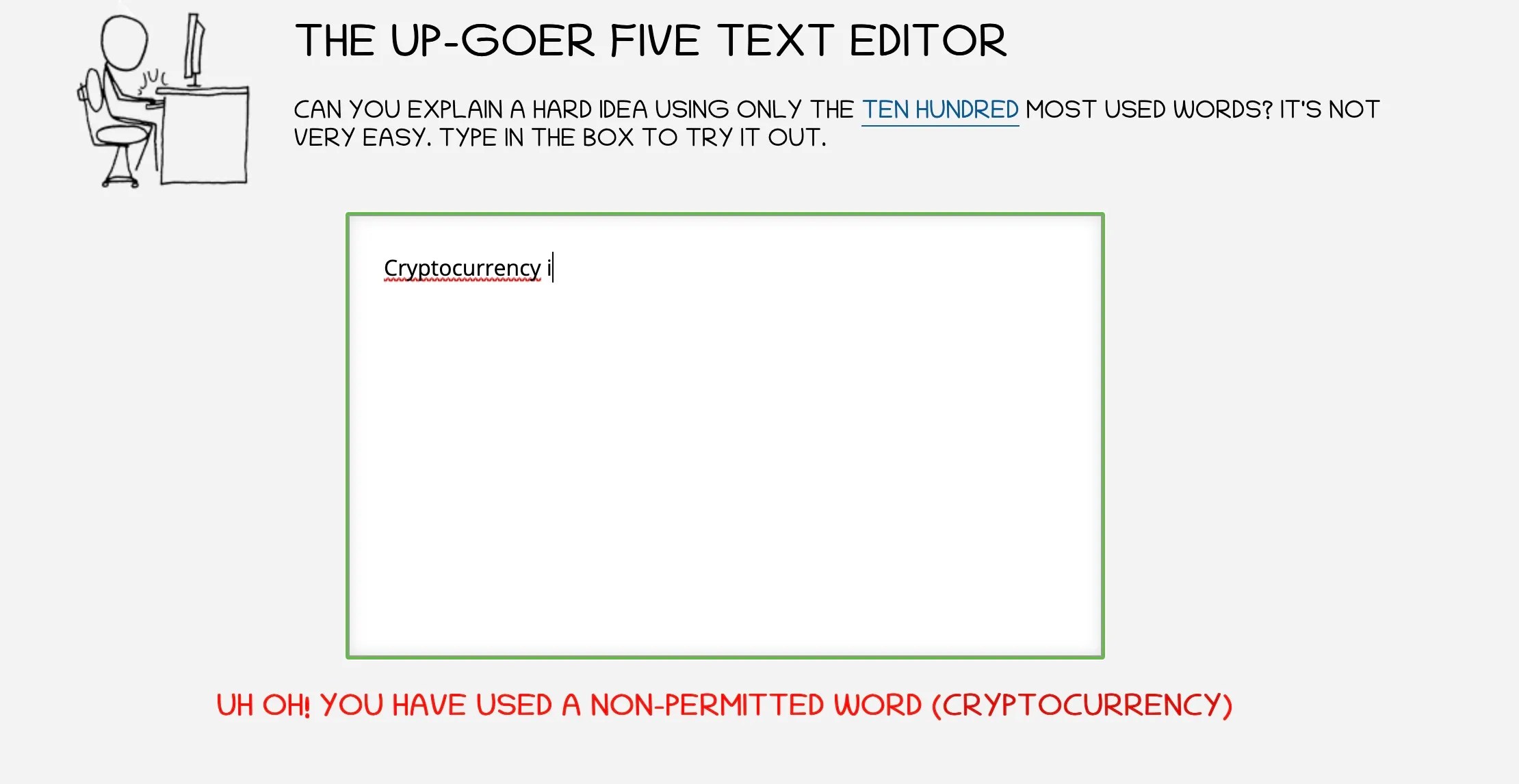
Putting it as simply as possible…
Try explaining something difficult or complex using only the most common thousand—sorry, ten hundred—words [the list is here]. The Up-Goer Five Text Editor isn’t a new idea (here’s a MacOS app from 2016) but now it’s on the web…
Boing Boing
Here’s your correspondent’s shot at explaining “Manichaeism”:

“Explain something with the thousand most used words in English,” via @BoingBoing.
* Jack Kerouac, The Dharma Bums
###
As we streamline, we might send tuneful birthday greetings to an avatar of a different kind of plain speaking, Steve Jones; he was born on this date in 1955. A musician and songwriter who has recorded and performed solo, in the short-lived supergroup Neurotic Outsiders with members of Guns N’ Roses and Duran Duran, and with the likes of Johnny Thunders, Iggy Pop, Bob Dylan, and Thin Lizzy, he is best remembered as the founding guitarist of The Sex Pistols (whose songs he co-wrote with John “Johnny Rotten” Lydon and drummer Paul Cook). He ranks in Rolling Stone‘s list of the “100 Greatest Guitarists of All Time.”

You must be logged in to post a comment.