Posts Tagged ‘ship’
“There is nothing more tentative, nothing more empirical (superficially, at least) than the process of establishing an order among things; nothing that demands a sharper eye or a surer, better-articulated language”*
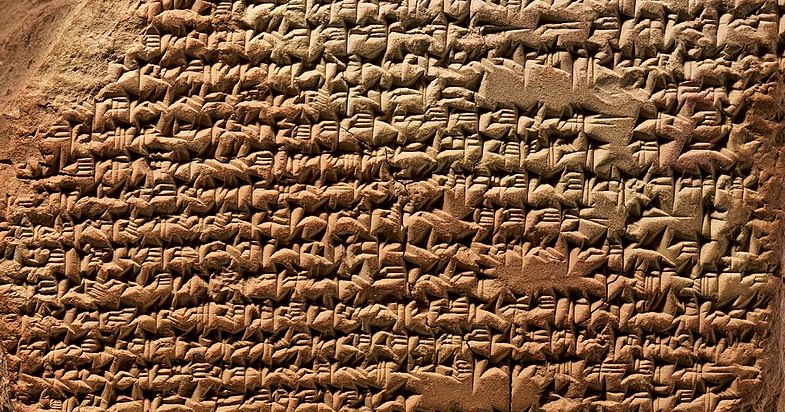
James Vincent on the emergence of earliest writing and its impact on culture, with special attention to the phenomenon of the “list” and its role in the birth of metrology…
Measurement was a crucial organizing principle in ancient Egypt, but metrology itself does not begin with nilometers. To understand its place in human culture, we have to trace its roots back further, to the invention of writing itself. For without writing, no measures can be recorded. The best evidence suggests that the written word was created independently thousands of years ago by a number of different cultures scattered around the world: in Mesopotamia, Mesoamerica, China, and Egypt. But it’s in Mesopotamia—present-day Iraq—where the practice is thought to have been invented first.
…
There’s some debate over whether this invention of writing enabled the first states to emerge, giving their rulers the ability to oversee and allocate resources, or whether it was the demands of the early states that in turn led to the invention of writing. Either way, the scribal arts offered dramatic new ways to process knowledge, allowing for not only superior organization, but also superior thinking. Some scholars argue that the splitting of noun and number on clay tablets didn’t just allow kings to better track their taxes but was tantamount to a cognitive revolution: a leap forward that allowed humans to abstract and categorize the world around them like never before.
Lists may not seem like cognitive dynamite, but their proliferation appears to have helped develop new modes of thought in early societies, encouraging us to think analytically about the world. “The list relies on discontinuity rather than continuity,” writes anthropologist Jack Goody. “[I]t encourages the ordering of the items, by number, by initial sound, by category, etc. And the existence of boundaries, external and internal, brings greater visibility to categories, at the same time as making them more abstract.”…
More at: “What If… Listicles Are Actually an Ancient Form of Writing and Narrative?” from @jjvincent in @lithub
* Michel Foucault
###
As we organize, we might recall that it was on this date in 1872 that the Mary Celeste (often erroneously referred to as Marie Celeste, per a Conan Doyle short story about the ship), an American-registered merchant brigantine, was discovered adrift and deserted in the Atlantic Ocean off the Azores Islands.
The Canadian brigantine Dei Gratia found her in a dishevelled but seaworthy condition under partial sail and with her lifeboat missing. The last entry in her log was dated ten days earlier. She had left New York City for Genoa on November 7 and was still amply provisioned when found. Her cargo of alcohol was intact, and the captain’s and crew’s personal belongings were undisturbed. None of those who had been on board were ever seen or heard from again.
At the salvage hearings in Gibraltar following her recovery, the court’s officers considered various possibilities of foul play, including mutiny by Mary Celeste‘s crew, piracy by the Dei Gratia crew or others, and conspiracy to carry out insurance or salvage fraud. No convincing evidence supported these theories, but unresolved suspicions led to a relatively low salvage award.
The inconclusive nature of the hearings fostered continued speculation as to the nature of the mystery. Hypotheses that have been advanced include the effects on the crew of alcohol fumes rising from the cargo, submarine earthquakes, waterspouts, attack by a giant squid, and paranormal intervention.
After the Gibraltar hearings, Mary Celeste continued in service under new owners. In 1885, her captain deliberately wrecked her off the coast of Haiti as part of an attempted insurance fraud.

The ship in 1861 (source)
“Induction for deduction, with a view to construction”*…

Mushroom cloud from the world’s first successful hydrogen bomb test, Nov. 1, 1952
At RAND in 1954, Armen A. Alchian conducted the world’s first event study to infer the fissile fuel material used in the manufacturing of the newly-developed hydrogen bomb. Successfully identifying lithium as the fissile fuel using only publicly available financial data, the paper was seen as a threat to national security and was immediately confiscated and destroyed…
How a bench researcher used publicly-available market data to unlock the secret of the H Bomb: “The Stock Market Speaks: How Dr. Alchian Learned to Build the Bomb” (pdf).
* Auguste Compte (attributed by John Arthur Thomson in a quote at heading of the chapter “Scientific Method,” in his Introduction to Science
###
As we comb the columns, we might recall that it was on this date in 1883 that the S.S. Daphne sank moments after her launching at the shipyard of Alexander Stephen and Sons in Glasgow. The 500-ton steamer went down with 200 men on board– all of them working to finish her before the shipyard closed for the Glasgow Fair. Only 70 were saved.

You must be logged in to post a comment.