Posts Tagged ‘values’
“We are not what we know but what we are willing to learn”*…

Abigail Tulenko argues that folktales, like formal philosophy, unsettle us into thinking anew about our cherished values and views of the world…
The Hungarian folktale Pretty Maid Ibronka terrified and tantalised me as a child. In the story, the young Ibronka must tie herself to the devil with string in order to discover important truths. These days, as a PhD student in philosophy, I sometimes worry I’ve done the same. I still believe in philosophy’s capacity to seek truth, but I’m conscious that I’ve tethered myself to an academic heritage plagued by formidable demons.
The demons of academic philosophy come in familiar guises: exclusivity, hegemony and investment in the myth of individual genius. As the ethicist Jill Hernandez notes, philosophy has been slower to change than many of its sister disciplines in the humanities: ‘It may be a surprise to many … given that theology and, certainly, religious studies tend to be inclusive, but philosophy is mostly resistant toward including diverse voices.’ Simultaneously, philosophy has grown increasingly specialised due to the pressures of professionalisation. Academics zero in on narrower and narrower topics in order to establish unique niches and, in the process, what was once a discipline that sought answers to humanity’s most fundamental questions becomes a jargon-riddled puzzle for a narrow group of insiders.
In recent years, ‘canon-expansion’ has been a hot-button topic, as philosophers increasingly find the exclusivity of the field antithetical to its universal aspirations. As Jay Garfield remarks, it is as irrational ‘to ignore everything not written in the Eurosphere’ as it would be to ‘only read philosophy published on Tuesdays.’ And yet, academic philosophy largely has done just that. It is only in the past few decades that the mainstream has begun to engage seriously with the work of women and non-Western thinkers. Often, this endeavour involves looking beyond the confines of what, historically, has been called ‘philosophy’.
Expanding the canon generally isn’t so simple as resurfacing a ‘standard’ philosophical treatise in the style of white male contemporaries that happens to have been written by someone outside this demographic. Sometimes this does happen, as in the case of Margaret Cavendish (1623-73) whose work has attracted increased recognition in recent years. But Cavendish was the Duchess of Newcastle, a royalist whose political theory criticises social mobility as a threat to social order. She had access to instruction that was highly unusual for women outside her background, which lends her work a ‘standard’ style and structure. To find voices beyond this elite, we often have to look beyond this style and structure.
Texts formerly classified as squarely theological have been among the first to attract significant renewed interest. Female Catholic writers such as Teresa of Ávila or Sor Juana Inés de la Cruz, whose work had been largely ignored outside theological circles, are now being re-examined through a philosophical lens. Likewise, philosophy departments are gradually including more work by Buddhist philosophers such as Dignāga and Ratnakīrti, whose epistemological contributions have been of especial recent interest. Such thinkers may now sit on syllabi alongside Augustine or Aquinas who, despite their theological bent, have long been considered ‘worthy’ of philosophical engagement.
On the topic of ‘worthiness’, I am wary of using the term ‘philosophy’ as an honorific. It is crucial that our interest in expanding the canon does not involve the implication that the ‘philosophical’ confers a degree of rigour over the theological, literary, etc. To do so would be to engage in a myopic and uninteresting debate over academic borders. My motivating question is not what the label of ‘philosophy’ can confer upon these texts, but what these texts can bring to philosophy. If philosophy seeks insight into the nature of such universal topics as reality, morality, art and knowledge, it must seek input from those beyond a narrow few. Engaging with theology is a great start, but these authors still largely represent an elite literate demographic, and raise many of the same concerns regarding a hegemonic, exclusive and individualistic bent.
As Hernandez quips: ‘[W]e know white, Western men have not cornered the market on deeply human, philosophical questions.’ And furthermore, ‘we also know, prudentially, that philosophy as a discipline needs to (and must) undergo significant navel-gazing to survive … in an ever-increasingly difficult time for homogenous, exclusive academic disciplines.’ In light of our aforementioned demons, it appears that philosophy is in urgent need of an exorcism.
I propose that one avenue forward is to travel backward into childhood – to stories like Ibronka’s. Folklore is an overlooked repository of philosophical thinking from voices outside the traditional canon. As such, it provides a model for new approaches that are directly responsive to the problems facing academic philosophy today. If, like Ibronka, we find ourselves tied to the devil, one way to disentangle ourselves may be to spin a tale…
Wisdom is where we find it: “Folklore is philosophy,” in @aeonmag. Eminently worth reading in full.
Apposite: “Syncretic Past.”
* Mary Catherine Bateson
###
As we update our understanding of understanding, we might send thoughtful birthday greetings to Michael Sandel; he was born on this date in 1953. A philosopher and professor of government theory at Harvard Law School (where his course Justice was the university’s first course to be made freely available online and on television, seen so far by tens of millions of people around the world), he is probably best known for his critique of John Rawls‘ A Theory of Justice (in Sandel’s book, Liberalism and the Limits of Justice).
Sandel subscribes to a certain version of communitarianism (although he is uncomfortable with the label), and in this vein he is perhaps best known for his critique of John Rawls’s A Theory of Justice. Rawls’s argument depends on the assumption of the veil of ignorance, which Sandel argues commits Rawls to a view of people as “unencumbered selves”. Sandel’s view is that we are by nature encumbered to an extent that makes it impossible even hypothetically to have such a veil. Some examples of such ties are those with our families, which we do not make by conscious choice but are born with, already attached. Because they are not consciously acquired, it is impossible to separate oneself from such ties. Sandel believes that only a less-restrictive, looser version of the veil of ignorance should be postulated. Criticism such as Sandel’s inspired Rawls to subsequently argue that his theory of justice was not a “metaphysical” theory but a “political” one, a basis on which an overriding consensus could be formed among individuals and groups with many different moral and political views.
source

“Nations, as well as men, almost always betray the most prominent features of their future destiny in their earliest years.”*…

Further, in a fashion, to yesterday’s post: assumptions in the developed West were that, as economic development progressed around the world, rising countries would become more liberal– just like us (or, at least just like the expert’s image of “us”). Similarly, there was an expectation by many that, as the U.S. and Europe continued to develop, their cultures and politics might become more homogenous. Alice Evans has a theory as to why that hasn’t happened…
In the West economic development spawned individualism and the spirit of ‘68. Modernisation theorists predicted that growth would deliver liberalism worldwide. Inglehart and Welzel argued that post-industrial societies would champion self-expression. But in fact, this has not transpired. Many prosperous places – like Saudi Arabia, Malaysia and South Korea – remain quite conservative. India’s economic growth has not delivered secularism, but Hindu nationalism.
What explains this global cultural divergence?
I have a theory:
- Cultural change occurs when bold rebels stick their necks out, champion some radical alternative, and successfully encourage wider defiance.
- In close-knit, collectivist societies, people care intensely about wider social approval, and tend to follow the herd. This suppresses individualism.
- Cultural tightness is much higher in societies where:
- Agriculture was extremely labour-intensive and required strong inter-dependence (e.g. rice or Andean potatoes), and/or
- Intensive kinship meant that commerce, cooperation and marriages were all rooted in a close-knit, endogamous community (tribe, clan or jati);
- Authoritarian governance represses dissent and reinforces despondency.
- In culturally tight societies (with labour-intensive agriculture or strong kinship intensity), then even as families grow richer, they still care for social approval. This suppresses individual resistance.
…
If you walk outside and do something weird, will anyone mind? India’s panchayats would certainly express disapproval and punish deviation. Such cultures are ‘tight’. The rules are known, conformity is widespread and subversion is abhorred. But head to São Paulo and no one will care. ‘Loose’ cultures like these are relatively tolerant and open-minded. There’s plenty of scope for self-expression.
Professor Michele Gelfand and co-authors’ international survey (spanning 33 countries across 5 continents) reveals a spectrum of ‘tight and loose cultures. People in tight cultures show greater self-control, conscientiousness, less littering, lower crime, more synchrony, stronger prejudice against outsiders, low immigration, low ethnic diversity, and more restrictions on public speech. Loose cultures are typically more open, tolerant, creative and over-weight.
Neither extreme is superior, these are just descriptively different cultures.

Within the US, there’s great cultural heterogeneity. Southern states have far higher rates of corporal punishment, executions and alcohol restrictions. In Texas in 2011, 28,000 school students were paddled or spanked. Alabama still criminalises the sale of sex toys. Tight states like these strongly opposed the Equal Rights Amendment.

Norm adherence isn’t just a function of self-regulation. Gelfand also emphasises institutions. Tight cultures tend to have more police per capita and security personnel. In Singapore, there are harsh punishments for littering, drug possession and even importing chewing gum. In some Chinese classrooms, webcams broadcast children’s behaviour, relaying footage to parents and school officials.
…
Our ancestors used to farm a rich variety of crops. Some were very labour intensive, requiring neighbourly cooperation.
A phenomenal new paper by Martin Fiszbein, Yeonha Jung and Dietrich Vollrath finds that in U.S. counties with labour-intensive crops, parents were more likely to give their children names that were common. This may indicate a desire for conformity. By contrast, in areas where farmers could be more self-sufficient, they chose names that were more individualistic. And when exogenous shifts propelled farmers into economic autonomy, they became even more self-expressive… Crops in the U.S. South were exceptionally labour intensive.
…
Economic interdependence seems to breed cultural conformity and collectivism. These are both examples of what Michele Gelfand calls ‘cultural tightness’. People in tight cultures show more synchrony, stronger prejudice against outsiders and more restrictions on public speech. Outraged by deviants, they tend to impose harsh punishments…
Fiszbein et al do not consider cultural tightness, but it does seem correlated with 19th century labour intensity [as one can see in comparing this map to the one above].

Globally, cultural tightness seems more common in places where farming was once extremely labour intensive and necessarily interdependent. Wet paddy rice required immense coordination. Thomas Talhelm argues that this encouraged East Asian collectivism. Students from rice-growing regions contribute more to public goods and harshly punish free-riders.
I was initially sceptical of the rice theory of culture. What about Confucianism and institutions? Fiszbein et al’s paper enables us to disentangle the two. Even under totally different, American institutions, agrarian interdependence nurtures conformity.
…
Strong kinship intensity keeps commerce and cooperation rooted around the family. This enables strong social policing and concern for wider approval.
Arabs continue to rely on wasta. Social connections are necessary to access jobs, secure permits, avoid trickery, and resolve conflicts. Even middle-class, professional Jordanians acquire social insurance from kin. Loyalty is also culturally esteemed: girls are encouraged to put family first, above narrow self-interest.
Caste remains imperative in India. Cities (especially the smaller ones) are rife with caste-based residential segregation. People remain dependent on close-knit networks, which maintain strict surveillance (messaging via Whatsapp)…
…
My theory can be tested empirically!
I predict that economic growth will foster more cultural liberalisation in societies
- historically reliant on crops with low labour intensity
- with weak kinship intensity.
Data-wise, I would recommend using the World Values Survey composite score of emancipative values over the past 15 years…
Eminently worth reading in full: “Why are some Rich Societies Conservative?” from @_alice_evans.
{Image at top: source]
* Alexis de Tocqueville, Democracy in America (in which he also relevantly observed: “I know of only two methods of establishing equality in the political world; every citizen must be put in possession of his rights, or rights must be granted to no one.”)
###
As we contemplate culture, we might recall that it was on this date in 1890 that journalist Nellie Bly completed her 72-day trip around the world.
In 1888, Bly suggested to her editor at the New York World that she take a trip around the world, attempting to turn the fictional Around the World in Eighty Days into fact for the first time. A year later, at 9:40 a.m. on November 14, 1889, with two days’ notice, she boarded the steamer Augusta Victoria, and began her 24,899-mile journey.
She brought with her the dress she was wearing, a sturdy overcoat, several changes of underwear, and a small travel bag carrying her toiletry essentials. She carried most of her money (£200 in English bank notes and gold, as well as some American currency) in a bag tied around her neck.
Bly traveled through England, France (where she met Jules Verne in Amiens), Brindisi, the Suez Canal, Colombo (Ceylon), the Straits Settlements of Penang and Singapore, Hong Kong, and Japan. Just over seventy-two days after her departure from Hoboken, having used steamships and existing railway lines, Bly was back in New York; she beat Phileas Fogg’s time by almost 8 days.

“The idea that there might be limits to growth is for many people impossible to imagine”*…

Jason Wilson on the Carthusian monks’ decision to limit production of their famed liqueur and what it says about quality and scale in our modern world…
[In January, 2023] a letter from the Carthusian monks in Voiron, France circulated through the world of spirits. It was, in the hackneyed parlance of journalism, a “bombshell.” The letter explains a decision by the monks to limit the production of Charteuse, their famed Alpine liqueur dating to 1605, in order “to focus on their primary goal: protect their monastic life and devote their time to solitude and prayer.”
Apparently this decision had been made quietly in 2021 (quietly being how most decisions are made in a monastic order sworn to a vow of silence). A growing Chartreuse shortage started being noticed by spirits enthusiasts during 2022. The drinks website Punch verified the letter a couple of weeks ago. Chartreuse will now only be sold exclusively under allocation, making it much more difficult to find.
First of all, allow me to applaud this stance by the Carthusian monks. I deeply admire their willingness to say “enough” to the relentless market forces pushing them to produce more, more, more, at all costs. It’s honestly inspiring that the monks refuse to see their earthly purpose as satisfying the demands of some knucklehead mixologist doing his little riff on the Last Word at some lame speakeasy in some third-tier city.
Less but better and for longer. What a refreshing thing to hear in 2023. In nearly every other realm of our soul-crushing age, the focus is to scale everything as big as possible, quality be damned. As someone who operates in a media industry that values an endless stream of cheap, SEO-driven clickbait over well-written, thoughtful content that costs effort and money to produce, I stand with the monks…
“Where Has All the Chartreuse Gone?” from @boozecolumnist.
* Donella Meadows
###
As we find balance, we might recall that it was on this date in 1915 that Absinthe is outlawed in France and several other countries.
Absinthe was a licorice/anise flavored liqueur that contained wormwood, and was 132 proof. The high alcohol content, and the presence of the toxic oil thujone from the wormwood, seemed to cause hallucinations, convulsions, and severe mental problems amongst hard core absinthe drinkers.
In response to the ban, Henry-Louis Pernod, who manufactured Absinthe, came out with the lower alcohol, wormwood free liqueur ‘Pernod’, to replace Absinthe… though Absinthe sales were subsequently reinstated in the E.U.

“Not what we have, but what we enjoy, constitutes our abundance”*…

After Aristotle, Hellenic philosophy was dominated by two rival schools of thought, the Stoic (founded by Zeno) and the Epicurean (founded by Epicurus). Over the centuries since, “stoic” has come to mean “self-disciplined indifference to pleasure or (especially) pain as a matter of principle or self-discipline,” while “epicurean” has now conjures “fond of or adapted to luxury or indulgence in sensual pleasures; having luxurious tastes or habits, esp. in eating and drinking.” But as Emily Austin argues in Living for Pleasure, an Epicurean Guide to Life, that’s a bum rap. Stoicism is having a moment. In a review of her new book, Julian Baggini argues that we should consider Epicureanism as well…
No one today would dream of practising the physics, medicine or biology of the ancient Greeks. But their thoughts on how to live remain perennially inspiring. Plato, Aristotle and the Stoics have all had their 21st-century evangelists. Now it is Epicurus’s turn, and his advocate is American philosopher Emily A. Austin.
Living for Pleasure is likely to evoke feelings of deja vu. One reason why “ancient wisdom” is so enduring is that most thinkers came to very similar conclusions on certain key points. Do not be seduced by the shallow temptations of wealth or glory. Pursue what is of real value to you, not what society tells you is most important. Be the sovereign of your desires, not a slave to them. Do not be scared of death, since only the superstitious fear divine punishment.
The more general such claims are, the easier it is to agree. But when we delve into what makes the various philosophers different, what sounds like universal good sense can suddenly seem a bit wacky.
Epicurus’s distinctive feature is his insistence that pleasure is the source of all happiness and is the only truly good thing. Hence the modern use of “epicurean” to mean gourmand. But Epicurus was no debauched hedonist. He thought the greatest pleasure was ataraxia: a state of tranquility in which we are free from anxiety. This raises the suspicion of false advertising – freedom from anxiety may be nice, but few would say it is positively pleasurable.
Still, in a world where even the possibility of missing out inspires fear, freedom from anxiety sounds pretty attractive. How can we get it? Mainly by satisfying the right desires and ignoring the rest. Epicurus thought that desires could be natural or unnatural, and necessary or unnecessary. Our natural and necessary desires are few: healthy food, shelter, clothes, company. As long as we live in a stable, supportive community, they are easy to achieve…
There’s much more in this timely guide to the Greek philosopher – and rival to the Stoics – who saw freedom from anxiety as the ultimate goal: “Living for Pleasure by Emily A Austin – an Epicurean guide to happiness,” from @JulianBaggini in @guardian.
See also: “How to be an Epicurean.”
* Epicurus
###
As we contemplate contentment, we might send revelatory birthday greetings to Emanuel Swedenborg; he was born on this date in 1688 (O.S.). At age 53, after a successful career as an inventor and scientist, Sedenborg began to experience dreams and visions, a “spiritual awakening,” in which he received a revelation that Jesus Christ had appointed him to write The Heavenly Doctrine to reform Christianity. According to The Heavenly Doctrine, the Lord had opened Swedenborg’s spiritual eyes so that from then on, he could freely visit heaven and hell to converse with angels, demons and other spirits, and that the Last Judgment had already occurred in 1757 (not by Christ in person but by a revelation from him through the inner, spiritual sense of the Word through Swedenborg), the year before the 1758 publication of De Nova Hierosolyma et ejus doctrina coelesti (Concerning the New Jerusalem and its Heavenly Doctrine). The New Church, also known as Swedenborgianism, is a new religious movement originally founded in 1787 and comprising several historically related Christian denominations that revere Swedenborg’s writings as revelation.
Swedenborg argued against Luther’s concept of salvation through faith-alone (sola-fide in Latin), since he considered both faith and charity necessary for salvation. His thinking influenced a variety of important cultural figures, both writers and artists, including Robert Frost, Johnny Appleseed, William Blake, Jorge Luis Borges, Daniel Burnham, Arthur Conan Doyle, Ralph Waldo Emerson, John Flaxman, George Inness, Henry James Sr., Carl Jung, Immanuel Kant, Honoré de Balzac, Helen Keller, Czesław Miłosz, Joseph Smith, August Strindberg, D. T. Suzuki, and W. B. Yeats.

“Teach Your Children”*…
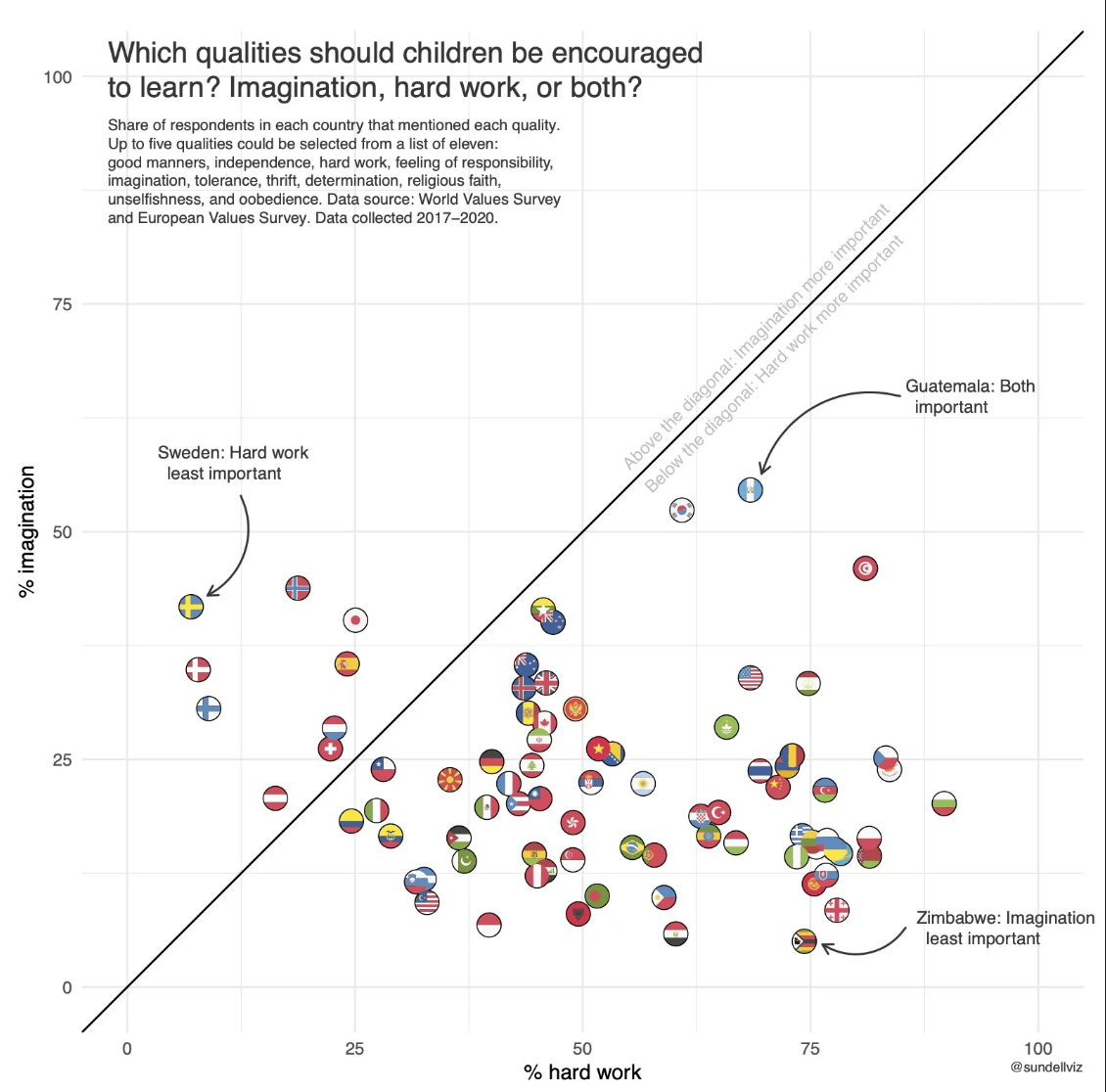
Values around the world, graphed…
What’s more important for a child to be encouraged to learn: imagination, hard work or both?
And what do you value the most: family, work, friends, leisure, religion or politics?
These are questions asked by the World Values Survey, “a large non-commercial, cross-national, longitudinal investigation of human beliefs and values.” The comparative social survey polled 1,000-3,000 people in countries around the globe to get a consensus on where they stood on varying principles and ideals.
Anders Sundell, a political scientist at University of Gothenburg, scoured through the data and put the results on a line graph, with each country represented by a dot.
Many Nordic countries said they wanted to encourage children to learn imagination the most, with Sweden being the country to list hard work as the least important attribute. Guatemala and South Korea were the countries that overwhelmingly valued both imagination and hard work. Zimbabwe was the country that listed imagination as the least important quality.
Sundell also mapped the countries around the globe that valued family, work, friends, religion, leisure and politics the highest, e.g.:

Dive more deeply into the data at “The Countries That Value Family, Work, Friends, Leisure, Religion And Politics The Most, Visualized.”
* Crosby, Stills & Nash (written by Graham Nash)
###
As we compare cultures, we might recall that it was on this date in 1899 that Henry Hale Bliss, a 69-year-old local real estate dealer, was alighting from a south bound 8th Avenue trolley car when an electric-powered taxicab (Automobile No. 43) struck him. Bliss hit the pavement, crushing his head and chest. He was taken by ambulance to Roosevelt Hospital; but upon arrival the house surgeon, Dr. Marny, said his injuries were too severe to survive, and Bliss died from his sustained injuries the next morning… becoming the first recorded instance of a person being killed in a motor vehicle collision in the U. S.

You must be logged in to post a comment.