Posts Tagged ‘Henry Hale Bliss’
“These gems have life in them: their colors speak, say what words fail of”*…
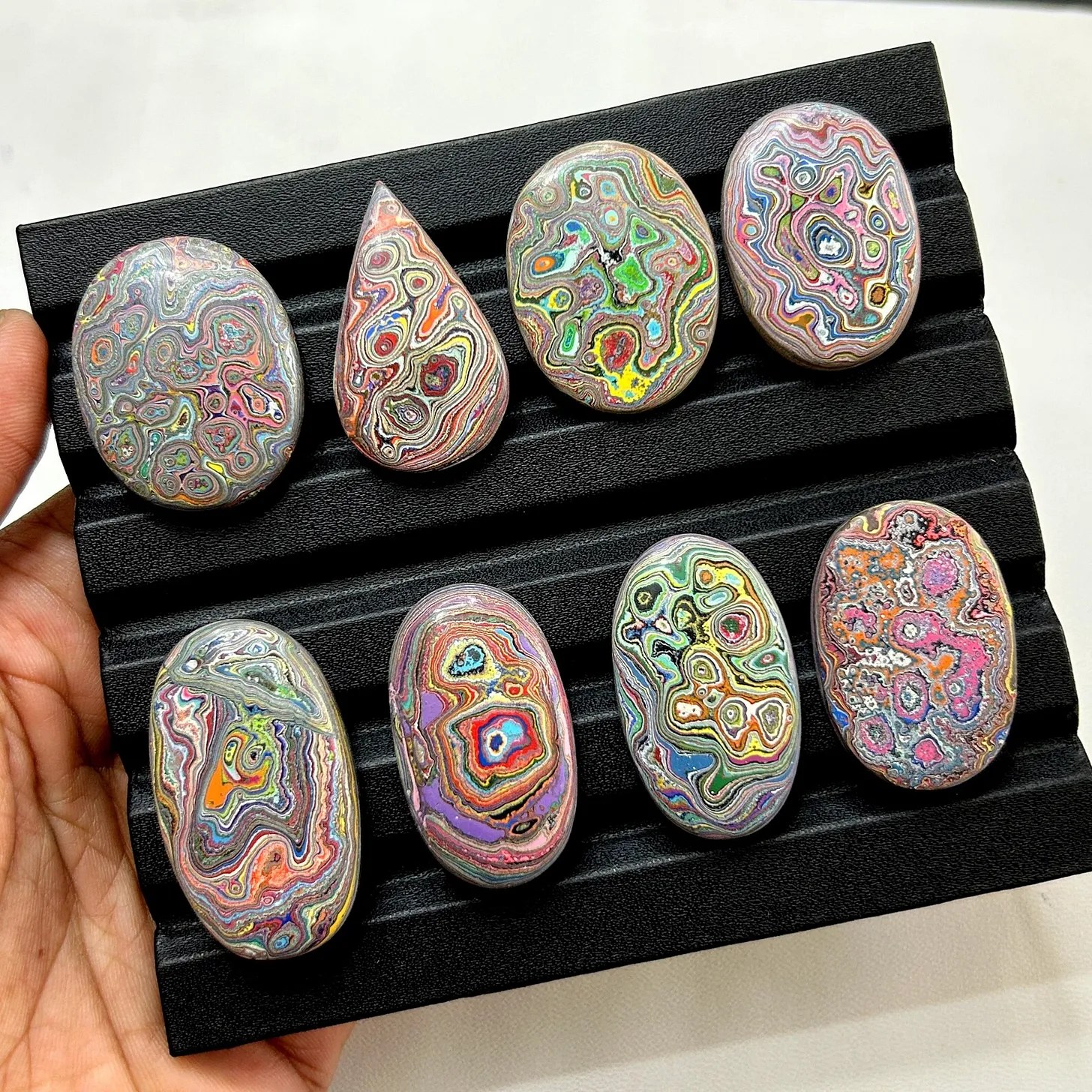
Ryan McManus on geologic byproducts, American automotive lore, and the hidden beauty of the industrial age…
Let’s be real for a second: gems are basically very pretty garbage. A byproduct of a geologic or biological process we hang on our bodies for some weird reason. Diamonds are just charcoal that has been squeezed a little longer than usual. Geodes are dried lava that got a little wet. Pearls? Oyster mucus, secreted to smooth out the bivalve equivalent of a stone in one’s shoe. They are unintentional, accidental and, due to the peculiarities of our brains, unquestionably beautiful.
So, if nature can accidentally create works of art while going about its business, why not us?
In the 1940s and 50s, Detroit’s automotive factories had a beautifully messy problem: paint. Workers hand-sprayed enamel paint onto cars on assembly lines, with excess overspray gradually building up on the tracks, skids, and walls of painting bays. This oversprayed paint accumulated over years, layer by layer—creating thick, multicolored deposits that factory workers would periodically chip away and discard.
What they were throwing out, however, would eventually become one of the most sought-after materials in contemporary jewelry making: Fordite, also known as Detroit agate.
Fordite is a man-made gemstone (technically a non-faceted gemstone, called a cabochan), but not like the rubies and diamonds grown in labs. The material represents a fascinating intersection of industrial inefficiency and geological mimicry: As cars were spray painted by hand, the hardened enamel paint built up and baked, creating sedimentary-like layers that mirror how natural agates form over millennia, except compressed into decades of automotive production.
When cut and polished, the visual result is striking—especially in the most valuable samples from the late 1960s and early 1970s, the period of bright “high impact” colors like Ford’s Grabber Blue or Mopar’s Plum Crazy purple. Fordite reveals psychedelic swirls and bands that chronicle automotive color trends year by year, strata by strata: It’s essentially a cross-section of American car culture, with each stratum representing a different model year’s palette. Like the proverbial Jurassic Age mosquito trapped in the stone of amber, the DNA of a bygone epoch is hidden inside.
But Fordite’s deeper appeal lies in its accidental scarcity and temporal specificity. By the 1980s, car manufacturers had moved away from hand-spray painting, adopting an electrostatic process that magnetizes enamels to car bodies, leaving little to no overspray. Efficient, yes—but this electrostatic process ended Fordite production in abundance by the late 1970s. The material can never be recreated—it’s a finite byproduct of a particular moment in industrial history.
This creates a curious value proposition: Fordite is valuable precisely because modern manufacturing has become more efficient. It is industrial waste transformed into luxury material through the simple passage of time and technological progress. With the old factories long gone and today’s automated systems eliminating waste, each piece of Fordite becomes increasingly rare (and expensive), turning Detroit’s former inefficiency into today’s artisanal treasure.
In an age of planned obsolescence and disposable manufacturing, Fordite stands as an accidental monument to the beauty that emerges from industrial imperfection—proof that sometimes the most interesting materials come from processes we’ve intentionally left behind.
A better poet might even see Fordite as metaphor for the City of Detroit itself—forever tied to the automobile, often written off as worthless; unrecognized as a thing of curious quality and glorious beauty waiting for its moment…
More beautiful examples at “Fordite,” from @ryantomorrow.bsky.social in the always-illuminating Why is This Interesting?
* George Eliot (Mary Ann Evans)
###
As we rethink remnants, we might recall that it was on this date in 1899 that America’s first fatal automobile accident occurred. At West 74th Street and Central Park West in New York City, Henry Hale Bliss, a 69-year-old local real estate dealer, stepped off of a south bound 8th Avenue trolley car and was struck by the driver of an electric-powered taxicab (Automobile No. 43). Bliss hit the pavement, crushing his head and chest. He was taken by ambulance to Roosevelt Hospital, but upon arrival the house surgeon, Dr. Marny, judged his injuries too severe to survive. Bliss died the next morning.

“How deluded we sometimes are by the clear notions we get out of books. They make us think that we really understand things of which we have no practical knowledge at all.”*…

Anthony Grafton on Pamela H. Smith‘s new book, From Lived Experience to the Written Word: Reconstructing Practical Knowledge in the Early Modern World, and the challenges of understanding the origins of the practical arts, crafts, and sciences…
… The knowledge that goes into building a brick wall that is truly vertical or hanging a door that doesn’t stick, printing a book that doesn’t smudge or casting a bell that won’t split, is hard to trace to its origins. Historians of science specialize in theories and methods that they can tie to people and dates: for example, astronomy based on the heliocentric theory and human anatomy based on human dissection. Both of these, as it happens, were the subjects of long, technical books—by Copernicus and Vesalius, respectively—that appeared in 1543.
The knowledge that underpins our world of things, by contrast, has been discovered over centuries, through trial and error, two steps forward and one step back. It has been produced and improved by collaboration: the work of talented, largely anonymous groups, generation after generation, rather than identifiable individuals. And it is less verbal than embodied. Most of the experiments involved in forming a craft and the practices used to teach and further develop it go unrecorded, as do those who carried them out. French bakers often start their careers nowadays with formal training. But they master their craft at work, learning from those with experience and skills, hands in the dough and senses focused on what happens to it in the oven.
Teaching astronomy or anatomy happens in a lecture hall or anatomy theater—a place where some people pronounce and others take notes (or zone out). Teaching in the world of things goes on in places where people work. Teaching in the university is usually abstract and verbal. Teaching in the world of things is often physical: the teacher urges pupils to apply all of their senses and employs gestures as well as words to make clear how one wields a tool or decides if something has finished cooking.
As a history professor I have told stories and argued about interpretations before hundreds of students in lecture halls and seminar rooms. Long ago, as a theater technician, I taught apprentices—face-to-face and with our hands on tools and materials—how to swing a hammer or glue the cloth for scenery to a wooden frame. When teaching history I present an ever-changing body of material that I have read and thought and argued about with colleagues over the decades. When teaching theater crafts I transmitted physical skills that I had learned from others in shops and about which I had not read a word. No notes preserve those lessons. How can we hope to discover how a medieval blacksmith learned to forge tools or a Renaissance tailor learned to cut brocade?…
The knowledge that underpins our world of things has been discovered over centuries, produced as the result of collaboration, and generally unrecorded. How does a historian overcome these obstacles? “How to Cast a Metal Lizard,” @scaliger on @ps2270 in @nybooks.
Similarly, see “How a Bedouin Tracker Sees the Desert.” And for how a successful manager (and artist) incorporates “the art of craft” into his life, see “Leading with Slow Craft,” from @natenatenate.
* Thomas Merton
###
As we noodle on knowledge, we might recall that it was on this date in 1899 that Henry Hale Bliss, a 69-year-old New York City real estate dealer, was alighting from a south bound 8th Avenue trolley car when an electric-powered taxicab (Automobile No. 43) struck him. Bliss hit the pavement, crushing his head and chest. He was taken by ambulance to Roosevelt Hospital; but upon arrival the house surgeon, Dr. Marny, said his injuries were too severe to survive; Bliss died the next morning… becoming the first recorded instance of a person being killed in a motor vehicle collision in the U. S.

“Teach Your Children”*…

Values around the world, graphed…
What’s more important for a child to be encouraged to learn: imagination, hard work or both?
And what do you value the most: family, work, friends, leisure, religion or politics?
These are questions asked by the World Values Survey, “a large non-commercial, cross-national, longitudinal investigation of human beliefs and values.” The comparative social survey polled 1,000-3,000 people in countries around the globe to get a consensus on where they stood on varying principles and ideals.
Anders Sundell, a political scientist at University of Gothenburg, scoured through the data and put the results on a line graph, with each country represented by a dot.
Many Nordic countries said they wanted to encourage children to learn imagination the most, with Sweden being the country to list hard work as the least important attribute. Guatemala and South Korea were the countries that overwhelmingly valued both imagination and hard work. Zimbabwe was the country that listed imagination as the least important quality.
Sundell also mapped the countries around the globe that valued family, work, friends, religion, leisure and politics the highest, e.g.:

Dive more deeply into the data at “The Countries That Value Family, Work, Friends, Leisure, Religion And Politics The Most, Visualized.”
* Crosby, Stills & Nash (written by Graham Nash)
###
As we compare cultures, we might recall that it was on this date in 1899 that Henry Hale Bliss, a 69-year-old local real estate dealer, was alighting from a south bound 8th Avenue trolley car when an electric-powered taxicab (Automobile No. 43) struck him. Bliss hit the pavement, crushing his head and chest. He was taken by ambulance to Roosevelt Hospital; but upon arrival the house surgeon, Dr. Marny, said his injuries were too severe to survive, and Bliss died from his sustained injuries the next morning… becoming the first recorded instance of a person being killed in a motor vehicle collision in the U. S.
You must be logged in to post a comment.