Posts Tagged ‘taste’
“In the last analysis, a pickle is a cucumber with experience”*…
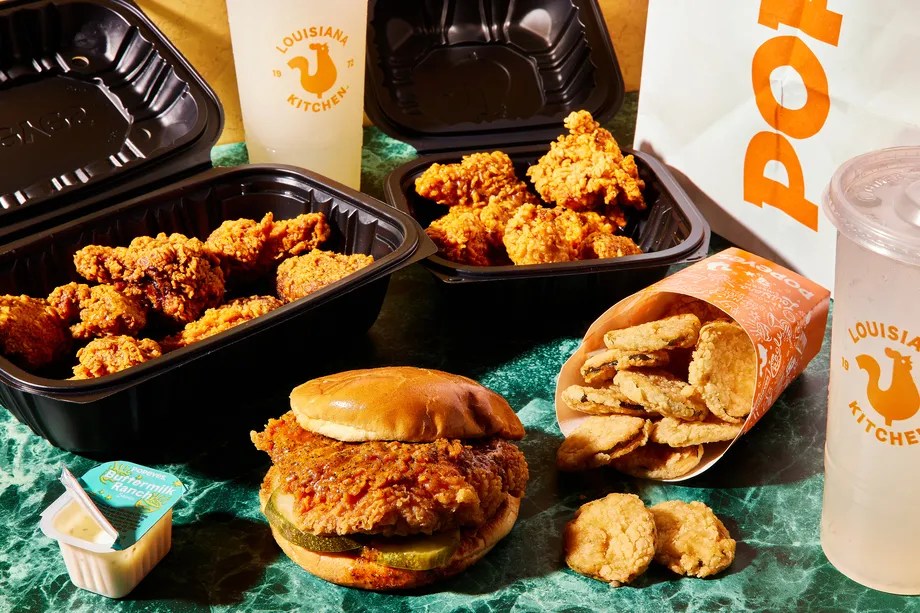
The pickle is Gen Z’s avocado; it’s a passion and a personality. But maybe, Jaya Saxena suggests, that’s missing the point…
In the Top Chef episode “Pickle Me This,” which aired on April 17, host Kristen Kish, in power clashing greens, announces that two teams of chefs must go head to head in creating an all-pickle dinner. The five-course meal was to feature different kinds of pickles in every course — not kimchi or achar necessarily, but instead the cornichons and dill of the European influence. There were charred pickles with cured mackerel, cucumber and celeriac pickle gelee, chef Massimo Piedimonte’s winning fried pickle cannolo, and of course a bread and butter pickle curd with dill ice cream. Individually, each dish sounded great, and judge Tom Colicchio said two of the dishes, including the dessert, were some of the best he’s ever had on the show.
Top Chef contestants often have to create meals utilizing an ingredient that’s in the culinary zeitgeist. Some of those meals are more successful than others. But a successful five-course meal of all things pickles illustrates the strange place in culture the pickle holds now: both cheffy and with diverse-enough flavor profiles to inspire chefs in fierce competition, but obvious and basic enough to also be a little bit of a joke. It’s the food of the moment, both sincerely and ironically.
As Rebecca Jennings wrote in Vox, pickles are Gen Z’s avocado, a viral food that people genuinely enjoy: They “pair well with other contemporary food trends like dirty martinis and canned cocktails, and fit right in with aesthetically pleasing butter boards and “girl dinner” spreads.” But people are also consuming pickles for the meme of it all. There are pickle chips, pickle popcorn, Flamin’ Hot pickle Cheetos, and pickle seltzer. Popeyes recently introduced an entire pickle menu, including pickle lemonade. 21Seeds wants you to make a spicy pickle martini with its tequila, and people are putting pickles in their soda. Sweetgreen has pickle ketchup, and of course Molly Baz has dill pickle mayo. And like any “it” food nowadays, the pickle has moved into fashion and home decor.
Like with any trend, though, it’s kind of exhausting when it’s everywhere. Pickles have become subject to the flavor-ification of actual foods; half the time, pickle-flavored anything is an unsatisfying approximation of the flavor of Central European-style pickled cucumbers — typically a combination of salt, vinegar, and artificial dill which evokes none of the live-culture fizz that hums through the real thing. It’s that complexity we crave, herbs and lactic acid and often spices like coriander.
But for the pickle to be the centerpiece of an entire five-course meal, or for it to be one’s personality to the point that it flavors every snack in one’s house, slightly misses the point of the pickle. A Popeyes meal of fried pickles and pickle glazed wings washed down with a pickle lemonade serves no refreshing alternative to the onslaught of puckering pickle potency. A filthy martini and a bowl of pickle popcorn offers no relief. What makes pickles great on a sandwich or a charcuterie board is usually that the pungent brine and preserving salt make for a great contrast to any creamy, sweet or rich ingredients. Pickles are salt and acid bombs that are delicious on their own, but also enhance every other flavor. It’s why olives are often served with bread and cheese plates have all that cheese. The back and forth is what makes pickles truly shine.
Obviously no one is forcing anyone to only consume pickles, and if that is indeed what your taste buds crave, then congrats on being the moment! But put pickles everywhere and they cease to be a treat, the shining zinging bite to zap you into whatever else you’re eating. Maybe they should stay a sometimes food…
The flavor of the moment: “Is There Too Much Pickle?” from @jayasaxena.com in @eater.bsky.social.
Possibly apposite?: “Will Gen Z’s Pivot to the Republican Party Last?– It’s not only young men who lean conservative. The youngest female voters are also abandoning the Democratic Party.” (gift article)
###
As we test our tastebuds, we might recall that it was on this date in 2009 that 12 year old Catherine Ralston ( a member of Gen Z) was named Easy-Bake “Baker of the Year” for her “Queen of Hearts Strawberry Tart.” The Easy-Bake Oven is, of course, a working toy oven that Kenner introduced in 1963 (more than 16 million Easy-Bake Ovens (in 11 models) had been sold by 1997), and which Hasbro still manufactures.

“Tell me what you eat, and I will tell you who you are”*…

Fuchsia Dunlop in praise of the multifaceted, deliciously-diverse Chinese cuisine…
If you visit a Shaoxing wine factory, you may walk past a stack of crumbly bricks made of some rough, pale, porous material. You’ll probably assume it’s debris left behind by negligent builders. But these bricks, this stuff, so unprepossessing to the eye, is one of the most important Chinese ingredients. You won’t see it in your bowl; you won’t smell or taste it directly; yet it’s an invisible presence in almost every Chinese meal. It is not merely an ingredient, but a pre-ingredient, the progenitor of some of the most vital components of Chinese edible culture. Like a genie, it brings Chinese food and drink to life.
The bricks are made of what is known as qu—which sounds like “choo,” but with a lovely softness—a sort of coral reef teeming with desiccated microorganisms, enzymes, moulds and yeasts that will spring into action in the presence of water, ready to unleash themselves on all kinds of foods, especially those that are starchy. The Japanese, who learned about qu from China, call it koji ; it’s sometimes translated into English as “ferment.” When awakened, all these microorganisms will magically transform cooked beans, rice and other cereals, unravelling their tight-knit starches into simple sugars, then fermenting the sugars into alcohol, meanwhile spinning off a whole aurora of intriguing flavors. It is qu that converts soybeans into soy sauce and jiang. Qu is the catalyst for fermenting alcoholic drinks from rice, millet and other cereals, as well as grain vinegars. It’s no exaggeration to say that qu is one of the keys to what makes Chinese food Chinese…
More kitchen secrets in this excerpt from her new book, Invitation to a Banquet: The Story of Chinese Food “The Marvels of Qu: What Makes Chinese Food and Drink Unique,” in @lithub.
* Jean Anthelme Brillat-Savarin
###
As we investigate identity, we might send tasty birthday greetings to Edwin Traisman; he was born on this date in 1915. A food scientist, he developed the process for freezing McDonald’s french fries that allowed for their standardization, developed Cheez Whiz for Kraft Foods, and researched E. coli.

“No one ever went broke underestimating the taste of the American public”*…

… and now two beverage giants are turning their attention to Europe:
Coca-Cola and Pernod Ricard plan to debut Absolut Vodka & Sprite as a ready-to-drink pre-mixed cocktail in early 2024, the companies said in a statement.
The pre-mixed cocktail will be available in versions with Sprite and Sprite Zero Sugar, with the initial launch planned for select European countries, including the U.K., the Netherlands, Spain and Germany.
Coca-Cola has brought several of its most popular brands into the alcohol space during the last two years through partnerships with booze companies such as Molson Coors and Brown-Forman…
FoodDive
The inimitable Walt Hickey reacts…
Coca-Cola and Pernod Ricard have cut a deal to produce a ready-to-drink mixed cocktail that is literally just Absolut vodka and Sprite. Legendary adwoman Peggy Olson once quipped that “You need three ingredients for a cocktail. Mountain Dew and vodka is an emergency,” and that wisdom certainly holds here. The idea that a company could charge a premium to mix together Absolut and Sprite is an insult; as we all know, cheap vodka mixed with Sprite is an innovation of desperation, the mixture one creates when all other options have been exhausted, the kind of drink that you have when you’re 17 and new to the whole thing. This is the kind of beverage that is exclusively made at 2:45 in the morning in a college dorm because the bars closed and we can’t get mixers at Wawa because the line was too long. An Absolut and Sprite is the official drink of a CYO party. An Absolut and Sprite makes a Jack and Coke look like a Sazerac. That it is being combined in a ready-to-drink offering is an insult to the aluminum that went into that can. Given that the ready-to-drink category is projected to grow by $11.6 billion from 2022 to 2026 alone, I can almost guarantee it’s going to be amazingly successful and I already hate it.
Numlock
[Image above: source]
* H. L. Mencken
###
As we ponder progress, we might recall that today is observed (by some) as World Tripe Day— a celebration of the culinary delicacy known as tripe (the edible lining from the stomach of various farm animals, such as cattle, sheep, and goats).

“Thousands have lived without love, not one without water”*…

Katherine LaGrave with the story of America’s first water sommelier believes that the more we think about what we drink, the more we will care about the planet. But first, he has to get people to take him seriously…
… Martin Riese, is America’s first water sommelier, curating menus and tastings around what he calls “the most important beverage on the planet.”…
Riese is taking cues from the element he considers most beloved, going with the flow and flowing where he’s able, taking opportunities as they come, and sharing why we should care about water with anyone who cares to listen.
“Water is not just water,” he says to me one sunny October afternoon, shining bright from Los Angeles via laptop with the urgency of a theater attendant walking you to your seat just before the lights dim and the show starts. OK, I think. Off we go. Down into waterworld…
A trip worth taking- Riese’s story and his provocative thoughts on that most crucial substance: “Waterworld,” from @kjlagrave in @AFARmedia.
* W. H. Auden
###
As we get wet, we might recall that on this date in 1993, after weeks of flooding elsewhere in the state (dramatically, in Ames), efforts to protect Valley Junction in West Des Moines from flooding failed, forcing 5,000 people from their homes. The Court Avenue district in downtown Des Moines was awash. By the next day, more than 250,000 people were without water after flooding shut down the Des Moines Water Works. In addition, An estimated 35,000 to 40,000 people were without electricity. Then-Sec Taylor Stadium, now the Iowa Cubs’ Principal Park, was underwater. The entire state was declared a disaster area.

“There’s no accounting for taste”*…

As Matthew Baldwin demonstrates, the praise of professional critics hardly matters to the book-reviewing readers at Amazon.com…
The following are excerpts from actual one-star Amazon.com reviews of books from Time’s list of the 100 best novels from 1923 to the present. Some entries have been edited.
Beloved by Toni Morrison (1987)
“Morrison’s obviously a good writer, but truly, her subject matter leaves a LOT to be desired in this book. It’s raunchy beyond belief. People do things with farm animals that they shouldn’t. I couldn’t get through the first two chapters without vomiting. Some things you just shouldn’t put in your head.”…
The Catcher in the Rye by J.D. Salinger (1951)
“So many other good books…don’t waste your time on this one. J.D. Salinger went into hiding because he was embarrassed.”…
The Grapes of Wrath by John Steinbeck (1939)
“While the story did have a great moral to go along with it, it was about dirt! Dirt and migrating. Dirt and migrating and more dirt.”…
The Sound and the Fury by William Faulkner (1929)
“This book is like an ungrateful girlfriend. You do your best to understand her and get nothing back in return.”…
More at “Lone Star Statements,” a compilation of the best of the worst… about the best. From @TheMorningNews.
Apposite: “The Strangely Beautiful Experience of Google Reviews“
* An English adaptation of the medieval (Scholastic) Latin saying “De gustibus non est disputandum” (regarding taste, there is no dispute)
###
As we contemplate connoisseurship, we might recall that it was on this date in 1927 that Louis B. Mayer presided over the founding of the Academy of Motion Picture Arts and Sciences.
Anxious to create to create an organization that would mediate labor disputes without unions and improve the film industry’s image, he envisaged an elite club open only to people involved in one of the five branches of the industry: actors, directors, writers, technicians, and producers. He gathered a group of thirty-six industry leaders at a formal banquet at the Ambassador Hotel in Los Angeles, and presented them what he called the International Academy of Motion Picture Arts and Sciences. Everyone in the room that evening became a founder of the Academy. Between that evening (this date in 1927) and the filing of the official Articles of Incorporation for the organization (on May 4, 1927), the “International” was dropped from the name. Labor negotiations were also briskly dropped, leaving the organization to focus on promoting the industry.
In 1929, Academy members, in a joint venture with the University of Southern California, created America’s first film school to further the art and science of moving pictures. The school’s founding faculty included Douglas Fairbanks (President of the Academy), D. W. Griffith, William C. deMille, Ernst Lubitsch, Irving Thalberg, and Darryl F. Zanuck.
But their most recognizable venture into image enhancement was also born in 1929: the Academy held it’s first annual awards ceremony, bestowing the first “award of merit for distinctive achievement,”-what has become the Academy Awards– the Oscars.

You must be logged in to post a comment.