Posts Tagged ‘rock’
“The Beatles were thugs who were put across as nice blokes, and the Rolling Stones were gentlemen who were made into thugs by Andrew [Loog Oldham, their manager]”*…

A reminder that your correspondent is traveling– to wit, more occasional posts. Regular service should resume on or about September 20…
John McMillan on a controversy that raged back when music mattered– politics and image in the age of “the wax manifesto”…
Many in the media were quick to notice the two groups’ contrasting styles. When the Rolling Stones arrived in the United States, the first Associated Press (AP) report described them as “dirtier, streakier, and more disheveled than the Beatles.” Tom Wolfe put things more sharply: “The Beatles want to hold your hand,” he quipped, “but the Stones want to burn down your town.” Since these comparisons proved useful to everyone, both the bands and the journalists collaborated on the charade. In the early 1960s, Keith Richards remarked, “nobody took the music seriously. It was the image that counted, how to manipulate the press and dream up a few headlines.” Peter Jones, who wrote about both bands for the Record Mirror, recalled being in a “difficult position” because he was expected to “gloss over” the Beatles’ tawdry indiscretions. “It was decreed that the Beatles should be portrayed as incredibly lovable, amiable fellows, and if one of them, without mentioning any names, wanted to have a short orgy with three girls in the bathroom, then I didn’t see it.”
Whether one preferred the Beatles or the Stones in the 1960s was largely a matter of aesthetic taste and personal temperament. Though clichéd and sometimes overdrawn, most of the Beatles/Stones binaries contain a measure of plausibility: the Beatles were Apollonian, the Stones Dionysian; the Beatles pop, the Stones rock; the Beatles erudite, the Stones visceral. But in the United States, during the watershed summer of 1968, the Beatles/Stones debate suddenly became a contest of political ideologies, wherein the Beatles were thought to have aligned themselves with flower power and pacifism, and the Stones with New Left militance. Though both of these immensely talented bands helped to construct images of youth culture that generated powerful confidence, self-awareness, and libidinal energy among their listeners, neither of them ever articulated, or proved willing to defend, a coherent political cosmology. The supposed “ideological rift” between the two bands was nearly as stylized as the contrasting costumes they wore on The Ed Sullivan Show.
Nowhere was the Beatles/Stones debate more fiercely fought than in American underground newspapers, which by 1968 could be found in every pocket of the country, and had a readership that stretched into the millions. “The history of the sixties was written as much in the Berkeley Barb as in the New York Times,” claimed literary critic Morris Dickstein. Freewheeling and accessible to all manner of left-wing writers, these papers generated some of the earliest rock criticism, and provided a nexus for a running conversation among rock enthusiasts nationwide. To recall how youths assayed the Beatles/Stones rivalry is to be reminded that when rock and roll was in its juvenescence, youths interrelated with their music heroes in a way that today seems scarcely fathomable. Amid the gauzy idealism and utopian strivings that characterized the late-1960s youthquake, they believed that the Beatles and the Rolling Stones—the biggest rock stars in the world!—should speak to them clearly and directly, about issues of contemporary significance, in a spirit of mutuality, and from a vantage of authenticity. Young fans believed that rock culture was inseparable from the youth culture that they created, shared, and enjoyed. In some fundamental way, they believed themselves to be part of the same community as John and Paul, and Mick and Keith. They believed they were all fighting for the same things….
…
… Even beyond the usual hysterical interest attracted by any new Beatles record,” Time magazine announced, “‘Hey Jude/Revolution,’” was “special.” Released in the United States on August 26, 1968, it soon became one of the best-selling 45s in music history. Many were drawn to “Hey Jude” for its infectious chorus and unconventional four-minute fade-out, but it was Lennon’s raucous “Revolution,” on side B, that captured the attention of American radicals that summer. “That’s why I did it,” Lennon later said. “I wanted to talk, I wanted to say my piece about revolutions.”
“Revolution” opens with Lennon screaming abrasively over heavily distorted guitars, but it quickly settles into a bluesy stomp, and it soon becomes apparent that Lennon’s sonic epistle to the New Left does not express solidarity, but disaffection. Though Lennon says he shares the goals of many radicals (“We all want to change the world”) he disavows the tactics of ultramilitants (“When you talk about destruction / Don’t you know that you can count me out?”)2 Elsewhere, he expresses skepticism of the New Left’s overwrought rhetoric (“Don’t you know it’s gonna be alright?”) and says he’s tired of being pestered for money for left-wing causes (“You ask me for a contribution, well you know / We’re all doing what we can”). The final verse amounted to an endorsement of the apolitical counterculture, and a toxic kiss-off to Movement radicals…
…
… Contra to “Revolution” was the Stones new single from Beggars Banquet “Street Fighting Man,” which was released in the United States on August 30, 1968, just four days after “Revolution.” (Years before, the two groups had agreed never to release their records on the same day, so as not to divide their fans.) Fearful that the song would further inflame the passions of militants involved in the now famous chaos surrounding the Democratic National Convention, most Chicago radio stations refused to play it. “No song better captured the feeling of 1968 than ‘Street Fighting Man,’” historian Jon Wiener argues. Jagger supposedly penned its lyrics after attending a March 1968 antiwar rally at London’s Grosvenor Square, where demonstrators and mounted policemen skirmished outside the U.S. Embassy. Witnesses are divided about the extent of Jagger’s participation; one remembers him “throwing rocks and having a good time,” while another recalls him “hiding [and] running.” Supposedly to his regret, Jagger had to abandon the protest after being recognized by fans and reporters. The song’s refrain was thought by some to evoke his feelings of impotence and frustration (“But what can a poor boy do? / except to sing for a rock ’n’ roll band? / ’Cause in sleepy London town / there’s just no place for a street fighting man”). Others saw the refrain as a hedge against the song’s more provocative lyrics…
Read this essay (from 2007) in full: “Beatles or Stones?” from @believermag. For even more, see the book into which this piece grew.
(Image above: source)
* Sean O’Mahony, publisher of both bands’ official fan magazines starting respectively in 1963 and 1964
###
As we choose a side, we might recall that it was on this date in 1963 that Swan Records released the Beatles’ “She Loves You”, with its flip side, “I’ll Get You” in the US. Although it was then number one in the UK, “She Loves You” was ignored Stateside until 1964 and the arrival of Beatlemania when it would reach the top of the US Pop chart.

“I’m not a member of any organized political party…. I’m a Democrat”*…

As we face the prospect of a post-Biden election, a consideration of the mechanics that will come into play. Much ink has been (justifiably) spilled dissecting the differences in the Republican and Democratic approaches to governance, their goals, and their potential implications for our future. Tanner Greer suggests that there are other important differences too– more specifically, he explains the difference between patronage (Republican) and constituent (Democratic) parties…
The Republican and Democratic parties are not the same: power flows differently within them. The two big political news items of this week—the happenings of the Republican National Convention and the desperate attempts of many Democrats to replace their candidate before their own convention next month—reflect these asymmetries. Nevertheless, many discussions of American politics assume that that the structures and operational norms of the two parties are the same. If these party differences were more widely recognized, I suspect we would see fewer evangelicals frustrated with their limited influence over the GOP party platform, fewer journalists shocked with J.D. Vance’s journey from never-Trump land to MAGA-maximalism, and greater alarm among centrist Democrats about the longer-term influence that the Palestine protests will have on the contours of their coalition.
My perspective on all this has been strongly shaped by two research articles penned by political scientist Jo Freeman. In her youth Freeman was a new left activist, one of the founding activist-intellectuals of feminism’s second wave. She is perhaps most famous today for two essays she wrote in her activist days (both under her movement name “Joreen”). The first, “The Tyranny of Structurelessness,” is a biting critique of the counterculture dream of eliminating hierarchy from activist organizations. The second, “Trashing: the Dark Side of Sisterhood,” is one of the original descriptions of “Cancel Culture.” There Freeman provides a psychological account of how cancellation (she calls it “trashing”) works and the paralyzing effect it has within leftist organizations, where cancellations are most common. If you have never read these essays I recommend you do. Freeman’s internal critiques of left-wing movements at work are more insightful than most rightwing jeremiads against them.
Neither of these essays shed much light on the Republican Party. For that we must turn to her later, more academic work. In particular, her 1987 article “Who You Know vs. Who You Represent: Feminist Influence in the Democratic and Republican Parties,” and her 1986 “The Political Culture of the Democratic and Republican Parties.”
Freeman’s academic interests were framed by her activist experiences. She was deeply involved in the seventies attempts to get feminist planks onto the Democratic and Republican party platforms. Up to that juncture the Republican Party had far stronger feminist credentials than the Democrats did; had the feminist of 1960 been forced to predict which party would champion her cause thirty years later, she would have guessed the GOP.
This is not what happened. That is the mystery that drives much of Freeman’s late ‘80s work: why did the feminist movement succeed so brilliantly with the Democrats, but fail so miserably with the Republicans? Freeman argues that this had less to do with demographics or deep ideological alignment than with the structures and operational culture of each party. Although both parties have changed in the days since Freeman stalked the convention floors, many of the differences she observed between the two parties still hold true today.
The place to start is a 1980 vote on the floor of the Democratic National Convention. That year the primary feminist organizations working the convention hall were the National Woman’s Political Caucus (NWPC) and the National Organization for Women (NOW). Their pet cause was the Equal Rights Amendment (ERA). The Democrats had already endorsed the amendment, so NOW and the NWPC decided to up the ante: they would support a party plank that read “the Democratic Party shall offer no financial support and technical campaign assistance to candidates who do not support the ERA.” This measure, known as Minority Report #10, became the focus of their efforts.
Jimmy Carter’s delegates controlled the floor. Though no enemy to feminism, his team thought Ten was ill advised. The Democrat’s existing support for the ERA was robust, Carter balked at draconian single-issue “loyalty tests” that might erode his shaky coalition, and he did not wish to make feminist issues central to his campaign. He had the numbers to defeat this change. NOW and the NWPC understood this. They decided to push for a floor vote anyway. As expected, they lost that vote decisively. The platform was not changed.
What did this public defeat portend for the movement? Victory. Losing the fight on the floor did not set the movement back an inch. Far from it: at the next convention these same women’s organizations were given a greater share of decision making authority. All potential presidential candidates courted NOW’s endorsement months before the 1984 convention began; their preferred amendments were incorporated into the platform without issue. “Because feminists got pretty much everything they wanted prior to the Democratic Convention,” Freeman comments, “there wasn’t much to do there except celebrate.”
This is somewhat mysterious. The feminist movement leaders sought an intentional defeat—but only gained power because of it.
We still see this story play out on the left today. Though the contest for clout has shifted out of the convention halls and out onto social media, when you look at the trajectory of leftist movements over the 2010s—such as the Black Lives Matters movement—you find a similar pattern. Protests that closed with policy defeat, changing nothing but media coverage, did not lead to the marginalization of protest leaders or their moment. Quite the opposite: with each defeat the influence these movements held over the Democratic establishment grew.
Why does this happen? Freeman argues that peculiar features of Democratic Party organization and political culture allow activists to profit from defeat. Here is how she describes the salient Democratic Party features:
Both parties are composed of numerous units, which have a superficial similarity… In addition to these formal bodies, the Democratic Party, especially on the national level, is composed of constituencies. These constituencies see themselves as having a salient characteristic creating a common agenda which they feel the party must respond to. Virtually all of these groups exist in organized form independent of the Party and seek to act on the elected officials of both parties. They are recognized by Democratic Party officials as representing the interests of important blocs of voters which the Party must respond to as a Party. Some groups have been recognized parts of the Democratic coalition since the New Deal (e.g. blacks and labor); others are relatively new (e.g. women and gays). Still others which participated in State and local Democratic politics when those were the only significant Party units have not been active as organized groups on the national level (e.g. farmers ethnics).
Some of the Party’s current constituencies have staff members of the Democratic National Committee identified as their liaisons. In addition, in the last few years an informal understanding has arisen that one of each of the three Vice-Chairs will be a member of and represent women, blacks and hispanics. Labor — still the largest and most important constituency — does not feel the need for a liaison as it has direct contact with the party chair. However, a majority of the 25 at-large seats on the DNC, as well as seats on the Executive Committee and the Rules and Credentials Committees at the conventions are reserved for union representatives. Party constituencies generally meet as separate caucuses at the national conventions. Space for these meetings is usually arranged by the DNC. While caucuses are usually open to anyone, the people who attend are generally those for whom that constituency is a primary reference group; i.e. a group with which they identify and which gives them a sense of purpose. With an occasional exception the power of group leaders derives from their ability to accurately reflect the interests of constituency members to the Party leaders. Therefore, while leaders are rarely chosen by the participants, they nonetheless feel compelled to have their decisions ratified by them through debate and votes in the caucuses. The votes usually go the way the leaders direct, but they are symbolically important.
For Freeman the most important fact about the Democratic Party is that its representative constituent groups exist in an organized form independent of the party apparatus proper. This means that the position (and to a lesser extent the power) of the men and women who lead these constituencies is not dependent on the favor of party leaders. To the contrary, Democratic Party leaders tend to think of their personal power as being dependent on the support of the constituencies the activist leaders represent.
This has two important implications. The first is that the power and career success of Democrats who either lead or strongly identify with a minority constituency “is tied to that of [their minority] group as a whole. They succeed as the group succeeds. When the group obtains more power, individuals within that group get more positions.” Democratic leaders think of their party as a bargaining table: various groups looking for representation in the Democratic Party come to this table, demonstrate what they can do for the party, demand that the party do something for them in turn, and negotiate with competing constituencies on matters of policy and personnel. The more electorally important an identity group is, the more personnel slots it will generally receive.
The preceding paragraph is an imperfect model of actually existing Democratic politics—but it is the mental model of Democratic politics that Democratic politicians use as a reference point when evaluating the real thing. Ideals shape behavior…
…
… This leads to the second implication of the Democrats bottom-up structure. It is not always obvious who speaks for a given constituency. Activists and group leaders thus not only need to pick fights that demonstrate the importance of their group, but also need to pick fights that cement their legitimacy as representatives of this constituency…
This is why the feminist maneuvers in the 1980 convention made sense: whether the feminists won the floor fight was less important than demonstrating that the women’s groups were a constituency capable of forcing a floor fight in the first place. The activists lost their battle, but successfully proved that their army could be mustered, and that its soldiers looked to them for marching orders. They demonstrated that they deserved a larger spot at the negotiating table—and during the next convention they were given one.
The Republicans are different. In the ‘70s and ‘80s Republican feminists refused to bring losing battles to the floor. Where most Democratic activists view their constituency identity as primary and their party identity as secondary, most of the Republican feminists Freeman worked with saw themselves as Republicans first. Many were the wives of sitting Republican officials. They were not outsiders clamoring for clout but insiders maneuvering for influence. Their party worked in a very different way from the Democrats:
The basic components of the Republican Party are geographic units and ideological factions. Unlike the Democratic groups, these entities exist only as internal party mechanisms. The geographic units—state and local parties— are primarily channels for mobilizing support and distributing information on what the Party leaders want. They are not separate and distinct levels of operation.
Ideological factions are also not power centers independent of their relationship to Party leaders. Unlike Democratic caucus leaders, Republican faction leaders do not feel themselves accountable to their followers. Sometimes there are no identifiable followers… The purpose of ideological factions—at least those that are organized— is to generate new ideas and test their appeal. Initially these new ideas are for internal consumption. Their concept of success is not winning benefits, symbolic or otherwise, for their group, so much as being able to provide overall direction to the Party.
…The Republican Party does have several organized groups within it such as the National Federation of Republican Women, National Black Republican Council and the Jewish Coalition, but their purpose is not to represent the views of these groups to the party. Their function is to recruit and organize group members into the Republican Party as workers and contributors. They carry the party’s message outward, not the group’s message inward. Democratic constituency group members generally have a primary identification with their group, and only a secondary one with the Party. The primary identification of Republican activists is with the Republican Party. They view other strong group attachments as disloyal and unnecessary…
…
… the Republican party is fundamentally a leader oriented political organization. Power flows from the top down. Convention battles were not contests between constituencies, but contests between patronage networks. The party is organized around powerful leaders and those who fly their colors under their patron’s banner:
Legitimacy within the Republican Party is dependent on having a personal connection to the leadership. Consequently, supporting the wrong candidate can have disastrous effects on one’s ability to influence decisions. Republican Presidents exercise a monolithic power over their party that Democratic Presidents do not have. With the nomination of Ronald Reagan, many life-long Republicans active on the national level who had supported Ford or Bush had to quickly change their views to conform to those of the winner or find themselves completely cut off. Mavericks, who do not have any personal attachments to identified leaders, may be able to operate as gadflies, but can rarely build an independent power base. Since legitimacy in the Democratic Party is based on the existence of just such a power base, real or imagined, one does not lose all of one’s influence within the Party with a change in leaders as long as one can credibly argue that one represents a legitimate group.
While the importance of personal connections works against those Republicans who have the wrong connections it rewards those who spend years toiling in the fields for the Party and its candidates. The longer one spends in any organization the more personal connections one has an opportunity to make. These aren’t lost when one’s Party or leaders are out of power, and thus can be “banked” for future use. Occasionally a dedicated party worker can develop sufficient ties even to competing leaders to assure continued access, if not always influence, regardless of who’s in power. Those Democrats whose legitimacy derives from leadership of a coalition group find it is quite transitory when they can no longer credibly represent the group. The greater willingness of the Republican Party to reward loyalty and dedication to the Party in preference to any other group makes it is easier for the Party to discourage extra-Party attachments…
…
… There are advantages and disadvantages to both operational cultures. “In the short run [Democratic political culture] appears disruptive,” Freeman argues, but in the long run “it is more stable. Once a consensus develops about the desirability of a particular course of action, whether it be programmatic or procedural, it is accepted as right and proper and is not easily thwarted by party leaders, even when one of them is the President.” In contrast, “the Republican Party is more likely to change directions when it changes leaders.”
Is there a better example than the ascension of Donald Trump? The GOP was once a party of full of men like J.D. Vance, eager to condemn Trump as the American Hitler. The GOP is now a party full of men… like J.D. Vance, eager to fête Trump as the savior of the Republic. How could this happen? The Republican Party offers neither power nor refuge to those who have not hitched their cart to its reigning star. A Republican Party that won in 2012 or lost in 2016 would look fundamentally different—much more fundamentally different than a Democratic Party helmed by Hillary Clinton or Bernie Sanders instead Obama or Biden. The ability of democratic presidents to reshape their party is limited unless, like FDR, they bring in a new suite of constituencies to the coalition…
… It is possible this structure may change in the future. From the 1860s forward Republican Party leaders governed secure in the belief that they defended the American mainstream. In the late 20th century that meant middle and upper-middle class white families. That demographic is not as aligned with the Republicans as it was in the pre-Trump era; the upper-middle class now defaults Democrat. Moreover, the relative share of the population occupied by the old American core is shrinking. In many states it is already a plurality demographic. Increasingly, Republicans see themselves not as defenders of the American mainstream but as the tribunes of the American outcasts.
Some on the right wing would prefer if the GOP adopted Democratic forms. This would mean framing itself as a coalitional party like the Democrats with formally recognized constituencies whose interests must be explicitly catered to. In this vision the white working class would become the most important of these constituencies.
Freeman’s analysis suggests why it will be difficult for the Republicans to follow this path. It will be hard enough for the GOP to abandon an operational culture a century and a half old. It will be harder still to restructure the party apparatus itself, building out caucus-like civic organizations to represent the interests of its constituencies. At the moment it simply is not clear which organizations or individuals might represent the white working class within party circles; with the exception of the evangelicals, most of the potential Republican constituencies lack the group-consciousness needed for Democratic style politics. No GOP leader would wish to create these groups himself—it would mean siphoning away his power. As long as power flows downwards in Republican politics there will be little incentive for Republican leaders to change the system.
It is not clear the party as a whole would benefit from doing so. The Biden succession drama points to the weaknesses of a bottom-up party structure. Unity is much more difficult to achieve in the Democratic Party. The structure and culture of the party encourages small disputes to metastasize. Democratic Party leaders do not want to abandon Biden for the same reasons no one wanted to run against him in the primaries: when fissures in the Democratic Party open, they are difficult to close again. After fighting, the Republicans get back in line; those who will not do so are sidelined. They lack an external base of power to keep up the fight. For Democrats things are different—only the threat of electoral defeat keeps them cohesive. “Ridin’ with Biden” is an easy Schelling point. Remove that point and the knives will come out. Few Democratic politicians imagine they will fare well in a late season knife fight. With a party structure this fissiparous, they are probably right…
Eminently worth reading in full: “Why Republican Party Leaders Matter More Than Democratic Ones,” from @Scholars_Stage.
Apposite (albeit from an orthogonal point of view): “Vance, Trump and the shifting coalitions behind Republican economic policy” from @adam_tooze.
* Will Rogers
###
As we muse on mechanisms, we might send harmonic birthday greetings to John Hall; he was born on this date in 1948. After serving in the legislature of Ulster County, New York and on the Saugerties, New York Board of Education, he was the (Democratic) U.S. representative for New York’s 19th congressional district from 2007 to 2011.
Earlier in his varied career he co-founded and led the pop rock group Orleans (“Dance With Me,” “Still the One”), with whom he performed until his retirement in 2019.


“The young, no doubt, make mistakes; but the old, when they try to think for them, make even greater mistakes.”*…
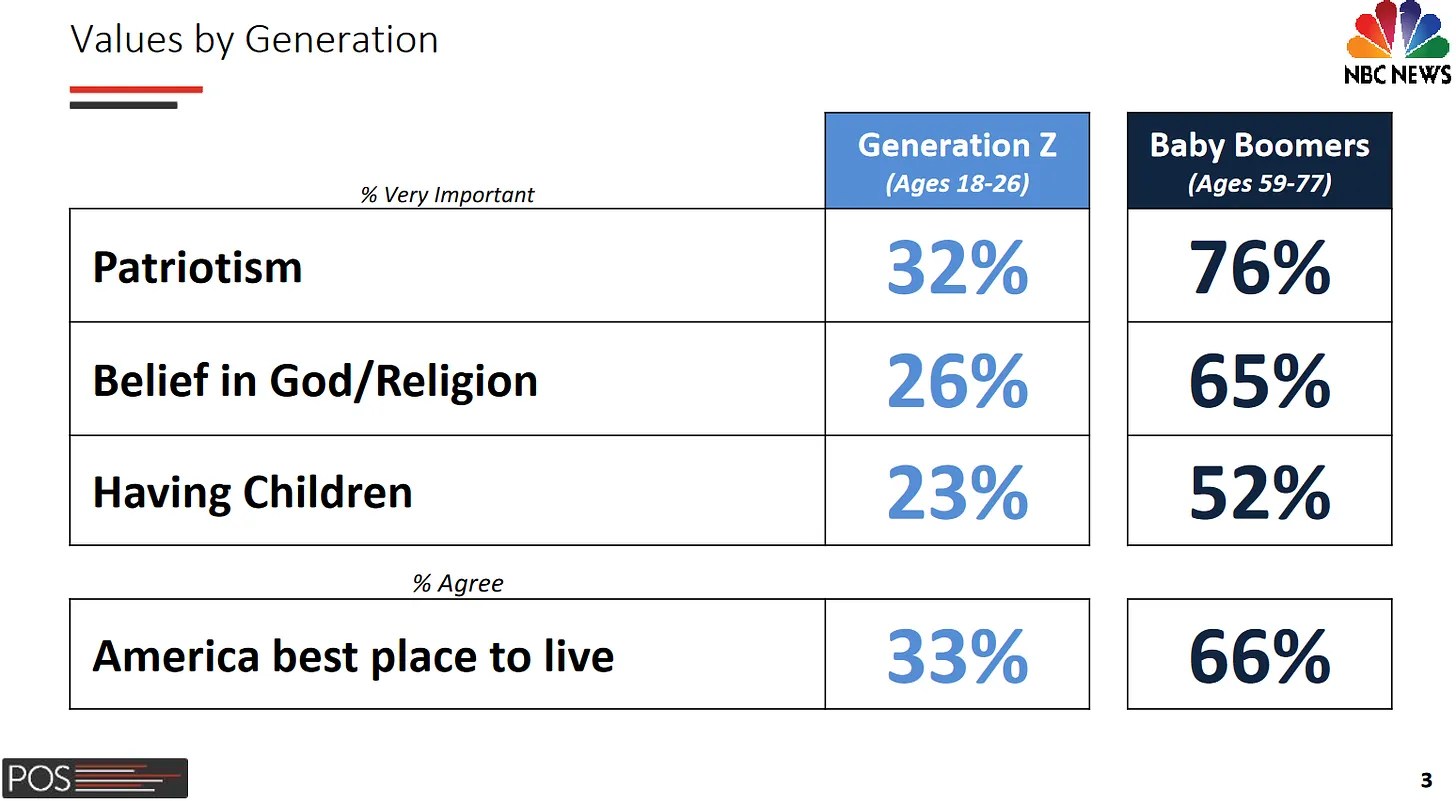
Every Sunday Bruce Mehlman, a Washington insider (a “government relations consultant”) publishes “Six Chart Sunday” in his newsletter, Age of Disruption. They’re always fascinating and informative; this week’s was especially striking.
The chart above and five others, each with brief explanatory summaries, tell the tale of wide “Generation Gaps.”
As Victor Klemperer observed, “A generation has more in common, after all, than a nation, than a profession.”
* Bertrand Russell, Mortals and Others: American Essays 1931-35
###
As we mind the gap, we might recall that it was on this date in 1971 that the Rolling Stones’ Sticky Fingers hit #1 on the U.S. album chart (their second chart-topping album). A critical and popular success, it is also remembered for its cover (conceived by Andy Warhol and photographed and designed by members of his art collective, the Factory, featuring a zippable image of a man’s jeans) and for its introduction of the now ubiquitous tongue and lips logo.

“And these children that you spit on / “As they try to change their worlds / Are immune to your consultations. / They’re quite aware of what they’re going through.”*…

From our friends at The Pudding— specifically, from Alvin Chang— a thorough (and illuminating and bracing) look at how the conditions in which our young are raised have everything to do with how their lives unfold…
In this story, we’ll follow hundreds of teenagers for the next 24 years, when they’ll be in their late-30s. They’re among the thousands of kids who are part of the National Longitudinal Survey of Youth. This means researchers have followed them since their teenage years to the present day – and beyond.
As Matt Muir observes in his invaluable Web Curios…
… Very North America-centric in terms of the data it’s drawing on, but wherever you are in the world the themes that it speaks to will apply – drawing on data about the life experiences of young people tracked by US statisticians….
As you scroll you see visual representations of the proportion of kids in each agegroup coterie who will experience ‘significant’ life events, from crime to poverty and beyond, and how those life events will go on to impact their academic prospects and, eventually, their life prospects – none of this should be surprising, but it’s a hugely-effective way of communicating the long-term impacts of relatively small differences in early-stage life across a demographic swathe…
Data visualization at its best and most compelling: “This Is a Teenager,” from @alv9n in @puddingviz via @Matt_Muir.
* David Bowie, “Changes”
###
As we analyze adolescence, we might recall that it was on this date in 1961 that the Cleftones, a group of teens who had formed a vocal group a 3 years earlier in high school, released “Heart and Soul” (a rearrangement of the 1938 standard); it reached #18 on the pop chart and #10 on the R&B chart and was later used in the 1973 movie American Graffiti.
Then fifteen-year-old Duane Hitchings, who went on to win a Grammy award for his work on the Flashdance soundtrack in 1984, played keyboards on the track– his first professional gig. In an interview with Rock United, he recalls that the recording session was cut short when singer Pat Spann, who was dating drummer Panama Francis, was caught in a compromising position with the guitarist. “That ended the session. So the last track we recorded was the record.”
“I’m sick to death of people saying we’ve made 11 albums that sound exactly the same. In fact, we’ve made 12 albums that sound exactly the same.”

Ever wonder what your taste in Classic Rock means? John K. Peck is here to help; a sample:
The Doors: You have been bitten by an animal while trying to get it stoned.
Ted Nugent: Your hair has at some point been caught in a ceiling fan, boat propeller, or lathe.
Led Zeppelin: The first three things you smoked were banana peels, catnip, and poppies, in that order.
The Grateful Dead: Your stories about the ‘70s make your daughter’s roommates at Tufts very uncomfortable.
AC/DC: You only remove your socks to shower, and then only reluctantly.
Kiss: You have partied on a boat in a driveway.
The Byrds: There is a thin layer of sand on the bottom shelf of your fridge.
The Band: You have misspelled your name while carving it into a picnic table.
Slade: You have smoked speed through a TV antenna.
Joe Jackson: You are an excellent speller.
Van Morrison: You have had to use bolt cutters to remove a mood ring.
Don McLean: You have used a lint roller on a dropped piece of toast.
James Gang: You have eaten two consecutive meals in a hot tub.
Vanilla Fudge: You have slept in a bathtub for two or more consecutive nights.
Much, much more: “What Your Favorite Classic Rock Band Says About You,” (Part 1, Part 2, Part 3), from @johnkpeck in @mcsweeneys.
* Angus Young (AC/DC)
###
As we stroll down memory lane, we might recall that on this date in 1989 the number on song in the U.S. was soap opera star and vocalist Michael Damian‘s cover of David Essex‘s “Rock On.”

You must be logged in to post a comment.