Posts Tagged ‘Pythagoras’
“February is the uncertain month, neither black nor white, but all shades between by turns. Nothing is sure.”*…

Yeah, but why is it shorter than all of the other months? Timothy Taylor has the story…
I understand why the calendar adds an extra day to February every four years. The revolution of the earth around the sun is approximately 365 and one-quarter days. Every four years, that adds up to one additional day, plus some extra minutes. The modest rounding error in this calculation is offset by steps like dropping the extra day of leap year for years ending in “00.”
But my question is why February has only 28 days in other years. After all, January has 31 days and March has 31 days. If those two months each donated a day to February, then all three months could be 30 days long, three years out of four, and February could be 31 days in leap years. Every other month is either 30 or 31 days. Why does February only get 28 days?…
… The answer to such questions leads to a digression back into the history of calendars. In this case, Jonathan Hogeback writing at the Britannica website tells me, it seems to settle on the Roman king Numa Pompilius back around 700 BCE, before the start of the Roman Empire. The ancient Roman calendar of that time had a flaw: it didn’t have nearly enough days. As Hogeback writes:
The Gregorian calendar’s oldest ancestor, the first Roman calendar, had a glaring difference in structure from its later variants: it consisted of 10 months rather than 12. In order to fully sync the calendar with the lunar year, the Roman king Numa Pompilius added January and February to the original 10 months. The previous calendar had had 6 months of 30 days and 4 months of 31, for a total of 304 days. However, Numa wanted to avoid having even numbers in his calendar, as Roman superstition at the time held that even numbers were unlucky. He subtracted a day from each of the 30-day months to make them 29. The lunar year consists of 355 days (354.367 to be exact, but calling it 354 would have made the whole year unlucky!), which meant that he now had 56 days left to work with. In the end, at least 1 month out of the 12 needed to contain an even number of days. This is because of simple mathematical fact: the sum of any even amount (12 months) of odd numbers will always equal an even number—and he wanted the total to be odd. So Numa chose February, a month that would be host to Roman rituals honoring the dead, as the unlucky month to consist of 28 days.
This discussion does explain why February would be singled out, since it was the month of rituals honoring the dead. In Numa’s calendar, the 355-day year would be made up of 11 months that had the lucky odd numbers of 29 or 31 days, plus unlucky February.
The discussion also explains why months that start with the prefix “Oct-” or eight, “Nov” or nine, and “Dec-” or ten, are actually months 10, 11, and 12 in the calendar. Those names were originally part of a 10-month calendar year.
But questions remains unanswered: Why did the Romans of that time view odd numbers as lucky, compared with unlucky even numbers? I suppose that explaining any superstition is hard, but I’ve never seen a great explanation. A Dartmouth course on “Geometry in Art and Architecture” describes Pythagorean feelings about odd and even numbers. For those of you keeping score at home, Pythagoras lived about two centuries after Numa Pompilius. The Dartmouth course material summarizes aspects of “Pythagorean Number Symbolism”:
Odd numbers were considered masculine; even numbers feminine because they are weaker than the odd. When divided they have, unlike the odd, nothing in the center. Further, the odds are the master, because odd + even always give odd. And two evens can never produce an odd, while two odds produce an even. Since the birth of a son was considered more fortunate than birth of a daughter, odd numbers became associated with good luck…
[Taylor recounts the recurrence of this theme, from Virgil to Shakespeare…]
… While I acknowledge this history of a belief in odd numbers, as a person born on an even day of an even month in an even year, I’m not predisposed to accept it. But it’s interesting that modern photographers have a guideline for composing photographs called the “rule of odds.” Rick Ohnsman at the Digital Photography School, for example, describes it this way:
This is where the rule of odds comes into play, a deceptively simple yet powerful tool in your photographic arsenal. It’s all about arranging your subjects in odd numbers to craft compositions that are naturally more pleasing to the eye. Unlike more static guidelines, the rule of odds offers a blend of structure and organic flow, making your images both aesthetically pleasing and impressively compelling.
The revised calendar of Numa Pompilius couldn’t last. With only 355 days, it didn’t reflect the actual period of the earth revolving around the sun, and thus led to further revisions which are a story in themselves.
But when you think about it, the question of February having 28 days all goes back to Numa Pompilius and the superstitions about odd numbers. The modern calendar has 365 days in a typical year. You might think that the obvious way to divide this up would be to start off with 12 months of 30 days, and then add five days. Indeed, the ancient Egyptians had a calendar of this type, with five “epagomenal” or “outside the calendar days added each year.
The preference over the last two millennia, at least since the time of Julius Caesar, is to have 12 months, with a few of them being a day longer. But even so, why not in a typical year have five months of 31 days, and the rest with 30? The “problem,” I think, is that most months would then have unlucky totals of an even number of days. By holding February to 28 days rather than 30, you can redistribute two days from February and have 31 days in January and March. Thus, you can have only four months with an even total of 30 days every year (“Thirty days hath September, April, June, and November …”), and seven months always with the luckier odd total of 31 days. In leap years, when February has 29 days, then eight months have an odd number of days. I think this makes February 29 a lucky day?…
“Why Does February (Usually) Have 28 Days?” from @TimothyTTaylor.
###
As we muse on the marking of months, we might recall that it was on this date in 1692 that a doctor in Salem, Massachusetts (generally believed to have been William Griggs), was unable to find a physical explanation for the ailments (fits, pins-and-needles) of three young girls. As other young women in Salem began to evince the same symptoms, the local preacher declared them “bewitched”… and the stage was set for The Salem Witch Trials.

“The only truth is music”*…
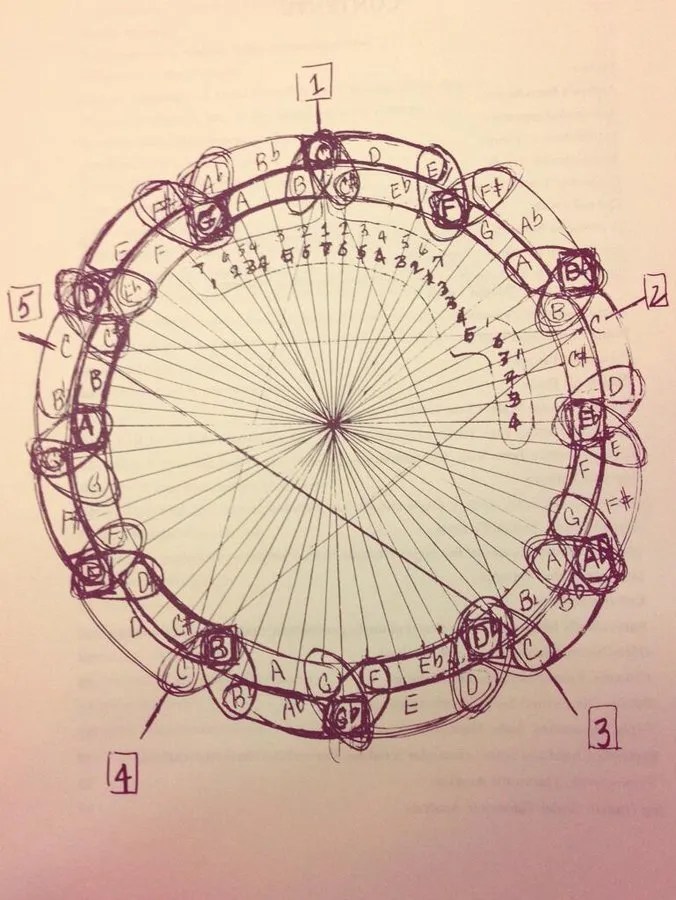
The pseudonymous Kerwin Fjøl on music theory and its origins…
A while back, I posted the above picture onto Elon Musk’s X, and it got fairly popular, which was nice. It’s a sketch that John Coltrane made, and I had no idea what it was meant to demonstrate. Apparently, he gave it to fellow jazz musician Yusef Lateef in 1967, the same year he died (although I heard elsewhere he actually drew it in 1961), and he would pretty regularly produce these sorts of sketches to help himself reason through his music. A small handful of people started wondering about its mystical or occult implications, while others connected it to the “my coworker be losing his mind” meme. But what surprised me about it was the amount of people who got annoyed and immediately started yammering about how it isn’t really mystical; it’s just a boring circle of fifths, as though the fact that anyone might find this picture interesting for spiritual reasons was offensive on its face. One guy in particular, an account with 10k followers and a furry avatar, used it as the basis of a thread in which he saw a dichotomy between the real music theorists, the serious guys who are simply working out their ideas visually, and the woo-woo mystics who have no idea what they’re talking about but desperately want to see magic things everywhere. I’d link the post, but X doesn’t allow me to go through view most of the quote-tweets for some reason. In any case, you can imagine the kind of person who made it: the classic fedora-wearing, Reddit-using atheist that has become a cliché by this point.
There are a few problems with this interpretation, though, that are worth discussing. First, the picture isn’t just a typical circle of fifths. A circle of fifths is usually drawn by laying out the notes of a major scale in one circle and its relative minor notes in another, whereas this picture demonstrates a chromatic scale distributed along two concentric circles, with each circle arranged by whole tones. The likely reason Coltrane drew the picture, as I think this YouTube video lecture convincingly argues, was to think through what you can do with tritones during improvisation. And although it’s unclear what the pentangle might be doing besides linking the C octaves, it’s not at all unreasonable to guess that Coltrane was interested in its esoteric significance and wanted to incorporate it into his music somehow. After all, people have discussed this exact sort of influence when interpreting how he devised his Coltrane changes, which use major third interval chord substitutions that form an equilateral triangle on the circle of fifths. And he was clearly into pan-religious mysticism, which should be obvious by the content of his late albums.
But the more important problem with this distinction between the “Real Music Theorists” and the “woo-woo mystics” is that music has always been grounded in woo-woo mysticism. Bizarre philosophical ideas and supernatural notions have always accompanied the formal development of music theory, and composers themselves have often embedded religious and theological ideas into their compositional approach. I’d like to spend a bit of time here discussing exactly that topic…
There follows a fascinating history and analysis of the Pythagorean origins of Western music theory: “Yes, Music Is Mystical (and woo-woo),” from @zermatist.
See also Ted Gioia‘s broader survey of much the same turf: “Music to Raise the Dead: The Secret Origins of Musicology” @tedgioia
* Jack Kerouac
###
As we contemplate the key to keys, we might recall that it was on this date in 1969 that David Bowie’s “Space Oddity” was released as a single in the U.K. The tale of a fictional astronaut, it was hurried out to precede the Apollo moon landing– and became Bowie’s first commercial hit, reaching the UK top five.

“The scientist does not study nature because it is useful; he studies it because he delights in it, and he delights in it because it is beautiful.”*…

As Tom Siegfried explains, the “music of the spheres” was born from the effort to use numbers to explain the universe…
If you’ve ever heard the phrase “the music of the spheres,” your first thought probably wasn’t about mathematics.
But in its historical origin, the music of the spheres actually was all about math. In fact, that phrase represents a watershed in the history of math’s relationship with science.
In its earliest forms, as practiced in ancient Egypt and Mesopotamia, math was mainly a practical tool for facilitating human interactions. Math was important for calculating the area of a farmer’s field, for keeping track of workers’ wages, for specifying the right amount of ingredients when making bread or beer. Nobody used math to investigate the nature of physical reality.
Not until ancient Greek philosophers began to seek scientific explanations for natural phenomena (without recourse to myths) did anybody bother to wonder how math would help. And the first of those Greeks to seriously put math to use for that purpose was the mysterious religious cult leader Pythagoras of Samos.
It was Pythagoras who turned math from a mere tool for practical purposes into the key to unlocking the mysteries of the universe. As the historian Geoffrey Lloyd noted, “The Pythagoreans were … the first theorists to have attempted deliberately to give the knowledge of nature a quantitative, mathematical foundation.”…
More at: “How Pythagoras turned math into a tool for understanding reality,” from @tom_siegfried in @ScienceNews.
Apposite: Walter Murch’s ideas on “planetary harmony” (and Lawrence Weschler’s book on him and them)
* Henri Poincare
###
As we seek beauty, we might recall that it was on this date in 1595 that Johann Kepler (and here) published Mysterium cosmographicum (Mystery of the Cosmos), in which he described an invisible underlying structure determining the six known planets in their orbits. Kepler thought as a mathematician, devising a structure based on only five convex regular solids; the path of each planet lay on a sphere separated from its neighbors by touching an inscribed polyhedron.
It was a beautiful, an elegant model– and one that fit the orbital data available at the time. It was of course, nonetheless, wrong.

“The golden ratio is the key”*…

… in any case, to good design. So, how did it come into currency? Western tradition tends to credit the Greeks and Euclid (via Fibonacci), while acknowledging that they may have been inspired by the Egyptians. But recent research has surfaced a a more tantalizing prospect:
Design remains a largely white profession, with Black people still vastly underrepresented – making up just 3% of the design industry, according to a 2019 survey…
Part of the lack of representation might have had to do with the fact that prevailing tenets of design seemed to hew closely to Western traditions, with purported origins in Ancient Greece and the schools out of Germany, Russia and the Netherlands deemed paragons of the field. A “Black aesthetic” has seemed to be altogether absent.
But what if a uniquely African aesthetic has been deeply embedded in Western design all along?
Through my research collaboration with design scholar Ron Eglash, author of “African Fractals,” I discovered that the design style that undergirds much of the graphic design profession today – the Swiss design tradition that uses the golden ratio – may have roots in African culture.
The golden ratio refers to the mathematical expression of “1: phi,” where phi is an irrational number, roughly 1.618.
Visually, this ratio can be represented as the “golden rectangle,” with the ratio of side “a” to side “b” the same as the ratio of the sides “a”-plus-“b” to “a.”

Create a square on one side of the golden rectangle, and the remaining space will form another golden rectangle. Repeat that process in each new golden rectangle, subdividing in the same direction, and you’ll get a golden spiral [the image at the top of this post], arguably the more popular and recognizable representation of the golden ratio.
This ratio is called “golden” or “divine” because it’s visually pleasing, and some scholars argue that the human eye can more readily interpret images that incorporate it.
For these reasons, you’ll see the golden ratio, rectangle and spiral incorporated into the design of public spaces and emulated in the artwork in museum halls and hanging on gallery walls. It’s also reflected in nature, architecture, and design – and it forms a key component of modern Swiss design.
The Swiss design style emerged in the 20th century from an amalgamation of Russian, Dutch and German aesthetics. It’s been called one of the most important movements in the history of graphic design and provided the foundation for the rise of modernist graphic design in North America.
The Helvetica font, which originated in Switzerland, and Swiss graphic compositions – from ads to book covers, web pages and posters – are often organized according to the golden rectangle. Swiss architect Le Corbusier famously centered his design philosophy on the golden ratio, which he described as “[resounding] in man by an organic inevitability.”

Graphic design scholars – represented particularly by Greek architecture scholar Marcus Vitruvius Pollo – have tended to credit early Greek culture for incorporating the golden rectangle into design. They’ll point to the Parthenon as a notable example of a building that implemented the ratio in its construction.
But empirical measurements don’t support the Parthenon’s purported golden proportions, since its actual ratio is 4:9 – two whole numbers. As I’ve pointed out, the Greeks, notably the mathematician Euclid, were aware of the golden ratio, but it was mentioned only in the context of the relationship between two lines or figures. No Greek sources use the phrase “golden rectangle” or suggest its use in design.
In fact, ancient Greek writings on architecture almost always stress the importance of whole number ratios, not the golden ratio. To the Greeks, whole number ratios represented Platonic concepts of perfection, so it’s far more likely that the Parthenon would have been built in accordance with these ideals.
If not from the ancient Greeks, where, then, did the golden rectangle originate?
In Africa, design practices tend to focus on bottom-up growth and organic, fractal forms. They are created in a sort of feedback loop, what computer scientists call “recursion.” You start with a basic shape and then divide it into smaller versions of itself, so that the subdivisions are embedded in the original shape. What emerges is called a “self-similar” pattern, because the whole can be found in the parts…
Robert Bringhurst, author of the canonical work “The Elements of Typographic Style,” subtly hints at the golden ratio’s African origins:
“If we look for a numerical approximation to this ratio, 1: phi, we will find it in something called the Fibonacci series, named for the thirteenth-century mathematician Leonardo Fibonacci. Though he died two centuries before Gutenberg, Fibonacci is important in the history of European typography as well as mathematics. He was born in Pisa but studied in North Africa.”
These scaling patterns can be seen in ancient Egyptian design, and archaeological evidence shows that African cultural influences traveled down the Nile river. For instance, Egyptologist Alexander Badaway found the Fibonacci Series’ use in the layout of the Temple of Karnak. It is arranged in the same way African villages grow: starting with a sacred altar or “seed shape” before accumulating larger spaces that spiral outward.
Given that Fibonacci specifically traveled to North Africa to learn about mathematics, it is not unreasonable to speculate that Fibonacci brought the sequence from North Africa. Its first appearance in Europe is not in ancient Greece, but in “Liber Abaci,” Fibonacci’s book of math published in Italy in 1202.
Why does all of this matter?
Well, in many ways, it doesn’t. We care about “who was first” only because we live in a system obsessed with proclaiming some people winners – the intellectual property owners that history should remember. That same system declares some people losers, removed from history and, subsequently, their lands, undeserving of any due reparations.
Yet as many strive to live in a just, equitable and peaceful world, it is important to restore a more multicultural sense of intellectual history, particularly within graphic design’s canon. And once Black graphic design students see the influences of their predecessors, perhaps they will be inspired and motivated anew to recover that history – and continue to build upon its legacy.
The longer-than-we’ve-acknowledged history of the Golden Ratio in design; Audrey Bennett (@audreygbennett) unpacks “The African roots of Swiss design.”
For more on Fibonacci‘s acquisitive habits, see this earlier post.
* Sir Edward Victor Appleton, Nobel Laureate in physics (1947)
###
As we ruminate on relationships, we might send careful-calculated birthday greetings to Mary Jackson; she was born on this date in 1921. A mathematician and aerospace engineer, she worked at Langley Research Center in Hampton, Virginia (part of the National Advisory Committee for Aeronautics [NACA], which in 1958 was succeeded by the National Aeronautics and Space Administration [NASA]) for most of her career. She began as a “computer” at the segregated West Area Computing division in 1951; in 1958, she became NASA’s first black female engineer.
Jackson’s story features in the 2016 non-fiction book Hidden Figures: The American Dream and the Untold Story of the Black Women Who Helped Win the Space Race. She is one of the three protagonists in Hidden Figures, the film adaptation released the same year. In 2019, she was posthumously awarded the Congressional Gold Medal; in 2020 the Washington, D.C. headquarters of NASA was renamed the Mary W. Jackson NASA Headquarters.

“In so far as the mind sees things in their eternal aspect, it participates in eternity”*…

David Ramsay Hay’s mapping of color onto musical notes, a diagram from his The Laws of Harmonious Colouring (1838)
“All art constantly aspires towards the condition of music.” So wrote the Victorian art critic Walter Pater in 1888. Earlier in the century, Scottish artist David Ramsay Hay composed a series of fifteen books published between 1828 and 1856 that attempted to develop a theory of visual beauty from the basic elements of music theory. Anticipating Pater but also fin-de-siècle attempts to unite the arts via spiritual or synesthetic affinities, Hay’s writings mapped colors, shapes, and angles onto familiar musical constructs such as pitches, scales, and chords. While these ideas might appear highly eccentric today, an understanding of them offers a glimpse of the remarkable importance of music to the Victorian Zeitgeist…
Hay’s approach to visual aesthetics was equally applicable to architecture, color theory, the ornamental arts, and the human face and figure. It can be understood as a psychological account of beauty, as opposed to other contemporary theories that anchored beauty in notions of the picturesque, the mimetic, or the sublime. Though analogies between music and the fine arts certainly do not originate with Hay, his application of music theory to an extensive array of visual experiences including color, shapes, figures, and architecture broke new ground. Rather than locating musical properties in the objects themselves, as earlier thinkers ranging from Plato to Newton had done, Hay worked in the post-Kantian tradition, regarding these features as immanent to our own minds, where they create our experience of beauty by determining the very structure of our perceptions…
Throughout his writings, Hay consistently links the claim that a single fundamental law of nature determines aesthetic perception to the work of the philosopher and mathematician Pythagoras…
Understanding the same laws to apply to both visual and aural beauty, David Ramsay Hay thought it possible not only to analyze such visual wonders as the Parthenon in terms of music theory, but also to identify their corresponding musical harmonies and melodies: “Music of the Squares: David Ramsay Hay and the Reinvention of Pythagorean Aesthetics.”
*
###
As we excavate the essential, we might send elegantly-composed birthday greetings to Mary Cassatt; she was born on this date in 1844. An American printmaker and painter, she moved to Paris as an adult, where she developed a friendship with Edgar Degas and became, as Gustave Geffroy wrote in 1894, one of “les trois grandes dames” of Impressionism (with Marie Bracquemond and Berthe Morisot).

Self-portrait, c. 1878
You must be logged in to post a comment.