Posts Tagged ‘publishing’
“But if thought corrupts language, language can also corrupt thought”*…

Bulwer-Lytton had nothing on Indian jurists…
The English language arrived in India with the British colonists of the 17th century, giving rise to unique genres and variants, including some that characterize formal communications on the subcontinent to this day. Among these, the derogatory term “Babu English” was originally used by the British to describe the overwrought officialese of “babus” or Indian bureaucrats—a style described at the British Library as “aspiring to poetic heights in vocabulary and learning, despite being full of errors.”
“Babu English is the much caricatured flowery language of… moderately educated clerks and others who are less proficient in formal English than they realise,” wrote Rajend Mesthrie in English in Language Shift (1993). His examples include the clerk who asked his employers for leave because ‘the hand that rocked the cradle has kicked the bucket’; the job applicant “bubbling with zeal and enthusiasm to serve as a research assistant”; and a baroque acknowledgement from a PhD thesis: “I consider it to be my primordial obligation to humbly offer my deepest sense of gratitude to my most revered Garuji and untiring and illustrious guide professor . . . for the magnitude of his benevolence and eternal guidance.”
The modern form of Babu English turns up most frequently in the language of India’s legal system.
Take for example the 2008 case of 14-year-old Aarushi Talwar, who was killed, together with a housekeeper, Hemraj, in the Talwar family home in Delhi; the murder rocked the nation. In 2013, a trial court ruled that the victims had been murdered by the girl’s parents:“
The cynosure of judicial determination is the fluctuating fortunes of the dentist couple who have been arraigned for committing and secreting as also deracinating the evidence of commission of the murder of their own adolescent daughter—a beaut damsel and sole heiress Ms Aarushi and hapless domestic aide Hemraj who had migrated to India from neighbouring Nepal to eke out living and attended routinely to the chores of domestic drudgery at the house of their masters.”
Had the judge accidentally inhaled a thesaurus? With its tormented syntax and glut of polysyllabic words, the judgment is a clear descendant and example of today’s Babu prose. In May 2016, a landmark judgment on criminal defamation written by a future Chief Justice pushed into new stylistic directions with phrases such as “proponements in oppugnation” and “made paraplegic on the mercurial stance.”
“It seems that some judges have unrealised literary dreams,” one former judge told me. “Maybe it’s a colonial hangover, or the feeling that obfuscation is a sign of merit… It can then become a 300-page judgment, just pontificating.”
Judges also retain a tendency to also quote scripture, allude to legends and myths, and throw in a dash of Plato, Shakespeare or Dickens. Some trace the legacy of flowery judgments to Justice Krishna Iyer, a pioneering and influential Supreme Court judge who served a seven-year term in the seventies. (“You had to perhaps sit with a dictionary to understand some [of his] judgments,” one lawyer remarked.)
But the former judge pointed out that this isn’t just a problem bedevilling judgments written in English. Even lower court judgments written in Hindi, he said, often deploy “words that were in vogue in Mughal times… It’s a problem of formalism.”
…
“Wherefore, qua, bonum: decrypting Indian legalese“: a colonial hangover, or unrealized literary dreams? Mumbai-based @BhavyaDore explores.
* George Orwell, Politics and the English Language
###
As we choose our words carefully, we might send passionate birthday greetings to Mary Barbara Hamilton Cartland; she was born on this date in 1901. A paragon of prolixity, Barbara Cartland wrote biographies, plays, music, verse, drama, and operetta, as well as several health and cook books, and many magazine articles; but she is best remembered as a romance novelist, one of the most commercially successful authors worldwide of the 20th century.
Her 723 novels were translated into 38 languages. and she continues to be referenced in the Guinness World Records for the most novels published in a single year (1977). Estimates of her sales range from 750 million copies to over 2 billion.

“Perhaps the window is not a sun but an asterisk, interrupting the grammar of the sky”*…

Ceiling paper, by Steubenville Wallpaper Company, c. 1905. Cooper Hewitt
With luck, this is the final logistical note to those readers who subscribe by email: Google is discontinuing the Feedburner email service that (Roughly) Daily has used since its inception; so email will now be going via Mailchimp. That should be relatively seamless– no re-subscription required– but there may be a day or two of duplicate emails, as I’m not sure how quickly changes take effect at Feedburner. If so, my apologies. For those who don’t get (Roughly) Daily in their inboxes but would like to, the sign-up box is to the right… it’s quick, painless, and can, if you change your mind, be terminated with a click. And now, to today’s business…
Sumerian pictographic writing includes a sign for “star” that looks like a modern asterisk. These early writings from five thousand years ago are the first known depiction of an asterisk; however, it seems unlikely that these pictograms are the forerunner of the symbol we use today. Palaeographers know that Aristarchus of Samothrace (220–143 bc) used an asterisk symbol when editing Homer in the second century bc, because later scholars wrote about him doing so. Physical examples of Aristarchus’ asterisks have not survived, so we cannot know their physical shape, but as the word asteriskderives from the Greek asteriskos, meaning “little star,” an assumption has been made that they resembled a small star. Aristarchus used the symbols to mark places in Homer’s text that he was copying where he thought passages were from another source. By the third century Origen of Alexandria had adopted the asterisk when compiling the Hexapla—a Greek translation of the Jewish scriptures, the Septuagint. Origen used the asterisk to demarcate texts that he had added to the Septuagint from the original Hebrew. Both these early uses of the asterisk are as an editing tool, to notify the reader that the passage they are reading should be read with caution.
In the medieval period the asterisk continued to be employed in the copying of Bibles to flag up text from other sources. It also was increasingly used as a signe de renvoi (sign of return)—a graphic symbol which indicates where a correction or insertion should be made, with a corresponding mark in the margin with the correct text inserted. The asterisk is also found in medieval texts as a sign of omission. The use of the asterisk by scribes copying the Bible continued with the advent of the printing press; early printed Bibles, such as Robert Estienne’s 1532 Latin Bible, make use of an asterisk. Scribes did not always use the modern asterisk shape, some instead adopting a hooked cross with dots between each arm. However, when the asterisk was cut into type it was rendered as the five- or six-pointed star, and this is the form that has largely endured.
The asterisk (often used interchangeably with the dagger or obelus) persisted as an editing mark but was also frequently used as a caveat, showing that the passage highlighted by the asterisk was served by a footnote or side note. By the eighteenth century the asterisk was being deployed as a sort of censorship, covering up letters to represent a d**n vulgar word without actually b****y spelling it out. But, as W. Somerset Maugham points out, this has become somewhat outmoded: “We have long passed the Victorian era when asterisks were followed after a certain interval by a baby.”
A similar method, however, is still employed in comics, where it is known as grawlix, although the swear words are usually represented by a series of graphical glyphs, for example %@~#$!, rather than just asterisks. One of the problems with using asterisks to deaden the effect of a swear word is that it just draws attention to it (sometimes simply because one spends ages trying to work out which word the author is censoring).
In modern printed books [and in the titles of posts on (Roughly) Daily] the asterisk is most likely to show up as a method to mark footnotes. In advertising and on packaging it is generally a caveat—an advert might state “Free Beer*” but when you follow the asterisk you discover in the terms and conditions that to claim the free beer you must sign over your firstborn. Online and on instant messaging, asterisks have become increasingly useful and now provide a series of services; for example, to show emphasis, in the way italics are used on the printed page. This use probably started on certain online forums where to make a word show up as bold it needed to be surrounded by asterisks, like *this*. This convention then crept online where, rather than using bold to show emphasis, the asterisks serve the purpose instead.
It is also frequently used for corrections when you male* a spelling mistake.
* make
The history of the asterisk: “A Star is Born,” excerpted from Hyphens & Hashtags*: *The Stories Behind the Symbols on Our Keyboard by Claire Cock-Starkey, published by Bodleian Library Publishing. Copyright © 2021 by Claire Cock-Starkey. Distributed in North America by the University of Chicago Press. Via Lapham’s Quaterly.
* China Mieville
###
As we annotate accurately, we might recall that it was on this date in 1631 that Mumtaz Mahal died during childbirth. Her husband, Mughal emperor Shah Jahan I, spent the next 17 years building her mausoleum, the Taj Mahal.

“I suppose illustration tends to live in the streets, rather than in the hermetically sealed atmosphere of the museum, and consequently it has come to be taken less seriously”*…

But surely, it shouldn’t necessarily be so. Consider Tom Gauld (@tomgauld). He’s probably best known for his work for The New Yorker (e.g.) and The New York Times (e.g.); but he’s also an accomplished cartoonist. Your correspondent’s favorites are his on-going contributions to The Guardian Review (above and below)

… and The New Scientist…

See more of his marvelous work at his site.
* master illustrator Quentin Blake.
###
As we visualize it, we might send carefully limned birthday greetings to Richard McClure Scarry; he was born on this date in 1919. A children’s author and illustrator, he published over 300 books with total sales of over 100 million worldwide.


“It isn’t easy, coming up with book titles. A lot of the really good ones are taken. Thin Thighs in 30 Days, for example. Also The Bible.”*…
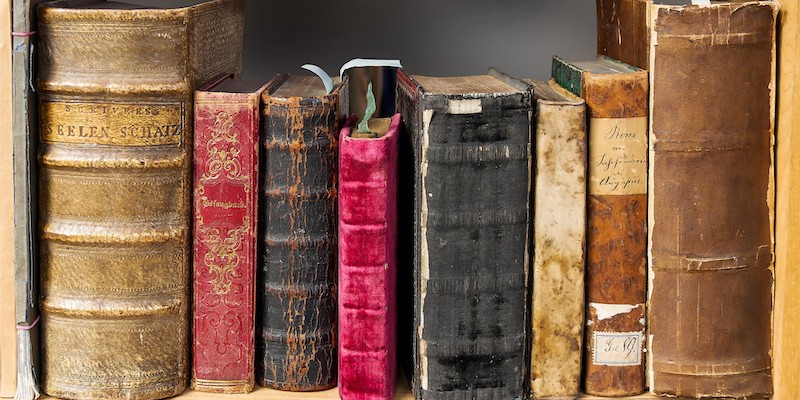
“What’s in a name?” mused Shakespeare in Romeo and Juliet (first published in print in 1597 as An Excellent Conceited Tragedie of Romeo and Juliet). Would he have said the same, one wonders, if he’d been around to hear that F. Scott Fitzgerald’s The Great Gatsby was at one point titled Trimalchio in West Egg; or that for Dracula, Bram Stoker considered The Dead Un-Dead? There is certainly an art to the great title, as demonstrated by the late English humourist Alan Coren, who when choosing a name for a collection of essays in 1975 noticed that the most popular books in Britain at that time were about cats, golf and Nazis. So he called his book Golfing for Cats and slapped a swastika on the front cover.
We also learn that care should be taken to avoid tempting an ironic fate. Bill Hillman, the American author of the 2014 guide Fiesta: How to Survive the Bulls of Pamplona, was gored by the bulls of Pamplona that same year—and again the next year. And in the 2017 British national election, the Conservative politician Gavin Barwell, author of How to Win a Marginal Seat, lost his marginal seat.
The humorous literary award known as the Bookseller/Diagram Prize for Oddest Title of the Year has been running since 1978, with past winners including Oral Sadism and the Vegetarian Personality (1986) by Glenn C. Ellenbogen, The Joy of Waterboiling (2018) by Achse Verlag and The Dirt Hole and its Variations by Charles L. Dobbins (2019). But we can go back centuries earlier to find their ancestors…
For example…
An Essay upon Wind, with Curious Anecdotes of Eminent Peteurs (1787) by Charles James Fox
Sun-beams May Be Extracted From Cucumbers, But the Process is Tedious (1799) by David Daggett
How to Cook Husbands (1898) by Elizabeth Strong Worthington
Fishes I Have Known (1905) by Arthur A. Henry Bevan
Does the Earth Rotate? No! (1919) by William Westfield
Thought Transference (Or What?) in Birds (1931) by Edmund Selous
The Boring Sponges Which Attack South Carolina Oysters (1956) by Bears Bluff Laboratories
A Weasel in My Meatsafe (1957) by Phil Drabble
Proceedings of the Second International Workshop on Nude Mice (1977) edited by Tatsuji Nomura et al.
…
Just a taste of the delights at: “77 Strange, Funny, and Magnificent Book Titles You’ve Probably Never Heard Of.” From @foxtosser.
* Dave Barry
###
As we nominate, we might send bright birthday greetings to Greg Sherwood Cohelan; he was born 70 years ago today. An accomplished marketing consultant, he is best known for his decades on the radio and television (as Greg Sherwood) in the San Francisco Bay area.
The son of Don Sherwood, “The World’s Greatest Disc Jockey” (who ruled the Bay Area airwaves in the 1950s and 60s), Greg began his on-air career while in high school as a correspondent for his father, doing a call-in show as he drove across country, “Young Man on the Road”; he followed that with a stint as a morning traffic reporter, flying around in a helicopter doing traffic reports for his dad.
After college he joined KQED, the local public television and radio organization, first as a volunteer, then as an employee. Over the years, he’s become the face of KQED-TV and the voice of KQED radio, hosting interviews, anchoring award-winning documentaries, and especially during pledge periods.
“Call right now, 1 (800) 937-8850.”

“It is not only fine feathers that make fine birds”*…

Sometimes profane, often profound, always wonderfully watercolory…

Visit the amazing aviary at False Knees (@FalseKnees)
* Aesop
###
As we have fun with fowl, we might send powerfully-drawn birthday greetings to Jack Kamen; he was born on this date in 1920. An artist and illustrator, he is remembered for his work in books, magazines, comic books, and advertising, especially for his work illustrating crime, horror, humor, suspense and science fiction stories for EC Comics (and for the onscreen artwork he contributed to the 1982 horror anthology film Creepshow, a tribute to EC created by Stephen King and George Romero’s homage to EC).

Kamen had four children, one of whom is the inventor Dean Kamen— whose patent application for the Segway was drawn by his father.

You must be logged in to post a comment.