Posts Tagged ‘publishing’
“Beware of him who would deny you access to information, for in his heart he dreams himself your master”*…

Stewart Brand once suggested that “Information wants to be free. Information also wants to be expensive. …That tension will not go away.” Indeed, it seems to be growing…
Aaron Swartz was 26 years old when he took his own life. He did so under the shadow of legal prosecution, pursued by government lawyers intent on maximal punishment. If found guilty, he potentially faced up to 50 years in prison and a $1 million dollar fine. Swartz’s crime was not only legal, but political. He had accessed a private computer network and gained possession of highly valuable information with the goal of sharing it. His actions threatened some of the most powerful, connected, and politically protected groups in the country. Their friends in the government were intent on sending a message.
It’s the kind of story you would expect about some far-off political dissident. But Swartz took his life in Brooklyn on a winter day in 2013 and his prosecutor was the U.S. federal government. When Swartz died, he was under indictment for 13 felony charges related to his use of an MIT computer to download too many scientific articles from the academic database JSTOR, ostensibly for the purpose of making them freely available to the public. Ultimately, Swartz potentially faced more jail time for downloading academic papers than he would have if he had helped Al Qaeda build a nuclear weapon. Even the Criminal Code of the USSR stipulated that those who stored and distributed anti-Soviet literature only faced five to seven years in prison. While prosecutors later pointed toward a potential deal for less time, Aaron would still have been labeled a felon for his actions—and to boot, JSTOR itself had reached a civil settlement and didn’t even pursue its own lawsuit.
But Aaron’s cause lived on. This September marks the ten-year anniversary of Sci-Hub, the online “shadow library” that provides access to millions of research papers otherwise hidden behind prohibitive paywalls. Founded by the Kazakhstani computer scientist Alexandra Elbakyan—popularly known as science’s “pirate queen”—Sci-Hub has grown to become a repository of over 85 million academic papers.
The site is popular globally, used by millions of people—many of whom would otherwise not be able to finish their degrees, advise their patients, or use text mining algorithms to make new scientific discoveries. Sci-Hub has become the unacknowledged foundation that helps the whole enterprise of academia to function.
Even when they do not need to use Sci-Hub, the superior user experience it offers means that many people prefer to use the illegal site rather than access papers through their own institutional libraries. It is difficult to say how many ideas, grants, publications, and companies have been made possible by Sci-Hub, but it seems undeniable that Elbakyan’s ten-year-old website has become a crucial component of contemporary scholarship.
The success of Sci-Hub has made it a target for injunctions and investigations. Academic publishers have sued Sci-Hub repeatedly, opponents have accused the site’s creators of collaborating with Russian intelligence, and private sector critics have dubbed it a threat to “national security.” Elbakyan recently tweeted out a notification she received that the FBI had requested her personal data from Apple.
Whatever happens to Sci-Hub or Elbakyan, the fact that such a site exists is something of a tragedy. Sci-Hub currently fills a niche that should never have existed. Like the black-market medicine purchased by people who cannot afford prescription drugs, its very being indicts the official system that created the conditions of its emergence…
The cost of individually purchasing all the articles required to complete a typical literature review could easily amount to thousands of dollars. Beyond paying for the articles themselves, academics often have to pay steep fees to publish their research. Meanwhile, most peer reviewers and editors charged with assessing, correcting, and formatting papers do not receive compensation for their work.
It’s particularly ironic that this situation exists alongside a purported digital “infodemic” of misinformation. The costs of this plague are massive, from opposition to the pandemic response to the conspiracy theories that drove a loving father to fire his gun inside a pizza parlor and a man to kill a mafia boss accused of having ties to the deep state. But few public figures, if any, draw the direct connection between the expensive barricades around scientific research and the conspicuous epistemic collapse of significant portions of the American political discourse…
Whether intended or not, the impossibly high paywalls of academic publishers only serve to keep scientific information out of the population’s hands. What makes this even more discordant is that the people being prevented from accessing the information are often also the taxpayers who helped fund the research in the first place.
By framing the debate about Sci-Hub as one concerning property rights, both advocates of Elbakyan’s site and its detractors fall afoul of what John Gall called the “operational fallacy.” In his book The Systems Bible, Gall defined the operational fallacy as a situation where “the system itself does not do what it says it is doing.” In other words, what a system calls itself is not always a reliable indicator of its true function. In this case, the name of the “academic publishing industry” implies that it is supposed to be involved in the dissemination of scholarship. But the effective function of the academic publishing industry as it actually exists is to prevent the dissemination of scholarly work.
Given the example of Sci-Hub, the easy logistics of internet publication, and the funding structure of academic research, it seems clear that in the absence of the academic publishing industry, scholarship would be more widely available, not less. If the academic publishing industry did not exist, scientists could still do their research—in fact, it would be easier to do so as more people would have access to scholarly literature. The peer-review process could still function normally—though there are good reasons to change that as well. And the resulting papers could simply be posted in a place where anyone could read them.
When we explore the actual function of the academic publishing industry—restricting access to scholarly research—we see that these publishers have little in common with the companies that have opposed other file-sharing sites. When several record companies sued Napster in 2001, they could make the legitimate case that the economic well-being of the musicians, producers, and all the people who were needed to distribute recorded music was at stake. No such parallel exists in the case of Sci-Hub. Scientists are not paid by the publishers. Peer reviewers are not paid by the publishers. Distribution itself, as proven by Sci-Hub and its more law-abiding brother arXiv, is cheap enough to be provided to the public for free. It’s not surprising, then, that polls reveal that scientists overwhelmingly support Sci-Hub…
Eminently worth reading in full– the civic tragedy of academic publishing: “A World Without Sci-Hub,” from Jason Rhys Perry (@JRhysParry) in @palladiummag.
###
As we share and share alike, we might recall that it was on this date in 1970 that the Public Broadcasting Service– PBS– premiered, when it took over (most of) the functions of its predecessor, National Educational Television.
Unlike the five major commercial broadcast television networks in the United States (ABC, CBS, NBC, Fox, and The CW) PBS is technically not a network, but rather a program distributor that provides television content and related services to its member stations. Each station sets its own schedule and programs local content (e.g., local/state news, interviews, cultural, and public affairs programs) that supplements content provided by PBS and other public television distributors.

“For some of us, books are as important as almost anything else on earth”*…
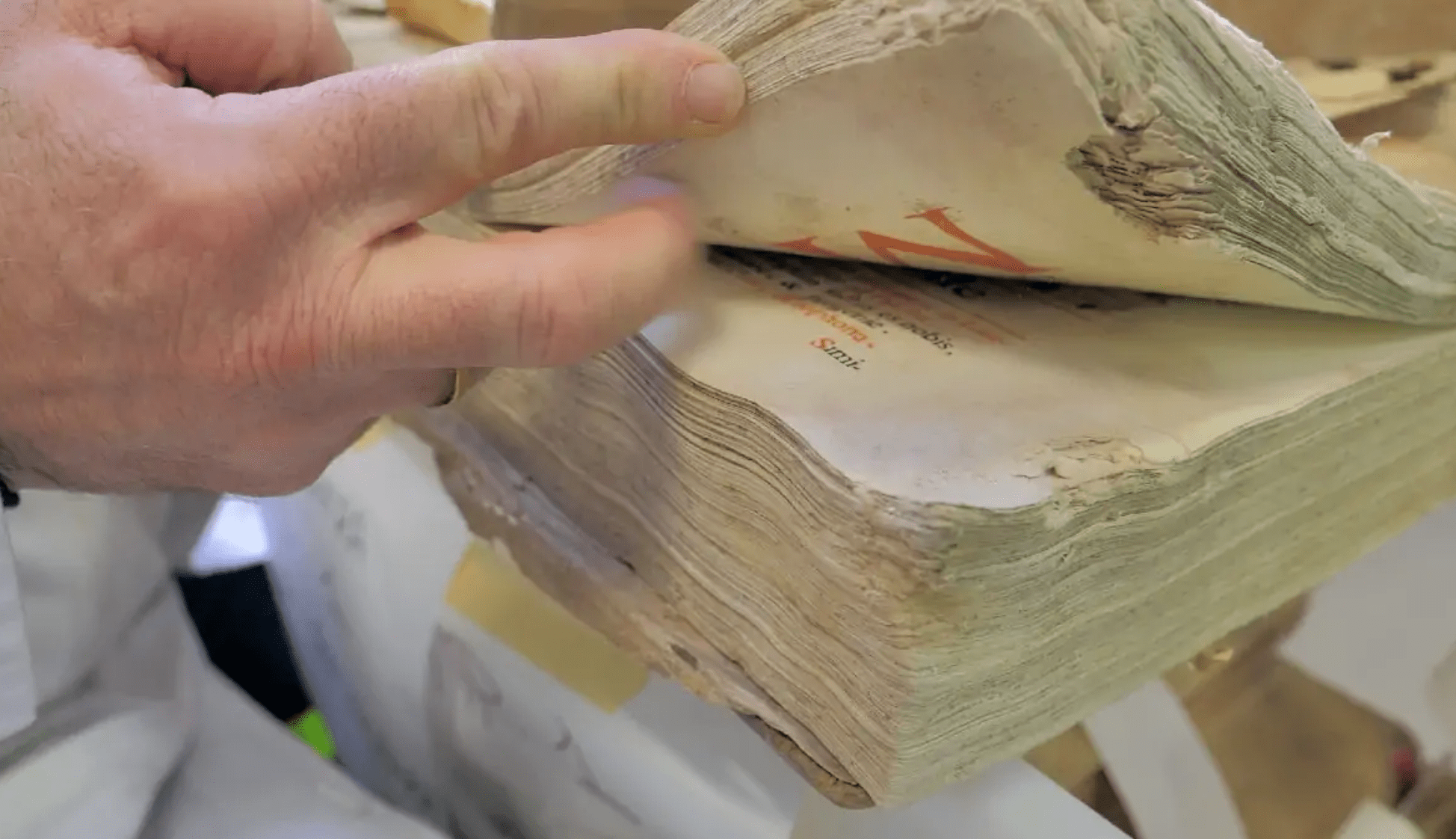
Preserving precious publications…
It all started in 1994. The flooding of the Po river and its tributaries had just swept away entire villages in the Piedmont region of northern Italy, leaving behind only death and debris. The whole of Italy was shocked. Of all the damage broadcast on television, one caused a particular sensation: In the village Santo Stefano Belbo, the historical archive of Cesare Pavese, one of the most famous and beloved Italian writers, was buried in mud.
The debacle particularly impressed a man named Pietro Livi, president of Frati & Livi in Bologna, a company that had been restoring and conserving ancient texts for nearly 20 years. At that time, however, no one in Italy was equipped for this kind of rescue. In the past, flooded and muddy documents were entrusted to companies that used basic restoration methods that proved both invasive and ineffective: The books were simply placed in ovens or air-dried in large rooms, which often left the texts unusable and made mold only proliferate.
So Livi decided to find out if anyone in Europe had found a more effective way to save these invaluable records of human achievement. Finally, in Austria, Livi found a freeze dryer that held some promise, but it was too big and costly for a small artisanal company like his. Then, in 2000, the Po river overflowed again. In the city of Turin, entire archives belonging to distinguished institutes and libraries ended up underwater.
At a loss for what to do, Italy’s Archival Superintendency of the Ministry of Cultural Heritage summoned Livi. By this time, Livi had established a solid reputation as a master restorer, having studied the art of book restoration with Benedictine friars. But he realized that for a project of this scope, his expertise was no longer enough; he needed a kind of Renaissance workshop, where he could collaborate with professionals from a variety of disciplines. Livi believed that the time had come where the world of artisan knowledge and the world of technology, too often considered as opposites, had to talk to each other—for the benefit of one another…
Then, on November 12, 2019, the city of Venice, one of the world’s most mythical and most admired locales, suffered its worst flood in 53 years. The swollen lagoon soaked roughly 25,000 valuable texts, including the last surviving original of one of Vivaldi’s musical scores. Frati & Livi was quickly called to the scene…
In the city of Bologna, home to the western world’s oldest university, Pietro Livi developed an unusual machine shop—part artisanal and part high-tech—built to restore damaged ancient texts to their former glory. And then came Venice’s historic floods of 2019: “Italy’s Book Doctor,” from @CraftsmanshipQ.
* “For some of us, books are as important as almost anything else on earth. What a miracle it is that out of these small, flat, rigid squares of paper unfolds world after world after world, worlds that sing to you, comfort and quiet or excite you. Books help us understand who we are and how we are to behave. They show us what community and friendship mean; they show us how to live and die.” – Anne Lamott
###
As we celebrate craft, we might we spare a thought for publishing pioneer Condé Montrose Nast; he died on this date in 1942. After serving as Advertising Director at Colliers, then a brief stint in book publishing, Nast bought a small New York society magazine called Vogue— which he proceeded to turn into the nation’s, then the world’s leading fashion magazine. While other periodical publishers simply sought higher and higher circulation, Nast introduced the “lifestyle” title, targeted to a group of readers by income level or common interest. By the time of his death, his stable of monthlies also included House & Garden, British, French, and Argentine editions of Vogue, Jardins des Modes, (the original) Vanity Fair, and Glamour; subsequently, the group added such resonant lifestyle books as Gourmet, New Yorker, and Wired.

“a publisher’s emblem or imprint, especially one on the title page or spine of a book”*…

Knowing a book (or its publisher anyway) by its cover (art)…
Colophons started out as short statements providing a book’s publication info—details like where and who and when. Those statements often included little emblems, logos, which are now also referred to as colophons (from the Greek kolophōn, meaning “summit, final touch”), and they slowly made their way to the spines of books. Like tattoos or mascots, many of these logos depict animals, often fish (or dolphins): FSG, Anchor Doubleday, Aldine Press, and Houghton Mifflin Harcourt. Birds are another well-represented category: Penguin, Bantam, Norton, and Europa Editions, to name a few. So if you’re going to be judging a book by its cover (you’re probably kidding yourself if you think you don’t) then you better start factoring in the colophon as well.
These symbols are often taken for granted because most readers are, understandably, less familiar with publishers than writers or booksellers are, but they have a totemic quality to them that’s worthy of consideration, functioning not just as trademarks but as little windows into the personalities of the publishing houses and the people who run them. The following list is a very unofficial ranking of some of the more interesting colophons, the ones that take risks or have more of an emphasis on design, something unique about them, that offer subtle clues as to what awaits us inside…
“An Unofficial Ranking of Publishing Colophons“: Dylan Brown (@dylanwalsdorf) on the fishes, kangaroos, and borzois that adorn our books.
[With thanks to MK]
* “Colophon” as defined by Oxford Languages
###
As we linger over logos, we might recall that in Britain on this date in 1752 absolutely nothing happened. There was no “September 3” (nor September 4-13) in Britain that year, as 1752 was the year that Britain converted from the Julian to the Gregorian calendar, which required an adjustment of 11 days. Thus, that year British calendars went from Wednesday, September 2 directly to Thursday, September 14.
Most historians believe that persistent stories of riots in England at the time, demanding “give us our eleven days,” are an urban legend, fueled in part by an over-enthusiastic take on Hogarth’s 1755 painting “An Election Entertainment”:

“How do I know what I think until I see what I say?”*…
Montaigne would be amused…
The first quarter of the twenty-first century has been an uneasy time of rupture and anxiety, filled with historic challenges and opportunities. In that close to twenty-five-year span, the United States witnessed the ominous opening shot of September 11, followed by the seemingly unending Afghanistan and Iraq wars, the effort to control HIV/AIDS, the 2008 recession, the election of the first African American president, the legalization of same-sex marriage, the contentious reign of Donald Trump, the stepped-up restriction of immigrants, the #MeToo movement, Black Lives Matter, and the coronavirus pandemic, just to name a few major events. Intriguingly, the essay has blossomed during this time, in what many would deem an exceptionally good period for literary nonfiction—if not a golden one, then at least a silver: I think we can agree that there has been a remarkable outpouring of new and older voices responding to this perplexing moment in a form uniquely amenable to the processing of uncertainty.
When the century began, essays were considered box office poison; editors would sometimes disguise collections of the stuff by packaging them as theme-driven memoirs. All that has changed: a generation of younger readers has embraced the essay form and made their favorite authors into best sellers. We could speculate on the reasons for this growing popularity—the hunger for humane, authentic voices trying to get at least a partial grip on the truth in the face of so much political mendacity and information overload; the convenient, bite-size nature of essays that require no excessive time commitment; the rise of identity politics and its promotion of eloquent spokespersons. Rather than trying to figure out why it’s happening, what’s important is to chart the high points of this resurgence, and to account for the range of styles, subgenres, experimental approaches, and moral positions that characterize the contemporary American essay…
Read “The Silver Age of Essays,” an excerpt from Phillip Lopate‘s introduction to a new collection, The Contemporary American Essay; via @parisreview.
* E. M. Forster
###
As we praise perceptive prose, we might recall that it was on this date in 1854 that Ticknor & Fields published transcendentalist Henry David Thoreau’s reflection on simple living in natural surroundings, Walden; or, Life in the Woods... essentially a long essay.

“A town isn’t a town without a bookstore. It may call itself a town, but unless it’s got a bookstore, it knows it’s not foolin’ a soul.”*…
Behold, a behemoth…
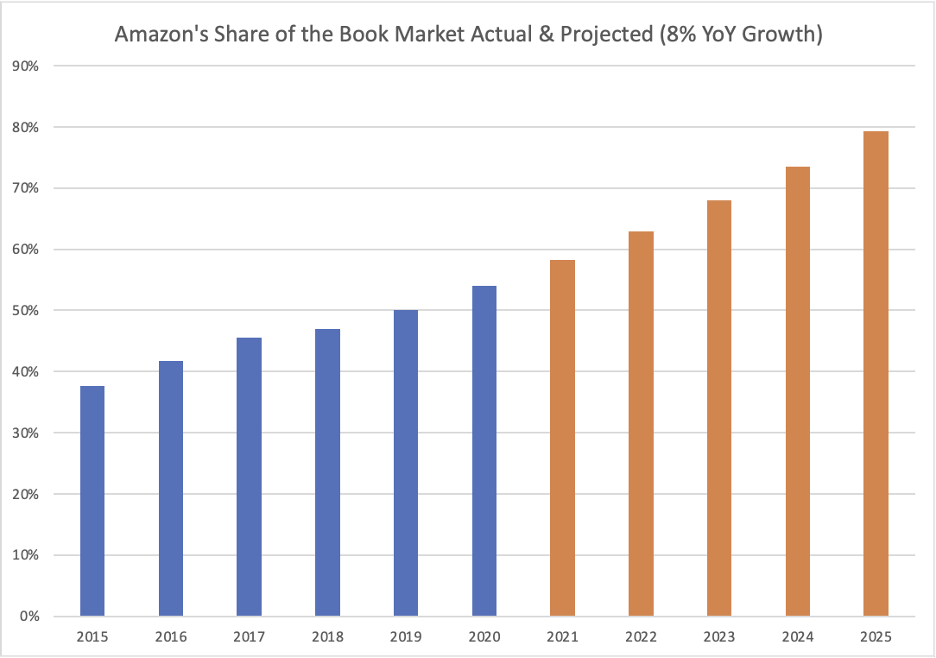
Take a look at this graph. The blue is Amazon’s share of book sales in the past six years. The orange is where we are headed if their average growth rate (8%) continues. If nothing slows their momentum, Amazon will control nearly 80% of the consumer book market by the end of 2025. Every single book lover should worry. After we’re done worrying, we must change the way we buy books.
Books are a fundamental social good that have an outsized impact on our development, individually and collectively. They move us forward. They have been fundamental to our moral and social evolution, our inner lives, and our understanding of ourselves, others, and the world. What they give us is too precious to trust to a single entity for whom they are ultimately just a product, and whose algorithms value them only by the revenue and customers they bring in.
Popular books are so deeply discounted on Amazon that other bookstores have found it hard to compete. Why does Amazon sell books at prices so low they lose money? Cheap books are a loss-leader that devalue books to drive competitors out of business and help Amazon gain control of the market, leaving them with near-monopoly power.
What is lost if at the end of 2025, Amazon sells 80% of books in the US? If one mega-retailer has unprecedented control over what everyone reads?
For one thing, diversity. The vast majority of people will be reading the same top-selling books, as determined by Amazon. On Amazon, as The New York Times puts it, “Best Sellers Sell the Best Because They’re Best Sellers”. Amazon is algorithm driven; the books promoted by Amazon are the ones that are already selling well. That makes it very difficult for new authors to build audiences. It keeps lesser known, unconventional books from reaching the readers who would appreciate them. It narrows our national conversation down to a very fine point, and sands the edges off of human ideas and creativity. It excludes marginalized voices. It does to our culture what losing biodiversity does to our environment.
Authors and publishers need to worry. Once Amazon dominates 80% of the book market, who are authors working for? Authors will effectively be producing content for Amazon to sell on commission, and Amazon will have control over the terms. Everything we’ve seen from Amazon indicates that when they have leverage, they use it to squeeze the most profit for themselves at the expense of their partners.
Local bookstores are essential to a healthy culture around books. Independent bookshops are crucial for emerging authors, who find passionate advocates in the booksellers who hand-sell their books and can make their careers. They are where authors meet readers, where book clubs form, where children discover a love of reading, and where schools and businesses partner to increase the impact of worthy books. Every bookstore is an activist for the importance of books in our culture; they ar ethe fertile grounds where all kinds of wild narratives are nurtured and grow.
f Amazon succeeds in putting bookstores out of business, readership will decline and the importance of books in our culture will diminish. Books will not thrive without the advocacy, passion, and resourcefulness of our booksellers.
Booksellers are people so taken by the imagination and insights of books that they have dedicated their working lives to them. Only a very special person makes that choice, and independent bookstores are filled with remarkable people. People with enthusiasm and curiosity, who can press a new book into your hands that you would never have discovered otherwise. We need that humanity in the book market, not algorithms.
I created Bookshop.org, a public benefit corporation, to help independent bookstores compete for online sales. Bookshop.org has just hit a major milestone — in the past 16 months we’ve helped bookstores earn $15,000,000 in profit, providing a lifeline for many stores. We’ve made progress, capturing about 1% of Amazon’s book sales. But it’s not enough. We need to shore up the culture around books against the forces of consolidation and big business. We need to make this a movement…
“Every Book Lover Should Fear This Graph“; Andy Hunter (@AndyHunter777) reminds us to take our book buying where it matters.
Note that the effect of Amazon’s growing monopoly power on competition isn’t the only concern for readers…
You may own a Kindle full of books, but in reality, the only thing you truly own is the Kindle. Buried in the spaghetti code that is Amazon’s Kindle license agreement is the truth: your eBooks are not yours. You have a license agreement to view those books, and Amazon can revoke it at any time…
Technology Review
And of course, even as we support our local booksellers, we must also support our libraries, both local and global.
* Neil Gaiman, American Gods
###
As we vote with our dollars, we might send historically-accurate birthday greetings to James MacGregor Burns; he was born on this date in 1918. A historian, political scientist, presidential biographer, and authority on leadership studies, received both the Pulitzer Prize and the National Book Award in History and Biography for his work on Franklin Delano Roosevelt, America’s 32nd president, Roosevelt: The Soldier of Freedom.

You must be logged in to post a comment.