Posts Tagged ‘meteorology’
“One of the first conditions of happiness is that the link between man and nature shall not be broken”*…

The estimable Jonathan Watts on the (painfully) pivotal year just ended…
As historically high temperatures continued to be registered in many parts of the world in late December, the former Nasa scientist James Hansen told the Guardian that 2023 would be remembered as the moment when failures became apparent.
“When our children and grandchildren look back at the history of human-made climate change, this year and next will be seen as the turning point at which the futility of governments in dealing with climate change was finally exposed,” he said.
“Not only did governments fail to stem global warming, the rate of global warming actually accelerated.”…
The bright side of this clear dichotomy is that young people may realise that they must take charge of their future. The turbulent status of today’s politics may provide opportunity,” he said.
…
His comments are a reflection of the dismay among experts at the enormous gulf between scientific warnings and political action. It has taken almost 30 years for world leaders to acknowledge that fossil fuels are to blame for the climate crisis, yet this year’s United Nations Cop28 summit in Dubai ended with a limp and vague call for a “transition away” from them, even as evidence grows that the world is already heating to dangerous levels…
Veteran climate watchers have been horrified at the pace of change. “The climate year 2023 is nothing but shocking, in terms of the strength of climate occurrences, from heatwaves, droughts, floods and fires, to rate of ice melt and temperature anomalies particularly in the ocean,” Prof Johan Rockström, the joint director of the Potsdam Institute for Climate Impact Research in Germany, said.
…
Aquino [Francisco Eliseu Aquino, a professor of climatology and oceanography at the Federal University of Rio Grande do Sul and the deputy director of Brazil’s polar and climatic centre] said human influence – through the burning of fossil fuels – had also created “frightening” dynamics between the poles and the tropics. Cold wet fronts from the Antarctic had interacted with record heat and drought in the Amazon to create unprecedented storms in between. Floods in southern Brazil killed 51 people in early September and then returned with similarly devastating force in mid-November.
Aquino said this “record record” was a taste of what was to come as the world entered dangerous levels of warming. “From this year onwards, we will understand concretely what it means to flirt with 1.5C [of heating] in the global average temperature and new records for disasters,” he said.
This is already happening. This year’s deadliest climate disaster was the flood in Libya that killed more than 11,300 people in the coastal city of Derna. In a single day, Storm Daniel unleashed 200 times as much rain as usually falls on the city in the entire month of September. Human-induced climate change made this up to 50 times more likely.
Forest fires burned a record area in Canada and Europe, and killed about 100 people in Lahaina on Maui island, the deadliest wildfire in recent US history, which happened in August. For those who prefer to calculate catastrophe in economic terms, the US broke its annual record of billion-dollar disasters by August, by which time there had already been 23.
…
…as science has proved beyond any doubt, global temperatures would continue to rise as long as humanity continues to burn fossil fuels and forests.
In the years ahead, the heat “anomaly” and catastrophes of 2023 would first become the new norm, and then be looked back on as one of the cooler, more stable years in people’s lives. As Hansen warned, unless there is radical and rapid change, failure will be built into the climate system…
Bracing, but critically important– eminently worth reading in full: “World will look back at 2023 as year humanity exposed its inability to tackle climate crisis, scientists say,” from @jonathanwatts in @guardian.
* Leo Tolstoy
###
As we face facts, we might recall that it was on this date in 1870 that Congress authorized the formation of the U.S. weather service (later named the Weather Bureau; later still, the National Weather Service), and placed it under the direction of the Army Signal Corps. Cleveland Abbe, who had started the first private weather reporting and warning service (in Cincinnati) and had been issuing weather reports or bulletins since 1869, was the only person in the country at the time who was experienced in drawing weather maps from telegraphic reports and forecasting from them. He became the weather service’s inaugural chief scientist– effectively its founding head– in January, 1871. The first U.S. meteorologist, he is known as the “father of the U.S. Weather Bureau,” where he systemized observation, trained personnel, and established scientific methods. He went on to become one of the 33 founders of the National Geographic Society.

“Criticism may not be agreeable, but it is necessary. It fulfills the same function as pain in the human body. It calls attention to an unhealthy state of things.”*…

The estimable Henry Farrell on why, on average, we’re better at criticizing others than thinking originally ourselves…
… our individual reasoning processes are biased in ways that are really hard for us (individually) to correct. We have a strong tendency to believe our own bullshit. The upside is that if we are far better at detecting bullshit in others than in ourselves, and if we have some minimal good faith commitment to making good criticisms, and entertaining good criticisms when we get them, we can harness our individual cognitive biases through appropriate group processes to produce socially beneficial ends. Our ability to see the motes in others’ eyes while ignoring the beams in our own can be put to good work, when we criticize others and force them to improve their arguments. There are strong benefits to collective institutions that underpin a cognitive division of labor.
This superficially looks to resemble the ‘overcoming bias’/’not wrong’ approaches to self-improvement that are popular on the Internet. But it ends up going in a very different direction: collective processes of improvement rather than individual efforts to remedy the irremediable. The ideal of the individual seeking to eliminate all sources of bias so that he (it is, usually, a he) can calmly consider everything from a neutral and dispassionate perspective is replaced by a Humean recognition that reason cannot readily be separated from the desires of the reasoner. We need negative criticisms from others, since they lead us to understand weaknesses in our arguments that we are incapable of coming at ourselves, unless they are pointed out to us…
…
… It’s not about a radical individual virtuosity, but a radical individual humility. Your most truthful contributions to collective reasoning are unlikely to be your own individual arguments, but your useful criticisms of others’ rationales. Even more pungently, you are on average best able to contribute to collective understanding through your criticisms of those whose perspectives are most different to your own, and hence very likely those you most strongly disagree with. The very best thing that you may do in your life is create a speck of intense irritation for someone whose views you vigorously dispute, around which a pearl of new intelligence may then accrete…
…
… One of my favourite passages from anywhere is the closing of Middlemarch, where Eliot says of Dorothea:
“Her full nature, like that river of which Cyrus broke the strength, spent itself in channels which had no great name on the earth. But the effect of her being on those around her was incalculably diffusive: for the growing good of the world is partly dependent on unhistoric acts; and that things are not so ill with you and me as they might have been, is half owing to the number who lived faithfully a hidden life, and rest in unvisited tombs.”
Striving to be a Dorothea is a noble vocation, and likely the best we can hope for in any event; sooner or later, we will all be forgotten. In the long course of time, all of our arguments and ideas will be broken down and decomposed. At best we may hope, if we are very lucky, that they will contribute in some minute way to a rich humus, from which plants that we will never see or understand might spring.
Eminently worth reading in full: “In praise of negativity,” from @henryfarrell.
* Winston Churchill
###
As we contemplate the constructive, we might recall that it was on this date in 1871 that a discipline wholly dependent on incorporating corrective critique into its methods was founded: Cleveland Abbe became the founding chief scientist– effectively the head– of the newly formed U.S. Weather Service (later named the Weather Bureau; later still, the National Weather Service).
Abbe had started the first private weather reporting and warning service (in Cincinnati) and had been issuing weather reports or bulletins since 1869 and was the only person in the country at the time who was experienced in drawing weather maps from telegraphic reports and forecasting from them. The first U.S. meteorologist, he is known as the “father of the U.S. Weather Bureau,” where he systemized observation, trained personnel, and established scientific methods. He went on to become one of the 33 founders of the National Geographic Society.

“Dust to dust”*…
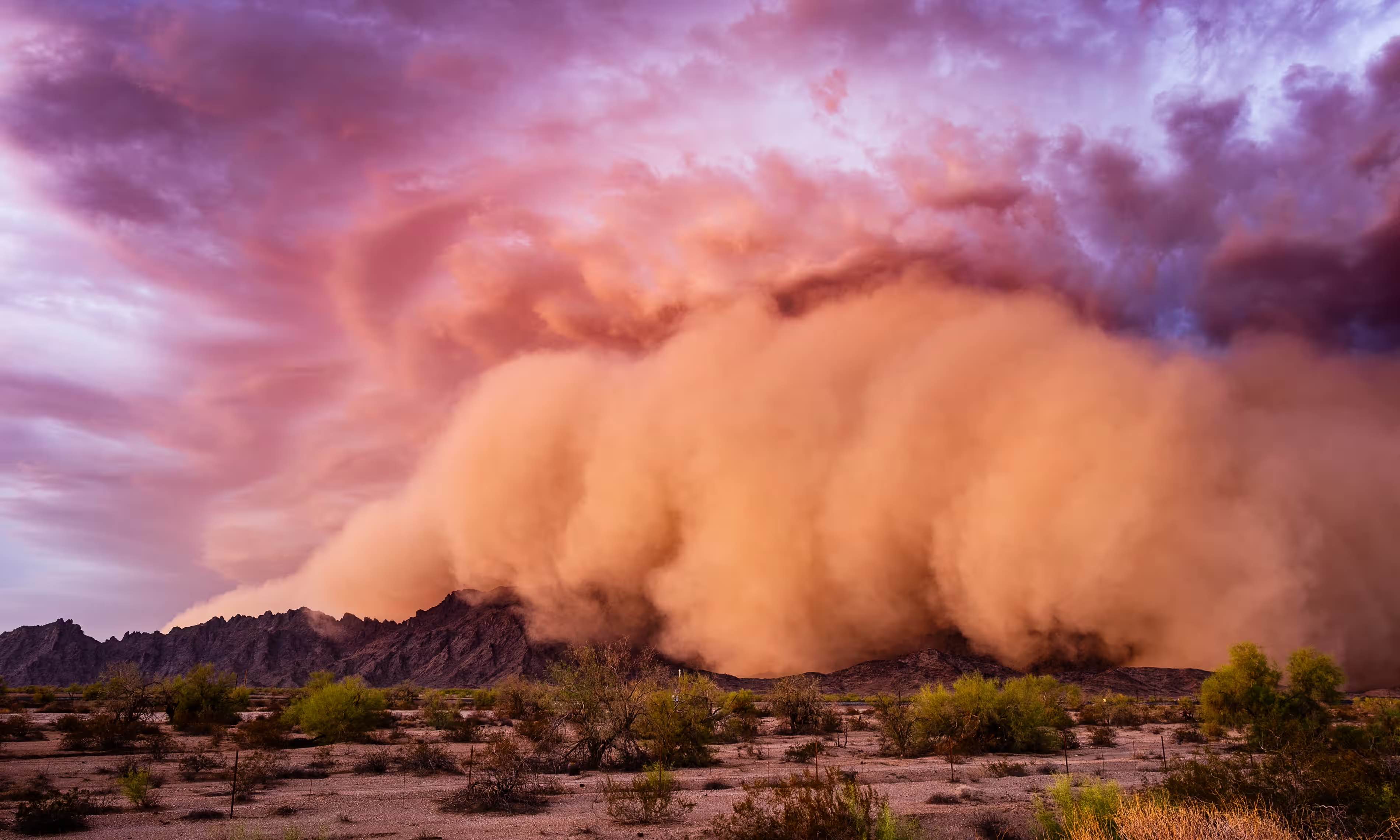
Back in 2016, we visited Jay Owens and his fascinating newsletter on dust… which went silent a couple of years later. Those of us who missed it, and were worried about its author were relieved to learn that he’d pulled back in order to turn his thinking into a book. That book is now here: Dust: The Modern World in a Trillion Particles, and The Guardian is here with an excerpt…
… Nobody normally thinks about dust, what it might be doing or where it should go: it is so tiny, so totally, absolutely, mundane, that it slips beneath the limits of vision. But if we pay attention, we can see the world within it.
Before we go any further, I should define my terms. What do I mean by dust? I want to say everything: almost everything can become dust, given time. The orange haze in the sky over Europe in the spring, the pale fur that accumulates on my writing desk and the black grime I wipe from my face in the evening after a day traversing the city. Dust gains its identity not from a singular material origin, but instead through its form (tiny solid particles), its mode of transport (airborne) and, perhaps, a certain loss of context, an inherent formlessness. If we knew precisely what it was made of, we might not call it dust, but instead dander or cement or pollen. “Tiny flying particles,” though, might suffice as a practical starting definition…
…
Dust is simultaneously a symbol of time, decay and death – and also the residue of life. Its meaning is never black or white, but grey and somewhat fuzzy. Living with dust – as we must – is a slow lesson in embracing contradiction: to clean, but not identify with cleanliness; to respect the material need for hygiene while distrusting it profoundly as a social metaphor…
A fascinating sample of a fascinating book: “Empire of dust: what the tiniest specks reveal about the world,” from @hautepop in @guardian.
Pair with: “Nothing is built on stone; all is built on sand” and “In every grain of sand there is the story of the earth.”
* from the burial service in the Book of Common Prayer
###
As we examine the elemental, we might send exploratory birthday greetings to Friedrich Wilhelm Heinrich Alexander von Humboldt; he was born on this date in 1769. The younger brother of the Prussian minister, philosopher, and linguist Wilhelm von Humboldt, Alexander was a geographer, geologist, archaeologist, naturalist, explorer, and champion of Romantic philosophy. Among many other contributions to human knowledge, his quantitative work on botanical geography laid the foundation for the field of biogeography; he surveyed and collected geological, zoological, botanical, and ethnographic specimens, including over 60,000 rare or new tropical plants.
As a geologist, Humboldt made pioneering observations of geological stratigraphy, structure (he named the Jurassic System), and geomorphology; and he understood the connections between volcanism and earthquakes. His advocacy of long-term systematic geophysical measurement laid the foundation for modern geomagnetic and meteorological monitoring.
For more, see: The Invention of Nature: Alexander Von Humboldt’s New World.

“Hurricane season brings a humbling reminder that, despite our technologies, most of nature remains unpredictable”*…

Still, as Katarina Zimmer explains, an emerging science can help us improve our forecasts…
… contemporary simulations suggest the Great Colonial Hurricane was a Category 3.5 storm, probably the strongest in recorded eastern New England history. (For reference, Sandy, which killed nearly 150 people and caused some $65 billion in damage in the United States, was technically no longer even a hurricane when it made landfall in the New York metro area in 2012.)
Scientists know about the Great Colonial Hurricane’s impact not only from written reports but curiously, also from hidden, physical impressions the long-ago storm left on the landscape.
At the bottom of a pond, Jeffrey Donnelly, a hurricane scientist at the Woods Hole Oceanographic Institution, and his colleagues found subtle, buried evidence of the storm that almost felled the Mather line. The researchers were collecting sediment cores from a lakebed on Cape Cod. The spot, known as Salt Pond, lies about a third of a mile from the ocean and has long been a place of mud. But in their core samples, they found a pinky finger-thick layer of pure ocean sand in layers that dated back to roughly 1635. The only thing that could have pulled that much beach material over the sand barrier and that far inland was a truly massive storm.
The cores revealed other clues, too. Although written accounts suggest the 1635 tempest was the strongest of its time, the exhumed samples showed it wasn’t the only intense storm in the area. Donnelly found evidence for 10 major storms in the area between 1400 and 1675—a surprising toll, given that major hurricanes are virtually unheard of this far north today. The fact that hurricanes were much more frequent in the past begs the question of why, and whether these levels of storm activity could someday return.
Which is why researchers like Donnelly are traipsing along coastlines and digging in the muck. They hope their relatively new branch of science, paleotempestology (the study of old storms), can use these buried traces of long-gone winds to augur ancient patterns. Patterns that might also help us predict the weather that lies ahead…
Paleotempestology promises to uncover patterns of historical hurricanes—to better predict destructive weather of the future. More at: “The Secret Messages in Ancient Storms,” (or here) from @katarinazimmer in @NautilusMag.
* Diane Ackerman
###
As we muse on the meteorological, we might send exploratory birthday greetings to Bernard Brunhes; he was born on this date in 1867. A geophysicist, he is known for his pioneering work in paleomagnetism, in particular, his 1906 discovery of geomagnetic reversal [see here]. The current period of normal polarity, Brunhes Chron, and the Brunhes–Matuyama reversal are named for him.
Brunes made his discovery in a way that presaged the work of paleotempestologists: he found volcanic lava and clay samples that recorded the Earth’s inversion of its magnetic field.

“Ice contains no future, just the past, sealed away”*…

From her new book, Ice: From Mixed Drinks to Skating Rinks—A cool history of a hot commodity, Amy Brady…
Despite more than 150 years’ worth of study and experimentation, no one really knows why ice is slippery….
Nineteenth-century Americans used ice to store perishable foods in amounts that astounded visitors from Europe, where an ice trade had yet to be developed. Apples, for example, became so commonplace in the young republic that visitors coined the phrase “as American as apple pie.”…
By WWII, the burgeoning industry of electric refrigeration was catching up to the ice industry, and companies like the Southland Ice Company were forced to rethink their business plans. Southland began selling kitchen staples like milk and bread alongside their ice. The combination became so popular, the company extended its hours to keep up with demand, and within a few years renamed itself after its new hours of operation. The 7-Eleven was born, and convenience stores today still sell ice…
Between WWII and 1975, the amount of electricity refrigerators consumed grew by more than 350 percent. Today, a look at energy use around the globe reveals that the cooling industry (refrigerators, freezers, and air conditioners) accounts for almost 10 percent of all CO2 emissions…
Six more cool facts at “10 Things You Probably Didn’t Know about Ice,” from @ingredient_x in @Orion_Magazine.
* Haruki Murakami
###
As we chill, we might recall that it was on this date in 1982 that record low temperature of -117 F was recorded in Antarctica. That record was broken the following year, also in Antarctica, at -128.6 F– a mark that stands to this date, as Antartica has been warming… leading Dr. Brady to ask, “in an age of accelerating global warming… can ice in the freezer and ice on our planetary poles continue to coexist?”
You must be logged in to post a comment.