Posts Tagged ‘logistics’
“The keeping of bees is like the direction of sunbeams”*…
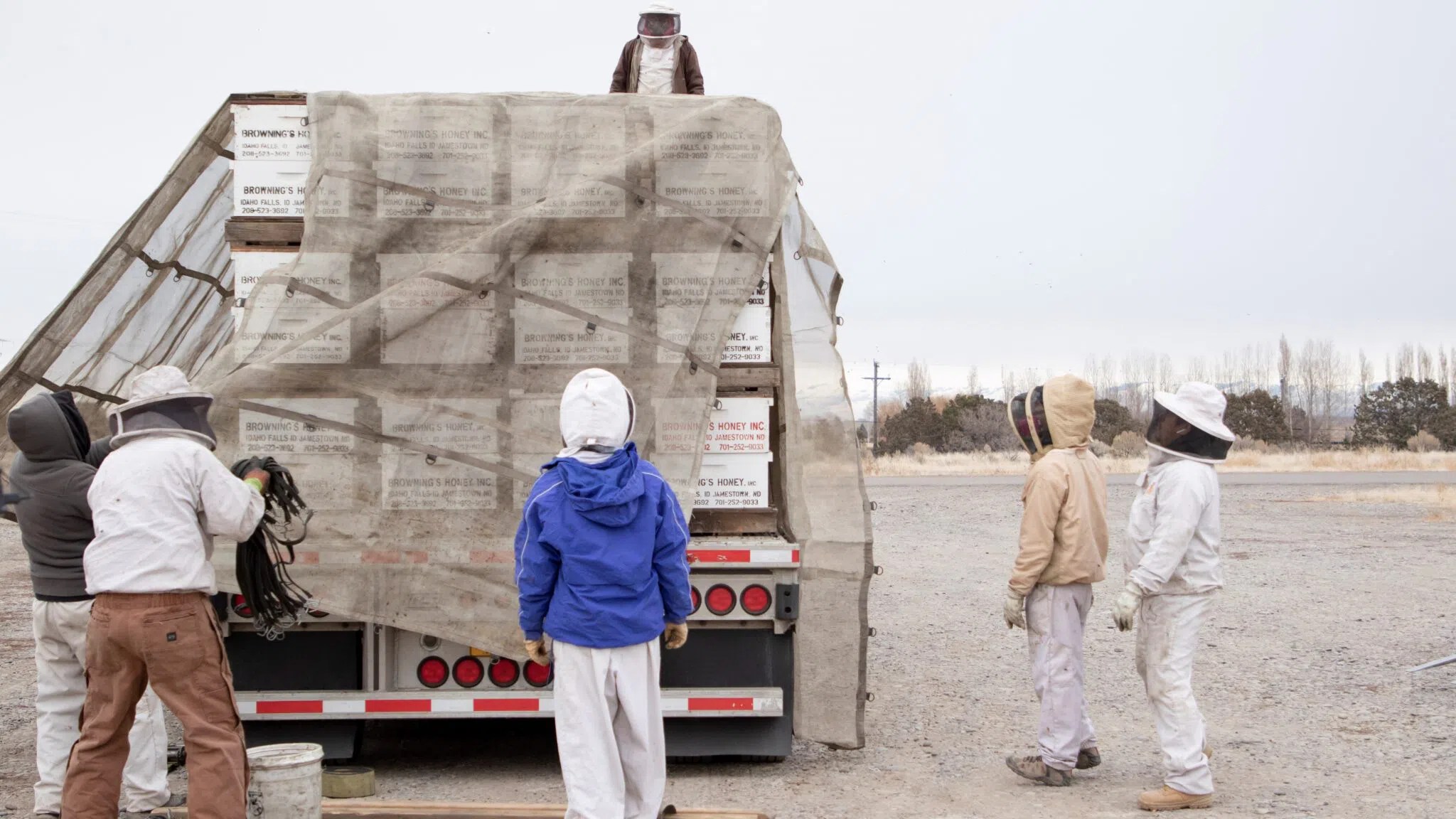
And moving those bees…
About 75% of crops and one-third of the global food supply rely on pollinators such as honeybees, according to Our World in Data. But farmers have to rely on commercially managed honeybees trucked in from other states to help pollinate certain crops, such as almonds, because there aren’t enough wild bees to do the job. And trucking bees hundreds or thousands of miles is not simple…
Honeybees are disappearing due to shrinking habitats and the growing use of pesticides. When there aren’t enough bees to pollinate fields of crops, companies pay beekeepers to transport their colonies of bees for pollination season.
“The great pollination migration” happens every year in February when the almonds bloom in California.
Pollinating the seemingly endless fields of almond trees in California requires 85% to 90% of all honeybees available to pollinate in the U.S… Bees are trucked into California from across the country…
Earl and Merle Warren are brothers, truck drivers and co-owners of Star’s Ferry Transport, based in Burley, Idaho. They started hauling bees for a local beekeeper in 1990 and moved about 50 loads of approximately 22 million bees each last year for companies such as Browning’s Honey Co.
“This is not like a load of steel or lumber. These are live creatures. This is those beekeepers’ livelihoods, so we do everything possible to keep them alive,” Earl Warren said.
Some beekeepers estimate that every time you move a truck of bees, up to 5% of the queens die… Minimizing stress for bees is critical, so beekeepers rely on experienced truck drivers to navigate difficult situations such as warm weather, few opportunities to stop during the day and inspections…
A fascinating link in the modern food chain: “A day in the life of a honeybee trucker,” from Alyssa Sporrer (@SporrerAlyssa).
* Henry David Thoreau
###
As we ponder pollination, we might spare a thought for a scientist whose very field of study was (and is) made possible by bees, Anders (Andreas) Dahl; he died on this date in 1789. A botanist and student of Carl Linnaeus, he is the inspiration for, the namesake of, the dahlia flower.

“Where there’s a will, there’s a way”*…

Each year, millions of barrels are shipped from NYC to the Caribbean. Ameena Walker unpacks the why, how, and the economics involved…
For many Caribbean communities across New York City, carefully curating barrels to ship to relatives outside of the U.S. is a relatively common practice. Fueled by an urge to provide for loved ones left back home, the Caribbean diaspora in New York, and cities around the country, meticulously source a variety of sought-after goods, intricately packing them in barrels on the cusp of overflowing and eventually mailing them overseas. The unconventional shipping method is the most affordable way to get a hefty load abroad. More than four million barrels are shipped from the northeast to the Caribbean annually, indicating a strong demand for merchandise from the U.S and a thriving business in this niche logistic sector….
The justification for using barrels to ship goods is practical. An empty 55-gallon HDPE or HMWPE drum weighs around 50 kg, but has a capacity of around 1,200 kg. Their maneuverability also plays a large part, as they can be easily stacked, rolled, or forklifted and withstand pressure and temperature changes during storage and handling….
Once the barrel is obtained, you’ll need to fill it to the brim. This is one of the more intriguing aspects of the process, as it is essential that no space is left unfilled. Practices like rolling clothes as tight as possible, stuffing the insides of footwear with additional items, removing excess packaging (e.g., taking shoes out of boxes) and shoving small items like batteries and toothbrushes into nooks and crannies ensure that not even a single crevice is left void. It’s not uncommon for someone to climb into the barrel to squish the whole mass further down, provided there aren’t any breakables or spillables inside. Virtually any item can be shipped, and it can take anywhere from a couple of hours to several months to fill a drum to maximum capacity. It’s an unspoken rule that if the barrel doesn’t require a full-sized adult to sit on top of it to force it closed, there’s room to pack more! After the drum is willed shut, it is sealed with a metal clamp and locking security cable that secures the lid and ensures its contents will not be accessed while enroute. It is then labeled on the top and side with sender and receiver’s information that should match whatever is on the shipping documents…
Despite the expansion of e-commerce, many Caribbean countries still don’t have access to simple conveniences like online shopping, making it difficult to obtain necessities. Relatives in major U.S. cities mollify this by making sure their loved ones back home get the goods they want and need, with no ocean standing in their way and no barrel packed too full…
Eminently worth reading in full: “Remittance by the Barrel,” from @awalkinny in @the_prepared.
* Proverb
###
As we pack it tight, we might send gilded birthday greetings to Johns Hopkins; he was born on this date in 1795. A businessman who is largely remembered as a philanthropist, he operated wholesale and retail businesses in the Baltimore area; he built his fortune by judiciously investing his proceeds in myriad other ventures, most notably, the Baltimore and Ohio (B & O) Railroad. In 1996, Johns Hopkins ranked 69th in “The Wealthy 100: From Benjamin Franklin to Bill Gates – A Ranking of the Richest Americans, Past and Present“
His bequests founded a number institutions bearing his name, the best-known of which are, of course, Johns Hopkins Hospital and Johns Hopkins University.
Although Hopkins is widely-noted as an abolitionist, recent research indicates that Johns Hopkins was a slave owner for at least part of his life.

“All roads lead to Rome”*…

Spanning one-ninth of the earth’s circumference across three continents, the Roman Empire ruled a quarter of humanity through complex networks of political power, military domination and economic exchange. These extensive connections were sustained by premodern transportation and communication technologies that relied on energy generated by human and animal bodies, winds, and currents.
Conventional maps that represent this world as it appears from space signally fail to capture the severe environmental constraints that governed the flows of people, goods and information. Cost, rather than distance, is the principal determinant of connectivity…
ORBIS: The Stanford Geospatial Network Model of the Roman World reconstructs the time cost and financial expense associated with a wide range of different types of travel in antiquity. The model is based on a simplified version of the giant network of cities, roads, rivers and sea lanes that framed movement across the Roman Empire. It broadly reflects conditions around 200 CE but also covers a few sites and roads created in late antiquity…
For the first time, ORBIS allows us to express Roman communication costs in terms of both time and expense. By simulating movement along the principal routes of the Roman road network, the main navigable rivers, and hundreds of sea routes in the Mediterranean, Black Sea and coastal Atlantic, this interactive model reconstructs the duration and financial cost of travel in antiquity.
Taking account of seasonal variation and accommodating a wide range of modes and means of transport, ORBIS reveals the true shape of the Roman world and provides a unique resource for our understanding of premodern history.
Ancient transportation and travel: “ORBIS: The Stanford Geospatial Network Model of the Roman World.”
* The proverb “All roads lead to Rome” derives from medieval Latin. It was first recorded in writing in 1175 by Alain de Lille, a French theologian and poet, whose Liber Parabolarum renders it as ‘mille viae ducunt homines per saecula Romam’ (a thousand roads lead men forever to Rome)
###
As we plot our paths, we might recall that it was on this date in 1937 that Sylvan Goldman introduced the first shopping cart in his Humpty Dumpty grocery store in Oklahoma City.

“Liest thou in smoky cribs, Upon uneasy pallets stretching thee”*…

What’s the most important object in the global economy? The classic answer… is the shipping container, which carries just about every type of object you can think of through the arteries and veins of global trade.
But let’s drill down a little further. How do those boxes of grapefruits and scissors and puffer jackets get into the containers in the first place, and then get offloaded at their destinations? The answer, most commonly, is an even more humble and ubiquitous technology: the pallet.
“The magic of these pallets is the magic of abstraction,” Jacob Hodes writes at Cabinet. “Take any object you like, pile it onto a pallet, and it becomes, simply, a ‘unit load’—standardized, cubical, and ideally suited to being scooped up by the tines of a forklift. This allows your Cheerios and your oysters to be whisked through the supply chain with great efficiency.”
But this simple tool, precisely because of its essential role in the global supply chain, comes with unexpectedly complex logistics…
From Quartz Obsessions, the story of the world’s lo-fi load bearers: “Pallets.”
* Shakespeare, Henry IV, Part II (Act 3, Sc 1)
###
As we pile it on, we might recall that it was on this date in 1858 that Philadelphia iron products manufacturer Albert Potts patented his design for a lamppost-mounted collection mailbox (U.S. patent #19,578). His box was designed to be affixed to a lamppost so that people could drop their letters into the box instead of making a special trip to the post office to mail their letters. While Potts was a pioneer in America (anticipating the demand for letter boxes that expanded when City Free Delivery– the delivery of letters to addressees’ doors– was introduced), his were predated by the “pillar box” (introduced in the UK in 1852 by novelist Anthony Trollope, in has day-job capacity as Postal Surveyor) and by a short-lived postal system using collection boxes on street corners around Paris that was set up by Renouard De Valayer in 1653.

“Location, location, location”*…

London tech start-up What3Words has created a new approach to location that could improve lives and economies around the world:
Julius Caesar famously divided Gaul into three parts. [What3Words founder Chris] Sheldrick and his team have gone a little further, dividing the earth’s surface — land, sea and ice caps included — into 57tn 3m-squares, each assigned a unique three-word identifier. What3Words’s entire address is just index.home.raft. Furthermore, a free smartphone app can identify any What3Words location in the world, even if the phone is offline… according to What3Words, 75 per cent of the world’s population has no address; imagine the benefit to an African villager of having Amazon packages delivered as if he lived in a city with a formal postal address. Imagine the benefit to Amazon, too.
Then there are places you would imagine have street addresses, but do not. Japan, for example, is a delivery person’s nightmare: just one complication among many is that homes are numbered according to when they were built. Many Middle East countries’ addresses are famously shambolic. “Dubai expats filling in US tax forms often have to draw a picture of where they live”…
How did Mr Sheldrick, a musician by training, come up with the idea? He was a band manager and had to get trucks of equipment and performers to venues. “It was obvious that postcodes were not fit for purpose. A venue like the Birmingham NEC has one code and many entrances.” He would give 20-digit GPS co-ordinates to drivers for satnavs. When one driver reversed two numbers and ended up more than 50 miles from his Rome destination, Mr Sheldrick decided to take action…
Find your place at “What3Words: new tech that will find any location.”
* real estate agents’ mantra
###
As we zero in, we might recall that it was on this date in 1942 that The Alaska Highway (AKA, the Alaska-Canadian Highway, or ALCAN Highway) opened. Spurred by the bombing of Pearl Harbor in Dec 1941, the highway, deemed a military necessity, was completed at mile 1202, Beaver Creek , when the 97th Engineers met the 18th Engineers. Originally approximately 1,700 miles long, it now runs 1,387 miles– the difference due to constant reconstruction of the highway, which has rerouted and straightened out numerous sections. Opened to the public in 1948, the road was legendary over many decades for being a rough, challenging drive; the highway is now paved over its entire length.


You must be logged in to post a comment.