Posts Tagged ‘delivery’
“There’s no better feeling in the world than a warm pizza box on your lap”*…

On the origin of that sacred vessel…
Ah, the humble pizza box. When else has such a more modest creation kept so many so well fed? Patented in 1984, after being filed in ‘81 by a Robert E Hall, the creation is described as such: “A box is formed from a unitary, double-sided corrugated cardboard blank having a plurality of scored lines which enable a set up in box form. A bottom panel of the box has cemented thereto a single-sided, fluted corrugated cardboard medium with the fluted side facing upwardly. A moisture-resistant glue is used between the smooth faces of the fluted corrugated medium and the confronting liner of the blank to provide an impenetrable barrier which prevents grease from penetrating through the box. The boxes are manufactured on a conventional production line which is modified by, in effect, running one stage in a reverse direction in order to invert the single-sided medium and to apply the glue in a different manner to establish the moisture barrier.”
In truth, the pizza box has many parents, with patent 4,441,626 simply improving grease absorption and venting (dunno who came up with the weird little three legged table you sometimes see.) Neapolitan pizza bakers would put their pies in metallic containers called stufe as far back as the 19th century. Corrugated cardboard was added to the recipe in the ‘60s, with Domino’s creating something pretty similar to the package we know and love — aka the Chicago Folder — shortly thereafter…
“Who Invented the Pizza Box,” from Modern Delivery.
More at: “Pizza packaging: Overview and History.”
See also: “My favorite dish to prepare is something on the takeout menu.”
* Kevin James
###
As we hold the mushrooms, we might recall that it was on this date in 1901 that Chapman J. Root opened the Root Glass Company in Terre Haute, Indiana; his specialty was the manufacture of glass bottles that would withstand high internal pressures. In 1915 the company entered, and in 1916 won the design competition for what would become another packaging superstar: the iconic 6.5 ounce Coca-Cola bottle.

“Inflation is when you pay fifteen dollars for the ten-dollar haircut you used to get for five dollars when you had hair”*…

Mike Konczal unpacks happens when one takes the AEI graphic of items that have had high and low inflation, but extend it to all categories…
This graphic is in the news again:
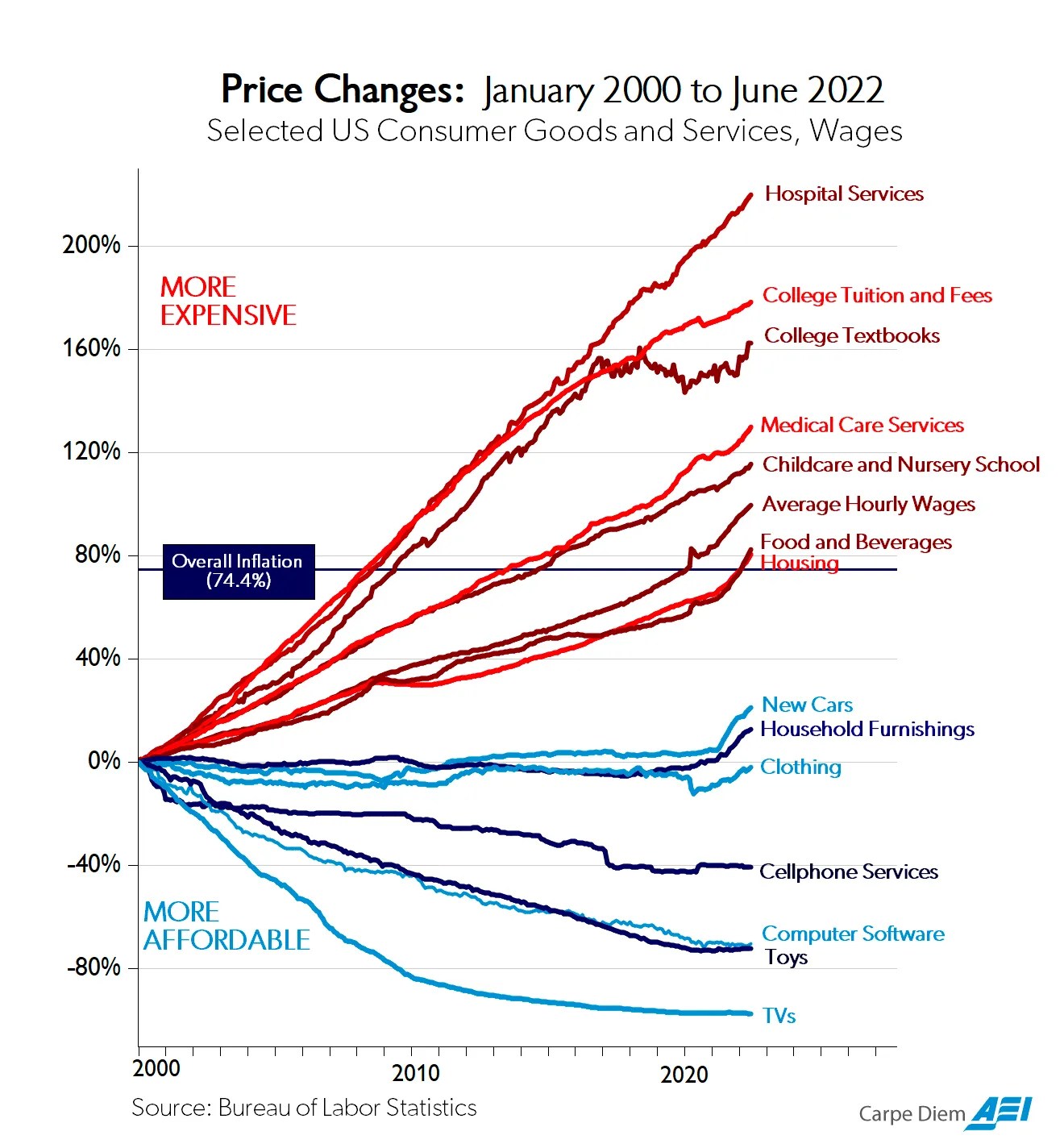
Its creator is Mark Perry of the American Enterprise Institute, who last posted an update to it in July 2022. He’s been doing a version since at least 2016, and if you read enough economics blogs or content you’ve probably seen some iteration of it.
People are talking about it again after Marc Andreessen posted it under the headline “Why AI Won’t Cause Unemployment.” Andreessen describes what people generally take away from it – blue line capitalism and dynamic, red line government regulations and stagnant…
Matt Yglesias noted on twitter that he’s “come to think it’s misleading — by being very selective in which categories of labor-intensive services it chooses to chart, it’s generated a narrative that relative price shifts are just about government regulation.”
That seems correct to me; these categories are pretty loaded. Let’s see if we can do better by including every possible category… let’s download all of the current Consumer Price Index (CPI) data off the BLS download site…
Since the BLS is constantly changing categories, we have to select the items that exist in both January 2000 and February 2023 to duplicate the chart. That leaves us with 62 categories. Doing a quick glance (and seeing in Perry’s own chart) the year-by-year evolution over time doesn’t really tell us much, so we can go with a simple bar chart for overall change. Let’s chart that here in full:

There are a few key takeaways looking at it this way:
In our version of the AEI chart the number one item isn’t health care but ‘delivery services,’ which is “fees for delivery of items such as letters, documents, and packages at non-US Postal Services facilities.”Think UPS or FedEx. This is pretty far from a government monopoly, indeed it’s the private sector alternative to a government program. But it is services and it is labor intensive.
The biggest thing, to me, isn’t “regulations” but whether it’s a service or a good…
More on how and why that matters in “A Better AEI Graphic of Inflation Over the Past 20 Years.”
* Sam Ewing
###
As we ruminate in the rise, we might recall that it was on this date in 2006 that Twitter co-founder Jack Dorsey sent the first tweet.

“You can’t go wrong with pizza, unless it’s terrible pizza”*…

(Roughly) Daily has considered the pizza box before (see, e.g., here and here); but Saahil Desai does a deep dive… and the results aren’t pretty…
Pizza delivery, it turns out, is based on a fundamental lie. The most iconic delivery food of all time is bad at surviving delivery, and the pizza box is to blame. “I don’t like putting any pizza in a box,” Andrew Bellucci, a legendary New York City pizza maker of Andrew Bellucci’s Pizzeria, told me. “That’s just it, really. The pizza degrades as soon as it goes inside,” turning into a swampy mess.
A pizza box has one job—keeping a pie warm and crispy during its trip from the shop to your house—and it can’t really do it. The fancier the pizza, the worse the results: A slab of overbaked Domino’s will probably be at least semi-close to whatever its version of perfect is by the time it reaches your door, but a pizza with fresh mozzarella cooked at upwards of 900 degrees? Forget it. Sliding a $40 pie into a pizza box is the packaging equivalent of parking a Lamborghini in a wooden shed before a hurricane.
…
The basic issue is this: A fresh pizza spews steam as it cools down. A box traps that moisture, suspending the pie in its own personal sauna. After just five minutes, Wiener said, the pie’s edges become flaccid and chewy. Sauce seeps into the crust, making it soggy. All the while, your pizza is quickly losing heat. After 15 minutes, the cheese has congealed into dollops of rubber. And after 45 minutes, your pizza deteriorates into something else entirely…
The painful present and the possible future of a delivery icon that hasn’t changed for 60 years: “You Don’t Know How Bad the Pizza Box Is,” from @Saahil_Desai in @TheAtlantic.
One answer is to consume one’s pizza at the point of purchase. Liam Quigley (@_elkue), a reporter in NYC, has made that a habit– and he’s kept notes. Starting in 2014, he logged every slice that he ate– type (e.g., “plain,” “pepperoni”) and price– 464 in all.
* Andy Kindler
###
As we reach for the red pepper flakes, we might note that today was an important day in the history of food packaging: George Palmer was born on this date in 1818. The proprietor of Huntley and Palmers biscuit manufacturers (in Reading, England), he introduced the first biscuit tin in 1831.

“You don’t win friends with salad”*…

The best meal I had all pandemic cost $1.14 and took about 90 seconds to make. It was a Margherita pizza inhaled in the car on a desolate day in late April. I know the precise cost because my husband is the chef who made it: 61 cents for a few slices of fresh buffalo mozzarella, 24 cents for the San Marzano tomatoes and salt, a quarter for enough basil leaves to supply the rest of the menu’s needs for free, and just 11 cents for the dough, made from a mix of top-shelf imported Italian flours. In normal times, his restaurant sold a Margherita for $20, but he could get away with selling it for $10 and still reach 10% food cost.
We are a nation in the throes of an unprecedented eight-month pizza binge that shows no signs of abating. Multiple pizzerias in Los Angeles reported a 250% rise in sales on Election Day, and on Thursday, Papa John’s reported quarterly same-store sales growth of 23.8%. For months now, the underlying forces for the sustained pizza craze have been as hotly debated within the restaurant industry as the election results have been parsed by professional pollsters. Stress eating is a major cause; quarantine-induced failure of imagination and the return of three major-league sports within weeks of one another over the summer certainly didn’t hurt.
But the actual reason that doesn’t get nearly enough notice is that pizza is one of the few genres of food that is actually more profitable than — and almost as addictive as — booze. Fries and fried chicken — not wings, but tenders and drumsticks — are the only other foods that come close. If that reminds you at all of the suggestions that await you on Grubhub and Uber Eats, well, that’s what’s left of the menu when restaurants lose their alcohol sales and are forced to fork over a third of their gross revenues to delivery app commissions. There are not a lot of foods where taste collides so perfectly with profit: Pizza stands alone…
But times are nothing if not desperate, and the financial case for making a pivot to pizza is anything but ambiguous. Tens of thousands of independent restaurants have closed permanently since March, but independent pizzerias listed on the delivery app Slice have seen sales grow 60%. The chain Marco’s Pizza, which just opened its 1,000th location, in Kissimmee, Florida, has seen sales surge roughly 50% every week since mid-April, according to the consumer data analytics firm Sense360. The pandemic has even breathed new life into the forgotten Pizza Hut chain, which reported a 9% rise in U.S. same-store sales last quarter despite the July bankruptcy of its debt-saddled biggest franchisee, NPC International — which said in a filing that its Pizza Hut division’s 2020 earnings (before interest, taxes, depreciation, and amortization) had exceeded its internal forecasts by a factor of eight. And mediocre pizza behemoth Domino’s, which was starting from a much higher base after reporting 38 consecutive quarters of same-store sales growth, reported a 16% uptick in same-store sales in its second quarter.
The losing side of this stark new restaurant reality is a virtually endless list, but the unequivocal biggest loser has been the so-called $15 salad genre embodied by the fast-food cum tech unicorn Sweetgreen, which recently announced it would be laying off 20% of its corporate staff in its second round of post-outbreak job cuts. Hard numbers on this mostly privately held category, which includes Chopt Creative Salads, Just Salad, Fresh & Co, and True Food Kitchen — all of which have at one point been hailed as the “next Sweetgreen” — were easier to come by in more prosperous times, but the few out there are ugly. Sweetgreen sales fell about 60% during the eight weeks after the first shutdowns, according to Sense360, and the one publicly traded chain in the salad business, Toronto’s Freshii, reported a 51.4% plunge in its second-quarter sales…
Learn how pizza won the pandemic—and Sweetgreen got left behind: “The Death of the $15 Salad.”
* Homer Simpson
###
As we savor a slice, we might send well-preserved birthday greetings to the man who was ultimately responsible for that getting that especially- delicious tomato sauce to your pizzeria: Nicolas Appert; he was born on this date in 1749. A confectioner and inventor, he is known as “the father of canning.”
In 1795, Napoleon, who famously understood that an army travels on its stomach, had offered a prize of 12,000 francs for a method of preserving food and transporting it to its armies. Appert, who worked 14 years to perfect a method of storing food in sterilized glass containers, won the award in 1810.
Interestingly, that same year (1810), Appert’s friend and agent, Peter Durand, took the invention to the other side. He switched the medium from glass to metal and presented it to Napoleon’s enemies, the British– scoring a patent (No. 3372) from King George for the preservation of food in metal (and glass and pottery) containers… the tin can.

“Location, location, location”*…

London tech start-up What3Words has created a new approach to location that could improve lives and economies around the world:
Julius Caesar famously divided Gaul into three parts. [What3Words founder Chris] Sheldrick and his team have gone a little further, dividing the earth’s surface — land, sea and ice caps included — into 57tn 3m-squares, each assigned a unique three-word identifier. What3Words’s entire address is just index.home.raft. Furthermore, a free smartphone app can identify any What3Words location in the world, even if the phone is offline… according to What3Words, 75 per cent of the world’s population has no address; imagine the benefit to an African villager of having Amazon packages delivered as if he lived in a city with a formal postal address. Imagine the benefit to Amazon, too.
Then there are places you would imagine have street addresses, but do not. Japan, for example, is a delivery person’s nightmare: just one complication among many is that homes are numbered according to when they were built. Many Middle East countries’ addresses are famously shambolic. “Dubai expats filling in US tax forms often have to draw a picture of where they live”…
How did Mr Sheldrick, a musician by training, come up with the idea? He was a band manager and had to get trucks of equipment and performers to venues. “It was obvious that postcodes were not fit for purpose. A venue like the Birmingham NEC has one code and many entrances.” He would give 20-digit GPS co-ordinates to drivers for satnavs. When one driver reversed two numbers and ended up more than 50 miles from his Rome destination, Mr Sheldrick decided to take action…
Find your place at “What3Words: new tech that will find any location.”
* real estate agents’ mantra
###
As we zero in, we might recall that it was on this date in 1942 that The Alaska Highway (AKA, the Alaska-Canadian Highway, or ALCAN Highway) opened. Spurred by the bombing of Pearl Harbor in Dec 1941, the highway, deemed a military necessity, was completed at mile 1202, Beaver Creek , when the 97th Engineers met the 18th Engineers. Originally approximately 1,700 miles long, it now runs 1,387 miles– the difference due to constant reconstruction of the highway, which has rerouted and straightened out numerous sections. Opened to the public in 1948, the road was legendary over many decades for being a rough, challenging drive; the highway is now paved over its entire length.

You must be logged in to post a comment.