Posts Tagged ‘services’
“‘Big’ government? Who wants that? I just want effective government. That means America’s government needs to be big in some places, small in others and non-existent in others.”*…

The Red would like to see less; the Blue, more– still, for all of their contention, the right and left in the U.S. agree that government isn’t doing the job that it could/should.
Indeed, the quantitation question obscures a qualitative issue: as our lives (and our businesses) have become more digital, governments have fallen behind in taking effective advantage of technology. Jen Pahlka, founder of Code for America, has devoted most of her life to precisely that problem. Now, she’s sharing the lessons she’s learned in a new book. Your correspondent has read and deeply appreciated it; but don’t take his word…
Beginning with “I’m Just a Bill,” an animated musical introduction to the American legislation system from Schoolhouse Rock!, Pahlka, the deputy chief technology officer during the Obama administration, delivers an eye-opening and accessible examination of why online interactions with government in America work—or, often, do not. The author provides numerous examples of failures, including a form for Veterans Affairs health insurance that only really worked on certain computers with certain versions of software; the development of healthcare.gov, where “the full set of rules governing the program they were supposed to administer wasn’t finalized until the site was due to launch”; or an “application for food stamps that requires answering 212 separate questions.” Through these and many other illustrative cases, Pahlka effectively shows that “when systems or organizations don’t work the way you think they should, it is generally not because the people in them are stupid or evil. It is because they are operating according to structures and incentives that aren’t obvious from the outside.” Indeed, by tracing the requirements of any technology developed by or for the government, it becomes increasingly apparent that simply adding new laws or throwing money at the problems fails to alleviate the confusion or waste. Throughout this empowering book, the author makes compelling, clear arguments, revealing inefficiency, bureaucracy, and incompetence, whether it stems from legislators, administrators, or IT professionals. “The good news is that software and the US government have something very important in common: they are made by and for people,” writes Pahlka. “In the end, we get to decide how they work.” Anyone dealing with the implementation of technology in government should pay attention to the author’s suggestions…
Starred review, Kirkus Reviews
An important– and eminently readable– exploration of the fraught intersection of technological innovation and government bureaucracy, and a guide to navigating it: Recoding America: why government is failing in the digital age and how we can do better, from @pahlkadot.
* Van Jones
###
As we get smart, we might spare a thought for Auguste Lumière; he died on this date in 1954. The son of a French portrait painter who added photography to his repertoire, Auguste joined with his brother Louis to pioneer a pre-digital technology that changed the world: cinema.
Their father returned in 1894 from a trip to the U.S. where he’d been enchanted by Edison’s kinetoscope. The brothers (who’d already pioneered new darkroom techniques for still photography) were excited… until they understood that Edison’s display could only be seen by a single viewer at a time. They envisioned something different: a projected image that could be shared by an audience, in the same way that audiences share a play. With his brother’s help, Lumière designed the Cinematograph, a self-contained camera and projector that used a clawed-gear to advance sprocketed film. It was the first apparatus for making and showing films to audiences in a way that would be recognizable today as “going to the movies,” thus the Lumière brothers are often credited as inventors of the motion picture. In any case, the principle at work in the Cinematograph was the principle used in movie cameras and projectors for more than a century afterwards.

“Inflation is when you pay fifteen dollars for the ten-dollar haircut you used to get for five dollars when you had hair”*…

Mike Konczal unpacks happens when one takes the AEI graphic of items that have had high and low inflation, but extend it to all categories…
This graphic is in the news again:
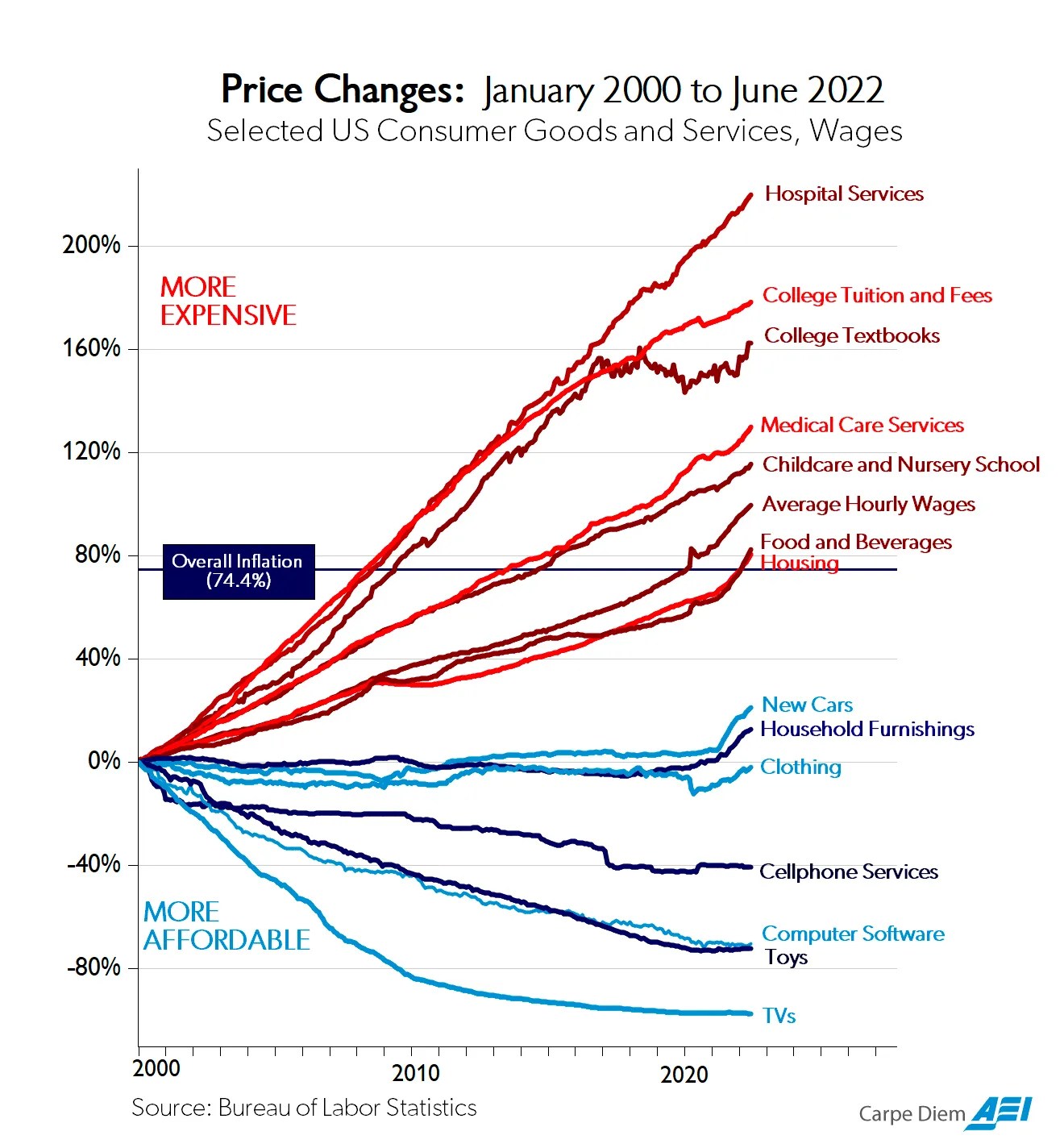
Its creator is Mark Perry of the American Enterprise Institute, who last posted an update to it in July 2022. He’s been doing a version since at least 2016, and if you read enough economics blogs or content you’ve probably seen some iteration of it.
People are talking about it again after Marc Andreessen posted it under the headline “Why AI Won’t Cause Unemployment.” Andreessen describes what people generally take away from it – blue line capitalism and dynamic, red line government regulations and stagnant…
Matt Yglesias noted on twitter that he’s “come to think it’s misleading — by being very selective in which categories of labor-intensive services it chooses to chart, it’s generated a narrative that relative price shifts are just about government regulation.”
That seems correct to me; these categories are pretty loaded. Let’s see if we can do better by including every possible category… let’s download all of the current Consumer Price Index (CPI) data off the BLS download site…
Since the BLS is constantly changing categories, we have to select the items that exist in both January 2000 and February 2023 to duplicate the chart. That leaves us with 62 categories. Doing a quick glance (and seeing in Perry’s own chart) the year-by-year evolution over time doesn’t really tell us much, so we can go with a simple bar chart for overall change. Let’s chart that here in full:

There are a few key takeaways looking at it this way:
In our version of the AEI chart the number one item isn’t health care but ‘delivery services,’ which is “fees for delivery of items such as letters, documents, and packages at non-US Postal Services facilities.”Think UPS or FedEx. This is pretty far from a government monopoly, indeed it’s the private sector alternative to a government program. But it is services and it is labor intensive.
The biggest thing, to me, isn’t “regulations” but whether it’s a service or a good…
More on how and why that matters in “A Better AEI Graphic of Inflation Over the Past 20 Years.”
* Sam Ewing
###
As we ruminate in the rise, we might recall that it was on this date in 2006 that Twitter co-founder Jack Dorsey sent the first tweet.

You must be logged in to post a comment.