Posts Tagged ‘information’
“Nothing so much assists learning as writing down what we wish to remember”*…
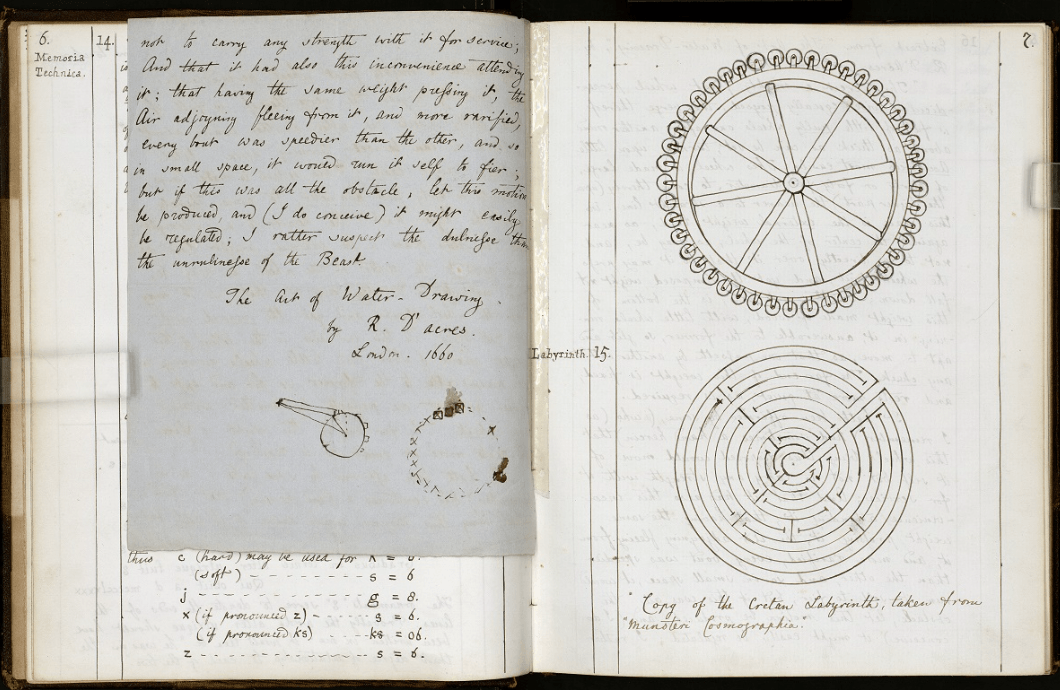
Your correspondent is away for the rest of this month; regular service will resume on or around September 1st. For the hiatus, a little something to occupy you…
As readers of this blog will have deduced, (Roughly) Daily is a kind of commonplace book…
Commonplace books (or commonplaces) are a way to compile knowledge, usually by writing information into books. They have been kept from antiquity, and were kept particularly during the Renaissance and in the nineteenth century. Such books are similar to scrapbooks filled with items of many kinds: sententiae, notes, proverbs, adages, aphorisms, maxims, quotes, letters, poems, tables of weights and measures, prayers, legal formulas, and recipes… Commonplaces are used by readers, writers, students, and scholars as an aid for remembering useful concepts or facts. Each one is unique to its creator’s particular interests but they almost always include passages found in other texts, sometimes accompanied by the compiler’s responses.
“Commonplace book“
As Steven Johnson points out, commonplace books have a storied history…
Scholars, amateur scientists, aspiring men of letters — just about anyone with intellectual ambition in the seventeenth and eighteenth centuries was likely to keep a commonplace book. In its most customary form, “commonplacing,” as it was called, involved transcribing interesting or inspirational passages from one’s reading, assembling a personalized encyclopedia of quotations. It was a kind of solitary version of the original web logs: an archive of interesting tidbits that one encountered during one’s textual browsing. The great minds of the period — Milton, Bacon, Locke — were zealous believers in the memory-enhancing powers of the commonplace book. There is a distinct self-help quality to the early descriptions of commonplacing’s virtues: in the words of one advocate, maintaining the books enabled one to “lay up a fund of knowledge, from which we may at all times select what is useful in the several pursuits of life.”
The philosopher John Locke first began maintaining a commonplace book in 1652, during his first year at Oxford. Over the next decade he developed and refined an elaborate system for indexing the book’s content. Locke thought his method important enough that he appended it to a printing of his canonical work, An Essay Concerning Human Understanding…
“The Glass Box And The Commonplace Book“
Perhaps because in these interconnected days almost anything seems re-retrievable at a click, not too many bother keeping commonplaces. That’s a shame. Your correspondent can testify that the habit– whether practiced in a book or digitally– is a powerful aid both to learning and to writing.
Happily, there are lots of sources of good advice for getting started, e.g., here, here (source of the image above), and here. There’s even a Masterclass.
* Marcus Tullius Cicero
###
As we live and learn, we might recall that it was on this date in 1858 that (prodigious journaler and commonplace keeper) Charles Darwin and Alfred Russel Wallace published “On the tendency of species to form varieties; and on the perpetuation of varieties and species by natural selection” in the Journal of the Proceedings of the Linnean Society. This was the first printed formal exposition of the theory of evolution by natural selection.
Darwin had developed the essential elements of his theory by 1838 and set them on paper in 1844; however, he chose to keep his work on evolution unpublished for the time, instead concentrating his energies first on the preparation for publication of his geological work on the Beagle voyage , and then on an exhaustive eight-year study of the barnacle genus Cirripedia.
In 1856, at the urging of Charles Lyell, Darwin began writing a vast encyclopedic work on natural selection; however, it is possible that the extremely cautious Darwin might never have published his evolutionary theories during his lifetime had not Alfred Russel Wallace, a naturalist born in New Zealand, independently discovered the theory of natural selection. Wallace conceived the theory of natural selection during an attack of malarial fever in Ternate in the Mollucas, Indonesia (Febuary, 1858) and sent a manuscript summary to Darwin, who feared that his discovery would be pre-empted.
In the interest of justice Joseph Dalton Hooker and Charles Lyell suggested joint publication of Wallace’s paper prefaced by a section of a manuscript of a work on species written by Darwin in 1844, when it was read by Hooker, plus an abstract of a letter by Darwin to Asa Gray, dated 1857, to show that Darwin’s views on the subject had not changed between 1844 and 1857. The papers by Darwin and Wallace were read by Lyell before the Linnean Society on July 1, 1858 and published on August 20.
“Darwin & Wallace Issue the First Printed Exposition of the Theory of Evolution by Natural Selection“

“Pam, this is from corporate. How many times have I told you that there is a special filing cabinet for things from corporate? Called the waste paper basket!”*…

The subject of this essay emerged by chance. I was researching the history of the U.S. passport, and had spent weeks at the National Archives, struggling through thousands of reels of unindexed microfilm records of 19th-century diplomatic correspondence; then I arrived at the records for 1906. That year, the State Department adopted a numerical filing system. Suddenly, every American diplomatic office began using the same number for passport correspondence, with decimal numbers subdividing issues and cases. Rather than scrolling through microfilm images of bound pages organized chronologically, I could go straight to passport-relevant information that had been gathered in one place.
I soon discovered that I had Elihu Root to thank for making my research easier. A lawyer whose clients included Andrew Carnegie, Root became secretary of state in 1905. But not long after he arrived, the prominent corporate lawyer described himself as “a man trying to conduct the business of a large metropolitan law-firm in the office of a village squire.” The department’s record-keeping practices contributed to his frustration. As was then common in American offices, clerks used press books or copybooks to store incoming and outgoing correspondence in chronologically ordered bound volumes with limited indexing. For Root, the breaking point came when a request for a handful of letters resulted in several bulky volumes appearing on his desk. His response was swift: he demanded that a vertical filing system be adopted; soon the department was using a numerical subject-based filing system housed in filing cabinets.
The shift from bound volumes to filing systems is a milestone in the history of classification; the contemporaneous shift to vertical filing cabinets is a milestone in the history of storage…
It is easy to dismiss the object: a rectilinear stack of four drawers, usually made of metal. With suitable understatement, one design historian has noted that “manufacturers did not address the subject of style with regard to filing units.” The lack of style figures into the filing cabinet’s seeming banality. It is not considered inventive or original; it is simply there, especially in 20th-century office spaces; and this ubiquity, along with the absence of style, perhaps paradoxically contributes to the easy acceptance of its presence, which rarely causes comment…
But if it appears to be banal and pervasive, it cannot be so easily ignored. The filing cabinet does not just store paper; it stores information; and because the modern world depends upon and is indeed defined by information, the filing cabinet must be recognized as critical to the expansion of modernity. In recent years scholars and critics have paid increasing attention to the filing systems used to store and retrieve information critical to government and capitalism, particularly information about people — case dossiers, identification photographs, credit reports, et al. But the focus on filing systems ignores the places where files are stored. Could capitalism, surveillance, and governance have developed in the 20th century without filing cabinets? Of course, but only if there had been another way to store and circulate paper efficiently. The filing cabinet was critical to the infrastructure of 20th-century nation states and financial systems; and, like most infrastructure, it is often overlooked or forgotten, and the labor associated with it minimized or ignored.
The vertical filing cabinet was invented in the United States in the 1890s, and quickly became a fixture throughout North America and around the world. It spread globally because it provided a way to store large amounts of paper so that individual sheets could be retrieved easily. The technique of using drawers for storing a sheet of paper on its long edge was significant because loose papers cannot stand upright on their own. Put another way, the filing cabinet technology enabled loose paper to stand on edge so that more sheets could be stored in less space but still be accessed with minimal difficulty. It allowed loose papers to do the work of paperwork…
The filing cabinet had at least two inventors — and likely several others who remain lost to the historical record. The current accepted version attributes the invention to the Library Bureau, the Boston-based company founded in 1876 by Melvil Dewey, inventor of the eponymous decimal system of library classification. Although the Library Bureau would proudly claim the invention, critical developments happened elsewhere. It was the secretary of a charity organization based in Buffalo, New York, a man identified as Dr. Nathaniel Rosenau, who provided the initial impetus for construction of a vertical filing cabinet. Inspired by the use of cabinets to store index cards on their edges, Rosenau sought a bigger container for papers.
In 1892, he took his idea to the Library Bureau’s Chicago office, which built a prototype. But no matter the inventor, the turn of the 20th century saw the filing cabinet develop as a part of the rapid growth of an office equipment industry in which dozens of companies manufactured practically identical products with little respect for the hundreds of patents issued for products and parts. To underscore their uniqueness and modernity, this industry explicitly labeled its products “equipment,” “appliances,” and “machines” — not furniture. And it made these products indispensable to offices, and thus helped to constitute the office as a “modern” workspace. The office with a vertical filing cabinet was decidedly not a 19th-century office…
The filing cabinet was critical to the information infrastructure of the 20th-century; like most infrastructure, it was usually overlooked– an oversight that Craig Robertson (@craig2robertson) rectifies: “The Filing Cabinet.”
* “Michael Scott,” The Office (Pilot episode)
###
As we savor storage, we might spare a thought for Malcolm Purcell McLean; he died on this date in 2001. A transportation entrepreneur, he parlayed his experience as a trucker into the development of the modern shipping container— which revolutionized transport and international trade in the second half of the twentieth century. Containerization led to a significant reduction in the cost of freight transportation by eliminating the need for repeated handling of individual pieces of cargo, and also improved reliability, reduced cargo theft, and cut inventory costs (thus, working capital needs) by shortening transit time.
When McLean died in 1987, then Secretary of Transportation Norm Minetta said:
Malcom revolutionized the maritime industry in the 20th century. His idea for modernizing the loading and unloading of ships, which was previously conducted in much the same way the ancient Phoenicians did 3,000 years ago, has resulted in much safer and less-expensive transport of goods, faster delivery, and better service. We owe so much to a man of vision, “the father of containerization,” Malcolm P. McLean.
In an editorial shortly after his death, the Baltimore Sun wrote that “he ranks next to Robert Fulton as the greatest revolutionary in the history of maritime trade,” and Forbes Magazine called McLean “one of the few men who changed the world.” On the morning of McLean’s funeral, container ships around the world blew their whistles in his honor.

“Don’t be afraid to break things. Don’t be romantic. Don’t take the time to breathe. Don’t aim for perfect. And whatever you do, keep moving.”*…

Eric Feigl-Ding picked up his phone on the first ring. “Busy,” he said, when asked how things were going. He had just finished up an “epic, long” social media thread, he added — one of hundreds he’s posted about society’s ongoing battle with the coronavirus. “There’s so many different debates in the world of masking and herd immunity and reinfection,” he explained, among other dimensions of the pandemic. “We at FAS, we’ve been kind of monitoring all the debates and how we’re seeing signals in which the data goes one way, the debate goes the other,” he said, referring to his work with the Federation of American Scientists, a nonprofit policy think tank. He rattled off a rapid-fire sampler of hot-button Covid-19 topics: the growing anti-vaxxer movement, SARS-CoV-2 reinfection and antibodies, the body of research suggesting masks could decrease viral load, along with a quick mention of the debate among experts about what “airborne” means.
This whirlwind tour through viral Covid-19 themes felt like the conversational equivalent of Feigl-Ding’s Twitter account, which has grown by orders of magnitude since the dawn of the pandemic. The Harvard-trained scientist and 2018 Congressional aspirant posts dozens of times daily, often in the form of long, numbered threads. He’s fond of emojis, caps lock, and bombastic phrases. The first words of his very first viral tweet were “HOLY MOTHER OF GOD.”
Made in January, weeks before the massive shutdowns that brought U.S. society to a halt, that exclamation preceded his observation that the “R0” (pronounced “R-naught”) of the novel coronavirus — a mathematical measure of a disease’s reproduction rate — was 3.8. That figure had been proposed in a scientific paper, posted online ahead of peer review, that Feigl-Ding called “thermonuclear pandemic level bad.” Further in that same Twitter thread, he claimed that the novel coronavirus could spread nearly eight times faster than SARS.
The thread was widely criticized by infectious disease experts and science journalists as needlessly fear-mongering and misleading, and the researchers behind the pre-print had already tweeted that they’d lowered their estimate to an R0 of 2.5, meaning that Feigl-Ding’s SARS figure was incorrect. (Because R0 is an average measure of a virus’s transmissibility, estimates vary widely based on factors like local policy and population density; as a result, researchers have suggested that other variables may be of more use.) He soon deleted the tweet — but his influence has only grown.
At the beginning of the pandemic, before he began sounding the alarm on Covid-19’s seriousness, Feigl-Ding had around 2,000 followers. That number has since swelled to over a quarter million, as Twitter users and the mainstream media turn to Feigl-Ding as an expert source, often pointing to his pedigree as a Harvard-trained epidemiologist. And he has earned the attention of some influential people. These include Ali Nouri, the president of FAS, who brought Feigl-Ding into his organization as a senior fellow; the journalist David Wallace-Wells, who meditated on Feigl-Ding’s “holy mother of God” tweet in his March essay arguing that alarmism can be a useful tool; and former acting administrator of the Centers for Medicare and Medicaid Services Andy Slavitt. (“We all learn so much from you,” he tweeted at Feigl-Ding in July.) Ronald Gunzburger, senior adviser to Maryland Gov. Larry Hogan, even wrote a letter to Feigl-Ding attesting to how his “intentionally provocative tweet” in January “elevated the SARS-CoV-2 virus to the top of our priorities list.”
But as Feigl-Ding’s influence has grown, so have the voices of his critics, many of them fellow scientists who have expressed ongoing concern over his tweets, which they say are often unnecessarily alarmist, misleading, or sometimes just plain wrong. “Science misinformation is a huge problem right now — I think we can all appreciate it — [and] he’s a constant source of it,” said Saskia Popescu, an infectious disease epidemiologist at George Mason University and the University of Arizona who serves on FAS’ Covid-19 Rapid Response Taskforce, a separate arm of the organization from Feigl-Ding’s work. Tara Smith, an infectious disease epidemiologist at Kent State University, suggested that Feigl-Ding’s reach means his tweets have the power to be hugely influential. “With as large of a following as he has, when he says something that’s really wrong or misleading, it reverberates throughout the Twittersphere,” she said…
A scientist has gained popularity as Covid’s excitable play-by-play announcer. But some experts want to pull his plug: “Covid’s Cassandra: The Swift, Complicated Rise of Eric Feigl-Ding.”
* Social media “influencer” Gary Vaynerchuk
###
As we interrogate influence, we might send bombastic birthday greetings to Ted Knight; he was born on this date in 1923. An actor and comedian, he was well-known as Henry Rush in Too Close for Comfort, and Judge Elihu Smails in Caddyshack; but he is surely most famous for his role as newscaster Ted Baxter on The Mary Tyler Moore Show.

“The speed of communications is wondrous to behold. It is also true that speed can multiply the distribution of information that we know to be untrue”*…

Paywalls are justified, even though they are annoying. It costs money to produce good writing, to run a website, to license photographs. A lot of money, if you want quality. Asking people for a fee to access content is therefore very reasonable. You don’t expect to get a print subscription to the newspaper gratis, why would a website be different? I try not to grumble about having to pay for online content, because I run a magazine and I know how difficult it is to pay writers what they deserve.
But let us also notice something: the New York Times, the New Yorker, the Washington Post, the New Republic, New York, Harper’s, the New York Review of Books, the Financial Times, and the London Times all have paywalls. Breitbart, Fox News, the Daily Wire, the Federalist, the Washington Examiner, InfoWars: free! You want “Portland Protesters Burn Bibles, American Flags In The Streets,” “The Moral Case Against Mask Mandates And Other COVID Restrictions,” or an article suggesting the National Institutes of Health has admitted 5G phones cause coronavirus—they’re yours. You want the detailed Times reports on neo-Nazis infiltrating German institutions, the reasons contact tracing is failing in U.S. states, or the Trump administration’s undercutting of the USPS’s effectiveness—well, if you’ve clicked around the website a bit you’ll run straight into the paywall. This doesn’t mean the paywall shouldn’t be there. But it does mean that it costs time and money to access a lot of true and important information, while a lot of bullshit is completely free…
The political economy of bullshit– and thoughts on a remedy: “The Truth is Paywalled But the Lies are Free.”
On a related (and somewhat complicating) note, see also “It is possible to compete with the New York Times. Here’s how,” the source of the image above.
* Edward R. Murrow
###
As we do like Diogenes, we might recall that it was on this date in 1974 that President Richard M. Nixon resigned, as a result of the Watergate scandal— which was itself, of course, in large measure the result of (expensive) investigatory journalism of the highest quality.
 Nixon departing the White House after his resignation (source)
“All that is solid melts into air”*…

Ideas replaced with feelings. A radical relativism that implies truth is unknowable. Politicians who revel in lying openly, shamelessly, as if being caught out is the point of politics. The notion of the people and the many redefined ceaselessly, words unmoored from meaning, ideas of the future dissolving into nasty nostalgias with enemies everywhere, conspiracy replacing ideology, facts equated to fibs, discussion collapsing into mutual accusations, where every argument is just another smear campaign, all information warfare … and the sense that everything under one’s feet is constantly moving, inherently unstable, liquid …
Almost a decade ago I left Russia because I was exhausted by living in a system where, to quote myself invoking Hannah Arendt, “nothing is true and everything is possible.” Those were still relatively vegetarian days in Moscow — before the invasion of Ukraine — but it was already a world where terms like liberal or democracy were used to mean their opposite, where paranoia was increasingly replacing reasoned argument, and where spectacle had pushed out sense. You were left with only gut feelings to lead your way through the fog of disinformation. I returned to the thing once known as “the West,” living in London and often working in the United States, because, in the words of my naïve self, I wanted to live in a world where “words have meaning,” where facts were not dismissed as “just information war.” Russia seemed a country unable to come to terms with the loss of the Cold War, or with any of the traumas of the 20th century. It was ultimately, I thought, a sideshow, a curio pickled in its own agonies. Russians stressed this themselves: in Western Europe, America, things are “normalno” they would tell me. If you have the chance, that is where you send your wives, children, money … to “normalnost.”
Back in the West, however, I soon noticed things that reminded me of Moscow…
Peter Pomerantsev in an essay from his new book, This Is Not Propaganda: Adventures in the War Against Reality: “Normalnost.”
Pair with his essay “The Info War of All Against All” and this review of his book.
[image above: source]
* Karl Marx and Friedrich Engels, The Communist Manifesto
###
As we get down with Diogenes, we might expect little or no help from today’s birthday boy, Henri-Louis Bergson; he was born on this date in 1859. A philosopher especially influential in the first half of the 20th Century, Bergson convinced many of the primacy of immediate experience and intuition over rationalism and science for the understanding reality…. many, but not the likes of Wittgenstein, Russell, Moore, and Santayana, who thought that he willfully misunderstood the scientific method in order to justify his “projection of subjectivity onto the physical world.” Still, in 1927 Bergson won the Nobel Prize (in Literature); and in 1930, received France’s highest honor, the Grand-Croix de la Legion d’honneur.
Bergson’s influence waned mightily later in the century. To the extent that there’s been a bit of a resurgence of interest, it’s largely the result, in philosophical circles, of Gilles Deleuze’s appropriation of Bergson’s concept of “mulitplicity” and his treatment of duration, which Deleuze used in his critique of Hegel’s dialectic, and in the religious and spiritualist studies communities, of Bergson’s seeming embrace of the concept of an overriding/underlying consciousness in which humans participate.

You must be logged in to post a comment.