A California Department of Food and Agriculture technician perform tests on chickens for bird flu in 2006 at the Best Live Poultry & Fish store in Sylmar. (source)
Noting that, technically, all pandemic flus start as bird flus, the estimable “Scott Alexander” addresses three all-too-timely questions: What is the H5N1 bird flu? Will it cause the next big pandemic? If so, how bad would that pandemic be?
The entire post is eminently worth reading; here, the summary:
Conclusions / Predictions
All discussed earlier in the piece, but putting them here for easy reference – see above for justifications and qualifications.
H5N1 is already pandemic in birds and cows and will likely continue to increase the price of meat and milk.
5% chance that H5N1 starts a sustained pandemic in humans in the next year.
50% chance that H5N1 starts a sustained pandemic in humans in the next twenty years, assuming no dramatic changes to the world (eg human extinction) during that time.
If H5N1 does start a sustained pandemic in the next few years, 30% chance it’s about as bad as a normal seasonal flu, 63% chance it’s between 2 – 10x as bad (eg Asian Flu), 6% chance it’s between 10 – 100x as bad (eg Spanish flu), and <1% chance it’s >100x as bad (unprecedented). The 1% chance is Outside View based on other people’s claims, and I don’t really understand how this could happen.
As Larry Brilliant once said, “outbreaks are inevitable, but pandemics are optional.”
* Barack Obama
###
As we prioritize preparation, we might spare a thought for Pierre-Joseph van Beneden; he died on this date in 1894. A zoologist and paleontologist, he specialized in parasitic worms and discovered the life cycle of tapeworms (Cestoda).
He is credited with introducing the term mutualism in biology– naming a phenomenon akin to the invader-host relationship central to the development of flus– in 1875.
On the state of healthcare around the world, three charts…
Over the last century, life expectancy at birth has more than doubled across the globe, largely thanks to innovations and discoveries in various medical fields around sanitation, vaccines, and preventative healthcare. Yet, while the average life expectancy for humans has increased significantly on a global scale, there’s still a noticeable gap in average life expectancies between different countries… (more)
The health of nations is shaped by many interconnected factors, from healthcare system quality to lifestyle and diet. Although challenging to quantify, a common metric for assessing a population’s overall health is average life expectancy. Other important indicators include child mortality rates and access to food and sanitation. These factors collectively provide a clearer understanding of what contributes to a nation’s health, which in turn is shown to correlate with GDP, individual spending, labor productivity. This graphic shows the healthiest countries across the world’s major economies, based on analysis from Ray Dalio’s Great Powers Index 2024… (more)
If a country’s average doctor visits are high, it could be easy to assume the population isn’t healthy. At the same time not going enough may seem like there’s an accessibility issue. As with most sociological data, the devil is in the details. And differences in payment systems, insurance plans, and how healthcare is delivered all play a part into why going to the doctor is more common or not. This chart tracks the number of in-person doctor visits per year by country. Data is sourced from the OECD, as of 2021, or the latest year available… (more)
* Virgil
###
As we contemplate care, we might send revealing birthday greetings to Leopold Auenbrugger; he was born on this date in 1722. A physician, he devised the diagnostic technique of percussion (the art of striking a surface part of the body with short, sharp taps to diagnose the condition of the parts beneath the sound)– by which he could estimate the amount of fluid in a patient’s chest and the size of his/her heart.
Auenbrugger was simply applying an approach he’d learned as boy, tapping his father’s wine casks to determine how full they were. After seven years of clinical investigation, he published the method in Inventum Novum (1761), though his technique did not gain recognition and acceptance until years after his death. When a translator republished the work in French (1808) the method gained acceptance around the world, and through time (to the present) as a fundamental diagnostic procedure… for which Auenbrugger is considered one of the fathers of modern medicine.
Jason Kottke on one artist’s attempt to illuminate those talents and the lives of those who practiced them…
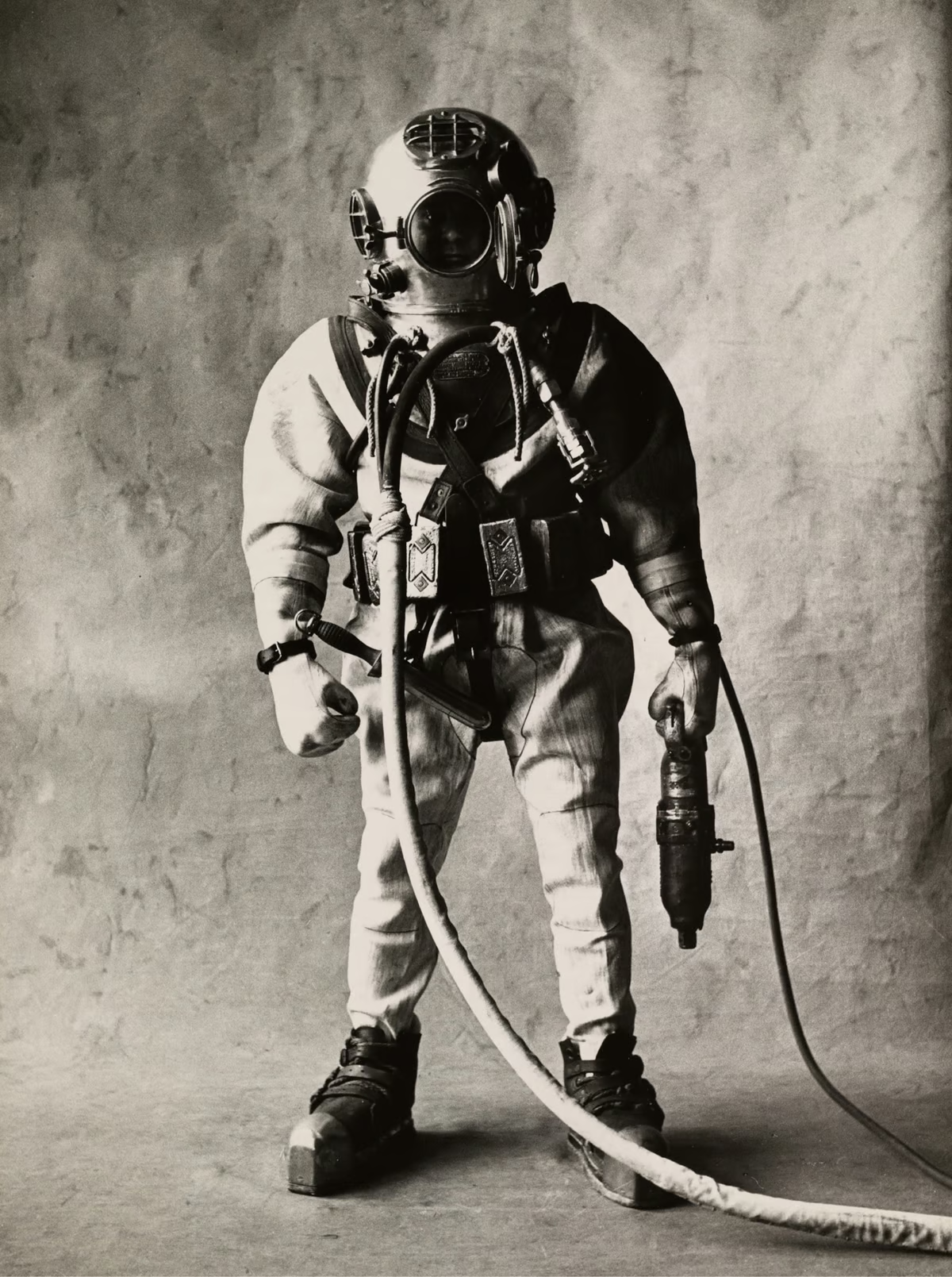
In 1950, master photographer Irving Penn set up a simple studio in Paris and started to photograph people of all kinds of professions, each wearing their work clothes and carrying the tools of their trade.
Working in the tradition of representing the petits métiers, Penn photographed fishmongers, firefighters, butchers, bakers, divers, baseball umpires, chefs, bike messengers, and sellers of goods of all kinds.
Penn continued photographing workers in New York and London, collecting the photos into a project called Small Trades.
Like everyone else who has recorded the look of tradesmen and workers, the author of this book was motivated by the fact that individuality and occupational pride seem on the wane. To a degree everyone has proved right, and since these photographs were made, London chimney sweeps have all but disappeared and in New York horseshoers — hard to find in 1950 — now scarcely exist…
As we peruse professions, we might send muckraking birthday greetings to Upton Sinclair; he was born on this date in 1878. A writer, activist, and politician, he is probably best remembered for his classic novel, The Jungle, which exposed labor and sanitary conditions in the U.S. meatpacking industry, causing a public uproar that contributed in part to the passage a few months later of the 1906 Pure Food and Drug Act and the Meat Inspection Act.
Many of his novels can be read as historical works. Writing during the Progressive Era, Sinclair describes the world of the industrialized United States from both the working man’s and the industrialist’s points of view: e.g., King Coal (1917, covering John D. Rockefeller and the 1914 Ludlow Massacre in the coal fields of Colorado), Oil! (1927, the Teapot Dome Scandal), and The Flivver King (1937, Henry Ford– his “wage reform,” his company’s Sociological Department, and his decline into antisemitism) describe the working conditions of the coal, oil, and auto industries at the time.
Sinclair ran (as a Democrat) for Governor of California in 1934, during the Great Depression, under the banner of the End Poverty in California campaign, but was defeated in the general election.
He was awarded he Pulitzer Prize for Fiction in 1943 for Dragon’s Teeth, which portrayed the Nazi takeover of Germany during the 1930s.
It is difficult to get a man to understand something, when his salary depends upon his not understanding it.
Upton Sinclair, ruminating on his gubernatorial loss
Trends across all causes and risks of disease/disability show that there have been substantial declines in infectious diseases, malnutrition, cardiovascular diseases, and several cancers. But even as we make strides in addressing physical health, mental health challenges are on the rise. In sharp contrast, mental health disorders and alcohol-related disability adjusted life years (DALYS) have increased sharply over the last few decades, especially among people aged 25 to 74.
The WHO found that the two most common mental disorders, anxiety and depression, cost global GDP $1 trillion in 2010. Lost output for the same time period attributed to mental, neurological, and substance abuse disorders – which often intersect – was estimated between $2.5-$8.5 trillion. This is expected to double by 2030.
A report from the Aspen Institute and Dalberg explores the global rise of mental illness through economics, lived experiences, and expert insights…
According to the World Health Organization (WHO), 450 million people suffer from some form of mental illness over the course of their lives. So, it’s no surprise that many of us have experienced, or know some-one who has experienced, severe struggles with mental health. This is a full-blown crisis exacerbated by a lack of infrastructure, lack of funding, and a lack of health equity. This is despite the fact that mental health issues are the leading cause of disability globally. Also, according to the WHO, mental health conditions are the primary cause of suicide. And suicide is the second leading cause of death for people age 15to 29. This is a crisis of our time.
In this report, we offer a snapshot into both the magnitude and the scope of the mental health crisis facing humanity. In addition to briefly framing the issues, we share summaries of dozens of interviews we held with both “expert practitioners” working both in the public and private sectors and individuals with a “lived experience” touched by mental health struggles.
In the course of our work, we looked for recurring themes that could promote a dialogue about seeking sustainable, scalable solutions to the crisis. Among those themes are the challenges of building an infrastructure for access to quality mental healthcare, the continued lack of parity between the provision of services for mental health versus physical health, and the pervasiveness of stigma associated with diseases of the mind.
Further, although most of us do not think of mental health as related to investing, and if we do, we might find the notion distasteful, there are indeed a growing number of developing technologies and treatment modalities that hold promise for expanding access to mental health services and offering innovative practices. We highlight a handful of examples. The individuals who generously shared their personal struggles also shared the resources and practices that they found most helpful.
We acknowledge the global nature of the crisis and the role that both the pandemic and other contextual factors have played in substantial increases in anxiety disorders and other mental health issues. Further, we are seeing increases in specific demographics, such as poorer mental health among women, with one in five women experience a more common mental disorder (such as anxiety or depression), compared with one in eight men. No demographic is immune.
Given the crisis at hand, it is our hope that offering greater transparency to the world of mental health will stimulate a search for solutions…
* from the notebook of Arthur Fleck (AKA, The Joker), via Todd Phillips 2019 film Joker
###
As we care about care, we might recall that it was on this date in 2019 that the first presentation print of Todd Phillip’s film Joker was shipped to Italy, where it premiered at the Venice International Film Festival and won the Golden Lion, the fest’s top prize. The film went on to box office success and set records for an October release. It grossed over $1 billion; the first R-rated to do so. It received numerous accolades, including two Academy Award wins at the 92nd Academy Awards for Best Actor (Joaquin Phoenix) & Best Original Score (Hildur Guðnadóttir) out of 11 nominations including Best Picture, first DC film to score.
According to the US Bureau of Labor Statistics, from 2000 to present, prices in the hospital industry have grown faster than prices in any other sector of the US economy. The $1.3 trillion US hospital sector accounts for 6% of US GDP, nearly a third of all health care spending (which is materially higher as a share of GDP in the U.S. than in any other country). The average price for an inpatient hospital stay is $25,000.
A new working paper from the NBER assesses the impact of these rising costs. From its abstract:
We analyze the economic consequences of rising health care prices in the US. Using exposure to price increases caused by horizontal hospital mergers as an instrument, we show that rising prices raise the cost of labor by increasing employer-sponsored health insurance premiums. A 1% increase in health care prices lowers both payroll and employment at firms outside the health sector by approximately 0.4%. At the county level, a 1% increase in health care prices reduces per capita labor income by 0.27%, increases flows into unemployment by approximately 0.1 percentage points (1%), lowers federal income tax receipts by 0.4%, and increases unemployment insurance payments by 2.5%. The increases in unemployment we observe are concentrated among workers earning between $20,000 and $100,000 annually. Finally, we estimate that a 1% increase in health care prices leads to a 1 per 100,000 population (2.7%) increase in deaths from suicides and overdoses. This implies that approximately 1 in 140 of the individuals who become fully separated from the labor market after health care prices increase die from a suicide or drug overdose.
Four of the authors of that paper looked more deeply into the issue, exploring why those costs are rising; they identified consolidation in the hospital sector– 90% of hospital markets are now highly concentrated, according to the thresholds set by the FTC and the U.S. Department of Justice– as a key culprit:
The study, conducted in collaboration with researchers at Harvard University, Yale University, and the University of Wisconsin-Madison, found that of 1,164 mergers among the nation’s approximately 5,000 acute-care hospitals that occurred in the United States from 2000 to 2020, the Federal Trade Commission (FTC), which is tasked with preserving competition, challenged only 13 of them — an enforcement rate of about 1%.
Meanwhile, the researchers show that the FTC, using standard screening tools available to the agency during that period, could have flagged 20% of the mergers — 238 transactions — as likely to cause reduced competition and increase prices…
Unchallenged hospital mergers should have had minimal effects on competition and prices if the FTC were optimally targeting enforcement, the researchers noted. However, using data on the prices that hospitals negotiate with private insurers, the researchers found that mergers the FTC could have challenged as predictably anti-competitive between 2010 and 2015 eventually led to price increases of 5% or more.
The researchers estimate that the 53 hospital mergers that occurred on average annually from 2010 to 2015 raised health spending on the privately insured by $204 million in the following year alone. Putting this spending increase in context, the researchers note that the FTC’s average annual budget and antitrust enforcement budget between 2010 and 2015 were $315 and $136 million, respectively…
The study found that mergers in rural regions and areas with lower incomes and higher rates of poverty generated larger average price increases, often in outpatient services. The researchers suggest this occurred because those regions — compared with higher income, urban settings—have fewer free-standing clinics that offer surgical and imaging services that compete against hospitals in the outpatient market…
The health system is a perfect example of how monopolization drives more monopolization, and how that comes to harm the public and workers. Health consolidation began with pharma mergers, that led to pharma companies gouging hospitals. Hospitals, in turn, engaged in a nonstop orgy of mergers, which created regional monopolies that could resist the pricing power of monopoly pharma – and screw insurers. That kicked off consolidation in insurance, which is why most Americans have a “choice” of between one and three private insurers – and why health workers’ monopoly employers have eroded their wages and working conditions.
How consolidation in the hospital sector is increasing healthcare prices and creating even steeper costs more broadly in the economy. @nberpubs@AEAjournals@doctorow
* Mitch Kapor
###
As we measure our blood pressure, we might send concerned birthday greetings to Janette Sherman; she was born on this date in 1930. A physician, toxicologist, author, and activist. She researched pesticides, nuclear radiation, birth defects, breast cancer, and illnesses caused by toxins in homes and was a pioneer in the field of occupational and environmental health.
Dr. Sherman served as a medical-legal expert witness in more than 5,000 workers’ compensation claims and served as an expert witness for residents in communities affected by environmental hazards, most famously the Love Canal neighborhood of Niagara Falls, N.Y. Her medical-legal files, among the largest collections of their kind in the United States, are preserved at the National Library of Medicine at the National Institutes of Health in Bethesda, Md.





You must be logged in to post a comment.