Posts Tagged ‘Hannah Arendt’
“The problem with introspection is that it has no end”*…

Still, we persevere. Samantha Rose Hill considers Hannah Arendt‘s final unfinished work, in which the philosopher (and self-described political theorist) mounted an incisive critique of the idea that we are in search of our true selves. More specifically, she explores Arendt’s wrestling with the concept of authenticity…
… In the midst of the Second World War, French existentialism emerged out of German existentialism. If authenticity was a question of being for Heidegger and a question of freedom for Jaspers, for Jean-Paul Sartre, Simone de Beauvoir and Albert Camus it became a question of individual ethics. The underlying question shifted from ‘What is the meaning of Being?’ to ‘How should I be?’ The credo underpinning Sartre’s work – ‘existence precedes essence’ – meant that we are thrown into the world without any fixed substance, and this meant that we get to choose who we become. While philosophers like Thomas Hobbes and Jean-Jacques Rousseau tried to capture human nature by imagining what life was like before society, for Sartre, there is no human nature. We must always be imagining and reimagining who we are, which is to say we are always in the process of becoming. For Beauvoir, becoming was a creative enterprise, a work of art. And she argued that it was not enough to shape oneself within the existing conditions of the world, but that one must also shape the conditions of the world itself. Authenticity for the French existentialists was not about uncovering a pre-existing true self, but rather choosing to engage in a process of becoming.
Caught between German and French existentialism, Arendt offered a critique of authenticity in her final unfinished work, The Life of the Mind. In place of authenticity, Arendt turned to the concept of the will in order to think about how one decides to act in the world. A student of Heidegger and Jaspers, and a fellow traveller of Sartre, Camus and Beauvoir from 1933-41 during her years of exile in Paris, Arendt rejected the idea that a true self exists within the self. She was not a transcendental thinker. For her there was no capital-G God, and there was no capital-B Being. In place of an inner-authentic self, she argued that the inner organ of decision-making that guided one’s actions was the will.
Following the work of St Augustine and Jaspers, Arendt turned Heidegger on his head and argued that all thinking moves from experience in the world, not from Being. By arguing that thinking was a function of Being, Heidegger had tried to divorce thinking from the will in order to argue that it was one’s true inner Being that determined ultimately who they became in the world. But for Arendt, this was an abdication of personal responsibility and choice. It was a way of handing over one’s decision-making power. And for her, it is only the choices that we make in real time when confronted with decisions that determine who we will become, and in turn determine the kind of world that we will help to shape.
So, what is the will? And is it a persuasive alternative to authenticity?
Unlike ‘authenticity’, ‘willing’ is not a very desirable word. First of all, it’s not a thing one can possess, it’s an action, something one has to do. And unlike authenticity, there is no sense of comfort in ‘the will’. Authenticity promises certainty, whereas the will promises uncertainty. And in times of turmoil, it is all too human to prefer that which promises predictability to the unknown. Colloquially, willing usually appears around New Year’s Eve when people start talking about resolutions and how they’d like to change their lives. The will becomes a question of ‘willpower’. Or worse, willing can remind us of those difficult times when someone implores us ‘Are you willing to cooperate?’ ‘Are you willing to try?’ ‘Are you willing to do what it takes to get the job done?’ But for Arendt, the will was the means to our freedom, it was the promise that we can always be other than we are, and so to the world. The will is a space of tension inside the self where one actively feels the difference between where they are and where they would like to be.
Willing is the mental activity that goes on between thinking and judgment. It has the power to shape us by drawing us into conflict with ourselves. Without inner conflict, there is no forward movement. These are the basic principles of willing:
- Willing is characterised by an inner state of disharmony.
- Willing is experienced as a felt sense of tension within the body where the mind is at war with itself.
- Willing makes one aware of possible decisions, which creates a feeling of being pulled in multiple directions at once.
- Willing can feel very lonely. Decisions and choices are shaped by one’s environment, by the everydayness of being, but ultimately the responsibility for deciding is up to oneself.
- Willing makes one aware of the tension that exists between oneself as a part of the world, and oneself as an individual alone existing in relationship to the world.
- Willing is the principle of human individuation.
- Willing relates to the world through action.
- The will is the inner organ of freedom.
Everyone makes hundreds of decisions a day, but most of the time they aren’t conscious of the decisions they are making. Their decisions are not subjected to the will. Instead, they are simply following a routine of patterns that have been formed over time. In order to engage the will, one must be willing to pause. Because, while thinking moves from past experience, and imagination fixates on what might happen in the future, the past and the future are beyond the reach of the will. Willing is what happens before one acts. To be in a state of willing is to be in the Now.
Authenticity is attractive in part because it promises a sense of harmony, it is the promise that, if we know who we are, then we can act in a way where our actions are in alignment with our values. But the will is characterised by a sense of conflict. It is the inner organ that generates tension within the self, making one aware of the discrepancies between who they are and who they might like to be, or what they want and what they might be able to have. But it is this tension that is vital for bringing consciousness to decision-making…
Eminently worth reading in full: “Beyond authenticity,” from @Samantharhill in @aeonmag.
Pair with Lionel Trilling‘s Sincerity and Authenticity, the transcriptions of his 1970 Norton Lectures at Harvard, in which Trilling examined “the moral life in process of revising itself” as first sincerity (in the pre-Enlightenment, e.g., Shakespeare), then “authenticity” (in the 20th century, as the article linked above explains) became central to moral thought.
* Philip K. Dick
###
As we double down on determination, we might recall that it was on this date in 2000 that the boy band *NSYNC had its first number #1 hit, “It’s Gonna Be Me.”
“Only in our speaking with one another does the world, as that about which we speak, emerge in its objectivity and visibility from all sides”*…

Blake Smith on trail-blazing publisher Michael Denneny and his embodiment of his mentor’s– Hannah Arendt‘s– thought…
Michael Denneny, the recently deceased co-founder and co-editor of the pioneering gay magazine Christopher Street , gay newspaper New York Native , and the gay publishing line at St. Martin’s Press, Stonewall Inn Editions, began his recently published collection of essays On Christopher Street with a quotation from his mentor, Hannah Arendt:
Only in our speaking with one another does the world, as that about which we speak, emerge in its objectivity and visibility from all sides. Living in a real world and speaking with one another about it are basically one and the same.
Denneny’s career as a gay cultural activist was a way of putting into practice Arendt’s thought as condensed in this citation…
…
Arendt argued throughout her work, although with critically shifting emphases, that the possibility of political freedom for society as whole depends on particular groups within it being able to constitute distinct “worlds” in which their members can exchange perspectives, debate their common interests, and face the wider “world” composed of other groups. That is, a healthy society is diverse in the sense of being made up of individual units like economic classes and religious and ethnic minorities (represented by associations, trade unions, churches etc.), which are themselves characterized by internal diversity and lively debate.
Diversity and debate prevent, in a logic familiar from Montesquieu and Madison, the emergence of a single all-powerful leader or stifling consensus. In such accounts, which form the basis for American political common sense today, we imagine minorities as homogenous interest groups, which, in the play of their rival ambitions, keep each other in check, through a kind of balance of power akin to that at work in international relations. Politicized minorities, each pursuing its collective interests, can, if their debates and rivalries are properly channeled, be a force for good in politics.
Arendt’s argument is substantively different. In her account, minorities are important not insofar as they are internally unified groups engaged in the play of countervailing interests and powers, but rather insofar as they are internally heterogeneous groups whose very diversity offers a sort of school in which citizens learn how to have judgment: the capacity to express and exchange ideas without appeal to fixed rules. Differences within “our own groups”—our everyday experiences of debates with other people “like us” in the spaces of our associational life (synagogues, union halls, gay bars, etc.) prepare us for the still more challenging experiences of disagreement in our wider political life, where we cannot necessarily trust that our interlocutors share our identities, experiences, and goals.
Indeed, the experience of uncertainty is constitutive of politics, as Arendt saw it. Politics is one of a number of domains, she argued, in which we cannot call upon, in the course of our mutual questioning about what is to be done, anything like a logical principle (2+2=4) that all rational beings might recognize or a universally agreed-upon norm that all, or nearly all, members of our community do recognize. In these domains we are obligated to, as she often says, “woo” each other, to practice the arts of rhetorical seduction—which does not mean in her account, that we are in debates over politics merely practicing sophistry.
Rather, we are—as we find ourselves constantly doing in our most quotidian, non-political conversations—appealing to each other to share perspectives (Look!, we say, don’t you see?), on the assumption that each of us is positioned differently, because of our experiences, knowledge, interests, etc., in relation to a field of objects to which we all refer. We assume, in other words, that our divergent perspectives are perspectives on something, on the same things, and that we can by discussing them, inviting our interlocutors into our position by rendering it in speech, and projecting ourselves through our imaginations into their own positions, come closer to a true picture of the situation…
…
…there is a danger that we may [Arendt argued], in the very exchange of perspectives, be speaking not at all to each other, that is, to specific interlocutors whose perspectives—and ultimately whose agreement—we desire (and thus whose disagreement we must tolerate), but rather to an abstract universal media pseudo-conversation, to the empty signifier of an invisible authority [and] one must admit that this peril characterizes our idle chatter on Twitter no less than the talk at cocktail parties and banal book reviews Arendt lamented in her day. In that sense it is not necessarily such a disaster if, for the moment, the possibility of a “national conversation” in media and politics seems to be suspended. Indeed, the whole point of Arendt and Denneny’s insight is to remind us that if we are to learn again how to speak to each other (and not merely speak in each other’s—perhaps merely virtual—presence), then participation in the life of real, concrete, internally diverse groups will be our classrooms…
Hannah Arendt, Michael Denneny, and the real value of diversity: “Living in Arendt’s World.”
* Hannah Arendt
###
As we explore empathy, we might recall that it was on this date in 2015 that Cecilia Bleasdale sent her daughter Grace photo of a dress she intended to wear to Grace’s wedding. Celia thought that the dress, blue with black lace, would be perfect; but her daughter saw a white dress with gold lace. Grace posted the photo to Facebook, and the debate– blue/black or white/gold– broadened.
Then a friend uploaded it to Tumblr… and the argument went global. That post saw up to 840,000 views per minute. The next day, the retailer, Roman Originals (which confirmed that the dress was, in fact, blue and black), sold out of the model within 30 minutes.
It spread further. Celebrities posted and reposted, tweeted and retweeted (e.g., Taylor Swift, who saw blue and black and said she was “confused and scared,” was retweeted 111,134 times and liked 154,188 times); morning news shows covered the controversy…
Science has yet adequately to explain the phenomenon.

“I prefer radio to TV because the pictures are better”*…

Was Walter Benjamin the ur-podcaster? Peter E. Gordon on Benjamin’s audio adventures, how they relate to his cultural theories, and what they suggest about what has become (and may yet become) of audio…
No audio recordings of Walter Benjamin have survived. His voice was once described as beautiful, even melodious—just the sort of voice that would have been suitable for the new medium of radio broadcasting that spread across Germany in the 1920s. If one could pay the fee for a wireless receiver, Benjamin could be heard in the late afternoons or early evenings, often during what was called “Youth Hour.” His topics ranged widely, from a brass works outside Berlin to a fish market in Naples. In one broadcast, he lavished his attention on an antiquarian bookstore with aisles like labyrinths, whose walls were adorned with drawings of enchanted forests and castles. For others, he related “True Dog Stories” or perplexed his young listeners with brain teasers and riddles. He also wrote, and even acted in, a variety of radio plays that satirized the history of German literature or plunged into surrealist fantasy. One such play introduced a lunar creature named Labu who bore the august title “President of the Moon Committee for Earth Research.”
Today Benjamin is widely esteemed as one of the foremost cultural critics and theorists of the 20th century. But his career was uneven and marked by failure. In 1925, after the faculty of philosophy in Frankfurt rejected his enigmatic study of German Baroque drama and dashed his hopes for an academic career, he found himself adrift, with little assurance of a regular income. But this failure also brought freedom. His untethering from the university meant that he could indulge in his interests without restraint, and he turned his talents to writing essays that took in the whole panorama of modern life—from high literature to children’s books and from photography to film—and, for nearly six years, he supplemented his earnings with radio broadcasts, some for adults and others meant especially for children. Of the many broadcasts, about 90 in all, that he produced for the radio stations in Frankfurt and Berlin, only a fragment of a single audio recording has been preserved; unfortunately, Benjamin’s voice cannot be heard.
Now transcripts of these broadcasts have been assembled and translated into English in a new volume edited by Lecia Rosenthal, whose incisive introduction assists the reader in appreciating their true significance. One can’t help but wonder what Benjamin would have made of all this attention, since he was inclined to dismiss his radio work as unimportant. In correspondence with his friend Gershom Scholem, he wrote with some embarrassment of “piddling radio matters” and condemned nearly all of it as having “no interest except in economic terms.” Today we know that he was mistaken. The transcripts are more than mere ephemera; they are perfect specimens of Benjamin’s interpretative method, exercises in a style of urban semiotics that he would later apply during his exile in Paris. Hannah Arendt once likened her late friend to a pearl diver who possessed a gift for diving into the wreckage of bourgeois civilization and emerging into the sunlight with the rarest of treasures. The radio transcripts offer further evidence of a genius whose career was ended far too soon…
A fascinating– and illuminating– read. Walter Benjamin’s radio years: “President of the Moon Committee,” from @thenation.
* Alistair Cooke
###
As we listen in, we might spare a thought for Hugo Gernsback, a Luxemborgian-American inventor, broadcast pioneer, writer, and publisher; he was born on this date in 1884. Gernsback founded radio station WRNY, was involved in the first television broadcasts, and is considered a pioneer in amateur radio. And he was a prolific inventor, with 80 patents at the time of his death.
But it was a writer and publisher that he probably left his most lasting mark: In 1926, as owner/publisher of the magazine Modern Electrics, he filled a blank spot in his publication by dashing off the first chapter of a series called “Ralph 124C 41+.” The twelve installments of “Ralph” were filled with inventions unknown in 1926, including “television” (Gernsback is credited with introducing the word), fluorescent lighting, juke boxes, solar energy, television, microfilm, vending machines, and the device we now call radar.
The “Ralph” series was an astounding success with readers; and later that year Gernsback founded the first magazine devoted to science fiction, Amazing Stories. Believing that the perfect sci-fi story is “75 percent literature interwoven with 25 percent science,” he coined the term “science fiction.”
Gernsback was a “careful” businessman, who was tight with the fees that he paid his writers– so tight that H. P. Lovecraft and Clark Ashton Smith referred to him as “Hugo the Rat.”
Still, his contributions to the genre as publisher were so significant that, along with H.G. Wells and Jules Verne, he is sometimes called “The Father of Science Fiction”; in his honor, the annual Science Fiction Achievement awards are called the “Hugos.”

“It is hard enough to remember my opinions, without also remembering my reasons for them!”*…

This is my summary of the history of (Western) philosophy showing the positive/negative connections between some of the key ideas/arguments of the philosophers. It’s a never-ending work-in-progress and the current version is mainly based on Bryan Magee’s The Story of Philosophy and Thomas Baldwin’s Contemporary Philosophy, with many other references for specific philosophers/arguments. (The source is noted with the book icon that appears when you click on an argument.)…
From Deniz Cem Önduygu, a fascinating interactive tool for exploring the development of Western philosophy: “The history of philosophy, summarized and visualized.” [TotH to friend MK]
For a different (but also engaging) visualization of some of this same history, see “The Structure of Recent Philosophy.”
* Friedrich Nietzsche
###
As we investigate influence, we might send deeply-thoughtful birthday greetings to Hannah Arendt; she was born on this date in 1906. Though often categorized as a philosopher, she self-identified as a political theorist, arguing that philosophy deals with “man in the singular,” while her work centers on the fact that “men, not Man, live on the earth and inhabit the world.” One of the seminal political thinkers of the twentieth century, the power and originality of her thinking was evident in works such as The Origins of Totalitarianism, The Human Condition, On Revolution and The Life of the Mind. Her famous New Yorker essay and later book, Eichmann in Jerusalem: A Report on the Banality of Evil— in which she raised the question of whether evil is radical or simply a function of thoughtlessness, a tendency of ordinary people to obey orders and conform to mass opinion without a critical evaluation of the consequences of their actions and inaction– was controversial as it was widely misunderstood as defending Eichmann and blaming Jewish leaders for the Holocaust. That book ended:
Just as you [Eichmann] supported and carried out a policy of not wanting to share the earth with the Jewish people and the people of a number of other nations—as though you and your superiors had any right to determine who should and who should not inhabit the world—we find that no one, that is, no member of the human race, can be expected to want to share the earth with you. This is the reason, and the only reason, you must hang.

“Nothing is easier than to denounce the evildoer; nothing is more difficult than to understand him”*…

Adolf Eichmann at his 1961 trial
Can one do evil without being evil? This was the puzzling question that the philosopher Hannah Arendt grappled with when she reported for The New Yorker in 1961 on the war crimes trial of Adolph Eichmann, the Nazi operative responsible for organising the transportation of millions of Jews and others to various concentration camps in support of the Nazi’s Final Solution.
Arendt found Eichmann an ordinary, rather bland, bureaucrat, who in her words, was ‘neither perverted nor sadistic’, but ‘terrifyingly normal’. He acted without any motive other than to diligently advance his career in the Nazi bureaucracy. Eichmann was not an amoral monster, she concluded in her study of the case, Eichmann in Jerusalem: A Report on the Banality of Evil(1963). Instead, he performed evil deeds without evil intentions, a fact connected to his ‘thoughtlessness’, a disengagement from the reality of his evil acts. Eichmann ‘never realised what he was doing’ due to an ‘inability… to think from the standpoint of somebody else’. Lacking this particular cognitive ability, he ‘commit crimes under circumstances that made it well-nigh impossible for him to know or to feel that he [was] doing wrong’.
Arendt dubbed these collective characteristics of Eichmann ‘the banality of evil’…
The banality-of-evil thesis was a flashpoint for controversy. To Arendt’s critics, it seemed absolutely inexplicable that Eichmann could have played a key role in the Nazi genocide yet have no evil intentions. Gershom Scholem, a fellow philosopher (and theologian), wrote to Arendt in 1963 that her banality-of-evil thesis was merely a slogan that ‘does not impress me, certainly, as the product of profound analysis’. Mary McCarthy, a novelist and good friend of Arendt, voiced sheer incomprehension: ‘[I]t seems to me that what you are saying is that Eichmann lacks an inherent human quality: the capacity for thought, consciousness – conscience. But then isn’t he a monster simply?’
The controversy continues to the present day…
Interrogate right and wrong at “What did Hannah Arendt really mean by the banality of evil?”
* Fyodor Dostoyevsky
###
As we think about the unthinkable, we might wish a crafty Happy Birthday to Niccolò di Bernardo dei Machiavelli; he was born on this date in 1469. Machiavelli wrote comedies, poetry, and some of the best-known personal correspondence in Italian; but he is best remembered as a Man of Affairs, first as a servant of the Florentine Republic in a time during which Medici influence was on the wane. His most famous work, The Prince— first published as a pamphlet in 1513– was written mid-career to gain favor with the Medici, who were at that point regaining dominance in Florence. The essay on the exercise of power (inspired by Cesare Borgia) not only failed to win over the Medici, it alienated Machiavelli from the Florentine public; he never again played an important role in government. Indeed, when the Florentine Republic was established in 1527, Machiavelli was effectively ostracized.
But published in book form posthumously (in 1532), The Prince began its steady growth in influence. And of course today, Machiavelli is considered one of the fathers of modern political theory.
For an extraordinarily-insightful look at Machiavelli’s thinking, see Isaiah Berlin’s “The Question of Machiavelli.”
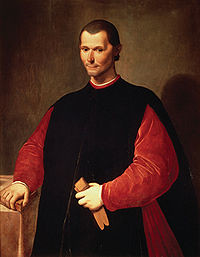
Niccolò Machiavelli by Santi di Tito
You must be logged in to post a comment.