Posts Tagged ‘Machiavelli’
“Remember that all through history, there have been tyrants and murderers, and for a time, they seem invincible. But in the end, they always fall. Always.”…

Indeed, they fall; they very rarely go willingly. And as autocrats rise in a growing number of countries, this is an increasingly valent issue. The estimable Branko Milanovic on why they hang on…
In an interesting paper he tweeted yesterday, Kaushik Basu discusses, using a mathematical model, an old problem: how rulers once they are in power cannot leave it even if they wish to do so, because their road to power, and in power, is littered with corpses that will all (metaphorically) ask revenge if the ruler were to step down. Furthermore, since the number of misdeeds and of rulers’ real or imagined enemies multiplies with each additional period in power, they need to resort to increasingly greater oppression to stay in power. Thus, even the originally well-meaning or tolerant rulers become, with the duration of their rule, tyrants. Basu is aware of the millennial nature of the problem; he cites Shakespeare’s Macbeth. He could have also cited Tacitus’ description of Tiberius’ descent into murderous suspiciousness and folly.
Basu terms this issue “temporal inconsistency” because his assumption is that the ruler would like at one point to leave and spend the rest of his life in affluence and leisure. (I write in “his” life because all individuals listed in Basu’s paper are men, and he strangely resorts to the use of “she” and “her” in the mathematical part of the paper.) This assumption of a ruler who wants to retire is unrealistic, and I will explain why below, But before I do so, I need to note that there is no inconsistency in the ruler’s or dictator’s behavior in each individual period. (Basu acknowledges this in the latter part of the paper by stating that fully rational maximizing behavior in each individual period may still lead to on overall suboptimal outcome.). Assume that the ruler plays an annual game where he wonders: am I better off if I retire now or if I commit another crime which would make my retirement next year more difficult but my rule this year safer? The answer is simple: he is better off committing another crime in the expectation that this would make his overthrow less likely. He replays that game every year and every year he reaches the same conclusion. Thus, the ruler’s decisions are not at all irrational or even inconsistent…
When power as such becomes the objective, as it is among all politicians, and autocratic rulers especially, there is no amount of worldly goods that could substitute for power. Rulers cannot be cajoled (as Basu seems to believe) into leaving power. And this is not just because of the possible punishment that may await them in retirement, but because they crave, and they need, the exercise of, power…
The same applies to ideologues. Or perhaps even more so because ideologues believe that they are on a unique mission to save their nation or the world, and obviously then being in power is a necessary condition for such a salvation…
… there is nothing that can be offered to dictators to make them step down. They have to continue to rule until they either die peacefully in their beds and after death became either vilified or celebrated (or at times, both), or until they are overthrown, or meet an assassin’s bullet. Once on the top, there is no exit. They have become prisoners like many others they have thrown in jail…
What drives autocrats: “There is no exit for dictators,” a sobering read from @BrankoMilan.
* Mahatma Gandhi, Gandhi: An Autobiography
###
As we ponder power and its products, we might recall that on this date in 1965 the number #1 song on the U.S. pop charts was “Get Off of My Cloud,” by the Rolling Stones (lyrics by Jagger; melody, Richards)
“One who deceives will always find those who allow themselves to be deceived”*…

Even if 2020 [and indeed, the events of January 6, 2021] felt apocalyptic, it is reasonable to think we have not yet hit rock bottom. The threat of climate disaster and resource wars, the building of walls and refugee camps, the exorbitant wealth of powerful oligarchs alongside poverty and precarity—these will not go away with vaccines or new presidents. Amidst all this, no wonder Niccolò Machiavelli has returned to our reading lists. In his new biography of the Florentine Secretary, Machiavelli: The Art of Teaching the People What to Fear, originally published in French in 2017, historian Patrick Boucheron reminds us that there is always interest in Machiavelli in turbulent times “because he’s the man to philosophize in heavy weather. If we’re reading him today, it means we should be worried. He’s back: wake up.”
Born in 1469 in Florence, Machiavelli is a central figure in the Western canon of political philosophy. Though he is best known in the popular imagination as the conniving mastermind behind The Prince (written in 1513), which so many think of as a kind of House of Cards how-to guide for seizing and maintaining political power, we miss what is crucial when we reduce his political thought to the simplistic thesis that the ends justify the means. It is not this misunderstood consequentialism that is noteworthy in Machiavelli’s philosophy; what really makes his writing so radically distinctive is his class-based, materialist outlook. He came from an impoverished household, and his philosophy disrupted naturalized hierarchies and the hegemonic ideas that reproduce them. John Adams would rightly describe him as the founder of a “plebeian philosophy” that marshaled strong arguments for embracing popular control over government…
The introduction to the English edition of The Art of Teaching the People What to Fear, written in June 2019 for readers in the United States, begins with the theme of fear in politics and an issue of Time magazine with Trump on the cover. Boucheron argues that the United States had entered a “Machiavellian moment”—“the dawning realization of the inadequacy of the republican ideal”—in the aftermath of the 9/11 terrorist attacks and that today, under “Trumpian America,” a fusion of politics and fiction has allowed for techniques of domination to be perfected, setting “a general disregard for the ‘actual truth of the matter.’” Referencing George Orwell’s 1984, Boucheron sees the United States as captured by a propaganda machine that has undermined reality and common sense—“that sixth sense Machiavelli spoke of, the accessory knowledge that the people have of what is dominating them.” Given the pervasive lack of realism in U.S. politics today, it is clear that the republic would appear to Machiavelli as a corrupt order, not because the powerful few break the rules or because a faction attempts to undermine the integrity of elections, but because the people have been “either deceived or forced into decreeing their own ruin.” Perhaps the most important part of Machiavelli’s wisdom for our own time is that republics tend to become oligarchic, giving the powerful few indirect control over government…
Much maligned as a mere tactician of power, Machiavelli was in fact a philosopher of the people. His critique of oligarchic domination remains essential today: “Our Machiavellian Moment.”
* Niccolò Machiavelli
###
As we ponder populism, we might recall that it was on this date in 1776 that Thomas Paine first published (albeit anonymously) his pamphlet “Common Sense.” A scathing attack on “tyrant” King George III’s reign over the colonies and a call for complete independence, “Common Sense” advocated immediate action. America, Paine argued, had a moral obligation to reject monarchy and declare independence. An instant bestseller in both the colonies and Britain (over 120,000 copies in just a few months), it greatly affected public sentiment at a time when the question of independence was still undecided, and helped shape the deliberations of the Continental Congress leading up to the Declaration of Independence.

“Everyone sees what you appear to be, few experience what you really are”*…

Niccolò Machiavelli has a bad reputation. Ever since the 16th century, when manuscript copies of his great work The Prince began to circulate in Europe, his family name has been used to describe a particularly nasty form of politics: calculating, cutthroat and self-interested. There are, to be sure, reasons for this. Machiavelli at one point advises a political leader who has recently annexed a new territory to make sure to eliminate the bloodline of the previous ruler lest they form a conspiracy to unseat him. He also praises the ‘cruelty … well-used’ by the mercenary captain Cesare Borgia in laying the foundations of his rule of the area around Rome. However, Machiavelli did not invent ‘Machiavellian politics’. Nor was his advocacy of force and fraud to acquire and maintain rule the cause of individual leaders using them. What then did Machiavelli do? What did he want to achieve?…
Machiavelli’s name has become synonymous with egotistic political scheming, yet his work is effectively democratic at heart; Catherine Heldt Zuckert explains: “The people’s Prince.”
[image above: source— also worth a listen on this subject]
The Prince
###
As we ponder power and presentation, we might send traitorous birthday greetings to Mildred Elizabeth Gillars; she was born on this date in 1900. After failing to find a career in the theater, vaudeville, or music in New York City, she left the country, ending up in the 1930s in Berlin… where, in 1940, she became announcer for the Reichs-Rundfunk-Gesellschaft (RRG), German State Radio. She broadcast English-language propaganda throughout World War II, earning (with her colleague Rita Zucca) the nickname “Axis Sally.” She was captured after the war and convicted of treason by the United States in 1949.

“Nothing is easier than to denounce the evildoer; nothing is more difficult than to understand him”*…

Adolf Eichmann at his 1961 trial
Can one do evil without being evil? This was the puzzling question that the philosopher Hannah Arendt grappled with when she reported for The New Yorker in 1961 on the war crimes trial of Adolph Eichmann, the Nazi operative responsible for organising the transportation of millions of Jews and others to various concentration camps in support of the Nazi’s Final Solution.
Arendt found Eichmann an ordinary, rather bland, bureaucrat, who in her words, was ‘neither perverted nor sadistic’, but ‘terrifyingly normal’. He acted without any motive other than to diligently advance his career in the Nazi bureaucracy. Eichmann was not an amoral monster, she concluded in her study of the case, Eichmann in Jerusalem: A Report on the Banality of Evil(1963). Instead, he performed evil deeds without evil intentions, a fact connected to his ‘thoughtlessness’, a disengagement from the reality of his evil acts. Eichmann ‘never realised what he was doing’ due to an ‘inability… to think from the standpoint of somebody else’. Lacking this particular cognitive ability, he ‘commit crimes under circumstances that made it well-nigh impossible for him to know or to feel that he [was] doing wrong’.
Arendt dubbed these collective characteristics of Eichmann ‘the banality of evil’…
The banality-of-evil thesis was a flashpoint for controversy. To Arendt’s critics, it seemed absolutely inexplicable that Eichmann could have played a key role in the Nazi genocide yet have no evil intentions. Gershom Scholem, a fellow philosopher (and theologian), wrote to Arendt in 1963 that her banality-of-evil thesis was merely a slogan that ‘does not impress me, certainly, as the product of profound analysis’. Mary McCarthy, a novelist and good friend of Arendt, voiced sheer incomprehension: ‘[I]t seems to me that what you are saying is that Eichmann lacks an inherent human quality: the capacity for thought, consciousness – conscience. But then isn’t he a monster simply?’
The controversy continues to the present day…
Interrogate right and wrong at “What did Hannah Arendt really mean by the banality of evil?”
* Fyodor Dostoyevsky
###
As we think about the unthinkable, we might wish a crafty Happy Birthday to Niccolò di Bernardo dei Machiavelli; he was born on this date in 1469. Machiavelli wrote comedies, poetry, and some of the best-known personal correspondence in Italian; but he is best remembered as a Man of Affairs, first as a servant of the Florentine Republic in a time during which Medici influence was on the wane. His most famous work, The Prince— first published as a pamphlet in 1513– was written mid-career to gain favor with the Medici, who were at that point regaining dominance in Florence. The essay on the exercise of power (inspired by Cesare Borgia) not only failed to win over the Medici, it alienated Machiavelli from the Florentine public; he never again played an important role in government. Indeed, when the Florentine Republic was established in 1527, Machiavelli was effectively ostracized.
But published in book form posthumously (in 1532), The Prince began its steady growth in influence. And of course today, Machiavelli is considered one of the fathers of modern political theory.
For an extraordinarily-insightful look at Machiavelli’s thinking, see Isaiah Berlin’s “The Question of Machiavelli.”
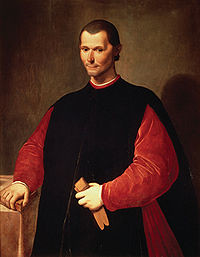
Niccolò Machiavelli by Santi di Tito
“Everyone sees what you appear to be, few experience what you really are”*…

Riverside Shakespeare Company production of The Mandrake Root, at the Casa Italia, New York, 1979, with a young Tom Hanks (center). Photograph by W. Stuart McDowell – Source
Most familiar today as the godfather of Realpolitik and as the eponym for all things cunning and devious, the Renaissance thinker Niccolò Machiavelli also had a lighter side, writing as he did a number of comedies. Christopher S. Celenza looks at perhaps the best known of these plays, Mandragola [The Mandrake Root], and explores what it can teach us about the man and his world…
More at “Machiavelli, Comedian.”
* Niccolò Machiavelli
###
As we ponder power, we might recall that it was on this date in 1515 that Thomas Wolsey was invested as a Cardinal. Henry VIII became King of England in 1509; Wolsey became the King’s almoner. Wolsey’s affairs prospered, and by 1514 he had becomeLord Chancellor, the King’s chief adviser– the controlling figure in virtually all matters of state, and extremely powerful within the Church. (His elevation to Cardinal gave him precedence even over the Archbishop of Canterbury.)
He fell from the King’s graces after failing to negotiate an annulment of Henry’s marriage to Catherine of Aragon and was stripped of his government titles. He retreated to York to fulfill his ecclesiastical duties as Archbishop of York, a position he had nominally held but had neglected during his years in government. He was recalled to London to answer to charges of treason—a common charge used by Henry against ministers who fell out of favor—but died en route of natural causes.

You must be logged in to post a comment.