Posts Tagged ‘Cartoon’
“Do I rue a life wasted doing crosswords? Yes, but I do know the three-letter word for ‘regret'”*…

Efforts to diversify the crossword puzzle industry might be having the opposite effect. As Matt Hartmann explains, although puzzles are an increasingly important part of The New York Times’ and others’ business strategies, only a handful of people actually make a living from crosswords…
The conspiracy theory writes itself. Start looking, and you’ll notice how many New York Times crossword puzzles are co-constructed (the preferred term for what most people would refer to as co-written) by a professional crossword constructor and someone with a day job—it’s hard not to see all the artists, web developers, professors, and other titles that imply a degree of wealth and elite connections. As the pandemic handed the work-from-home class extra time for their hobbies, the number of first-timers published in the Times has skyrocketed. Obviously, rich people are paying others to get the glory of their name in ink.
But the theory is almost diametrically wrong. It turns out the crossword industry really does consist of earnest wordplay lovers donating their time to unpaid mentorships, generally as part of an industry-wide effort to bring new and underrepresented people into crosswords.
Unfortunately, the end result might be even more exclusive than a pay-to-play scheme. And a game that brings the Times at least one million monthly subscribers—at $1.25 a week or $40 for a year—provides a sustainable living wage for shockingly few people…
Learn why at “Inside the Elite, Underpaid, and Weird World of Crossword Writers,” from @themhartman in @newrepublic.
###
As we fill in the blanks, we might recall that it was on this date in 1977 that South Park premiered on Comedy Central– where it runs to this day. The animated saga of Stan, Kyle, Eric, and Kenny and their exploits in their (titular) Colorado hometown has won five Emmys and a Peabody Award. A theatrical film, South Park: Bigger, Longer & Uncut, was released in June, 1999 to commercial and critical success, and scored an Academy Award nomination.

“I would say lenguage is that we may mis-unda-stend each udda”*…

Long-time readers will know that your correspondent adores George Herriman’s Krazy Kat (c.f., e.g., this post: the remarkable Chris Ware on the modern relevance of the seminal strip). Today, Amber Medland on Krazy Kat‘s huge resonance with Modernists throughout its run…
The Kat had a cult following among the modernists. For Joyce, Fitzgerald, Stein, and Picasso, all of whose work fed on playful energies similar to those unleashed in the strip, he had a double appeal, in being commercially nonviable and carrying the reek of authenticity in seeming to belong to mass culture. By the thirties, strips like Blondie were appearing daily in roughly a thousand newspapers; Krazy appeared in only thirty-five. The Kat was one of those niche-but-not-really phenomena, a darling of critics and artists alike, even after it stopped appearing in newspapers. Since then: Umberto Eco called Herriman’s work “raw poetry”; Kerouac claimed the Kat as “the immediate progenitor” of the beats; Stan Lee (Spider-Man) went with “genius”; Herriman was revered by Charles Schulz and Theodor Geisel alike. But Krazy Kat was never popular. The strip began as a sideline for Herriman, who had been making a name for himself as a cartoonist since 1902. It ran in “the waste space,” literally underfoot the characters of his more conventional 1910 comic strip The Dingbat Family, published in William Randolph Hearst’s New York Evening Journal. Hearst gave Herriman a rare lifetime contract and, with his backing, by 1913 the liminal kreatures had their own strip. Most people disliked not being able to understand it. Soon advertisers worried that formerly loyal readers would skip the strips and miss the ads. Editors were infuriated by devices like Herriman’s “intermission” panel, which disrupted the narrative by stalling the action…
For [E.E.] Cummings, who, with his flagrant anti-intellectual stance, privileged what he called “Aliveness” above all else, Charlie Chaplin was the only artist to rival Herriman. But technology disrupted both Chaplin’s and Herriman’s idiosyncratic work. At the introduction of sound in film in 1927, Chaplin said that the “spontaneity of the gags had been lost,” but what he really lost was his control of time. Sound erases distance; there was no longer a delay in which the incongruity between seeing and comprehending could bloom. In his essay “What People Laugh At” (1918), Chaplin noted “the liking of the average person for contrast and surprise in his entertainment.” Both Herriman and Chaplin orchestrated meticulously timed, silent dialogues between images and words. Slapstick—a word that originally referred to two pieces of wood joined together, used by pantomime clowns to make loud noises—is, in their work, a deliberately clumsy cleaving of the relationship between words and images. If people could explain themselves, there would be no time to revel in ludicrous situations, as when in The Kid, Chaplin, caressing the hand of a policeman’s wife, is accidentally caressed by her husband…
The unsung Modernist: “E. E. Cummings and Krazy Kat,” from @ambermedland in @parisreview.
Enjoy Krazy Kat strips here.
* Krazy, to Ignatz (Herriman one-upping Wittgenstein…)
###
As we praise percipience, we might recall that it was on this date in 1948, in the Bugs Bunny cartoon “Haredevil Hare,” that Marvin the Martian made his debut.

“The basic underlying problem does not entail misbehavior or incompetence but rather stems from the nature of the provision of labor-intensive services”*…

Why is it that stuff– clothing, electronics, toys– keep getting cheaper, while services– healthcare, education, child care– continue to rise on price?
Agatha Christie’s autobiography, published posthumously in 1977, provides a fascinating window into the economic life of middle-class Britons a century ago. The year was 1919, the Great War had just ended, and Christie’s husband Archie had just been demobilized as an officer in the British military.
The couple’s annual income was around around £700 ($50,000 in today’s dollars)—£500 ($36,000) from his salary and another £200 ($14,000) in passive income.
hey rented a fourth-floor walk-up apartment in London with four bedrooms, two sitting rooms, and a “nice outlook on green.” The rent was £90 for a year ($530 per month in today’s dollars). To keep it tidy, they hired a live-in maid for £36 ($2,600) per year, which Christie described as “an enormous sum in those days.”
The couple was expecting their first child, a girl, and they hired a nurse to look after her. Still, Christie didn’t consider herself wealthy.
“Looking back, it seems to me extraordinary that we should have contemplated having both a nurse and a servant,” Christie wrote. “But they were considered essentials of life in those days, and were the last things we would have thought of dispensing with. To have committed the extravagance of a car, for instance, would never have entered our minds. Only the rich had cars.”…
By modern standards, these numbers seem totally out of whack. An American family today with a household income of $50,000 might have one or even two cars. But they definitely wouldn’t have a live-in maid or nanny. Even if it were legal today to offer someone a job that paid $2,600 per year, nobody would take it.
The price shifts Christie observed during her lifetime continued to widen after her death…

As you can see, cars aren’t the only things that get cheaper over time. In the last 30 years, clothing, children’s toys, and televisions have all gotten steadily cheaper as well—as have lots of other products not on the chart.
It’s one of the most important economic mysteries of the modern world. While the material things in life are cheaper than ever, labor-intensive services are getting more and more expensive. Middle-class Americans today have little trouble affording a car, but they struggle to afford a spot in day care. Only the rich have nannies.
Who is to blame? Some paint the government as the villain, blaming excessive regulations and poorly targeted subsidies. They aren’t entirely wrong. But the main cause is something more fundamental—and not actually sinister at all.
Back in the 1960s, the economist William Baumol observed that it took exactly as much labor to play a string quartet in 1965 as it did in 1865—in economics jargon, violinists hadn’t gotten any more productive. Yet the wages of a professional violinist in 1965 were a lot higher than in 1865.
The basic reason for this is that workers in other industries were getting more productive, and that gave musicians bargaining power. If an orchestra didn’t pay musicians in line with economy-wide norms, it would constantly lose talent as its musicians decided to become plumbers or accountants instead. So over time, the incomes of professional musicians have risen.
Today economists call this phenomenon “Baumol’s cost disease,” and they see it as one of the most important forces driving the price trends in my chart above. I think it’s unfortunate that this bit of economics jargon is framed in negative terms. From my perspective as a parent, it might be a bummer that child care costs are rising. But my daughter’s nanny probably doesn’t see it that way—the Baumol effect means her income goes up…
A thoughtful consideration of a counterintuitive phenomenon: “Why Agatha Christie could afford a maid and a nanny but not a car,” from Timothy B. Lee (@binarybits) in Full Stack Economics (@fullstackecon).
From Baumol himself…
Briefly, the book’s central arguments are these:
1. Rapid productivity growth in the modern economy has led to cost trends that divide its output into two sectors, which I call “the stagnant sector” and “the progressive sector.” In this book, productivity growth is defined as a labor-saving change in a production process so that the output supplied by an hour of labor increases, presumably significantly (Chapter 2).
2. Over time, the goods and services supplied by the stagnant sector will grow increasingly unaffordable relative to those supplied by the progressive sector. The rapidly increasing cost of a hospital stay and rising college tuition fees are prime examples of persistently rising costs in two key stagnant-sector services, health care and education (Chapters 2 and 3).
3. Despite their ever increasing costs, stagnant-sector services will never become unaffordable to society. This is because the economy’s constantly growing productivity simultaneously increases the community’s overall purchasing power and makes for ever improving overall living standards (Chapter 4).
4. The other side of the coin is the increasing affordability and the declining relative costs of the products of the progressive sector, including some products we may wish were less affordable and therefore less prevalent, such as weapons of all kinds, automobiles, and other mass-manufactured products that contribute to environmental pollution (Chapter 5).
5. The declining affordability of stagnant-sector products makes them politically contentious and a source of disquiet for average citizens. But paradoxically, it is the developments in the progressive sector that pose the greater threat to the general welfare by stimulating such threatening problems as terrorism and climate change. This book will argue that some of the gravest threats to humanity’s future stem from the falling costs of these products, rather than from the rising costs of services like health care and education (Chapter 5).
The central purpose of this book is to explain why the costs of some labor-intensive services—notably health care and education—increase at persistently above-average rates. As long as productivity continues to increase, these cost increases will persist. But even more important, as the economist Joan Robinson rightly pointed out so many years ago, as productivity grows, so too will our ability to pay for all of these ever more expensive services.
William J. Baumol, from the Introduction to The Cost Disease: Why Computers Get Cheaper and Health Care Doesn’t
* William J. Baumol
###
As we interrogate inflation, we might recall that it was in this date in 1933 that United Artists released the animated short “Three Little Pigs,” part of the Silly Symphonies series produced by Walt Disney (though some film historians give the date as May 25). A hit, it won the Academy Award for Best Animated Short Film. In 1994 a poll of 1,000 animators voted it #11 of the 50 Greatest Cartoons of all time.
Its song, “Who’s Afraid of the Big Bad Wolf,” written by Frank Churchill, was a huge hit and was often used as an anthem during the Great Depression.
“And I have thrust myself into this maze / Haply to wive and thrive as best I may”*…

Taking the “ich” out of ichthyology…
To attract a female fish, the Japanese Puffer Fish male will work 24 hours a day, for an entire week in a row, to create the most stunning sand art…
* Shakespeare, The Taming of the Shrew
###
As we contemplate courtship, we might recall that it was on this date in 1958 that The Smurfs debuted as a comic strip in Spirou, the longest-running Belgian comics magazine. A colony of small, blue, humanoid creatures who live in mushroom-shaped houses in the forest, The Smurfs was created by the artist Peyo (the pen name of Pierre Culliford). From that humble beginning, the franchise has expanded into advertising, films, TV series, ice capades, music, video games, theme parks, and dolls.

“Give me juicy autumnal fruit, ripe and red from the orchard”*…
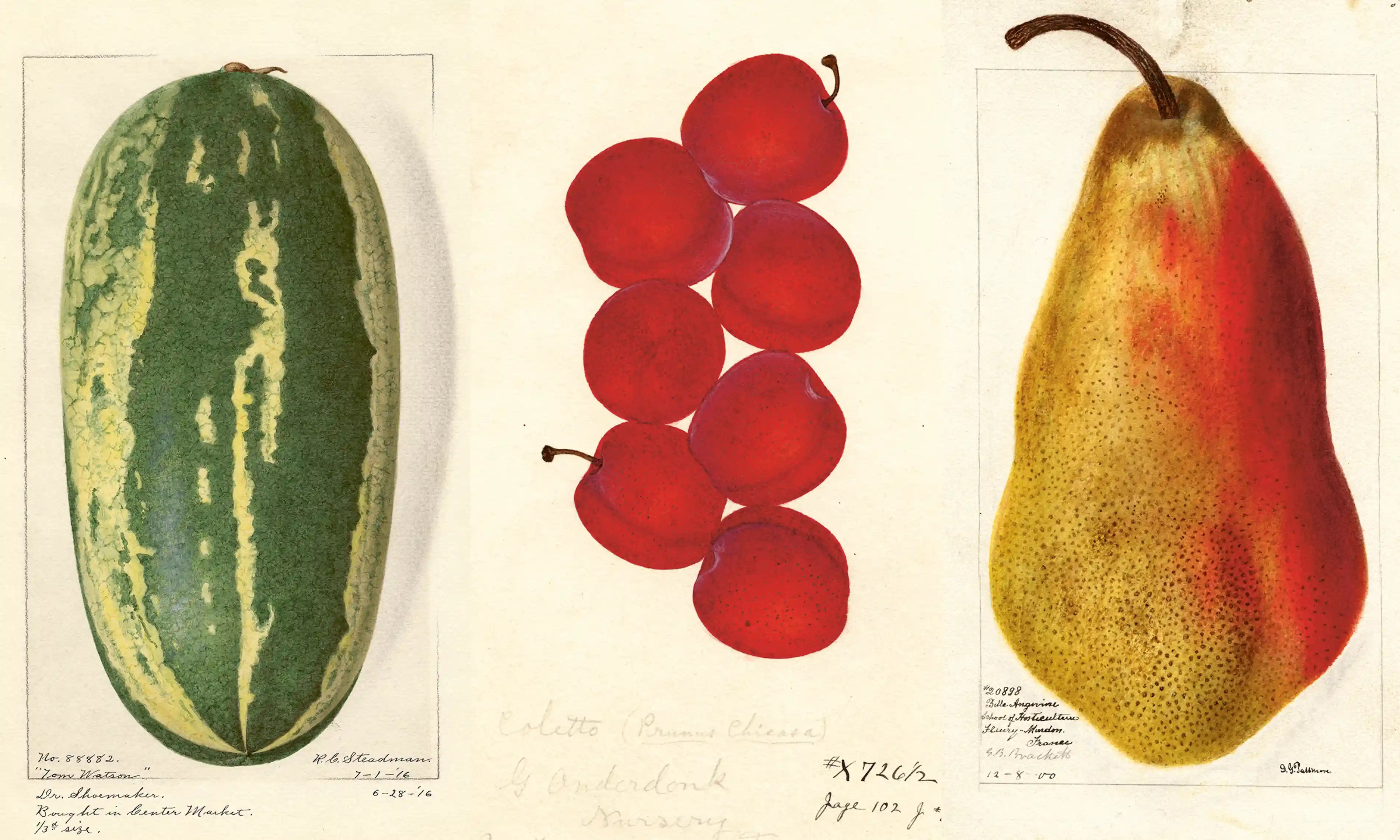
American fruit and nuts…
Pascale Georgiev, editorial director at Atelier Éditions, was researching botanical artwork a few years ago when she came across the US Department of Agriculture’s pomological watercolour collection, an archive of 7,500 watercolours of fruit and nuts grown in the US between 1886 and 1942, mostly created before photography was widespread. The discovery led to a new book, An Illustrated Catalog of American Fruits & Nuts (Atelier, £44), full of images that Georgiev describes as irresistible. “The belle angevine pear… makes my heart sing and I’m partial to a plum named tragedy.” She’s also proud that the book showcases women working in science: “Nine of this US department’s 21 artists were women. A rare thing at the time.” Most of all she’d like readers to think about biodiversity. “I hope they share my delight in discovering the history of the fruit we consume, alongside beautiful artworks.”
A glorious collection: “Get fruity: vintage botanical watercolors,” from @guardian.
* Walt Whitman
###
As we ruminate on ripeness, we might recall that it was on this date in 1950 that the daily comic strip Peanuts premiered in eight newspapers: The Washington Post, The Chicago Tribune, The Minneapolis Tribune, The Allentown Call-Chronicle, The Bethlehem Globe-Times, The Denver Post, The Seattle Times, and The Boston Globe. Its creator, Charles Schulz had developed the concept as a strip (L’il Folks) in his hometown paper, The St. Paul Pioneer Press, from 1947 to 1950. At its peak, Peanuts ran in over 2,600 newspapers, with a readership of 355 million in 75 countries, and was translated into 21 languages.

You must be logged in to post a comment.